

Film adaptations of characters from Robert E. Howard stories have a cursed history. After the first, 1982’s Conan the Barbarian, a legitimately great film, every one that has followed has either misunderstood the material or misunderstood how to make a movie, or both. John Milius’s adaptation, which introduced Arnold Schwarzenegger as the title character, is the best because Milius shared Howard’s brute force sensibilities and fascination with stories of violence. Conan the Barbarian is one of the few fantasy films that brings a genuine sense of mystery and weirdness to its world (see also John Boorman’s Excalibur and Lucio Fulci’s Conquest; it is perhaps a coincidence that all three of these films were released in a brief three year period, from 1981-83). Conan the Barbarian feels ancient, truly evoking Howard’s idea of a civilization predating the oldest we have on record, a Hyborian Age in which nations and peoples rose and fell thousands of years before Sumeria and Egypt, before even the Alps rose and the Mediterranean sank.
Its successors, however, abandoned Milius’s macho seriousness in favor of swashbuckling camp. This was somewhat successful in 1984’s Conan the Destroyer and disastrous in the following year’s Red Sonja, both directed by Richard Fleischer (a director with a filmography of remarkably mixed quality) and both of which are marred by a particularly British tone of condescension toward the material. Red Sonja’s scriptwriters were George MacDonald Fraser, author of the Flashman series of historical adventure novels as well as the (excellent) 1970s Three Musketeers films directed by Richard Lester and the (not-so-excellent) 1983 Bond film Octopussy, and Clive Exton, who wrote the terrific TV series adaptations of Poirot and Jeeves and Wooster. Fine as these writers were at tweaking the conventions of the Victorian and post-World War I British Empire, they were a terrible match for Howard’s world of blood and fire and magic.
A gritty reboot of Conan the Barbarian was attempted in 2011 with Marcus Nispel at the helm, a director whose film career seems built around remaking classic genre films (Friday the 13th, Texas Chain Saw Massacre) but whose best work is probably the videos for C+C Music Factory’s “Gonna Make You Sweat” and Janet Jackson’s “Runaway.” He too is a poor fit for the material, as unlike Milius or Fleischer, he doesn’t appear to have any point of view on it at all. Torn between wanting to be true R-rated pulp and a four-quadrant, personality-driven crowd-pleaser along the lines of the then-nascent MCU, the film ends up not being much of anything, despite some fine performances from the cast and, as always for Howard adaptations, even the worst ones, some exceptional set design.
So, with this history, expectations had to be low for a new version of Red Sonja. But, in a pleasant surprise, it’s found a novel way to avoid the Robert E. Howard curse: it doesn’t try to be a Howard adaptation at all.

The character of Red Sonja traces her origins back to a Howard story, but one set in a wholly different world than that of the Conan series. Instead, it was a comic book adaptation, written by Roy Thomas and drawn by Barry Windsor-Smith that transplanted Howard’s swashbuckling woman back in time to the Hyborian Age, where she became a popular swordswoman in bikini armor and eventually got herself reincarnated as Spider-Man’s red-haired girlfriend Mary Jane Watson. The 1985 film integrates the Thomas character into the world established by Conan the Destroyer, one of silly adventure, bad comic relief, questionable special effects, and truly impressive set design. It’s sunk more than anything else by poor acting (from star Brigitte Nielsen and a phoning-it-in Schwarzenegger) and worse writing.
The new version though takes for its inspiration one of the later reboots of the comics character, specifically the 2010s series written by Gail Simone. This adaptation does take place in the Hyborian Age, in a recognizably Howard-esque world of unrelenting violence and mystery, but with a more modern sensibility, jettisoning many of the more retrograde ideas in the Howard, Milius, and Thomas source material in favor of a more feminist take on the character. To put it the dumbest possible way: they made Red Sonja woke.
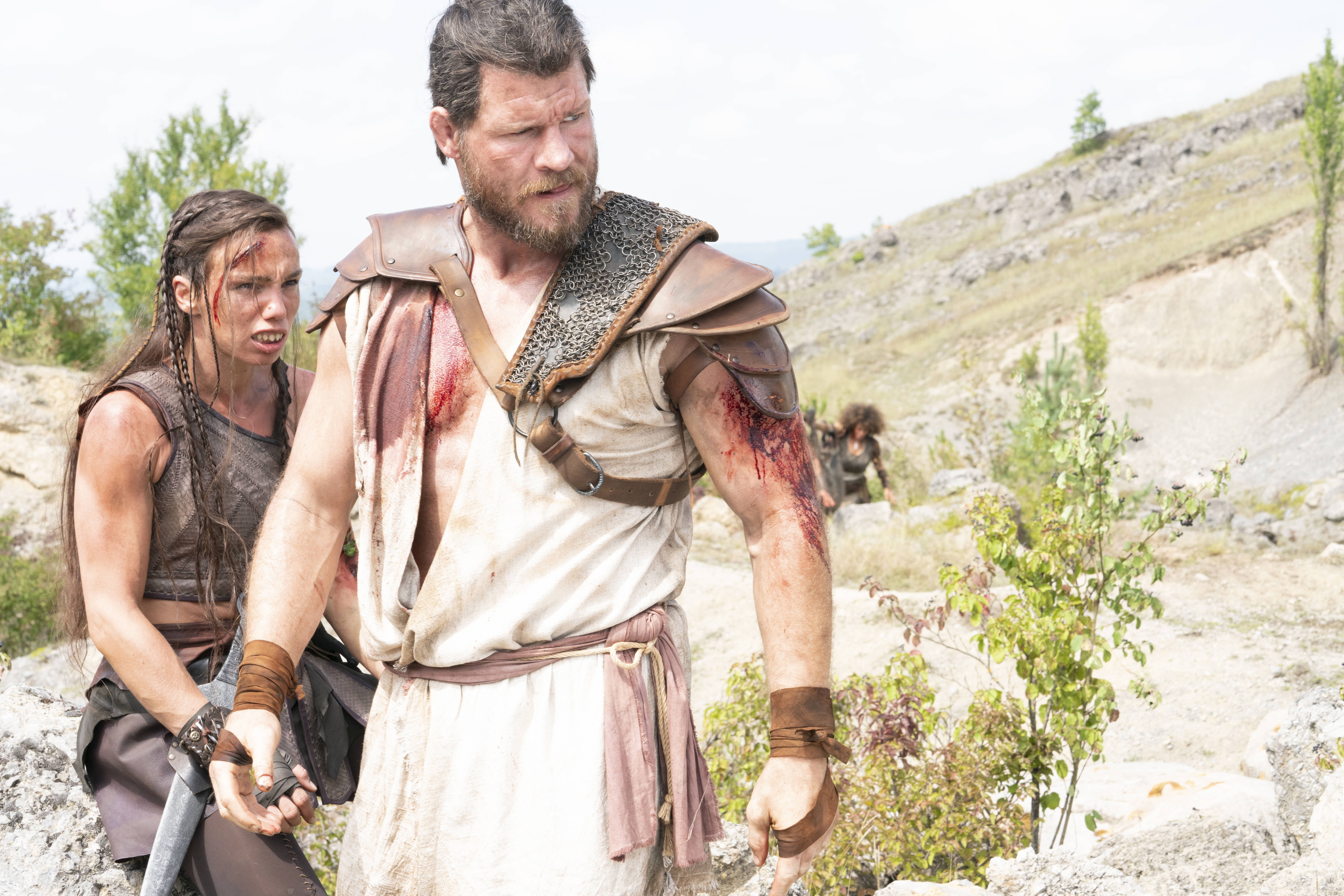
Directing is MJ Bassett, who directed a 2009 Howard adaptation I haven’t seen called Solomon Kane (it looks to be reasonably well-regarded, I just ran out of time). The film stars Matilda Lutz (star of Coralie Fargeat’s 2017 Revenge) as the heroine, introduced wandering a vast forest with her trusty horse, searching, for years, for the remnants of her tribe. She’s captured by the forces of an upstart Emperor and forced into a community of gladiators, whom she unites and leads in revolt against their captors. Her revolution spreads to the forest and, joining with her people at last, takes on the Empire as a whole. Being a low-budget genre film shot largely in Bulgaria, Red Sonja lacks the scale or CGI budget of the 2011 Conan, but makes up for it with a strong ensemble of actors, interesting characters who express real emotions, and actually good fight choreography filmed well. It’s reminiscent of recent low-budget woman-led action films like The Princess, Boudica: Queen of War, or In the Lost Lands) in its efficient use of limited resources to make top-notch, serious genre entertainment that emphasizes performance and action over spectacle and ironic distance. Lutz in particular is terrific as the lead: I hope all those people complaining in the youtube comments section for the film’s trailer that she isn’t big enough (physically, in terms of height and musculature) for the role actually watch it and realize that size isn’t everything. It’s a gritty and physical performance that effectively humanizes what is literally a cartoon character.
And that humanity, beyond the more primal pleasures of sword-fighting, giant-monsters, and silver bikinis, is what distinguishes this Red Sonja from any previous Howard-related film. Milius’s film works as well as it does because it stands against all modern sensibilities in favor of a world more primal than even classical notions of what it means to be human. His Hyborian Age is the Old Weird World, alien and therefore endlessly fascinating. This new film is in contrast wholly in keeping with the sensibilities of our modern world, concerned with technology and environmentalism and feminism and slavery and human rights and justice, concepts that exist only by accident in Howard and Milius but which are vitally important to us today. The villain in this Red Sonja is not the impassive God of Death played by James Earl Jones in the 1982 film, nor is it the embodiment of lesbian panic played by Sandahl Bergman in the 1985 film. Instead he’s a little guy, a tech genius turned capitalist, the prehistoric version of this year’s Lex Luthor as Elon Musk villain in Superman. His quest doesn’t involve magic or mystery or conquering the world of the dead like Stephen Lang’s villain from the 2011 film, but rather churning up natural resources (trees, people) for the sake of his own power and security. It’s not at all a subtle parallel to current events, but we don’t want subtle from this material. That’s how we end up with Wodehouse adapters writing our pulp fiction.
But beyond that, Barrett and screenwriter Tasha Huo, as well as actor Robert Sheehan, who plays Dragan the Emperor, give him a recognizable humanity. The 2011 film makes a courtesy nod in this direction with its villain, motivating Lang’s (otherwise finely snarling) bad guy with the sad story of a dead wife, but it plays like its something the film’s writers learned in a screenwriting manual. Dragan’s story is not especially original either, but it is given enough space to develop and breathe, and deftly weaves into Sonja’s story as well. Similarly, Sonja is paralleled by Annisia (played by Wallis Day), another former gladiator (she dresses all in white to match her white hair), She’s Sonja’s primary foil in Simone’s book as well, driven mad by the spirits of the people she’s killed and manipulated by the Emperor (in the film) to serve as his top killer. Unlike Rose MacGowan’s scary witch from the 2011 Conan, Day brings a humane confusion to the role of a mad killer. She and a half dozen other characters emerge as fully realized and complex beings, far more so than one would expect from low budget pulp filmmaking.
The result is a film that actually has something to say about the world, about how we’re all damaged and how we also all have choices about how we respond to the things in our past that make us who we are. Howard’s characters are determined, driven by forces beyond their control to rage against death while knowing it is inevitable: after all, their whole world is doomed to be erased from history, flooded by seas and crumbling to dust under rising mountains. This knowledge of their own doom dominates everything about how they behave and how we contextualize their adventures, with a kind of nihilist thrill in violence for its own sake that Milius taps into in a way few mainstream blockbusters ever have. Red Sonja’s world will ultimately share the same fate as the rest of the Hyborean Age. And Bassett’s heroes respond with violence for sure, glorious bloody violence, but never nihilistically. This is violence with a purpose. Violence to build a better world while they can, before their people, like their stories, are lost forever.
 Seattle Screen Scene