VIFF 2016: The Intestine (Lev Lewis, 2016)

intestinethe

Dark digital grain and hard lines of white light divide Lev Lewis’s The Intestine in two, separating the poor from the economically ascendant, the city from the suburb, night from day. But make no mistake, though these contrasts form roughly equal parts of the film’s ungainly shape, Lewis’s debut is haunted by the shadowier half; the ethos of night rules all things, even when the sun streams in through the windows.

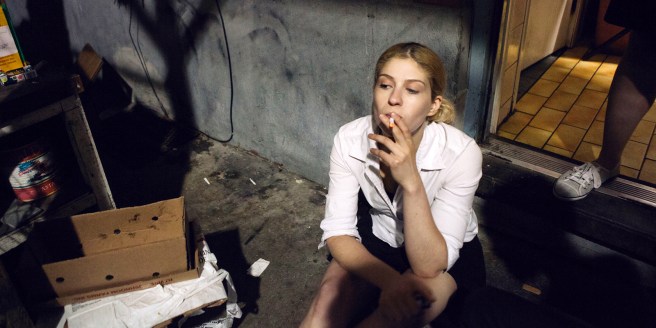
Lewis’s heroine Maya, a twenty-something reject of late capitalism, steps out from her dingy surroundings one night and awakens the next day in an abandoned modernist money-pit somewhere in the ‘burbs. The cut that bridges the space between Maya’s evening on the town and her sudden emergence amidst bright bourgeois sterility suggests, initially, a particularly bewildering morning-after and nothing more. But things progress into stranger territory as Lewis conjures up some dreamy images—a refrigerator stocked solely with a boar’s head stands out, both for its strangeness and as a barb pointed at the foodie pretensions of the 21st century’s finer-living set. The hard-lit morning-after starts to look like a portal to another reality, a rabbit hole which unearths the phantasmagoric pleasures of the moneyed class. It’s no wonder that Maya grows increasingly unwilling to vacate her new digs.

This shapeshifting debut insists—a bit precociously—on inscrutability, but what finally emerges is a vision of contemporary young adulthood as life lived in envy of other people’s spaces. Eventually unemployed but always unradicalized, a single brush with prosperity is enough to spark Maya’s exurban aspirations (“I can’t go back to my apartment”). Maya finally makes the place her own, but as she sits on her bed repeating her name through the phone to a listener who cannot hear it, she appears to be drifting back towards the void. The light is fading, and a gleaming new home can only ward off the darkness for so long.

VIFF 2016: Beautiful 2016 (Hideo Nakata; Alec Su; Stanley Kwan; Jia Zhangke, 2016)

beautiful2016__cutline__onedayinourlivesof

There are always one or two duds in these omnibus things, so let’s get those out of the way. Beautiful 2016’s first short is an embarrassing Ozu homage that repurposes his hometown (Kamakura) and his one-time actress (Kyoko Kagawa), though if you’re going to steal from the master, at least do us the favor of making off with some of his good humor. A dull banality best left forgotten. Dama Wang Who Lives on Happiness Avenue is quite possibly already forgotten. An indistinct void focused on a spritely, well-coiffed older woman jazzercising her way through Shangahi, Alec Su’s debut short is mercifully, well, short.

A real sense of artistry kicks in with One Day in Our Lives of…Director Stanley Kwan crafts some lovely images of nocturnal Hong Kong, his sense of texture undiminished even after a decade or so out in the wilderness. Distorted Wongian clocks, vertiginous tilts, and a weirdly haunting pop song provide the primary pleasures, though the Day for Night behind-the-scenes antics feel a bit stale. Kwan, once an inheritor of Hong Kong’s art-film tradition, seems to have lost opportunities as the industry shifted production modes this century, though it’s perhaps equally plausible that Kwan’s open life as a gay man curtailed his early promise. Whatever the case, One Day in Our Lives of… should prod those who’ve ignored Kwan for a decade or more (guilty as charged!) to give films like Everlasting Regret a belated look.

Jia Zhangke, on the other hand, is at the apex of his career. He comes swinging into Beautiful 2016—and I do mean swinging—with the swagger of a filmmaker who recognizes his own mid-career mastery. That self-knowledge is not, however, a straight-jacket for Jia. If anything, he’s discovered a more elastic vision of himself as an artist, willing to let in a kind of looseness that he kept at bay with the more static, calling-card early films. Last year’s Mountains May Depart proved that definitively, so it’s not coincidental that The Hedonists begins with a snatch of melancholic score from the prior feature. The presence of Jing Dong Liang as Liangzi, the poor miner destined for destruction in Mountains May Depart, also reiterates that we’re in a pre-established world. But without wasting time, Jia reconfigures the melodrama of his 2015 masterpiece into a buddy comedy. The transition plays subtly at first, until an uproarious cameo from the director himself, equipped with cigar and sunglasses and shouty bravado, brings down the house. Jia’s sense of play extends to the camera too, which he mounts on a newly acquired drone. Given that Jia helped reorient the Chinese film industry around digital technology, it shouldn’t come as a surprise that he employs the newest tech better than just about anyone else. But when a standard tracking shot suddenly achieves lift off and ascends to the heavens, a genuine sense of wonder sets in. At this point in Jia’s career, you can only marvel at the corporeal and artistic weightlessness.

VIFF 2016: The Unknown Girl (Jean-Pierre and Luc Dardenne, 2016)

unknowngirlthe

The architecture of the thriller suits the Dardennes more comfortably than it might first appear. In spite of their naturalism, the Belgian brothers construct intricate scaffolding for their films to rival many of their more outwardly formalist peers, and The Unknown Girl is perhaps more open about the structural blueprint than anything they’ve produced recently. A generic—in every sense of the word—tale of bad conscience gets the trademark handheld treatment in the dreary world of Liège, but it could just as well emerge from the wet streets of a 40s noir.

Guilt comes knocking, as it must, at the door of Dr. Jenny Davin. An unidentified African girl running from something sinister pleads entry into the safety of Davin’s clinic, though the young doctor is too busy lecturing her intern on the finer points of the profession to bother with the noise down the hall. The girl’s body is found nearby, and distraught at the consequences of her indifference, Davin hits the detective beat, searching for the girl’s name in an effort to offer her a modicum of dignity in death that the final moments of her life denied. Ratiocination unveils a web of guilt ensnaring everything in the doctor’s orbit, as if all of Liège harbors some complicity in this original sin, which, given the ethnic lines that divide here, suggests a reckoning with Belgium’s colonial past and present woes, though the capital ‘C’ Catholic Dardennes make it clear that no one escapes the fearful symmetry of guilt’s trap.

Trapped, certainly, but not unmovable. Jean-Pierre and Luc Dardenne may be clandestine formalists, but they’re also heart-on-the-sleeve humanists. The maze-like geometry of The Unknown Girl points towards noirish cynicism only to refute it. An embrace—with responsibility, with other people—is enough to open up a way out.

VIFF 2016: The Lockpicker (Randall Okita, 2016)

lockpickerthe

The promise of summer comes early in The Lockpicker in the form of a sailing trip, a post-diploma work opportunity that doubles, more importantly, as a dream of warmth and far-flung travels, a balm for the bleakness of winter. And Hashi could clearly use a lodestar to navigate his way through his final months of high school, which find him in an unsustainable cycle of drugs and outbursts. As conceived by director Randall Okita and played by Keigian Umi Tang, Hashi embodies a familiar vision of teenage masculinity: haunted, but sensitive, confrontational at times, but more out of hurt than genuine ill-will.

Okita’s film charts the teenage mind’s limited horizon, where just one school semester seems an uncrossable chasm between the present and the future. Admittedly, the present does look pretty dull. A slushy gray tone dominates the film and the soft textures of DP Jackson Parrell’s cinematography turn this small Canadian town into a blurred no-place. Only the crushed blacks of night provide an escape, although Hashi’s evenings morph into baroquely staged nightmares just as frequently as they take the form of drunken revelry. Okita is most at home with these party scenes; he understands how intoxicants heighten juvenile braggadocio, but also how those boasts paper over pain and vulnerability. The pain, however, proves too much for Hashi. His high school days end in violence and he’s cast out into unceasing winter, the film finally giving into the grim cliche it earlier strived to avoid. It needn’t end this way. A little more wisdom, and a little more time, might be enough to convince all involved that summer always, inevitably rolls around.

Cosmos (Andrzej Zulawksi, 2015)

cosmos-zulawski

At the end of his life and career, Andrzej Zulawski brooked no wasted time. His Cosmos screams into existence at a howling pitch and hurtles forward unhindered. The Polish director’s final film immediately thrusts frustrated young law student Witold—Jonathan Genet, as limber and deranged as the film itself—into a warped pan-European bed and breakfast populated by cranks and character actors. A galaxy of ideas orbits Witold’s extended stay, emanations from a mind wracked by scholarly frustrations and writerly ambitions (he shares both his name and aspired-to profession with Witold Gombrowicz, author of the novel on which Zulawski based his film). The mossed old lodgings and Witold’s attempts at writing form the only real center for the strange events that unfold in Cosmos, but even that center cannot hold for long. Things break into increasingly fragmentary pieces: Buñuelian doubles appear, characters invent their own linguistic code, and the filmmaking process itself eventually takes center stage. Attempting to divine a clearer narrative path is a fool’s errand, and rather beside the point.

Continue reading Cosmos (Andrzej Zulawksi, 2015)”

A Quiet Place in the Country (Elio Petri, 1968)

quiet_shot9l1

First, a contradiction: deafening Ennio Morricone music screams in over the title card. A promise of quiet immediately dashed, the flippant tone established at the outset. And then: shirtless Franco Nero tied to a chair in a modernist flat, the colors and lines à la Mondrian, the gentle torture courtesy of a prowling Vanessa Redgrave. So begins Elio Petri’s caustic 1968 thriller, with Nero’s frustrated artist already under attack by the forces of femininity and commerce, both embodied and entwined in Redgrave’s bottom-line gallery agent, Flavia. Naturally, he’s fantasizing about killing her.

The opening fever-dream awakens to a calmer register just briefly enough to sketch out the basics. Nero’s Leonardo needs some peace to get his work back on track so Flavia can keep the upper-crust buyers in Milan and New York flush with fresh product. A country retreat is in order. But the first villa comes pre-equipped with an exhibition and the accompanying hangers-on intent on a good deal (“I admire your work…and it’s a good investment”). A second villa must be acquired if anything is to be done, though the murder of the town’s “nympho” countess 25 years prior on the same grounds proves a more supernatural hindrance to the artistic process.

Continue reading A Quiet Place in the Country (Elio Petri, 1968)”

The Sea of Trees (Gus Van Sant, 2015)

image

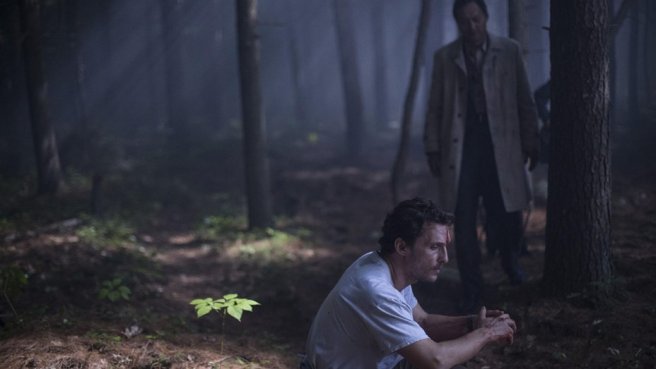
In our era of endless Letterboxd discoveries and Twitter reclamation projects (full disclosure: I am part of the problem), the whiplash responses that await troubled films often operate according to a kind of critical Newtonian physics: each dismissal creates an equal and opposite reappraisal. So it’s something of a surprise that The Sea of Trees met such a vicious critical drubbing when it premiered at Cannes last year with nary a supporter in sight of the Croisette willing to take up its defense…except, it must be assumed, Thierry Frémaux. The Cannes director likes to lob a bomb or two into the competition, but, even by those standards, Gus Van Sant’s latest film appeared a baffling inclusion, and critics responded accordingly. The intervening year has brought the film at least a modicum of relief: it’s finally getting a release, sneaking into theaters thanks to distributor A24. And yet, Monsieur Fremaux’s choice to include it in the competition still seems the prerogative of a man adrift in a thicket of red carpet photo ops and star junkets, desperate to find a Hollywood production worthy of inclusion in the world cinema festival par excellence, but lacking any fellow travelers able to guide him to critical safety.

It’s rather appropriate, then, that The Sea of Trees zeroes in on the life of middling adjunct professor Arthur, recently bereft of his wife, as he heads to Japan and loses himself in the notorious and densely wooded Aokigahara forest. Notorious, the film reminds us with a bit on-screen Googling, as a favored location for suicides. Of course that’s what Matthew McConaughey’s depressed academic is there to accomplish, until a raving Ken Watanabe crosses his path and provides him a traveling companion, a mission to escape the maze-like forest, and a reason for living.

Continue reading The Sea of Trees (Gus Van Sant, 2015)”

Yourself and Yours (Trailer) (Hong Sangsoo, 2016)

CpP1yitUIAAzR-A
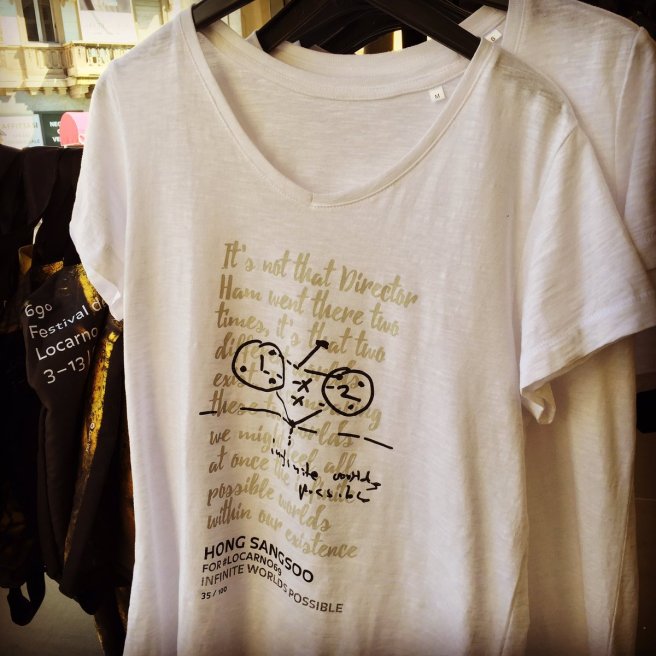
Hong Sang-soo has a t-shirt. As reported by the seemingly omniscient Hong Sang-soo Web Twitter account, the 2016 Locarno Film Festival featured some sartorial branding inspired by last year’s top-prize recipient. If you were lucky enough to spend your August in a palatial Swiss town and decided that nothing said “European Summer” like shuffling between darkened movie theaters, you might have been lucky enough to snatch up one of the shirts, fittingly adorned with a tipsy sketch by the Korean master scrawled above the Hongian pseudo-motto: “Infinite Worlds Possible.” And just like that, with a major European festival prize now under his belt and branded UNIQLO-lite duds, it seems Hong has officially become an event.

Of course, we’re talking about the niche of the niche here. 18 films into his career Hong’s audience has grown more than some of the long-time loyalists likely thought possible, though he’s not exactly setting the box office ablaze. The yearly anticipation for his new film feels a bit more communal than it once did, still rolling around with the same regularity but with greater pomp among the ever-important Film Twitter cognoscenti. What self-respecting cine-kid doesn’t want a Hong shirt this time of year? It’s festival season. It’s Hong time. And right on cue, we got a trailer.

Continue reading Yourself and Yours (Trailer) (Hong Sangsoo, 2016)”