A House of Dynamite (Kathryn Bigelow, 2025)

Kathryn Bigelow’s newest film opens with a black screen and a sound—deep, unidentifiable, metallic, inhuman. It’s a fittingly menacing opening for a film about the possibility of nuclear apocalypse. The first image we see shortly afterward is the launch of an intercontinental ballistic missile, which we will later learn is pointed at the United States, carrying a nuclear warhead toward an American city. A House of Dynamite dramatizes the professional response to such an event, following personnel in the military, the President’s office, FEMA, and other arms of the U.S. government. It turns its procedural attention to the ways America has—and hasn’t—planned for such an event. Rightly, it offers us few comforts in its 112-minute runtime and demands instead that we sit with the anticipation of the horrors that humans can unleash.

One of the comforts the film withholds is the set of familiar conventions we associate with suspense movies. The film’s first forty minutes seem to check all the expected boxes—a highly competent crew of people rushing to execute a risky plan to meet a threat of terrifying proportions—but then Bigelow yanks all that away and restarts the story from its beginning with a different crew responding to the same threat. This puncturing of suspense is a feature, not a bug. While some writers in online film forums have complained volubly about it, the point of Bigelow’s anti-suspense choice is clear: This subject is not something to be excited by. It’s something to be confronted.

Bigelow’s film considers exactly how a nuclear attack on the United States could begin, showing us repeatedly in nearly real time how an ICBM launched from a mysterious source might make its way toward American airspace, how military personnel would attempt to detonate it far from Earth, how the brightest minds in government would grapple with the threat, how people could be undone by the enormity of the danger and the overwhelming, incomprehensible magnitude of the imminent devastation. It also reveals numerous points of failure in U.S. systems along the way, including the fact that, unlike rank-and-file servicemembers, the one person with the actual nuclear codes is also the one person who has practiced the response to a nuclear attack the least.

When taking a procedural approach to the subject matter of nuclear warfare, there’s a danger of treating it in such a way that the physical, personal, moral hazard of a world-ending event feels too remote to be truthful. Christopher Nolan fell prey to this danger in Oppenheimer, which technologized the problem of nuclear weaponry and barely nodded to the grievous, miserable tragedy that the film’s real-life counterpart unleashed on other human beings. Bigelow, with her interest in precisely how the end of the world might come about, runs this risk in A House of Dynamite, too. However, she mostly avoids the trap of taking too chilly an interest in the mechanics of the event by letting us get to know her characters in snapshots interspersed throughout the drama, as well as by bringing their wholeness to how they, as fragile human beings, respond to the beginning of the end.

These characters, while steady and extremely competent, are also people confronting the unimaginable. Making the most of the expert performances of her exceptional cast, Bigelow’s camera lingers on the characters’ faces and bodies and lets us breathe—or not breathe—with them. The abundance of exposition necessary to tell the story of a highly technical process—responding to the launch of an ICBM—vanishes in these moments into an understanding of how individual humans might respond to the inhuman monstrosity bearing down on them. Bigelow lets their performances speak. As things begin to go badly, a soldier’s voice quakes, another’s eyes well up, still another is gripped by dry heaves. All personnel execute their duties precisely as they’ve been trained to do, but their faces and bodies bespeak their anguish. In one remarkable moment, a steel-jawed officer (played by Rebecca Ferguson) seems literally pushed backward by the force of the realization that a key defense against the ICBM has failed.

One of the more alarming themes of A House of Dynamite lurks quietly in the film’s subtext. In the film’s America, POTUS is a thoughtful, humane, competent leader. Likewise the leaders of other branches of the response. No one is motivated by narcissism, emotional reactivity, or personal grudges. No one appears to have been appointed to a powerful position as a result of cronyism or of toadying to an irrational actor. Everyone in the film is doing their best, and their best is considerable, regardless of the everyday apocalypses they’re facing in their own personal lives (a breakup, a sick child, divorce proceedings gone badly wrong). The failures of systems are the commonplace failures of technology, not those produced by personal failings or even ordinary human error. How much worse would it be, the film forces us to ask, if the real people charged with decision-making at the highest levels weren’t motivated by professionalism, weren’t the smartest people in the room, or weren’t for one reason or another up to the challenge of making a wise decision? A House of Dynamite shows an American wartime response made by an imaginary, idealized America—and it’s an America that still isn’t fully up to the challenge. What would happen, then, if our America today were faced with a real nuclear attack?

There is much that Bigelow doesn’t show us. Two characters write personal notes to one another on a shared notepad, but we never see what the notes say. We never learn what becomes of two characters who had enough advance warning to drive somewhere safe—or whether such a safe place could even continue to exist for long. On a broader scale, we never learn who launched the nuclear missile in the first place. We never see an explosion. No one dies onscreen. Bigelow insists on the discomfort of uncertainty, which is fitting in a film whose purpose appears to be to say, “Look. Look at what could still happen, even under nearly optimal conditions.” In this sense, despite the invisibility of violence in the film’s world, Bigelow has made a rigorously anti-nuclear film, one that leaves a great many questions unanswered—paramount among them, what in the world are we to do?

Barbie (Greta Gerwig, 2023)

It’s taken me a while to figure out what I really think about Barbie. I saw it last summer in a five-hundred-seat theater along with more than four hundred other people. They were mostly women—women who were laughing, shouting, murmuring, nodding in affirmation, and sometimes crying. The movie was witty, clever, infectiously joyful, often hilarious, sometimes subversive, and almost always delightful, and it resonated with us in ways that many of us were unprepared for. Friends of mine talked about it endlessly afterward.

Mostly, the women that I knew were talking about the speech. By now, most moviegoers know what I’m talking about: America Ferrera’s barnburner in which her character, Gloria, holds forth about the tightrope that so many women must walk in order to survive under patriarchy (a word which figures surprisingly prominently in a movie about a plastic doll). It’s the speech that will doubtless be sliced down to an awkward nanosecond from its already brisk two-minute and nineteen-second length when the clip plays at the Oscars this year. It’s the speech that drew cheers from women all across the country, and maybe across the world. It’s the speech (among many other parts of the movie, of course) that propelled the movie past the billion-dollar mark in international earnings. It’s also a speech that does a gross disservice to the real lived experiences of women, because it cannot do otherwise in a PG-13 movie based on a toy.

Barbie is a sparkling achievement, Ferrera is a brilliant actor, and the fact that Greta Gerwig wasn’t nominated for Best Director this time around is a travesty. But the speech isn’t the revelation that many people are calling it. It left me unsettled when I first heard it. Now, with the passage of time and a landslide of crumbling rights for women the world over, it leaves a bitter taste that I can’t rinse away.

This is not to say that Barbie isn’t sincerely, vigorously feminist. It keenly and cleverly skewers compulsory gender roles; centers the experiences of mothers and daughters; stars women of different shapes, ages, sizes, races, orientations, and identities; and shines a Klieg light on the extent to which our culture is absolutely not egalitarian (however much some might like to think it is) by imagining an alternate-universe fantasy matriarchy in which female characters hold real power. It’s feminist enough to have triggered at least one conservative commentator—an ostensibly grown man—to set a Barbie doll aflame on camera. But it’s not the speech that makes it so. In fact, the speech sands down the realities of being a woman to the point that it doesn’t tell the truth. How could it be otherwise? If the speech told the truth, the film would no longer be a comedy, or a family movie, or have merchandizing tie-ins and the blessing of Mattel. It would lose all its sparkle. It would not be Barbie.

The problem is that the speech purports to say something truthful about women’s experiences in the world—but because it’s hamstrung by the movie’s genre, it can’t. An honest speech would at least have to comment on women’s economic disempowerment—the fact that women are still disproportionately represented amongst the poorest people in this country and in the world, the fact that the gender-based wage gap still yawns even in progressive nations, the fact that divorce still leaves most women poorer than their ex-husbands, the fact that women still end up in the least remunerative professional fields, the fact that, in the U.S., everything from a pandemic to an absence of federally mandated paid family leave short-circuits the professional ambitions or even the financial survival of mothers (and daughters).

Further, it would have to say something about women being dramatically over-represented among the defenseless civilian casualties of war. It would have to comment on the paucity of medical research about menopause, menstrual pain, painful sex, and all the myriad illnesses that disproportionately plague and disable women, from migraine to long Covid. It would need to address the dearth of women among the most powerful positions in the clergy, the military, law enforcement, and finance. The film winks in a few of these directions, but it could not do more than wink and still be Barbie. Nor would anyone want it to, I imagine. The truth is too depressing, and after all, everyone is here to have fun. Still, the fact that the speech exists in the movie in the spot marked “the truth” deconstructs itself: it needs to be there, but it can’t be.

The speech has one line in it that comes close to touching on the most brutalizing reality of being a woman. Gloria says that women have to be pretty “but not so pretty that we tempt [men] too much.” That’s as much as it’s possible to say about the life-destroying, soul-scalding reality of sexual violence in a movie that children can go see with their parents. It cannot be otherwise. Yet it’s this reality of being a woman—the persistent, gnawing, inescapable, and all-too-realistic fear of sexual violence—that most diminishes our potential, that reshapes our habits, that haunts our minds, that limits our freedom of movement in the world. Sexual violence itself tears our bodies, breaks our spirits, and sometimes ends our lives. It sometimes leaves us pregnant with a rapist’s offspring. And now some states can force a girl or woman to undergo the excruciating ordeal of childbirth, only to produce her rapist’s child.

The rest of the speech? That’s the easy part of being a woman.

I don’t fault the movie for failing to tackle the most wrenching parts of being a woman. That’s not the job of a fun comedy that has singing and dancing and laughs for all ages. The fact that Barbie undertook to comment on the specific difficulties of womanhood at all is something I appreciate. But the speech is not the moment of truth-telling about womanhood that so many have made it out to be. It’s barely the beginning.

Potato Dreams of America (Dir. Wes Hurley, 2021)

It’s rare to see a film that’s so simultaneously affecting, funny, and inventively crafted as Wes Hurley’s Potato Dreams of America. A dark comedy infused with magical realism, the film tells the moving story of Hurley’s experience growing up gay in the former Soviet Union and then immigrating to the U.S. with his mother, Lena, a brave and principled prison physician who can only get out of the USSR as a mail-order bride. The two navigate the strange vicissitudes of life in the U.S., together coping with Hurley’s well-meaning but clueless teachers, his sometimes cruel classmates, his unpredictable stepfather, and his own evolving identity as an out gay man.

The story alone is remarkable enough that it would be entirely absorbing even if it were only told in plain, conventional, realistic narrative form. But Hurley makes some compelling choices in the way he crafts his film that heighten its impact. Most notably, he underlines the sharp differences between his life in Russia and his life in the U.S. with a dramatic mid-movie shift in visual style. During the first part of the movie, when young Hurley (nicknamed “Potato”) and his mother are still living in the Soviet Union, his child’s-eye view of his family, school, and home is conveyed through deliberately stagy, stylized, frequently absurdist dramedy, in which the progress of his life is interspersed with some well-placed cuts to an imaginary movie or vaudeville play of the “real” action unfolding before us. Potato even has an imaginary friend in Jesus Christ, portrayed by gay icon Jonathan Bennett. The visual world of this part of the film is anti-realistic, by turns evoking a school play, a dollhouse world, and—frighteningly—the Brechtian nightmare of a Soviet prison. All of these elements put us into Potato’s view of his world, which is marked by an incomplete but intuitive understanding of the significance of what he sees and hears.

In the second part of the film, we enter a different kind of heightened reality—more realistic than the first part but still clearly framed as a filmed world, almost like a period sitcom, with a bright, cheery soundtrack and sunny establishing shots of perfect residential exteriors. (This almost-sitcom effect is helped by Hurley’s choice of Dan Lauria—the dad from The Wonder Years—as his stepfather.) In this part of the story, the characters are portrayed by an entirely new set of actors who, in the style of the leads in Moonlight, resemble the previous actors only passingly. This choice works beautifully to suggest that we, along with the characters, are in a completely new world in this part of the narrative. It amplifies the stark drama of the characters’ departure from their old lives and causes us to feel that starkness alongside them.

It would have been possible for Hurley to become so absorbed in his film’s formal cleverness and adventurousness that audiences became detached from the emotional truth of the story. However, he cannily avoids this trap by keeping the pacing tight and focusing most of our attention on the inner worlds of the characters. The actors’ expressive performances are central here. Noteworthy among these is Sera Barbieri’s taut, coiled embodiment of the Soviet Lena, whose passionate moral convictions vie with the necessity of submitting to corrupt authority in order to protect her son’s life. Marya Sea Kaminski as American Lena reveals the same emotional tension as she mediates between the demands of her new husband’s authoritarianism and her need to protect her son’s psychological well-being. Both actresses reveal Lena’s intelligence, her moral courage, and her feeling heart in bravura performances that teleport us into the mind of a woman who faces unimaginable difficulties in her quest to protect her son and live freely herself.

The actors who portray Potato are similarly talented and committed to their roles. Promising teen actor Hersh Powers portrays Potato’s early adolescent uncertainty and angst with wit and intelligence. As the older version of Potato, Tyler Bocock (a ringer for a younger Tom Hiddleston) is charming in his befuddlement about life in America; he’s a pleasure to watch as his version of Potato grows wiser and more confident. The movie’s bigger names bring their reliable and considerable skill sets to bear on their roles. Lea DeLaria in particular is delightful here, portraying Potato’s grandmother with her trademark crusty puckishness.

Viewers who remember what B. Ruby Rich called the New Queer Cinema in the ’80s and ’90s—that movement in which queer filmmakers with micro-budgets opted to tell queer stories and did so in a frank, raw, unapologetic, creative way—might well see Potato Dreams of America as a kind of latter-day entry into that school of filmmaking. As a descendent of that lineage, Hurley reminds us that a true and truthful story can often be told best by a fearlessly creative filmmaker who lived that story. His is a story well worth telling and a film well worth seeing.

Black Widow (Cate Shortland, 2021)

Long overdue for reasons ranging from garden-variety studio sexism to serial pandemic-related delays, Black Widow is a top-tier entry in the Marvel Cinematic Universe. It earns a place alongside the likes of Black Panther (2018), Thor: Ragnarok (2017), and Guardians of the Galaxy (2014) for its vividly imagined world, whiz-bang action sequences, muscular direction, and terrific screenplay (written by screenwriters Jac Schaeffer, Ned Benson, and Eric Pearson, in collaboration with director Cate Shortland and performers Scarlett Johansson and Florence Pugh). More significantly, Black Widow also has real heart (in its heroine and in the broken, bonkers found-family at its center) and a compelling feminist theme—one that raises the stakes in the film considerably.

Continue reading Black Widow (Cate Shortland, 2021)”

Beau Travail (Claire Denis, 1999)

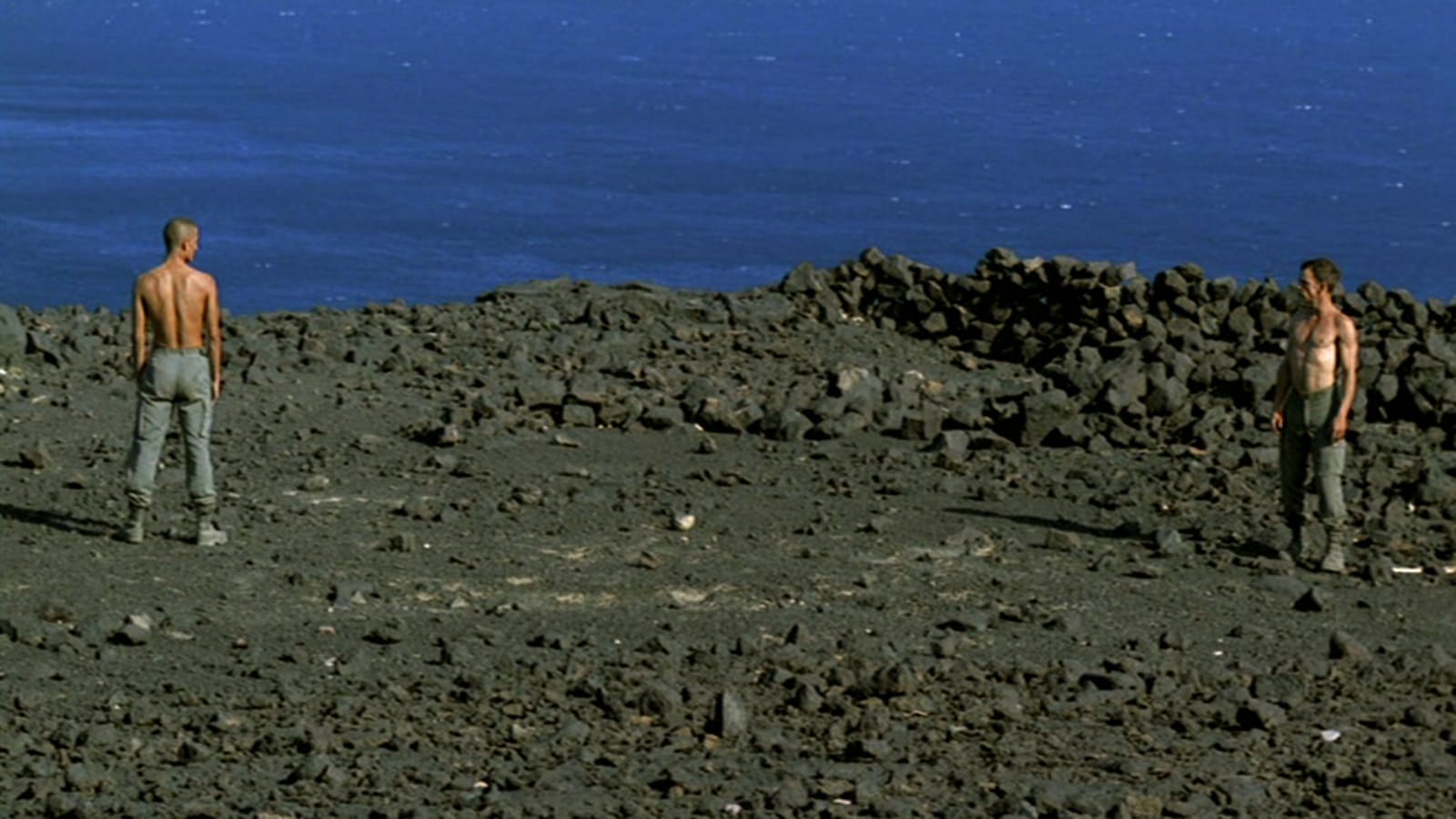
Criterion’s new 4K restoration of Claire Denis’ remarkable 1999 film looks absolutely gorgeous—stark, luminous, vividly colorful, and precise in every fine line and minute detail. That precision suits the film’s subject: a tightly disciplined French Foreign Legion troop under the demanding leadership of an obsessive sergeant. A loose adaptation of Herman Melville’s Billy Budd and a quasi-sequel to Jean-Luc Godard’s Le Petit Soldat (1960), the film tracks the gradual psychological unraveling of Chief Master Sergeant Galoup as he develops a jealous fixation on a new recruit, Gilles Sentain, whose beautiful face and ineffable cool make him a favorite both with the other legionnaires and with Galoup’s superior, Commander Forestier. Envy, repressed desire, and festering rage commingle in Galoup’s deteriorating mind, and the innocent Sentain suffers for it. As the film proceeds, we are inexorably drawn into the inevitable tragedy of their story, even as we revel in the startling beauty of Denis’ extraordinary vision.

Continue reading Beau Travail (Claire Denis, 1999)”

First Cow (dir. Kelly Reichardt, 2019)

first-cow-movie-review-2020

Kelly Reichardt’s latest film is, in most ways, of a piece with her previous films. Quiet in tone and measured in pacing, First Cow continues Reichardt’s sympathetic and observant explorations of the lives of outsiders and people on the margins. Like the settler women of Meek’s Cutoff and the homeless drifter of Wendy and Lucy, First Cow’s protagonists don’t have meaningful control of their destinies, despite their efforts to lift themselves out of their assigned places in the social and economic order. And like the radical environmentalists of Night Moves, First Cow’s protagonists aren’t above breaking laws in pursuit of their aims. First Cow, however, is perhaps the first Reichardt film that combines her keen-eyed artistry with genuine entertainment. Less grim than Wendy and Lucy, less cynical than Night Moves, more accessible than Meek’s Cutoff, and more tightly plotted than Certain Women, First Cow is an engrossing, engaging study of life in early nineteenth-century Oregon and two of its unlucky but ambitious inhabitants. Adapted from a novel by longtime Reichardt collaborator Jonathan Raymond, it has the rhythms of a folktale—and the lessons of one—detailing what might happen when clever, resourceful striving tips over into dangerous hubris.

Continue reading First Cow (dir. Kelly Reichardt, 2019)”

VIFF 2019: And Then We Danced (Dir. Levan Akin, 2019)

mv5bodbjmdzmy2mtn2iyoc00oduzltljogetntm2ytk3mzi2ndk0xkeyxkfqcgdeqxvynziwnza2mdu40._v1_

Levan Akin’s gorgeous coming-of-age tale And Then We Danced fairly glows with beauty, pain, hope, and joy. It is a thoroughly transporting film, one that makes you wish that you were part of its hero’s world instead of being a mere observer.

And Then We Danced is set in the nation of Georgia and features the hauntingly beautiful dance and music of traditional Georgian culture. The film follows Merab (Levan Gelbakhiani), a college-aged member-in-training of the National Georgian Ensemble, a troupe specializing in traditional dance. Merab has been chastely dating his dance partner, Mary (Ana Javakishvili), with whom he was first paired when they were just children, and the two have an easy, playful rapport that comes from many years of knowing each other and dancing together. If Mary suspects that her partner is gay, she keeps that suspicion under wraps until the truth becomes too obvious to ignore—which it does when a new dancer, Irakli (Bachi Valishvili), suddenly arrives from out of town and begins to claim more and more of Merab’s attention. Irakli is dashing and mysterious, and Merab is soon utterly fascinated by him. A relationship that should proceed apace, however, is complicated by the fact that both young men live in a sternly judgmental culture where being gay is a criminal offense. Further complexities arise when auditions are announced for a single, prestigious position in an ensemble piece, a position for which Merab and Irakli find themselves competitors.

Continue reading “VIFF 2019: And Then We Danced (Dir. Levan Akin, 2019)”

Be Natural: The Untold Story of Alice Guy-Blaché (dir. Pamela Green, 2018)

1749985693001_6037327643001_6037326542001-vs

Too few people know about the extraordinary woman who arguably created cinema as we know it. With La Fée aux Choux (1896), Alice Guy-Blaché became the first director in history to use film to do something that we now take for granted as the obvious job of the movies: to tell a story. (Some critics and scholars make a case for the Lumière brothers as the inventors of fiction film with the staged prank depicted in their 1895 L’Arroseur Arrosé, but this argument depends entirely on what one believes counts as a “story,” as opposed to an incident or attraction.) To note only that Guy-Blaché was “the world’s first woman director,” then, is to do her somewhat of a disservice, given her other even more remarkable achievements. (She also, for example, was the first director in history to use synchronized sound in film, decades before The Jazz Singer.) Pamela Green’s long-overdue documentary Be Natural: The Untold Story of Alice Guy-Blaché is therefore a little safe and cautious in calling Guy-Blaché only “one of” the earliest fiction filmmakers. Even so, Green’s compelling account performs an essential service in at last giving a remarkable and nearly forgotten figure from cinema history the feature-length documentary that she deserves. Be Natural (entitled after the advice Guy-Blaché always gave her actors) is wholly engrossing, and by turns surprising, illuminating, and moving.

Continue reading Be Natural: The Untold Story of Alice Guy-Blaché (dir. Pamela Green, 2018)”

Rafiki (Dir. Wanuri Kahiu, 2018)

mv5byjawngeynzctzwjhmi00ntq5lwflodktzji4ztczytjhzjeyxkeyxkfqcgdeqxvynjg2nzuzmde40._v1_

Kenyan director Wanuri Kahiu’s marvelous, joyful Rafiki tells the story of two girls in love. It’s a story that has been told before, replete with obstacles en route to what we hope will be a happy ending, but two things set this film apart from the rest of the star-crossed crowd. One, the girls live in Kenya, where a colonial-era law marks out homosexuality as a criminal offense. Two, despite the seriousness of the dangers and challenges before our heroines, their story is wildly, vibrantly fun.

Continue reading Rafiki (Dir. Wanuri Kahiu, 2018)”

Suburbia (Penelope Spheeris, 1983)

mv5bmjgxyzjjzditmwe5zi00mgrmlwiyztqtzmnmnmy1ywnlzwrixkeyxkfqcgdeqxvynzq1njgzota40._v1_

I first saw this film in the mid-1980s, when I was a mildly alienated, slightly chicken-hearted New Waver who was curious about what more dangerous versions of myself were up to. I remember thinking at the time that Suburbia was really cool. Its depiction of rebellious street punks who make a home together in a squat spoke to my need to feel affiliated with something wild and counter-cultural without actually taking any real risks myself. And as someone who was disillusioned with suburbia, I appreciated the movie’s frank commentary on the hypocrisies of middle-class life. Revisiting the film today, I realize that I overlooked a great deal the first time around—not just its major themes about the blindness of youth but also the directness of its depictions of the casual racism, misogyny, and homophobia of some of its characters (and their society as a whole). Watching it now, it looks like much more than a stylish time capsule of a not-so-great period in American history (the Reagan years). It looks like an honest attempt to tell the truth about the way that young people experience a harsh world.

This is not to say that the film is always good. The performances of its mostly non-professional actors (actual street punks) are often wooden, the dialogue is stilted, and the attempts at humor mostly fail. Even so, the film is bold and completely unflinching in its attention to human ugliness, to the simultaneous vulnerability and cruelty of the young, and to the way that disaster so often strikes with little warning and for no good reason.

Continue reading Suburbia (Penelope Spheeris, 1983)”