Before Ava DuVernay, before Dee Rees, before Gina Prince-Bythewood, before Kasi Lemmons, there was Julie Dash. Dash’s Daughters of the Dust earned its place in the history of film by becoming the first feature film directed by an African-American woman to gain general theatrical release and distribution—and it earned that place in the shockingly recent year of 1991. It is a remarkable piece of work not only for its place in cultural history but also for its distinctive aesthetics and for the story it tells: a story of hope, grief, and transition set among the Gullah people, a group of African Americans living on the islands off the South Carolina and Georgia coast. Somewhat isolated from the continental United States, as the film’s prologue tells us, the Gullah retained elements of their original African languages, values, and ways of life long after African culture was violently suppressed in the lives of mainland African Americans. Dash tells a graceful, dreamlike story of one Gullah family reuniting in 1902 before departing for life on the mainland—and for a nation on the brink of modernity.
Author: Sue Lonac
Only Lovers Left Alive (Jim Jarmusch, 2013)

Now that Tom Hiddleston is (thank you, Jesus!) single again, it’s as good a time as any to gaze at him, the thinking cinephile’s dreamboat, in Jim Jarmusch’s excellent 2013 vampire dramedy. Hiddleston emotes broodily as a depressed Detroit musician named Adam, opposite the always-brilliant Tilda Swinton as Eve, his beloved who lives across the globe from him yet is still profoundly connected to him. When Adam plunges into suicidal despair in the film’s early scenes, Eve rushes to his rescue. The two lovers are a gorgeous, if possibly doomed, pair who complement one another in virtually every way. Though the film leaves much unspoken about the exact nature of their relationship (how did they meet? why were they living separately? are they even the same sort of creature?), it nevertheless makes us feel the intensity of their bond and the inevitability of their mutual entanglement in every shot. This is partly due to the deft performances of the leads, and partly due to Jarmusch’s famous attentiveness to evocative detail. Low on incident but high on atmospherics, the film creates a slyly seductive mood with exactly the right music, the right images, and the right words.
Continue reading “Only Lovers Left Alive (Jim Jarmusch, 2013)”
Cameraperson (Kirsten Johnson, 2016)

Kirsten Johnson’s Cameraperson provides an extraordinary experience for viewers—those already familiar with her body of work and those new to it alike. Johnson is a documentary cinematographer best known to most for her work on Fahrenheit 9/11 (dir. Michael Moore, 2004), Pray the Devil Back to Hell (dir. Gini Reticker, 2008), and the Oscar-winning Citizenfour (dir. Laura Poitras, 2014). Those who have seen these films will know to expect bracing, sometimes unsettling, sometimes even devastating images, but they might not be as aware of Johnson’s eye for scenes of almost unbearable beauty and joy. The images Johnson assembles in Cameraperson reveal the full range of her remarkable gifts, in all their weight and force and radiance.
Mr. Right (Paco Cabezas, 2015)

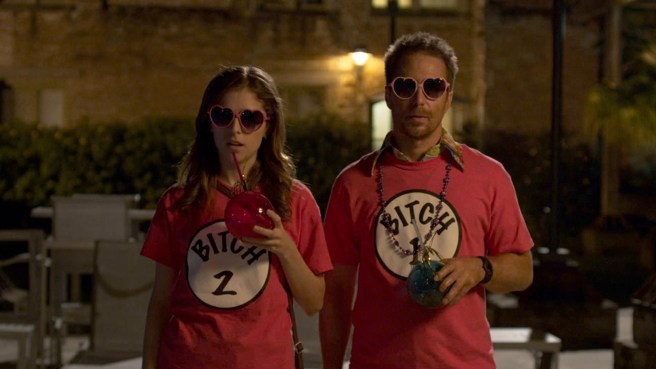
Sam Rockwell dancing, Anna Kendrick snarking and twinkling—what’s not to like? Mr. Right leans hard on the considerable charm of its leads and the skill of its supporting cast (most notably the excellent Tim Roth and the very funny newcomer Katie Nehra), and while it too often feels formulaic and forced, it’s still good fun. Continue reading “Mr. Right (Paco Cabezas, 2015)”
Born in Flames (Lizzie Borden, 1983)

Everything you’ve heard is true. Lizzie Borden’s Born in Flames is, in many ways, a really terrible movie. Performances by the mostly amateur cast are stiff and awkward, the editing is clumsy, the script consists entirely of polemic and exposition, and the soundtrack ranges from being simply unlistenable to becoming a source of torment of the kind expressly prohibited by the Geneva Convention. Some of the film’s flaws can be excused as being the result of its ultra-low budget, but others are inherent in its project, which is almost entirely political and only incidentally artistic. Continue reading “Born in Flames (Lizzie Borden, 1983)”
Requiem for the American Dream (Peter Hutchison, Kelly Nyks, Jared Scott, 2016)

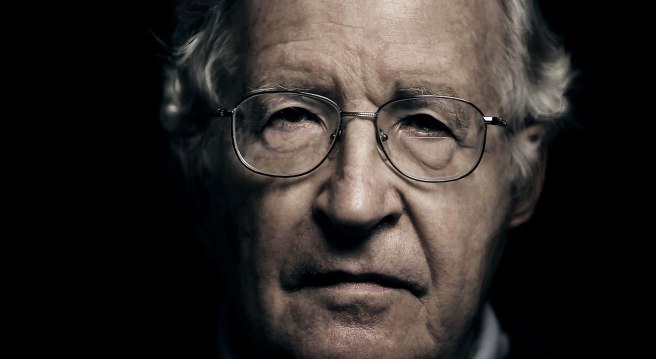
Requiem for the American Dream should be required viewing on every college campus in the nation. This is not just because of the film’s concise and lucid overview of the thinking of its interview subject, American intellectual Noam Chomsky, on a critically important topic, the erosion of American democracy and the subsequent rise of income inequality and decline of individual and communal rights and freedoms. This overview is of enormous value, but the film’s other gift to its audience is a model of what political discourse can sound like. At the present moment of rage politics and deafeningly loud appeals to the lizard-brain of the American voter, Chomsky’s quiet, humane voice and deeply informed, thoughtful perspectives provide a badly needed antidote to the prevailing culture of dumbed-down, amped-up public speech. Continue reading “Requiem for the American Dream (Peter Hutchison, Kelly Nyks, Jared Scott, 2016)”
Jenny’s Wedding (Mary Agnes Donoghue, 2015)
Jenny’s Wedding—a coming-out story set in Cleveland and starring Katherine Heigl—is a dated, lugubrious mess. The tone is drippy, the dialogue is ponderous, and the pacing operates in geological time. Watching this movie is like getting slapped in the face with raw, boneless chicken over and over.
Continue reading “Jenny’s Wedding (Mary Agnes Donoghue, 2015)”
Do I Sound Gay? (David Thorpe, 2014)
Director David Thorpe’s genial, absorbing documentary Do I Sound Gay? delves into the personal and political implications of the stereotypical “gay voice,” using the director’s worries about his own voice as a launch pad into questions of shame, desire, masculinity, and self-acceptance. In it, Thorpe strikes a fine balance between telling a personal story and exploring the topic analytically as he lets us eavesdrop on funny, thoughtful conversations between him and his friends, turns the lens on his efforts to change his own voice, interviews academics and speech therapists, solicits the insights of gay celebrities, and presents some revealing (and occasionally dismaying) clips from television and cinema from the last hundred years. While not quite as probing as I would have liked it to be, the film nevertheless is a smart and appealing look at an under-examined facet of gay life and culture.