Silence (Martin Scorsese, 2016)

silence

Boiled down to its essence, Silence is the story of two identically framed shots, both of which take place in the film’s first third. The first is of Father Rodrigues (Andrew Garfield) striding across a beach, accompanied by members of a village in Japan almost wholly inhabited by Kakure Kirishitans (Japanese who worship Christ in secret) that welcome him and the spiritual services he provides with open arms. The second is of Rodrigues stumbling along the very same beach alone in disbelief, the wide and distant framing creating a sense of absence rather than a feeling of grandeur. Of course, no movie, and certainly not one of this magnitude and accomplishment, can be summed up in such a way, but it provides an undeniable contrast that mirrors that of the film of the whole. It is a constant struggle, orchestrated with nigh-impossible finesse by Martin Scorsese and company, between faith and doubt, destruction (physical and spiritual) and endurance, and a score of other eternal opposites. But it is never a simple conflict of East versus West or Christianity or Buddhism, nor does it ever succumb to any sort of extreme. It remains exceedingly faithful and yes, quiet, but in a way that feels irrepressibly moving and impactful, that continues to affect this reviewer days after, and will likely to shake me for years to come.

Scorsese’s confidence and his utter trust in the thematics at the center of his film (and the novel by Shūsaku Endō that it is based on) is such that the driving narrative force is all but absent during much of the film. After introducing the impetus for Rodrigues’s and Father Garupe’s (Adam Driver) perilous journey to Japan, the disappearance and possible conversion of their well-known mentor Father Ferreira (Liam Neeson), the film purposefully moves in fits and spurts, never breaking away from Rodrigues’s perspective. Its flow is impeccable, as comfortable when it lingers on the Jesuit padres providing the sorely needed sacramental rituals as when they are itching to continue the search, to leave the outer villages and search among the grave dangers of the cities under the iron rule of the Tokugawa Shogunate.

This is an unexpectedly quiet and powerful aspect of Silence, occurring even before the unimaginable turmoil that dominates the latter two thirds of the film, the simple statement “We need you.” It is said in a moment of desperation by one of the villagers, but it feels as if it applies to every waking moment of the Kakure Kirishitans’ lives. For them, the arrival of the padres is almost literally life-changing, a return of hope for a hidden people who have been forced to use valiant imitations and a surrogate priest in the face of systemic suppression. It is a comfort born out of an immense hunger, where the gift of a single rosary bead or a handmade cross gives immeasurable satisfaction. Scorsese shows this with utmost clarity, with a profound empathy for their belief almost without reservation.

Continue reading Silence (Martin Scorsese, 2016)”

Hidden Figures (Theodore Melfi, 2016)

fences

Hidden Figures is the strange sort of film where absolutely everything, even and sometimes especially the not insignificant number of well-done parts, act as a sort of detriment. It is a disappointment, for sure, but there is something in its shamelessly crowd-pleasing manner that feels both ingratiating and off-putting.

The first oddity of Hidden Figures is its altogether odd attempts at a sort of verisimilitude through a mixed visual style. Most of the film takes place in flat but serviceable digital, but the opening few minutes, set in the 1930s, are irritatingly manipulated to seem “vintage” (a useless effect since the date is shown in a chyron). But the majority of the work seems to have gone into darkening the images to an absurd extent, an effect which serves as the opposite to the extensive “bright” CGI used in the second half of the film. It isn’t extraneous, as there are vital scenes surrounding the spaceflights of the Mercury 7, but it feels distracting, often coupled with archival footage where the shift from film grain to sleek digital destroys a sense of continuity.

Continue reading Hidden Figures (Theodore Melfi, 2016)”

Railroad Tigers (Ding Sheng, 2016)

railroad-tigers

January is the greatest movie month there is. Not only are we in the lesser metropolises of America finally granted access to tardiest of the previous year’s award hopefuls (see this week’s Silence), but via studio counter-programming logic, we also get Hollywood’s most interesting action films. The bloated prestige actioners get released in the summer (your Marvels and Nolans), while a handful of unstoppable forces stake their claim to winter break (the Star Warses and Camerons), while the suits and bean-counters push the films they don’t know how to exploit to the shadow of Oscar season. This is the month of Paul WS Anderson (his Resident Evil: The Final Chapter opens at the end of the month). It’s also blockbuster season in China, with big titles being released at Christmastime and especially at Lunar New Year, which falls between the end of January and the end of February (it’s January 28 this year). Two years ago the big early January Chinese import was Tsui Hark’s The Taking of Tiger Mountain, last year it was Donnie Yen’s Ip Man 3. This year, we’ve got Railroad Tigers, opening this week at the Pacific Place.

Continue reading Railroad Tigers (Ding Sheng, 2016)”

VIFF 2016: Nine Behind (Sophy Romvari, 2016)

ninebehind

This guest-review was written by Vancouver critic Josh Hamm.

“To be rooted is perhaps the most important and least recognized need of the human soul. It is one of the hardest to define… [and] preserves in living shape certain particular treasures of the past and certain particular expectations for the future.”

– Simone Weil, The Need For Roots

Sophy Romvari’s debut short film is a mature, fully formed contribution to cinema; a film imbuing the trivial and mundane with the weight they deserve. The opening sequence of shots almost channel a Yangian rhythm: an extended take captures a young woman, Nora, (Noémi Fabian) in her routine and establishes the mise-en-scène with a slow pan; a cursory glance at the bookshelf conjures up images of the past and present on film, of a woman enraptured by the silver screen. The soft sounds of a bubbling kettle and the slow drip from the sink into a pile of dishes as she pours a cup of tea and settles into her chair and grabs a phone, her leg an almost abstract reflection on the front of the dishwasher– there’s fully formed minutiae and sense of a person through a mere two minutes of seemingly unimportant actions. Yet they also have the steady rhythm of ritual and home-brewed comfort.

Still, Nine Behind is not a film about ritual, or the mundane, per se. It’s propelled by the woman’s conversation with her grandfather in Budapest (the title presumably referring to the time difference between there and Vancouver), a one-sided dialogue that reveals a filial ache for connection and tradition; a yearning for a nostalgia-filled future.

Continue reading “VIFF 2016: Nine Behind (Sophy Romvari, 2016)”

Fences (Denzel Washington, 2016)

fences

Fences is, quite understandably, inextricable from the acclaimed play by August Wilson that it was adapted from. Though it was only published in 1983, it has been continually lauded and produced over the past thirty years, earning Wilson both a Pulitzer Prize and a Tony Award and being placed in high school English classes across the country (including one attended by yours truly). So, it is both wise and unwise of director and star Denzel Washington (who also won a Tony for the same role in 2010) to stick as closely to the content of the play for his adaptation. Aside from a few montages in between the acts of the play (though of course this delineation isn’t explicitly stated), restagings of scenes, and one brief scene without dialogue, Washington stays doggedly faithful, producing a film that manages to both feel like its own work while feeling a certain absence.

The greatest asset that Fences possesses is its lead, Troy Maxson (Washington), a garbageman living in Pittsburgh with his wife Rose (Viola Davis) and son Cory (Jovan Adepo). It revolves around him; virtually every character mentioned or seen is first met through him. This isn’t to say that the characters don’t have their own aspirations or defining traits, but he is the anchor, almost literally in some cases, that grounds and strengthens the film. Washington takes to this role with almost too much vigor, infusing him with both an overflowing braggadocio and a more intriguing brand of tenderness, prone to anger and pride but also clearly caring in his own gruff manner. As a result, the movie is nearly thrown off balance in its struggle to keep up with his tremendously dynamic performance, often racing through various moods and modes in the same scene.

Continue reading Fences (Denzel Washington, 2016)”

Assassin’s Creed (Justin Kurzel, 2016)

assassin's creed

Assassin’s Creed‘s principal visual motif, that of the same eagle seemingly flying all over the world in multiple different time periods, feels as head-slappingly obvious yet needlessly convoluted as the film it stitches together. Said film, of course, is in the long-standing tradition of movies based on video games that almost invariably fail to attract critical support (the only probable exceptions are the Resident Evil films by Paul W.S. Anderson and Takashi Miike’s Ace Attorney), but this particular incarnation’s failure is more puzzling than usual. Directed by Justin Kurzel, who helmed last year’s lurid but tedious adaptation of Macbeth, and featuring many returning collaborators from cinematographer Adam Arkapaw to lead actors Michael Fassbender and Marion Cotillard, Assassin’s Creed possesses the talent to become a dynamic and thrilling movie. But it feels hampered by many aspects, neither embracing its video game origins nor providing any sort of compelling reason to exist.

Though the movie essentially takes place two timelines, and most of the physical action is set in 1492, it primarily follows the story of Callum Lynch (Fassbender), a convicted criminal sentenced to death, in present-day Spain. After undergoing a fake execution, he is brought to an organization known as Abstergo Industries and, under the supervision of Dr. Sophia Rikkin (Cotillard) and her father and CEO Alan Rikkin (Jeremy Irons), is connected to a device called the Animus. The contraption allows Callum to relive the memories of his ancestor Aguilar, a member of a group of assassins that has continually opposed the Templar Order, so that he may help Abstergo find the Apple of Eden, an ancient artifact that purportedly would allow the owner to control the free will of the entire human race.

Continue reading Assassin’s Creed (Justin Kurzel, 2016)”

The Wasted Times (Cheng Er, 2016)

thewastedtimes_trailer1

The Wasted Times was originally slated to be released in October of 2015. The film’s trailer has been playing before presentations of Chinese-language films here in North America for at least that long, but the film kept getting pushed back. There was speculation it might make the rounds of the fall film festivals (Vancouver, Toronto, etc) but when that didn’t happen, the film simply dropped off my radar. Then, when putting together the listings for this week, there it was, playing on a single screen, at the AMC Pacific Place, distributed by the good people at China Lion Film. And the movie provides exactly what that trailer promised: a ravishingly odd tale of 1930s Shanghai, interwoven stories of gangsters, actresses and the Japanese military, with superstars Zhang Ziyi and Tadanobu Asano looking impossibly cool and fashionable, all tinged with a self-conscious meta-humor. That last element is provided by an exchange in the middle of the film, reproduced in full in the trailer, when one of the actresses is describing the movie she’s working on to a friend:

Friend: I don’t get it.
Actress: Neither do I. The Director never wants us to get it. This is an art film, made for the 21st Century.
Friend: We’ll all be dead by then. It has nothing to do with us.
Actress: You’re right.

We’ll, fool that I am, I’m going to try to make sense of it anyway. Spoilers ahead.

Continue reading The Wasted Times (Cheng Er, 2016)”

Things to Come (Mia Hansen-Løve, 2016)

things to come

The title Things to Come may conjure in the viewer many conflicting feelings. Whether it be a sort of reminder that the best is yet ahead, an inducement of a fatalistic attitude, or even a memento mori, Mia Hansen-Løve foregrounds the idea of the inevitable. However, her film concerns itself solely with the present, anchoring itself in the rush of human experience with vigor and beauty. Centering on Nathalie (Isabelle Huppert), a philosophy professor living sometime in the late 2000s, Things to Come follows her life over the course of a year (with a brief prologue and extended epilogue) as she deals with marital problems, her aging and weakened mother (played with verve by Édith Scob), and engages in more academic matters. On the surface, this premise would smack of weightlessness, but Hansen-Løve imbues it with a light, always consequential import.

The key to the success of Things to Come is, perhaps inevitably in this year, the magnificence of Isabelle Huppert. For one, her ability to relay weighty philosophical ideas both in lecture and in casual conversation with her family and friends is impressive in more than one sense of the word; she is always persuasive and adamant in her belief, but it always feels like a conversation, like Huppert embodies Nathalie’s worldview and gives it life. Even more crucial is Huppert’s physicality, an odd term to be invoking in a film where no one moves more quickly than a brisk walk. Whether it be wading through a muddy beach to find a cell phone signal or moving through her apartment, she always seems to be in motion, never rudderless or lacking in purpose—though of course she does have many crises of faith or loneliness.

Continue reading Things to Come (Mia Hansen-Løve, 2016)”

The Sword Master (Derek Yee, 2016)

c%c2%99%c2%bee%c2%8a%c2%b1ae%c2%9e%c2%97c%c2%88ae%c2%9e%c2%81a%c2%af%c2%b9a%c2%86%c2%b3no-logo

In 1977, at the age of twenty and making only his third film, Derek Yee got the starring role in Death Duel, a film by prolific Shaw Brothers director Chor Yuen. After helping spark a revitalization of Cantonese language language cinema with his hit ensemble comedy The House of 72 Tenants in 1973, Chor had settled into his own little corner of the Shaw Brothers universe, making a series of lavishly ornate studio-bound wuxias, usually adaptations of novels by popular author Gu Long. The stories are intricate fantasy tales of swordsmen who travel the jianghu, the chivalric world that runs alongside but separate from the everyday reality of the Chinese peasantry, a world with its own hierarchical structures (usually based on swordsmanship) and complex rivalries and feuds. Unlike the Shaolin films that Shaws directors Chang Cheh and Lau Kau-leung were making at the same time, Chor’s movies are relentlessly ahistorical, existing entirely in a world of their own making (even the geography is fictional). The fights scenes are acrobatic and wire-aided and make occasional use of magic but more usually bizarre weaponry and poisons are featured. Chor fills his brightly colored sets with beautiful decorations, gorgeously landscaped backdrops and ornamentations that block  and frame our view of the scene: it’s the closest Shaw Brothers ever came to replicating Josef von Sternberg’s aesthetic. After the success of Death Duel, Derek Yee went on to star in several more Chor Yuen films over the next decade, the final days of the Shaws’ studio, joining Alexander Fu Sheng and Ti Lung as Chor’s primary stars in films like Heroes Shed No Tears, the Sentimental Swordsman movies, and Heaven Sword and Dragon Sabre Part I & II. But with Shaws in decline, wuxia work dried up and Hong Kong action cinema went in new directions: Fu Sheng died tragically young, and Ti Lung found himself overshadowed by his younger costar in A Better Tomorrow, Chow Yun-fat. Derek Yee turned to screenwriting and directing.

Never as prolific as many of his Hong Kong contemporaries, Yee has nonetheless had a productive and somewhat acclaimed career as a director. He won the Hong Kong Film Award for Best director for C’est la via, mon cheri in 1993 and One Night in Mongkok in 2004, and has been nominated for that award five other times. His 1996 film Viva Erotica, with Shu Qi and Leslie Cheung is one of the very best films I’ve seen in 2016. Cheung plays a young director with artistic aspirations who can only find work making a cheap soft-core porn movie. Shu Qi plays his star, a woman who comes to learn that she in fact has more to offer to art than her physical assets. Lau Ching-wan has a brief cameo as a successful director named “Derek Yee” who chats with Cheung and then runs and jumps off a pier, killing himself. Its the kind of weird, beautiful, romantic paean to art that one rarely finds among the work of martial arts actor/directors. Yee has made a handful of action movies over the years, along with comedies and romances, but now, with The Sword Master, he’s made his first period martial arts film. He’s gone all the way back to his beginning, remaking Death Duel in the style of 21st century digital wuxia.

050614_176

The story is about two swordsmen who have grown disillusioned with the cutthroat world of the jianghu, where all anyone cares about is celebrity and power. One, Yen Shi-san, cloaked in black with his face tattooed to look like a diseased skull, learns that he’s dying and retreats to a cemetery, where he works as a gravedigger. The other, the Third Master of Sword Manor, abandons his clan’s estate and finds work as an errand boy in a brothel, where he is known as Useless Chi. After defending a young prostitute (allowing himself to be stabbed multiple times by a pair of irate customers without flinching), he flees the brothel, knowing his identity will soon be discovered. He takes up with a friendly young man in a nearby village, who just happens to be the brother of the prostitute he saved and also happens to be located near to Yen’s cemetery. Eventually, all the forces of the jianghu descend on Chi and Yen and the village, led by the woman Chi was supposed to marry, the daughter of another powerful clan, along with a mysterious group of warriors in skull masks armed with nasty poisoned weapons. Everyone fights everyone while Yen resolves to defend the weak and Chi attempts to defend his new family from the psychotic woman who loves him without actually doing any fighting himself. It ends in a battle, followed by the inevitable duel between the two heroes.

a%c2%80%c2%9cc%c2%87%c2%95a%c2%8d%c2%81a%c2%b8%c2%89a%c2%80%c2%9da%c2%bd%c2%95ae%c2%b6%c2%a6a%c2%b8%c2%9ce%c2%8cao%c2%91ae%c2%89e%c2%90%c2%bda%c2%8f%c2%b6no-logo

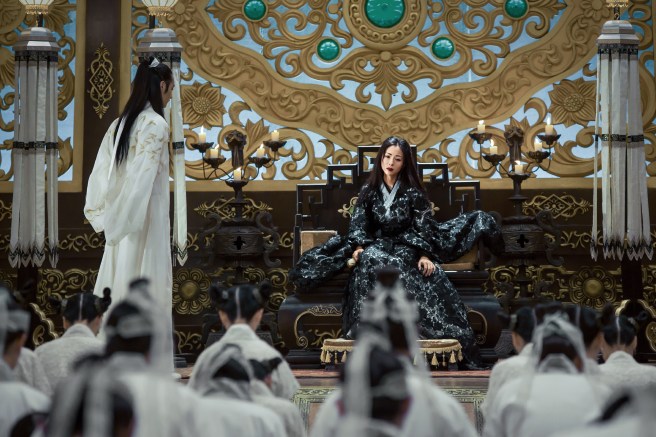
In tone, the film is faithful to Chor Yuen’s works: while lacking the distinctive overcluttered visual style it faithfully reproduces his bright colors and fanciful locations (the setting for the final duel, a fog-enshrouded mountain-top crowned by an ancient, white-blossomed tree, is pure Chor). But Yee and his co-writer and co-producer Tsui Hark, have slightly shifted the emphasis of the original film, amplifying the emotions and the romances while cutting down on the characters and miscellaneous swordsmen who appear only to be cut down after an action sequence or two. The result is less a reflection of a cutthroat world where everyone is driven by ambition, the desire to be known as the best, to rise to the top of the jianghu, where the only way a swordsman’s life can have value is by being known as a great swordsman than it is a soap operatic entanglement of intersecting love triangles. Chor’s films reflect the decadence of Hong Kong in the 1970s and 1980s, a laissez-faire world disconnected from the mainland and from history, a ruthless capitalist paradise. The new film is from a different world entirely, and its characters are driven not by ambition but by thwarted desire. Everyone in the film loves someone who doesn’t love them back, the heroes manage to make peace with this, the villains are twisted into evil. But along the way, we’re treated with many a lush romantic interlude, including several momentum-killing flashbacks to the lifelong romance between Chi and his murderous girlfriend.
072714_068

For the fight sequences, Yee adopts the digitally-enhanced techniques of contemporary wuxias, with lots of slow-motion and computerized movements. It lacks weight and none of the performances or scenes are particularly exceptional, though neither are they ever bad. The fights are fluid and faithfully recreate the fantastical style of the Shaws movies, eschewing the rapid cuts of Tsui and Ching Siu-tung’s wire-fus of the late 80s and early 90s. The choreography is by Yuen Bun, who’s most famous for his work with Johnnie To, and while it lacks the virtuosity of the fights in this summer’s Call of Heroes (with Eddie Peng and Wu Jing choreographed by Sammo Hung), it’s a step above the action in Yuen Woo-ping’s Crouching Tiger, Hidden Dragon: Sword of Destiny. That film provides the best point of comparison, as an adaptation of wuxia literature harkening back to the 1970s, but reformulating the characters and motivations for an audience trained to accept personal melodrama as the only motivation for action heroics (see also: every Marvel movie). The Crouching Tiger sequel though gets the balance all wrong: the characters don’t make much sense and the action is too disconnected, even when it’s quite good (and Donnie Yen and Michelle Yeoh are certainly more charismatic and accomplished performers than the competent stars of Yee’s film: Lin Gengxin and Peter Ho). The Sword Master is the best version of what Sword of Destiny tried to be, a pulpy wuxia romantic melodrama. A throwback and a tribute to one of Hong Kong’s most distinctive filmmakers.

La La Land (Damien Chazelle, 2016)

la la land

It begins with a joke and ends with glances. Perhaps this is the best way to describe the odd maturation of La La Land that occurs before the viewer’s very eyes, a movement from flashy kitsch to a fount of true human emotion wrapped up in dreams, that most Hollywood of ideas. Damien Chazelle and company certainly can’t be accused of insincerity, but they only seem to catch fire in the last twenty minutes, leaving the rest of the film to wallow in a strange mixing pot of playful cynicism at modern society and faint stabs at a genuinely compelling romance.

La La Land wears its influences on its sleeve, from Stanley Donen and Gene Kelly to Jacques Demy, but the movie often struggles to even come close to the kind of magic that those triumphs exuded. This comes from a myriad of reasons—for one, the songs, catchy as they are, lack a strong sense of momentum—but perhaps most importantly, he uses the traditions of those movies without truly embodying them or conveying what made them sing. Much of this feeling is due to a certain semblence of grandstanding that begins from the opening number, a grandiose, celebratory affair set over an entire traffic-jammed highway, all done in a single hyperactive shot to boot. Chazelle rarely lets up from there, extensively using the Steadicam to add a swooping flair to even the most mundane scenes in a way that feels intrusive in a strange way. The aesthetic feels misapplied, hyper-concentrated and suffocating instead of free and lithe like the classics Chazelle tries to imitate.

Continue reading La La Land (Damien Chazelle, 2016)”