The middle film in the Ephron/Ryan trilogy that defined the romantic comedy from 1988 (When Harry Met Sally…) to 1998 (You’ve Got Mail), is back on the screen this week at the Central Cinema. Meg Ryan plays an affianced journalist (Bill Pullman is her Bellamy) who happens upon a late night talk show where she hears the sad story of recently widowed Tom Hanks and his precocious son. Instantly in love, Ryan struggles for most of the film with the weirdness of her feelings, ultimately leading to a meeting at the top of the Empire State Building.
Category: Reviews
National Gallery
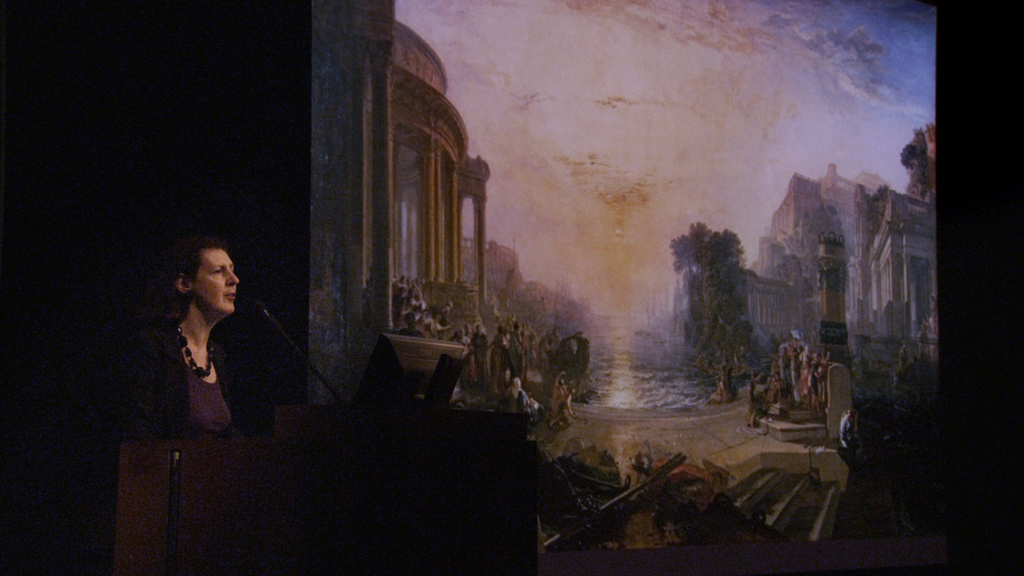
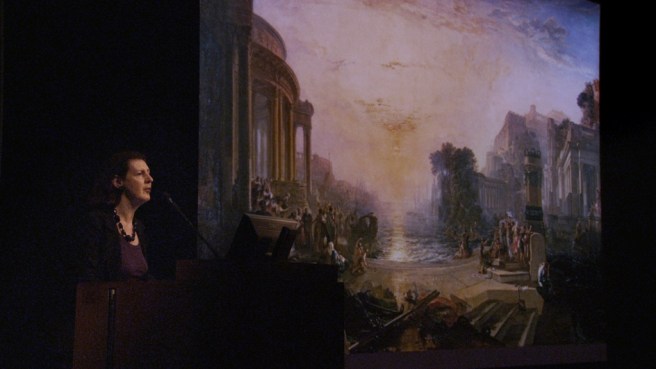
Following a successful two-week run at the Northwest Film Forum late last year, SIFF is bringing Frederick Wiseman’s latest documentary, National Gallery back for one Monday night this week as part of their Recent Raves series. At about three hours long, Gallery is only a medium length Wiseman film, a look at the venerable British art gallery, the paintings within it, the people that run it and the public that visits it. The 85 year old filmmaker is probably more well-known for his examinations of public institutions in films like Welfare (1975), Titicut Follies (1967), At Berkeley (2013) or High School (1968, followed by a sequel in 1994), but he’s also one of cinema’s great chroniclers of art as work. His dance films (Ballet, 1995; La danse, 2009; and Crazy Horse, 2011) are astounding, and, along with 2010’s Boxing Gym, form with National Gallery as expansive a look at the business, craft and sheer effort that goes into the presentation of art to an audience. Like those other films, Gallery is divided into a series of segments highlighting different aspects of the institution: the tour guides explaining a work or an artist; the craftsmen and women building frames, gallery spaces, designing and testing lighting; restorers at work fixing paintings damaged by time; and administrators debating the best ways to persevere the museums brand and grow its audience. The segments are broken up by shorter series of shots, much like the pillow shots of a Yasujiro Ozu film, where we get to look at the paintings and, as interestingly perhaps, the faces of the people as they look at the paintings. 19th Century landscape painter JMW Turner, himself the subject of a fine biopic directed by Mike Leigh starring Timothy Spall, is one of the featured artists. That film, Mr. Turner, is currently playing at the Sundance Cinemas. The pair would make for an excellent, if lengthy, cross-town double feature.
National Gallery plays at the Grand Cinema on Tuesday, March 3rd.
A Hard Day’s Night (Richard Lester, 1964)
Which Beatle came up with the title A Hard Day’s Night? Which Beatle was later cast in such meaty roles as Merlin the Magician, The Pope, and Frank Zappa? Which Beatle never wrote a bad song while a member of the band? Which Beatle is the true lead of A Hard Day’s Night?
Bingo, it’s all Ringo.
Ringo-bashing has been a pastime for so long that it’s no longer considered contrary and hip to be a staunch defender of the man. No matter, I will fight for Ringo’s honor until he garners the respect he truly deserves, not only for his contributions to the band but for his general, all-around awesomeness. All of this malarkey against Richard Starkey is baseless and unfair. He is a good drummer. He is hilarious. He is a downright cool rock ‘n’ roll star. There is no better example of Ringo’s worth than the entirety of A Hard Day’s Night. Continue reading “A Hard Day’s Night (Richard Lester, 1964)”
Naked Lunch (David Cronenberg, 1991)
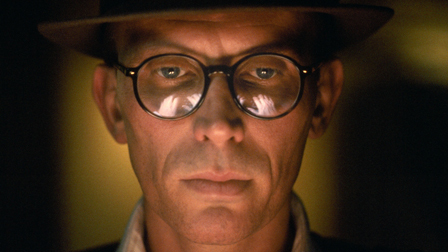
The great achievement of David Cronenberg’s Naked Lunch is that it proves an adaptation need not be faithful to the original text to be successful. Of course, in this instance a straightforward adaptation would be all but impossible as William S. Burroughs’ hallucinogenic novel is one of the most infamously unfilmmable books. Instead, Cronenberg cleverly combines elements of the novel with pieces from Burroughs’ more straightforward work, as well as events from the author’s real life, to construct a feature that captures the essence of Naked Lunch, if not the literal plot.
Goodbye to Language 3D at the SIFF Cinema Uptown
The latest film from Swiss filmmaker Jean-Luc Godard, 84-year old icon of the French New Wave (you know the hits: Breathless, Pierrot le fou, Contempt), after a smash-hit two-night run at the Cinerama earlier this month, gets a full run of shows this week at the Uptown. In keeping with the director’s late style, it’s a series of disjointed and overlapping ruminations and jokes, half-oblique narrative and half-essay film, shot in an experimental digital 3D that is guaranteed to slice out your eyeballs. Like a handful of other auteur projects (Werner Herzog’s Cave of Forgotten Dreams, Wim Wenders’s Pina), Adieu au langage (I prefer the French title, if only because it’s riffed and punned on throughout the movie) makes the case for the potential of digital 3D to add something truly new and wondrous to the art form, rather than simply as a tool for ever more “spectacular” effects designed to lure teenagers to the multiplex. There’s a kind of a plot, about two couples, or one couple twice, but like most late Godard, it isn’t, for the most part, immediately comprehensible (Professor David Bordwell has helpfully elucidated on his website his reading of the plot and its structure, along with a lot of other insights gleaned over much research and several viewings). Yet despite the gnomic impenetrability, few 2014 films are more immediately pleasurable, more of an experience. Under the sheen of narrative games and puns and references both literary and cinematic, at the center of it all, is a dog, Roxy Miéville, wandering the countryside, beside a lake, through a woods, a natural world utterly transformed by the phantasmagoric possibilities of digital cinema.
(Goodbye to Language 3D plays digitally at SIFF Cinema Uptown 1/23-1/29)
Inherent Vice (Paul Thomas Anderson, 2014)
Neil Young has a habit of changing course just when everybody starts to get on his wavelength. He’ll follow up an acclaimed album of pretty acoustic songs like Harvest with some loud fucked up sadness like On the Beach and Tonight’s the Night. It’s becoming apparent that Paul Thomas Anderson is a little like that, too. Early in his career, Anderson made a name for himself as the guy who wove dozens of disparate characters into the sweeping tapestries of Boogie Nights and Magnolia. He then abandoned his templates for the anger and intimacy of Punch-Drunk Love. Now Anderson, the zig-zag wanderer, has done it again, following up two raw portraits of American ego with an adaptation of Thomas Pynchon’s Inherent Vice, a goofy escapade to the paranoid summit of Stoner Mountain. If the Coen Brothers’ Inside Llewyn Davis was the album cover of The Freewheelin’ Bob Dylan come to life, Inherent Vice is the cover and title of Young’s Everybody Knows This is Nowhere. It’s the death knell of the ‘60s being banged on a dimestore gong. Continue reading “Inherent Vice (Paul Thomas Anderson, 2014)”
James Stewart Movies at the Grand Illusion Cinema

After failing to win the Best Actor Oscar for his performance in Mr. Smith Goes to Washington (he lost to Robert Donat in Goodbye, Mr. Chips, which is a very good performance in a fine film, but come on), James Stewart was rewarded by the Academy the very next year for The Philadelphia Story, in which he plays third lead to Katharine Hepburn and Cary Grant in George Cukor’s monumental screwball. He might better have won for Ernst Lubitsch’s The Shop Around the Corner, released earlier that same year, in which he co-starred with Margaret Sullavan as a pair of feuding store clerks who don’t know they’re pen pals in love. Both films are playing this week at the Grand Illusion, on 35mm (the GI continues to be the last great bastion of repertory-on-film in the Seattle area).
Continue reading “James Stewart Movies at the Grand Illusion Cinema”
The Taking of Tiger Mountain (Tsui Hark, 2014)
Look deep into the movie listings this January, past the big name awards fodder, the PT Andersons and the Rob Marshalls, the biopics and social problem films, and you’ll find, in limited release, the latest picture from one of the most influential and important directors of the past 40 years, Tsui Hark, whose name remains so unknown in the US he’s as likely to be identified by his personal name as his family name (for the record: he is Mr. Tsui, not Mr. Hark; pronounced “Choy – Hok”). As director, producer, writer and even actor, Tsui has played a prominent role in every stage of Hong Kong cinema since the mid-1970s, from the New Wave through “heroic bloodshed” and the wuxia revival of the 80s and early 90s; from the pre-Handover exodus to Hollywood to the present-day integration with the Mainland and the proliferation of digital technology. With at least a dozen classics spanning just as many genres, Tsui stands among the most accomplished directors in film history, Hong Kong or otherwise. Continue reading “The Taking of Tiger Mountain (Tsui Hark, 2014)”