Friday October 12 – Thursday October 18

Featured Film:

Monsters Attacking at Every Rep Theatre in Town

It’s officially Halloween season, and all over town the scary movies are popping up for limited runs. The Central Cinema has Alfred Hitchcock’s Psycho, the one that started it all, while the Northwest Film Forum has a one night only showing of George Romero’s Day of the Dead, less illustrious than his two prior zombie movies, but no less essential. The Grand in Tacoma has Tim Burton’s Beetlejuice on Friday night (and spreads the rep love around later in the week with Do the Right Thing and Henri-Georges Cluzout’s The Mystery of Picasso). But no one in town celebrates the dark soul of cinema like the Grand Illusion, and this week their annual All Monsters Attack series starts with 35mm prints of Kathryn Bigelow’s 80s vampire classic Near Dark and Antonia Bird’s cannibal thriller Ravenous. They’ve also got The Night Eats the World, a new film from French director Dominque Rocherthat starring Golshifteh Farahani and Denis Levant along with something called Ninja Zombie that the good people at VHS Uber Alles unearthed somewhere. And this Sunday they have Scarecrow Video’s annual triple feature of obscure oddities. In coming weeks, the series will continue with the original King Kong and The Most Dangerous Game, Brian dePalma’s SistersThe Cabin in the Woods, Roger Corman’s final film, 1990’s Frankenstein Unbound and more.

Playing This Week:

AMC Alderwood:

The Sisters Brothers (Jacques Audiard) Fri-Thurs
Free Solo (Jimmy Chin & Elizabeth Chai Vasarhelyi) Fri-Thurs

Central Cinema:

Psycho (Alfred Hitchcock, 1960) Fri-Mon, Weds
The Craft (Andrew Fleming, 1996) Fri-Tues

SIFF Egyptian:

TWIST Seattle Queer Film Festival 2018 Fri-Weds Full Program
Absinthe Films and B4BC Present Stay Tuned (Justin Hostynek) Thurs Only

Century Federal Way:

Son of Manjeet Singh (Vikram Grover) Fri-Thurs
Mr. Smith Goes to Washington (Frank Capra, 1939) Sun & Weds Only

Grand Cinema:

Monsters and Men (Reinaldo Marcus Green) Fri-Thurs
The Old Man & the Gun (David Lowery) Fri-Thurs
Beetlejuice (Tim Burton, 1988) Fri-Thurs
Kusama: Infinity (Heather Lenz) Tues Only
Do the Right Thing (Spike Lee, 1989) Weds Only
The Mystery of Picasso (Henri-Georges Clouzot, 1956) Weds Only

Grand Illusion Cinema:

The Night Eats the World (Dominique Rocher) Sat, Mon, Weds & Thurs
Near Dark (Kathryn Bigelow, 1987) Fri-Sun, Tues 35mm
Ravenous (Antonia Bird, 1999) Fri, Sat, Mon & Tues 35mm
Scarecrow Video Weirdo Horror Triple Feature Sun Only
Ninja Zombie (Mark Bessenger, 1992) Thurs & Next Fri

Cinemark Lincoln Square:

The Old Man & the Gun (David Lowery) Fri-Thurs
Free Solo (Jimmy Chin & Elizabeth Chai Vasarhelyi) Fri-Thurs
The Hate U Give (George Tillman Jr.) Fri-Thurs
Aravindha Sametha…Veera Raghava (Trivikram Srinivas) Fri-Thurs
96 (C. Prem Kumar) Fri-Thurs
Andhadhun (Sriram Raghavan) Fri-Thurs
Helicopter Eela (Pradeep Sarkar) Fri-Thurs
Mr. Smith Goes to Washington (Frank Capra, 1939) Sun & Weds Only

Regal Meridian:

The Sisters Brothers (Jacques Audiard) Fri-Thurs
The Old Man & the Gun (David Lowery) Fri-Thurs
Monsters and Men (Reinaldo Marcus Green) Fri-Thurs
Free Solo (Jimmy Chin & Elizabeth Chai Vasarhelyi) Fri-Thurs

Northwest Film Forum:

TWIST Seattle Queer Film Festival 2018 Fri-Weds Full Program
Kusama: Infinity (Heather Lenz) Sun-Thurs
Day of the Dead (George Romero, 1985) Weds Only
Stories of Our Watersheds (Various) Thurs Only

AMC Pacific Place:

Project Gutenberg (Felix Chong) Fri-Thurs
Lost, Found (Lv Yue) Fri-Thurs
The Hate U Give (George Tillman Jr.) Fri-Thurs

Regal Parkway Plaza:

Miss Granny (Joyce E. Bernal) Fri-Thurs
Exes Baggage (Dan Villegas) Fri-Thurs
Goyo the Boy General (Jerrold Tarog) Fri-Thurs
The Hate U Give (George Tillman Jr.) Fri-Thurs
Son of Manjeet Singh (Vikram Grover) Fri-Thurs

SIFF Film Center:

Bisbee ’17 (Robert Greene) Fri-Thurs Our Review
Headhunt Revisited (Michele Westmorland) Weds Only

AMC Southcenter:

Kinky (Jean Claude Lamarre) Fri-Thurs
The Hate U Give (George Tillman Jr.) Fri-Thurs

Regal Thornton Place:

The Hate U Give (George Tillman Jr.) Fri-Thurs
Free Solo (Jimmy Chin & Elizabeth Chai Vasarhelyi) Fri-Thurs
Mr. Smith Goes to Washington (Frank Capra, 1939) Sun & Weds Only

SIFF Uptown:

Matangi/Maya/MIA (Stephen Loveridge) Fri-Thurs Our Review
Inventing Tomorroe (Laura Nix) Fri-Thurs
Mandy (Panos Cosmatos) Fri-Thurs
BLIZZARD OF AAHHH’s 30th Anniversary ReCut (Greg Stump) Weds Only

Varsity Theatre:

Science Fair (Darren Foster & Cristina Costantini) Fri-Thurs
After Everything (Hannah Marks & Joey Power) Fri-Thurs
Seattle Latino Film Festival Fri Only Full Program
New York Cat Film Festival Sun Only
Mr. Smith Goes to Washington (Frank Capra, 1939) Weds Only

In Wide Release:

Mission: Impossible–Fallout (Christopher McQuarrie) Our Review
Ant-Man and the Wasp (Peyton Reed) Our Review

Friday October 5 – Thursday October 11

Featured Film:

The Atomic Café at the Grand Illusion

We’re still in Vancouver, watching as many movies as we can, which is why this is going up a couple of days late this week. So far we’ve seen and reviewed The LoadMiraiAsako I & IIDiamantino, four Short Films by Sofia BohdanowiczSpice It Up, and Fausto. That’s in addition to the movies that are here at VIFF that we covered when they played earlier this year at other festivals (Grass, People’s Republic of Desire, Girls Always Happy, Microhabitat and Matangi/Maya/MIA). We’ll have lots more to come over the next couple of weeks, once we return to America, including a special all-VIFF episode of The Frances Farmer Show.

But while all that is going on, the Grand Illusion has a new restoration of the excellent 1982 documentary The Atomic Café, built out of archival footage of nuclear America during the cold war. It’s horrifying and hilarious in all the best ways. Don’t miss it. Or maybe trek down to Tacoma to check out the Film Festival they’ve got going on at the Grand. This year’s is the best one yet, with a lot of movies that won’t make their way to King County for awhile yet.

Playing This Week:

AMC Alderwood:

The Great Battle (Kim Gwangsik) Fri-Thurs Our Review
Feng Shui (Park Heegon) Fri-Thurs

Central Cinema:

Rear Window (Alfred Hitchcock, 1954) Fri-Mon
Get Out (Jordan Peele) Fri-Tues

SIFF Egyptian:

Mandy (Panos Cosmatos) Fri-Thurs

Century Federal Way:

Asfar (Gulshan Singh) Fri-Thurs
Parahuna (Amrit Raj Chadha & Mohit Banwait) Fri-Thurs
The Great Battle (Kim Gwang-Sik) Fri-Thurs Our Review
Qismat (Jagdeep Sidhu) Fri-Thurs
Bullitt (Peter Yates, 1968) Sun & Tues Only

Grand Cinema:

Tacoma Film Festival Fri-Thurs Full Program
Mandy (Panos Cosmatos) Fri-Thurs
Pick of the Litter (Dana Nachman & Don Hardy) Fri-Thurs

Grand Illusion Cinema:

The Atomic Café (Kevin Rafferty, Jayne Loader & Pierce Rafferty, 1982) Fri-Thurs
Heavy Trip (Jukka Vidgren & Juuso Laatio) Fri-Sun
Saving Brinton (Tommy Haines & Andrew Sherburne) Tues Only
Hot to Trot (Gail Freedman) Weds Only Filmmaker in Attendance

Cinemark Lincoln Square:

The Sisters Brothers (Jacques Audiard) Fri-Thurs
Collette (Wash Westmoreland) Fri-Thurs
Chekka Chivantha Vaanam (Mani Ratnam) Fri-Thurs
96 (C. Prem Kumar) Fri-Thurs
Andhadhun (Sriram Raghavan) Fri-Thurs
Devadas (Sriram Aditya) Fri-Thurs
NOTA (Anand Shankar) Fri-Thurs In Tamil or Telugu, Check Listings
TCGN (Girish Joshi) Fri-Thurs
Sui Dhaaga-Made in India (Sharat Katariya) Fri-Thurs
Bullitt (Peter Yates, 1968) Sun & Tues Only

Regal Meridian:

The Sisters Brothers (Jacques Audiard) Fri-Thurs
Monsters and Men (Reinaldo Marcus Green) Fri-Thurs

Northwest Film Forum:

Tasveer South Asian Film Festival Sat Only Full Program
Kusama: Infinity (Heather Lenz) Sun-Thurs
Time for Ilhan (Norah Shapiro) Sun Only
Wacko (Greydon Clark) Weds Only

AMC Oak Tree:

Hello Mrs. Money (Wu Yuhan) Fri-Thurs

AMC Pacific Place:

Project Gutenberg (Felix Chong) Fri-Thurs
Hello Mrs. Money (Wu Yuhan) Fri-Thurs
Cry Me a Sad River (Luo Luo) Fri-Thurs
Collette (Wash Westmoreland) Fri-Thurs

Regal Parkway Plaza:

Miss Granny (Joyce E. Bernal) Fri-Thurs
Exes Baggage (Dan Villegas) Fri-Thurs

AMC Seattle:

Summer ’03 (Rebecca Gleason) Fri-Thurs

Seattle Art Museum:

Force of Evil (Abraham Polonsky, 1948) Thurs Only 35mm

SIFF Film Center:

The Apparition (Xavier Giannoli) Fri-Sun
Headhunt Revisited (Michele Westmorland) Weds Only

AMC Southcenter:

El día de la unión (Kuno Becker) Fri-Thurs
Trico Tri: Happy Halloween (Christian Vogeler) Fri-Thurs

Regal Thornton Place:

Collette (Wash Westmoreland) Fri-Thurs
Bullitt (Peter Yates, 1968) Sun & Tues Only

SIFF Uptown:

Matangi/Maya/MIA (Stephen Loveridge) Fri-Thurs Our Review
Blaze (Ethan Hawke) Fri-Thurs
Mandy (Panos Cosmatos) Fri-Thurs
Soufra (Thomas Morgan) Thurs Only

Varsity Theatre:

Love, Gilda (Lisa Dapolito) Fri-Thurs
Seattle Latino Film Festival Sat-Thurs Full Program
Manhattan Short 2018 Film Festival Fri Only
Bullitt (Peter Yates, 1968) Tues Only

In Wide Release:

Mission: Impossible–Fallout (Christopher McQuarrie) Our Review
Ant-Man and the Wasp (Peyton Reed) Our Review

VIFF 2018: Mirai (Mamoru Hosada, 2018)

mirai_02_copy_0

In 2012 Mamoru Hosada released Wolf Children, one of the finest animated films of the decade. It followed a young mother’s struggle to let her children go as they age, to become their own people, separate from her (that one of them chooses a human life while the other heeds the call of the wild and runs off to live as a wolf like his father is only tangentially relevant). With Mirai, Hosada addresses much the same issue from the opposite perspective, this time we see the child’s point of view as he grows form a wholly ego-driven individual into a member of a family, a continuum of people that extends not just horizontally to his sister and parents, but also backwards and forwards in time, to the people his ancestors were and the people he and his sister will become.

He’s not a werewolf this time (though he does have a talent for canine imitation) rather he is subject to a series of fantasies that grow out of the trauma of the arrival of his younger sibling, and the shattering of the idyllic existence he’d led as the center of the universe. He sees the family dog anthropomorphized into a fallen prince (an initial act of empathy that mirrors his own loss of place). He meets an older version of his baby sister, and he has an adventure with his great-grandfather. In interacting with these people (which may be mere figments of his young imagination or could be the manifestation of some supernatural power, it amounts to much the same thing) he learns perspective: that other beings are just as conscious as he is, that the world and the people in it are both distinct from him while also forming an essential part of him, a vast web of humanity with a center that might belong to him, but then again, it might not.

Mirai is as fanciful as anything Hosada has made, with a trip to the geometric horror of a train station a particular highlight. But like Wolf Children, as well as his version of The Girl Who Leapt through Time, it is fundamentally grounded in the every day, which in this case means a whole lot of parent humor, for which I am, no doubt, a sucker (I happen to have a self-centered, train-obsessed boy in my home as well). Hosada expertly fuses fantasy and slice-of-life anime, following in the tradition of the best of Studio Ghibli (Kiki’s Delivery Service, Only Yesterday and Whisper of the Heart), as well as any director of his generation.

VIFF 2018: Asako I & II (Ryūsuke Hamaguchi, 2018)

asako

In keeping the same minute attention to the smallest details of human routine and interaction that so distinguished his intimate 2015 epic Happy Hour, but trapping them within the familiar confines of a romantic comedy, Ryūsuke Hamaguchi has created something remarkable, a genre film as alive to the possibilities and contradictions of the human psyche and its dealing with other souls as we’ve seen in some time. It’s certainly the best romantic film since Hong Sangsoo’s Yourself and Yours, with which it shares a certain surface similarity. But in every important respect it is sui generis, very much its own thing.

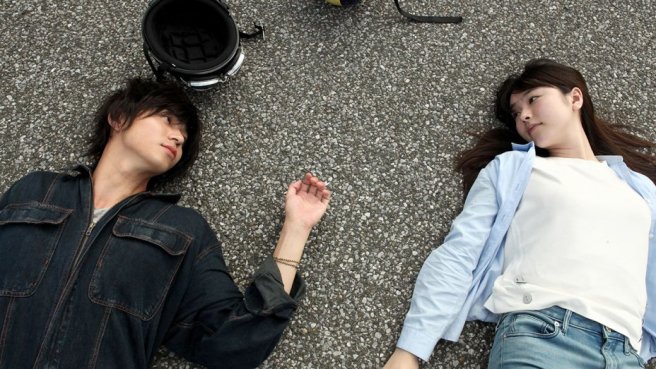
Asako and Baku meet-cute at an art gallery. It’s love at first sight, the two are wordlessly drawn together and stay that way for some time, in the pure romance of youth, impervious to the outside world and not only unafraid of death but turned on by its impossibility. Until, one day Baku disappears. Five years later, Asako meets cute again, this time with a young businessman named Ryôhei, who looks exactly like Baku and is played by the same actor (Masahiro Higashide, from Kiyoshi Kurosawa’s Before We Vanish). The bulk of the film tracks their relationship, growing from awkward avoidance to friendship to love with the rhythms of the everyday and in parallel to the romance between their respective best friends. The friends’ antagonistic first meeting over a performance of Chekov, is the best of the films several digressions, with an unexpected natural disaster and an idyllic montage in a fishing weekend providing other highlights.

The inevitable conflict comes in the final third, as Baku returns. If Hamaguchi doesn’t resolve The Case of the Two Bakus (or rather, the Two Asakos, the first crazed with the freedom of youth, the second safe in the benign contentment of maturity) with as much bald-faced ingenuity as Hong did, he can be forgiven. The solution he does find is as emotionally confused and true as real-life. We are unlikely to see a more open and all-embracing film this year.

VIFF 2018: Diamantino (Gabriel Abrantes & Daniel Schmidt, 2018)

e2809cdiamantinoe2809d-credit-charades

A soccer player strides across the field. Beautiful, dumb and happy, he tells us his story in a wide-eyed narration. A Candide lost in a world far too corrupt for his dim intelligence and brilliant soul. In the opening moment we get to see the world, the game, through his eyes. Not one of screaming lunatic fans or hulking, hostile opponents, but of giant fluffy puppies cavorting in slo-mo through cotton candy pink billows of cloud.

Circumstances, as they do, intrude on this perfect, pre-verbal vision of the world as it might be, and our hero, Diamantino, is sent into a tailspin of awareness, first by an encounter with refugees lost at sea, then by the death of his beloved father. Rather than center their film on their naive hero’s growing consciousness, as in, say, Daisy von Scherler-Meyer’s Party Girl, in which club kid Parker Posey grows into an existentialist librarian, directors Gabriel Abrantes and Daniel Schmidt instead put poor Diamantino at the center of a complex and farcical conspiracy involving his evil twin sisters, a pair of undercover cops, a Brexit-like campaign (but for Portugal) and a scientist who walks in water and tries to clone our hero (to make the perfect soccer team) but with gender-confounding consequences. His only ally is one of the cops, whom he adopts thinking she is an orphan refugee boy.

The conspiracy plotting is ridiculous, reminding me of the half-assed terrorism sub-plot in the film within the film of Spice It Up at best and the grotesque anti-comedy of Edgar Pêra’s Cinesapiens short at worst. A few of the jokes land, especially when the directors find new uses for familiar musical cues like the “Vorspiel” from Das Rheingold or Henry Purcell’s “Dido’s Lament”. But the film rarely again reaches the heights of its first few magical moments, yet every time they bring us back to Diamantino and his pure, foolish soul I’m won over again. He’s truly the hero we need in our dumb, degraded, beautiful world.

VIFF 2018: Spice It Up (Lev Lewis, Yonah Lewis, & Calvin Thomas, 2018)

spiceitup

One of the highlights of this year’s Future//Present program, and almost certainly the funniest movie to ever play in the now three-year-old series highlighting the cutting edge in Canadian independent cinema, is Spice It Up, from the directorial troika of Lev and Yonah Lewis and Calvin Thomas. Beginning life five years ago as a shambolic portrait of seven young women who, failing at high school, join the Canadian Army and spend one crazy summer together hanging out, dancing and somehow becoming involved in a terrorist plot involving French Canadian separatists. Charming and goofy, the original film seems like exactly the kind of thing people who teach in film schools rail against: it’s formless and fails to follow the rules of screenwriting as set done by hacks in how-to books. The current version of the film embraces that criticism, inventing a frame story in which the film student who ostensibly directed the movie (played by Jennifer Hardy), is tasked by her teacher (a very funny Adam Nayman) with restoring some classical virtues to her slice-of-life hangout movie. And he isn’t the only one with criticisms: seemingly everyone Hardy meets tells her what is wrong with her film and makes suggestions that simply don’t make sense to her. Still, she works at it, but, as she says, every change she makes away from her original vision simply makes her like the movie less.

Of course all the people who criticize Hardy’s work are men: her instructor, her editor, a guy who suggests she turn her characters into manifestations of virtues set down by moral philosophers, a guy who lives next door who walks out of her movie halfway through a screening. The only woman she actually talks to about it is her sister, played by Sophy Romvari, who hasn’t even bothered to watch the movie yet. It’s a pointed criticism of the film school system, and the wider world of film criticism, dominated by the point of view of men, both under- and over-educated, with directors like Hardy flustered when their personal style of cinema doesn’t line up with established norms. It’s hardly a polemic, though, and the film is just as hilarious in its parody of film culture as the film within a film is of a group of underprepared women sticking together (where Hardy in her story is pointedly alone) despite a significant dearth of common sense. It’s maybe the funniest movie about independent filmmaking since La última película, or maybe even Tom DiCillo’s classic Living in Oblivion. It’s also, with its memorable supporting cast, a compelling portrait of the Toronto film scene as it stands right now in the 2010s, resolutely opposed to commercial norms and dedicated to making the personal cinematic and the cinematic personal.

VIFF 2018 Preview: Grass, People’s Republic of Desire, Girls Always Happy, Microhabitat, Matangi/Maya/MIA

grass

I’m actually already here in Vancouver, three excellent movies into my time at this year’s Film Festival. But as a kind of a preview, I want to highlight some of our previously published coverage of films that will be playing here over the next couple of weeks.

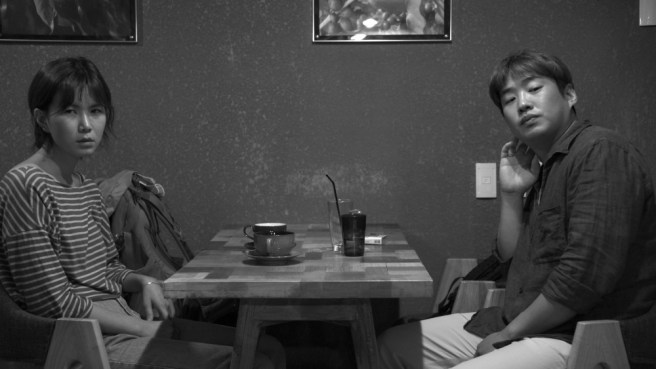
Hong Sangsoo is of course the headliner. His Grass, which premiered earlier this year, will be playing in the second week of the festival, after I leave town. Fortunately, Evan and I had a chance to see and talk about it earlier this year. Like The Day After and Hotel by the River (which isn’t playing VIFF but will be at the New York Film Festival this week), it’s a black and white film starring Kim Minhee. All three films are melancholy,  meditations on death and suicide informed by a Christian spirituality. I think Grass, the Purgatorio of Hong’s Divine Comedy, is the best of them.

Evan and I were split on the documentary People’s Republic of Desire when it played SIFF earlier this year. He found it too formally boring to really get anything out of its subject, the online celebrity culture of contemporary China, while I thought that was kind of the point, that despite the apparent newness of the world, all the old evils will reassert themselves.

Yang Mingming was the most adventurous of the several solid titles in SIFF’s Chinese film program this year, and I’m glad to see it pop up again here at VIFF. The director herself stars as a young woman with a hot and cold relationship with her mother (played by Nai An, who also stars here at VIFF in Ying Liang’s A Family Tour).  Yang “mixes tones cavalierly, one minute wrenching personal drama told in close-ups of anguished, sweaty, tear-stained faces, the next a jaunty scooter trip through Beijing’s warren of hutong alleys, the next those same alleys turned to the scene of unnamable, invisible dread. The result is a highly unstable film, lurching from lyricism to (self-)excoriation, coming dangerously close to resembling life itself.”

Also in VIFF’s Gateway stream is Jeon Go-woon’s Microhabitat, which I wrote about this summer when it played the New York Asian Film Festival. It’s a polished, warm film about a young woman who “chooses homelessness when price increases make sustaining her budget of cigarettes, whiskey and rent unsustainable. She couches surfs from one former college bandmate to another, all miserable in their own way while she remains pure, the only one of her peers not to compromise her independence and joy in life’s most basic consumptive pleasures.”

Finally, I was mixed on the documentary Matangi/Maya/MIA when it played at SIFF. Made up almost entirely of footage the star shot herself, long before she became famous or even., apparently had any idea of becoming a musician, it’s a fascinating look inside the mind of a creative person who hasn’t quite figured out what she wants to create. It kind of falls apart once she becomes famous, skipping from controversy to controversy, but I imagine that happens to all of us when we get old.

Friday September 28 – Thursday October 4

Featured Film:

Leave Her to Heaven at the Seattle Art Museum

SAM’s annual fall film noir series kicks into high gear this week with John Stahl’s 1945 Leave Her to Heaven, with Gene Tierney as the woman who will do absolutely anything it takes to win, and keep, the man she loves (Cornel Wilde). The most sublime intersection of Technicolor women’s melodrama and film noir, it’s one of the most singular, nastiest, and fun films of the classical Hollywood era. SAM’s noir series continues throughout the fall, with greats like Abraham Polonsky’s Force of Evil, Nicholas Ray and Ida Lupino’s On Dangerous Ground, Charles Laughton’s Night of the Hunter (maybe the best film ever made), and Michael Mann’s Heat. All but that last one are slated to be shown on 35mm to boot.

In the meantime, Seattle Screen Scene is going on the road for our annual trip to the Vancouver Film Festival. Stay tuned for extensive coverage of some of the most interesting movies of the year, including highlights from the summer festival season, the best in independent Canadian cinema, and one of North America’s finest and most adventurous Asian film programs.

Playing This Week:

AMC Alderwood:

The Great Battle (Kim Gwangsik) Fri-Thurs Our Review
The Negotiation (Yoon Jekyoon) Fri-Thurs

Central Cinema:

Mean Girls (Mark Waters, 2004) Fri-Tues
The Lost Boys (Joel Schumacher, 1987) Fri-Tues

Century Federal Way:

Parahuna (Amrit Raj Chadha & Mohit Banwait) Fri-Thurs
The Great Battle (Kim Gwang-Sik) Fri-Thurs Our Review
Qismat (Jagdeep Sidhu) Fri-Thurs
My Neighbor Totoro (Hayao Miyazaki, 1988) Sun, Mon & Weds Only Subtitled Monday

Grand Cinema:

Mandy (Panos Cosmatos) Fri-Thurs
The Catcher was a Spy (Ben Lewin) Fri-Thurs
Pick of the Litter (Dana Nachman & Don Hardy) Fri-Thurs
Let the Corpses Tan (Hélène Cattet & Bruno Forzani) Sat Only Our Review
Madeline’s Madeline (Josephine Decker) Tues Only
Prospect (Chris Caldwell & Zeek Earl) Thurs Only

Grand Illusion Cinema:

Rodents of Unusual Size (Quinn Costello, Chris Metzler & Jeff Springer) Fri-Thurs
Outrage Coda (Takeshi Kitano) Fri-Thurs
Let the Corpses Tan (Hélène Cattet & Bruno Forzani) Sat, Sun & Tues Only Our Review
Blood Salvage (Tucker Johnston) Sat Only VHS

Cinemark Lincoln Square:

Collette (Wash Westmoreland) Fri-Thurs
Chekka Chivantha Vaanam (Mani Ratnam) Fri-Thurs
Manmarziyan (Anurag Kashyap) Fri-Thurs
Batti Gul Meter Chalu (Shree Narayan Singh) Fri-Thurs
Devadas (Sriram Aditya) Fri-Thurs
Natakam (Kalyanji Gogana) Fri-Thurs
Pataakha (Vishal) Fri-Thurs
Sui Dhaaga-Made in India (Sharat Katariya) Fri-Thurs
My Neighbor Totoro (Hayao Miyazaki, 1988) Sun, Mon & Weds Only Subtitled Monday

Regal Meridian:

Science Fair (Darren Foster & Cristina Costantini) Fri-Thurs
Golden Job (Chin Ka-lok) Fri-Thurs Our Review

Northwest Film Forum:

Local Sightings Film Festival Fri & Sat Full Program
Pioneers: First Women Filmmakers Sun Only
True Conviction (Jamie Meltzer) Tues Only
The Changeling (Peter Medak, 1980) Weds Only
Queercore: How to Punk a Revolution (Yony Leyser) Weds-Fri Only

AMC Oak Tree:

Golden Job (Chin Ka-lok) Fri-Thurs Our Review

AMC Pacific Place:

Lizzie (Craig Macneill) Fri-Thurs
Collette (Wash Westmoreland) Fri-Thurs

Regal Parkway Plaza:

Miss Granny (Joyce E. Bernal) Fri-Thurs
The Hows of Us (Cathy Garcia-Molina) Fri-Thurs

AMC Seattle:

Lizzie (Craig Macneill) Fri-Thurs

Seattle Art Museum:

Leave Her to Heaven (John M. Stahl, 1945) Thurs Only 35mm

AMC Southcenter:

El día de la unión (Kuno Becker) Fri-Thurs
Trico Tri: Happy Halloween (Christian Vogeler) Fri-Thurs

Regal Thornton Place:

My Neighbor Totoro (Hayao Miyazaki, 1988) Sun, Mon & Weds Only

SIFF Uptown:

Blaze (Ethan Hawke) Fri-Thurs
Pick of the Litter (Dana Nachman & Don Hardy) Fri-Thurs
Mandy (Panos Cosmatos) Fri-Thurs
French Cinema Now Festival Fri-Thurs Full Program

Varsity Theatre:

Love, Gilda (Lisa Dapolito) Fri-Thurs
The Healer (Pablo Arango) Fri-Thurs
My Neighbor Totoro (Hayao Miyazaki, 1988) Weds Only

In Wide Release:

Mission: Impossible–Fallout (Christopher McQuarrie) Our Review
Ant-Man and the Wasp (Peyton Reed) Our Review

Golden Job (Chin Ka-lok, 2018)

They discover the car is loaded with gold

In the wake of the 1997 Handover, when Hong Kong turned from a relatively independent British colony to a Special Administrative Region of the People’s Republic of China, the Hong Kong film industry, which had been for most of the previous 30 years or so one of the glories of the world, almost completely collapsed. Uncertainty was the primary cause, both in economic and political freedom, which led many of the industry’s brightest talents to seek employment in the United States and beyond (Jackie Chan, John Woo, Tsui Hark, Sammo Hung, Jet Li, Ringo Lam, Michelle Yeoh, Corey Yuen, Ronny Yu, etc), while the excesses of production in the 80s and early 90s, plus infiltration of unsavory, criminal elements into the filmmaking business, led to the dissolution of most of the major production houses that had led Hong Kong’s last Golden Age. But still, the Hong Kong cinema didn’t collapse entirely: Herman Yau kept churning out low-budget horror and gangster films (as he continues to do to this day); Johnnie To founded his own studio, which found a way to produce anywhere from two to six high quality films a year, both popular entertainments and idiosyncratic personal explorations of genre; Stephen Chow, who for much of the mid-90s was the only star who mattered, single-handedly keeping the industry afloat, began directing and produced increasingly ambitious and accomplished work. But above all, the Young & Dangerous series struck a chord with the youth audience, leading to something in the neighborhood of a dozen sequels, prequels and spin-offs between 1996 and 2001.

The Young & Dangerous films, shepherded by director Andrew Lau (an accomplished cinematographer (he shot Wong Kar-wai’s debut As Tears Go By and parts of Chungking Express, he also co-directed the Infernal Affairs films, the first of which came out in 2002), were a cheap, glossy, teen idol-driven, comic book variations on the heroic bloodshed sagas of the late 1980s. Stars Ekin Cheng and Jordan Chan had fancy hair and stylish clothes and a propensity for finding themselves in musical montages depicting the anguish and joy of violent brotherhood. They are wholly absurd and a great deal of fun. Now, more than 20 years after the first installment, director Chin Ka-lok reunites the stars of the series for Golden Job, a maudlin action film about brotherhood among formerly stylish middle-aged men.

Five “brothers”, friends since they were orphans together, work as vaguely immoral mercenaries for hire, kind of like the A-Team, but with more hugging. One of them goes bad and betrays the group, and the others have to, well, not really seek revenge, but do something to fix his errors. The film skirts topics familiar from recent Chinese action films (the pharmaceutical foul play of Woo’s Manhunt and Lam’s Sky on Fire, the paternalism of China’s relationship with East Africa from Wolf Warrior II), but in most ways it is a throwback to those older movies, albeit with much more expensive and impressive action sequences. Director Chin is a former member of Sammo Hung’s stunt team with a long career as an actor and fighter, though this is only his third film as a director in his own right (he did Aces Go Places ’97 with Tony Leung and Alan Tam, and the 2002 Yuen Biao film No Problem 2). His action scenes are solid, if not original. Capable facsimiles of the military maneuverings of Operation Red Sea and vehicle stunts that honestly aren’t all that much worse than what you’d see in a Mission: Impossible movie. It’s just hard to take them seriously because the rest of the film is so generically earnest, its aged heroes so out of step with the times that their posed male laughter and tears play even more absurdly than they did twenty years ago.

The difference isn’t with the film’s earnestness. That was always there in the Young & Dangerous movies: their sentimentality is entirely believed. But what those earlier films also had were brilliant supporting performances, like Anthony Wong chewing up scenery and picking his nose, or Simon Yam at his oiliest, or which served to cut the sap with a bit of irony or acidic cruelty. Golden Job has Eric Tsang being wise and noble as the gang’s father figure, which is a complete waste. In fact, the only actor who seems to be having any fun at all is Yasuaki Kurata, who continues his late career rebirth with a far too brief appearance. His short fight scene is the best one in the film, though it’s also the smallest and probably the cheapest. Clement Cheng and Derek Kwok’s Gallants similarly revived stars of the past now well into middle-age into a genre film, one with its share of sentimentality but also one that updated the genre stylistically and ideologically for a new era. Golden Job plays everything straight, all as it would have been done twenty years ago, and as a result there’s nothing to leaven the soapiness, leaving a bunch of nice action sequences surrounding a sickeningly schmaltzy core.

The Great Battle (Kim Kwangsik, 2018)

fullsizephoto994975

One of the more peculiar and underexamined genres of the 21st century is an outgrowth of the two films at the heart of the Oscar race in 2000, Ridley Scott’s Gladiator and Ang Lee’s Crouching Tiger, Hidden Dragon. The former revived the sword and sandals craze of the 1950s: epic war movies set in the distant past, with handsome men and headstrong women wielding spears and arrows as they face oncoming hoards of villains; while the later breathed new life into the wuxia film, updating King Hu and Chang Cheh classics to a contemporary art house setting. As Gladiator spawned Troy, Alexander, Kingdom of Heaven and a handful of Arthurian, Viking and assorted other medieval adventures, Crouching Tiger led to Zhang Yimou’s trilogy of ornate epics Hero, House of Flying Daggers and Curse of the Golden Flower, along with countless lesser adventures produced across Asia (Mongol with Tadonobu Asano, Musa with Zhang Ziyi, God of War with Sammo Hung and The Great Wall with Matt Damon, and Korea’s own The Admiral: Roaring Currents with Choi Minsik). The decisive factor the revival of these spectacles was the easy availability of computer generated imagery, drastically reducing the time and cost of producing a “cast of thousands”, while also amplifying the action sequences with slow motion (“bullet time”), erasure of wires, cartoonish gore, and the stitching together of disparate takes to create an illusion of seamless, continuous action. What the technology has thus far been unable to do, unfortunately, is raise the quality of the films’ scripts.

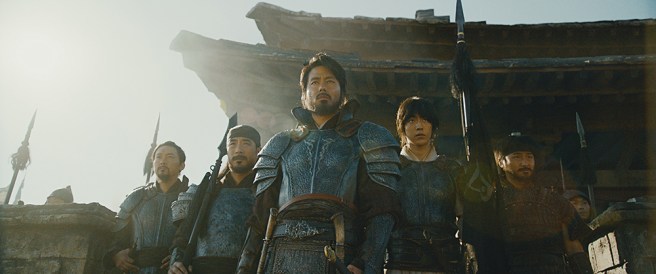
Into this heady tradition steps Kim Kwangsik’s The Great Battle, the story of the siege of Ansi fortress in northern Korea (at the time, AD 645, the kingdom of Goguryeo) by the massive army of Taizong, the Tang Dynasty ruler generally considered among the greatest of all Chinese Emperors. Outnumbered 40 to 1 (that is, 200,000 to 5,000), the Koreans are led by Yang Manchun, a mysterious historical figure embodied on-screen as a brilliant, brave, passionate, wise, honest, charming, generous, and handsome leader by Jo Insung. At his side are a pair of bickering captains (a tall, elegant leader of swordsmen and a hairy, gruff leader of axemen, the Legolas and Gimli of the story), a pair of young lovers (the leader of the cavalry and Yang’s sister, who leads a fearless band of crossbowwomen) and a callow youth, who has been sent to assassinate Yang by the leader of the Goguryeo army (who had killed the king and precipitated the war with the Tang), but who is instead so impressed by Yang’s moral and martial courage that he becomes his flag-bearer instead.

The cookie-cutter characterization and rote emoting of the generic plot can be tough to take, but fortunately the film’s real interest lies in its action scenes, which are of uniformly high quality. A siege movie, we are treated to a variety of infernal machines developed for the sole purpose of killing men on top of walls. Many of them we’ve seen before, but the film builds neatly from trebuchets, ladders and battering rams to massive towers and ultimately a gigantic earthen mound that takes months to build. Only the scrappy heroism and purity of Yang and his men (and women) are able to overcome the overwhelming numerical and technological superiority of the Tang. The combat itself is well-done, with a steady camera tracking though the bloody chaos, limbs and CGI reds flying as soldiers more or less follow the laws of physics. It’s all easy to read and delivers the essential violence that is the genre’s reason for being.

But that’s all it does. The better films in the genre have higher ambitions: Alexander‘s vision of a world-conquering madness; Hero‘s meditation on power and national unity;  Baahubali‘s genre-blending, intricate story-telling and wildly imaginative special effects; even The Great Wall‘s melding of medieval warfare with 50s style science-fiction; or Red Cliff, to date the finest example of the genre, deftly blending unique characters and relationships on a grand scale of schemes, tactics and action. The Great Battle plays it safe, content with the cliché, lacking even enough ideology to be a propaganda film.