The Revenant (Alejandro González Iñárritu, 2015)

angry dicaprio.png

There is a moment in Terrence Malick’s To the Wonder where Rachel McAdams and Ben Affleck are inexplicably surrounded by a herd of bison. The pair stand at their car and are awed by the majesty of the moment. And so are we, the audience. In Alejandro González Iñárritu’s new film The Revenant there is also a scene featuring a character stumbling upon some bison. The moment strives for a similar feeling of, well, wonder, but fails to deliver. It’s the approaches of these two filmmakers that spells all the difference. In Malick’s world an experience like that feels like luck, a chance encounter with real, live animals. And it’s also fleeting, a moment in a waterfall of moments that burns in your brain because it feels so fragile. In The Revenant everything is so rigorously composed, from the camerawork (filmed by longtime Malick associate Emmanuel Lubezki) to the herd itself, a computer-generated stampede heading to the end of the frame before disappearing, literally, forever.

It’s these moments in The Revenant that manage to shoot an otherwise pretty decent survivalist Western in the foot. When González Iñárritu is committed to the straightforward nature of his simple story, which is about a trapping scout who has to brave the elements to save his life and avenge a loved one, the film works well. There is a great sense of atmosphere and the occasional thrill. But whenever he grasps at poetry or pulls out a flashy camera trick–both of which happen often–the film flounders.

The film opens with a raid on a poacher’s encampment in which González Iñárritu throws the camera right in the middle of the action with sweeping, unbroken takes. While the technique is intended to feel visceral and immediate, it comes off like playing a video game. A similar problem crops up when steam or blood appears on the camera lens. Attempting to provide a thrilling verisimilitude, these elements just remind the viewer that there is a camera there, a move more distancing than inviting.

revenant mountain

González Iñárritu is a competent director but he’s a far too confident one for his capabilities. His misplaced desire to make this film more important than it is sabotages its better qualities. The same could be said for star Leonardo DiCaprio who grimaces, grunts, and groans his way through increasingly desperate–and subsequently sillier–circumstances. DiCaprio plays the story so straight that it teeters on the brink of collapse. Early on he fights a bear and it is terrifying. Two hours later, after being chased, shot at, abandoned, and nearly frozen, he falls off a cliff with his horse. By this point it has gone from harrowing to hilarious.

All of the issues with The Revenant are best summed up by its final moments. As the film comes to its entirely expected conclusion, Lubezki’s camera lingers on a shot of a snowy bank and an icy river. There is nobody in the frame, just the frigid water and a pool of blood. It’s a perfect shot to end a movie about the harsh worlds of nature and man. Instead González Iñárritu tacks on two more shots, closing with the worst decision in the entire film. In an effort to make something serious and smart, González Iñárritu ended up with something dopier than dumb and fun.
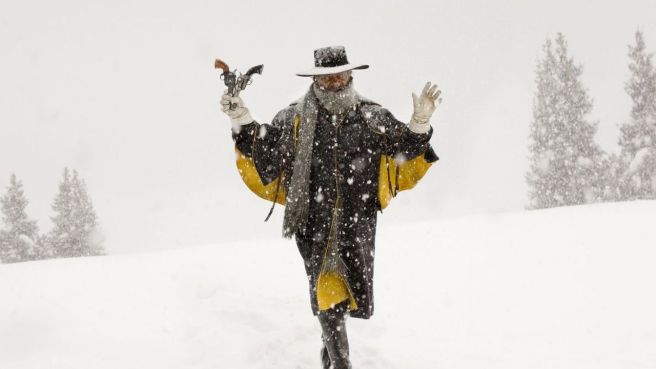
The Hateful Eight (Quentin Tarantino, 2015)

hateful jackson

Quentin Tarantino returns to screens this winter with the ultra-violent Western, The Hateful Eight. The story brings together a despicable coterie of villains and pits them against one another in a remote snowed-in outpost. As with every Tarantino film, The Hateful Eight is violent, verbose, and visually sumptuous. This one is also a movie of reflection, a conscious callback to the single setting bravura of the filmmaker’s debut, Reservoir Dogs. The film reunites the director with Dogs co-stars Michael Madsen and Tim Roth, as well as a who’s-who of other acolytes including Kurt Russell, Zoe Bell, and the ubiquitous Samuel L. Jackson.

The film is reportedly also about Tarantino working through his feelings about John Carpenter’s horror film, The Thing, released in 1982. The Hateful Eight contains many conscious nods to the previous film, including its frigid setting, the casting of Carpenter favorite Kurt Russell, gruesome imagery, and best of all, the return of cinema’s greatest composer, Ennio Morricone, who in addition to creating new music for the film, incorporated unused elements from his Thing score. The current three-hour roadshow version begins with a traditional overture, with Morricone’s haunting melodies playing out uninterrupted as the theatre lights dim. This is one of life’s greatest pleasures.

Continue reading The Hateful Eight (Quentin Tarantino, 2015)”

Mustang (Deniz Gamze Ergüven, 2015)

Mustang girls in car

“Are you afraid?” said the North Wind.

“No!” she wasn’t.

                –“East of the Sun and West of the Moon”

It might be tempting to read Deniz Gamze Ergüven’s beautifully confident feature film debut, Mustang (France’s official entry to the Academy Awards), exclusively as a portrait of the situation women face in Turkey today.  The situation, while it should  continue to concern those interested in in women’s rights , however, is too complex to be contained by a film that traces the story of one family of daughters in one part of Turkey, and I do not believe Erguven’s film should be, or is even intended to be, reduced to an examination of the particular issues faced just by women in the filmmaker’s own country, however much the story is, in fact, inspired by her experiences there and by her concern for Turkish women. She has noted  for example, that the inciting incident at the film’s beginning is one very similar to an episode in her own childhood, and she has also said that she “put many . . . stories that I heard in Turkey into the film.”

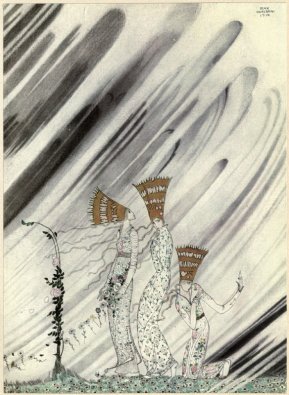
So while the film is, certainly, culturally specific in significant ways, it reads more as a fairy tale or a folk tale than as a slice of life story.  As such, its themes resonate as much for me, an American woman, as they might for anyone. Folk tales invite us to consider direct applications for the readers, and here, viewers might do the same, apply and identify. The five sisters at the center of the story and living at the edge of the Black Sea are very much like the sisters you might find in the Norwegian tales of East of the Sun and West of the Moon  collected by Peter Christen Asbjørnsen and Jørgen Engebretsen Moe, a book, gorgeously illustrated by Kay Nielsen, that I grew up with and pored over, and, embracing any hints of fantastical Other, identified with.

Three Princesses of Blue Mountain

Continue reading Mustang (Deniz Gamze Ergüven, 2015)”

45 Years (Andrew Haigh, 2015)

Kate Geoff bathroom

(This review is a revised version of an earlier review for Seattle Screen Scene.)

Like his 2011 feature, Weekend, Andrew Haigh, in his newest film, 45 Years, places us inside the circle of intimacy of one particular couple. Here, though, it examines a long-standing relationship, a marriage of 45 years, rather than a new one. This couple is established, rooted in an easy routine of closeness, rooted in a shared identity. That identity, however, as the film begins, is suddenly in question, and over the course of one week, Haigh examines the assumptions about identity and relationship through the lens of the small, private gestures of domesticity.  Continue reading 45 Years (Andrew Haigh, 2015)”

The 87th Annual Academy Awards

Boyhood-Gallery-2

The Academy Awards are this Sunday night, and a pair of local theatres are hosting festivities. The Central Cinema‘s shindig starts at 4 pm while the Grand Cinema (hosting the party at Theatre on the Square) kicks things off at 4:30.

Here’s a brief look at the top contenders for this year’s Academy Awards:

Boyhood: Filmed a little bit at a time over 12 years, director Richard Linklater’s epic portray of one boy’s coming of age made a whole generation of male film critics weep with self-recognition. It’s a fine film, and Linklater, one of the best filmmakers of his generation, may finally get some awards recognition. Almost certainly Patricia Arquette will for her supporting performance as The Boy’s mother.

Birdman or (The Unexpected Virtue of Ignorance): The inexplicably parenthesized title of Alejandro González Iñárritu’s study of an actor on the edge of insanity is the dark horse (dark bird?) contender for the major awards, but will almost certainly take home the prize for Emmanuel Lubezki’s cinematography, given how many people equate length-of-shot with quality-of-shot. Less certain are Michael Keaton’s chances at Best Actor. He should be in more, better things.

The Grand Budapest Hotel: Wes Anderson has his best ever shot at the Oscars this year, with his first Directing and Picture nominations to go along with his third Screenplay nomination (he was also nominated for Best Animated Film in 2009). He’s never won, and his best shot this year is probably in the Original Screenplay category. The film is also a heavy favorite in Production Design, Costume Design and Makeup.

American Sniper: Clint Eastwood’s latest box office smash is a stealth Best Picture contender, but will likely have to settle for simply making a ton of money. Brady Cooper received his third and fourth nominations in the past three years for Producing and Acting in this film. remember when he was Jennifer Garner’s goofy best friend on Alias?

Selma: The biggest snubs of the season were Ava DuVernay missing out on a Directing nomination and David Oyelowo for Best Actor. This might be the best of the Best Picture nominees, but it has no chance to win. It will likely earn only Best Song as a consolation prize, which is pretty awful in a lot of ways.

The Imitation Game: This won the Writer’s Guild Award for Adapted Screenplay, which is absolutely appalling. And it’ll probably win the Oscar too. There is likely to be no less deserving winner Sunday night.

The Theory of Everything: The best chance this by the numbers biopic has for a win is for Eddie Redmayne, for his performance as a real person with a disability, which is perennially an Oscar lock. Only sentimentality toward cinema’s third greatest Keaton can stop him. The film has a shot at Best Score, too.

Whiplash: A lock for Best Supporting Actor for JK Simmons, who has been one of our best supporting actors for years. A very good chance in Sound Mixing as well. I like it’s chances for Editing, though that could go to Boyhood instead. The Academy tends to favor volume in that category, and Whiplash has the most editing of the year. That the quick cutting is impeccably timed and used to expressive purpose is a bonus, largely irrelevant to its Oscar chances.

Best Actress: It’s been making the rounds on the internet in recent weeks the fact that the films that annually contend for the Best Actress Oscar are almost never winners, or even nominees in any other categories. That is again the case this year, with Julienne Moore likely to win for Still Alice. It’s kind of shocking considering just how good Two Days, One Night and Gone Girl are, both of which should have been multiple nominees anchored by terrific lead performances (by Marion Cotillard and Rosamund Pike, respectively). Also shocking is that Anna Kendrick isn’t nominated despite giving three fantastic lead performances in 2014, in Happy Christmas, The Last Five Years, and Into the Woods. Perhaps it was her supporting turn as Jennifer Aniston’s ghost-mentor in Cake that knocked her out of contention (Aniston got shut out as well).

The Tale of the Princess Kaguya: Isao Takahata’s film, likely the last production by Studio Ghibli’s two masters (Hayao Miyazaki’s The Wind Rises lost to Frozen last year), probably has no shot at Best Animated Feature (How to Train Your Dragon 2 is the heavy favorite), but if it did somehow get the prize, no win on Oscar night would make us happier.