Split (M. Night Shyamalan, 2016)

split-11162016-615x346

Preposterous in all of the best ways, and some of the worst, the latest film from once-overhyped, now underrated auteur M. Night Shyamalan is as confounding as any film Hollywood is likely to produce this year. Ostensibly a horror film of the ‘girls trapped in a basement by a madman’ subgenre, like last year’s 10 Cloverfield Lane, it somehow ends up being a rape-revenge superhero movie, like a DC Comics version of Elle. With a barely taped together plot, a streak of goofy black comedy and a cheap, exploitative perspective on real-life trauma, the movie is clearly the work of some kind of a lunatic. But what a lunatic!

Continue reading Split (M. Night Shyamalan, 2016)”

Elle (Paul Verhoeven, 2016)

elle

There is no tiptoeing around the subject matter of Elle, a study into the ramifications of sexual violence seen through a particularly perverse lens. This lens is of essentially three people: the central character Michèle, Isabelle Huppert as the actress that plays her, and the director Paul Verhoeven. Together, the two collaborators create an indelible and often frightening world filled with constant paranoia and even more black comedy, all while the mystery—surrounding both the identity of the attacker and Michèle’s motivations—moves further and further along, culminating in a place both completely logical and totally unexpected.

In the first of many salvos, Elle quite literally opens with the sounds of Michèle being raped in her home by a masked assailant, who leaves behind a scene filled with broken objects. Michèle, however, demonstrates she is no mere object, quickly cleaning up the mess and ordering sushi in a manner that both feels like a subversion and a natural extension of the personality that Huppert has already crafted, almost entirely nonverbally. Interestingly enough, Elle remains consistently nervy, even utilizing a scene like one where Michèle bathes for maximum effect, as blood appears under the suds and she stares before quickly wiping it away.

Continue reading Elle (Paul Verhoeven, 2016)”

Friday, January 13 – Thursday, January 19

Featured Film:

Paterson at the Regal Meridian

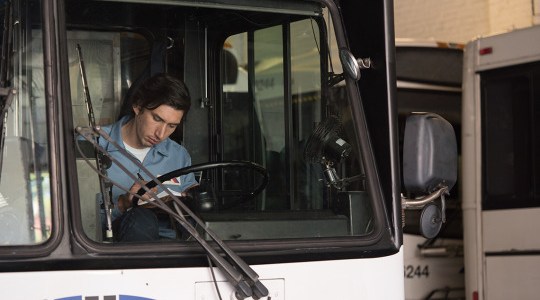
Jim Jarmsuch’s best movie in more than twenty years, and probably the best movie of 2016 (at least, that’s what I’ll say right now), stars Adam Driver as a poet named Paterson, who lives and drives a bus in the city of Paterson, New Jersey, which was itself the subject of an epic poem by William Carlos Williams called Paterson. Jarmusch deftly tracks a week in Paterson’s life: the habitual necessities and routines, and the small spaces within them that he carves out for writing (think Frank O’Hara’s Lunch Poems). Small details accrete: the job, the dog, the regulars at the neighborhood bar, and an infinite, livable world is created. Rarely has a film so elegantly captured creative work as process, as an integral part of everyday life. When Driver reads Paterson’s poems, he doesn’t recite them, the words in voiceover come with the halting, tentative speed of composition. Neil reviewed the film for us last fall at VIFF, and Ryan wrote about it this week.

Playing This Week:

AMC Alderwood:

Ok Jaanu (Shaad Ali) Fri-Thurs

Central Cinema:

The Maltese Falcon (John Huston, 1941) Fri-Tues
The Thing (John Carpenter, 1982) Fri-Tues

Century Federal Way:

Khaidi No. 150 (V. V. Vinayak) Fri-Thurs
Sarvann (Karaan Guliani) Fri-Thurs
Master (Cho Uiseok) Fri-Thurs
Singin’ in the Rain (Stanley Donen & Gene Kelly, 1952) Sun & Weds Only
One Piece Film: Gold (Hiroaki Miyamoto) Tues Only

Grand Cinema:

Jackie (Pablo Larraín) Fri-Thurs
Olympic Pride, American Prejudice (Deborah Riley Draper) Tues Only
Casablanca (Michael Curtiz, 1942) Weds Only

Grand Illusion Cinema:

Elle (Paul Verhoeven) Fri-Thurs Our Review
Mifune: The Last Samurai (Steven Okazaki) Sat & Sun Only
Saturday Secret Matinees: Presented by the Sprocket Society (Various directors & years) Sat Only 16mm
Up, Up and Away (Andy Liotta) Thurs Only

Landmark Guild 45th:

One Piece Film: Gold (Hiroaki Miyamoto) Sat & Tues Only

Cinemark Lincoln Square:

Khaidi No. 150 (V. V. Vinayak) Fri-Thurs
Dangal (Nitesh Tiwari) Fri-Thurs
Bairavaa (Bharathan) Fri-Thurs
Gautamiputra Satakarni (Krish) Fri-Thurs
Ok Jaanu (Shaad Ali) Fri-Thurs
Shatamanam Bhavati (Satish Vegesna) Fri-Thurs
Singin’ in the Rain (Stanley Donen & Gene Kelly, 1952) Sun & Weds Only
One Piece Film: Gold (Hiroaki Miyamoto) Tues Only

Regal Meridian:

Paterson (Jim Jarmusch) Fri-Thurs Our Review Our Other Review
Singin’ in the Rain (Stanley Donen & Gene Kelly, 1952) Sun & Weds Only

Northwest Film Forum:

Il Solengo (Alessio Rigo de Righi & Matteo Zoppis) Fri & Sat Only
Notes on Blindness (Peter Middleton & James Spinney) Fri-Sun Only
The Road to Nickelsville (Derek McNeill) Sun Only Filmmaker in Attendance
Goodnight Brooklyn – The Story of Death by Audio (Matthew Conboy) Starts Weds

AMC Pacific Place:

Some Like it Hot (Song Xiaofei and Dong Xu) Fri-Thurs
Singin’ in the Rain (Stanley Donen & Gene Kelly, 1952) Sun & Weds Only
One Piece Film: Gold (Hiroaki Miyamoto) Tues Only

Pacific Science Center:

Voyage of Time (IMAX) (Terrence Malick) Fri-Thurs Our Review

Regal Parkway Plaza:

Elle (Paul Verhoeven) Fri-Thurs
Sarvann (Karaan Guliani) Fri-Thurs
Ok Jaanu (Shaad Ali) Fri-Thurs
Shatamanam Bhavati (Satish Vegesna) Fri-Thurs
Jackie (Pablo Larraín) Fri-Thurs
Dangal (Nitesh Tiwari) Fri-Thurs

Seattle Art Museum:

Europa ’51 (Roberto Rossellini, 1952Thurs Only

Seven Gables:

Jackie (Pablo Larraín) Fri-Thurs

SIFF Film Center:

Nordic Lights Film Festival Fri-Mon Full Program
You Will Be My Son (Gilles LeGrand) Weds Only Pastries and Wine

Sundance Cinemas:

Nocturnal Animals (Tom Ford) Fri-Thurs

SIFF Uptown:

Jackie (Pablo Larraín) Fri-Thurs

Varsity Theatre:

Singin’ in the Rain (Stanley Donen & Gene Kelly, 1952) Weds Only

In Wide Release:

Silence (Martin Scorsese) Our Review
Live by Night (Ben Affleck) Our Review
Hidden Figures (Theodore Melfi) Our Review
Fences (Denzel Washington) Our Review
La La Land (Damien Chazelle) Our Review
Assassin’s Creed (Justin Kurzel) Our Review
Moonlight 
(Barry Jenkins)  Our Review
Arrival (Denis Villeneuve) Our Review

Paterson (Jim Jarmusch, 2016)

paterson

There is a famous quote by Alfred Hitchcock that posits, “Drama is life with the dull bits cut out.” In a way, Paterson acts as both a reinforcement and a challenge to this idea. It is a film that demands to be considered in its totality, a strange but endearing feeling that combines an ever-so-slightly abstract approach with the mood of a hangout movie. But it is neither of these, nor is it a simple valorization of the artist. Rather, Paterson is a film about both the constant and the ever-changing natures of life, that emphasizes the similarities and differences in equal nature.

Taking place over the course of a week in the life of Paterson (Adam Driver), a bus driver and burgeoning poet working in Paterson, New Jersey, Paterson very quickly establishes a sense of routine to its central character’s life. He wakes up, walks to work and drives while thinking of new poems, then goes home and walks his dog Marvin to the bar. Rinse and repeat. But Jarmusch uses this loose but reliable structure in fascinating ways, not to evoke monotony but to allow for significant jumping off points, not just in the mood (which mixes the hypnotic with the comic) but in fairly interesting subplots, some of which take place over the course of the whole film and some of which are only present in one scene.

Continue reading Paterson (Jim Jarmusch, 2016)”

Live by Night (Ben Affleck, 2016)

livebynight

It is often tempting to look at the possible influences that a particularly derivative-feeling movie has drawn on, to see the superior versions of a standard or rote narrative. Live by Night is no exception; to this reviewer the film almost reads as a clumsy marriage between Michael Mann’s Public Enemies, in overall style and milieu, and Miami Vice, if Colin Farrell’s character was on the other side of the law. Yes, the film is adapted from the novel of the same name written by Dennis Lehane, but there is an undeniable urge to compare this limp, lifeless work to its better examples.

There are, of course, many other and better examples. Live by Night is an extraordinarily by-the-book gangster film set in during Prohibition, detailing the rise to power of Joe Coughlin (Ben Affleck, who also directed and wrote the adapted screenplay) in first Boston and then Tampa. Herein lies the first fatal mistake of the film: Affleck structures the first third of the film that takes place in Boston as a kind of prologue, briefly introducing Joe lying in a hospital bed before moving back seemingly only a few months back in time. The Boston section as a whole is thus rendered moot, and the film feels too rushed to fully luxuriate in the urban grime that it attempts to evoke, especially in a mildly thrilling Model T chase.

Continue reading Live by Night (Ben Affleck, 2016)”

Silence (Martin Scorsese, 2016)

silence

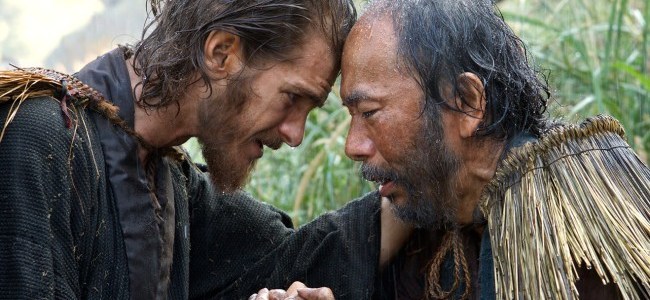
Boiled down to its essence, Silence is the story of two identically framed shots, both of which take place in the film’s first third. The first is of Father Rodrigues (Andrew Garfield) striding across a beach, accompanied by members of a village in Japan almost wholly inhabited by Kakure Kirishitans (Japanese who worship Christ in secret) that welcome him and the spiritual services he provides with open arms. The second is of Rodrigues stumbling along the very same beach alone in disbelief, the wide and distant framing creating a sense of absence rather than a feeling of grandeur. Of course, no movie, and certainly not one of this magnitude and accomplishment, can be summed up in such a way, but it provides an undeniable contrast that mirrors that of the film of the whole. It is a constant struggle, orchestrated with nigh-impossible finesse by Martin Scorsese and company, between faith and doubt, destruction (physical and spiritual) and endurance, and a score of other eternal opposites. But it is never a simple conflict of East versus West or Christianity or Buddhism, nor does it ever succumb to any sort of extreme. It remains exceedingly faithful and yes, quiet, but in a way that feels irrepressibly moving and impactful, that continues to affect this reviewer days after, and will likely to shake me for years to come.

Scorsese’s confidence and his utter trust in the thematics at the center of his film (and the novel by Shūsaku Endō that it is based on) is such that the driving narrative force is all but absent during much of the film. After introducing the impetus for Rodrigues’s and Father Garupe’s (Adam Driver) perilous journey to Japan, the disappearance and possible conversion of their well-known mentor Father Ferreira (Liam Neeson), the film purposefully moves in fits and spurts, never breaking away from Rodrigues’s perspective. Its flow is impeccable, as comfortable when it lingers on the Jesuit padres providing the sorely needed sacramental rituals as when they are itching to continue the search, to leave the outer villages and search among the grave dangers of the cities under the iron rule of the Tokugawa Shogunate.

This is an unexpectedly quiet and powerful aspect of Silence, occurring even before the unimaginable turmoil that dominates the latter two thirds of the film, the simple statement “We need you.” It is said in a moment of desperation by one of the villagers, but it feels as if it applies to every waking moment of the Kakure Kirishitans’ lives. For them, the arrival of the padres is almost literally life-changing, a return of hope for a hidden people who have been forced to use valiant imitations and a surrogate priest in the face of systemic suppression. It is a comfort born out of an immense hunger, where the gift of a single rosary bead or a handmade cross gives immeasurable satisfaction. Scorsese shows this with utmost clarity, with a profound empathy for their belief almost without reservation.

Continue reading Silence (Martin Scorsese, 2016)”

Hidden Figures (Theodore Melfi, 2016)

fences

Hidden Figures is the strange sort of film where absolutely everything, even and sometimes especially the not insignificant number of well-done parts, act as a sort of detriment. It is a disappointment, for sure, but there is something in its shamelessly crowd-pleasing manner that feels both ingratiating and off-putting.

The first oddity of Hidden Figures is its altogether odd attempts at a sort of verisimilitude through a mixed visual style. Most of the film takes place in flat but serviceable digital, but the opening few minutes, set in the 1930s, are irritatingly manipulated to seem “vintage” (a useless effect since the date is shown in a chyron). But the majority of the work seems to have gone into darkening the images to an absurd extent, an effect which serves as the opposite to the extensive “bright” CGI used in the second half of the film. It isn’t extraneous, as there are vital scenes surrounding the spaceflights of the Mercury 7, but it feels distracting, often coupled with archival footage where the shift from film grain to sleek digital destroys a sense of continuity.

Continue reading Hidden Figures (Theodore Melfi, 2016)”

Railroad Tigers (Ding Sheng, 2016)

railroad-tigers

January is the greatest movie month there is. Not only are we in the lesser metropolises of America finally granted access to tardiest of the previous year’s award hopefuls (see this week’s Silence), but via studio counter-programming logic, we also get Hollywood’s most interesting action films. The bloated prestige actioners get released in the summer (your Marvels and Nolans), while a handful of unstoppable forces stake their claim to winter break (the Star Warses and Camerons), while the suits and bean-counters push the films they don’t know how to exploit to the shadow of Oscar season. This is the month of Paul WS Anderson (his Resident Evil: The Final Chapter opens at the end of the month). It’s also blockbuster season in China, with big titles being released at Christmastime and especially at Lunar New Year, which falls between the end of January and the end of February (it’s January 28 this year). Two years ago the big early January Chinese import was Tsui Hark’s The Taking of Tiger Mountain, last year it was Donnie Yen’s Ip Man 3. This year, we’ve got Railroad Tigers, opening this week at the Pacific Place.

Continue reading Railroad Tigers (Ding Sheng, 2016)”

Friday January 6 – Thursday January 12

Featured Film:

Silence at the Meridian and the Lincoln Square

Every year it seems there’s one movie that doesn’t screen in time to make it onto end of the year lists, but that if it had, would have done quite well. This year, it’s Martin Scorsese’s Silence, which would surely have placed high in our end-of-the-year poll had it played here in time. As it is, it’s eligible for our 2017 poll, but will probably be forgotten by then. But regardless, it’s one of the best films of 2016, the story of Portuguese Jesuits attempting to evade persecution in 17th Century Japan, it’s at once remarkably nuanced in its exploration of faith and colonialism while remaining resolutely materialist and physical. The worthy final piece of Scorsese’s great trilogy of explicitly religious films, alongside The Last Temptation of Christ and Kundun.

Playing This Week:

AMC Alderwood:

Jackie (Pablo Larraín) Fri-Thurs
Master (Cho Uiseok) Fri-Thurs
Lost & Found (Joseph Itaya) Fri-Thurs

Central Cinema:

Blade Runner (Ridley Scott, 1982) Fri-Tues The Final Cut
The Last Starfighter (Nick Castle, 1984) Fri-Mon

SIFF Egyptian:

Jackie (Pablo Larraín) Fri-Thurs

Century Federal Way:

Master (Cho Uiseok) Fri-Thurs
Carousel (Henry King, 1956) Sun & Weds Only
One Piece Film: Gold (Hiroaki Miyamoto) Tues Only

Grand Cinema:

Jackie (Pablo Larraín) Fri-Thurs

Grand Illusion Cinema:

Mifune: The Last Samurai (Steven Okazaki) Fri-Thurs
Saturday Secret Matinees: Presented by the Sprocket Society (Various directors & years) Sat Only 16mm

Landmark Guild 45th:

One Piece Film: Gold (Hiroaki Miyamoto) Tues Only

Cinemark Lincoln Square:

Silence (Martin Scorsese) Fri-Thurs Our Review
Dangal (Nitesh Tiwari) Fri-Thurs
Jackie (Pablo Larraín) Fri-Thurs
Carousel (Henry King, 1956) Sun & Weds Only
One Piece Film: Gold (Hiroaki Miyamoto) Tues Only

Regal Meridian:

Silence (Martin Scorsese) Fri-Thurs Our Review
Dangal (Nitesh Tiwari) Fri-Thurs

Northwest Film Forum:

Harry Benson: Shoot First (Justin Bare & Matthew Miele) Fri-Thurs
2016 Sundance Film Festival Short Film Tour Weds Only
Il Solengo (Alessio Rigo de Righi & Matteo Zoppis) Starts Thurs

AMC Pacific Place:

Railroad Tigers (Ding Sheng) Fri-Thurs Our Review
One Piece Film: Gold (Hiroaki Miyamoto) Tues Only

Regal Parkway Plaza:

Jackie (Pablo Larraín) Fri-Thurs
Dangal (Nitesh Tiwari) Fri-Thurs

Seven Gables:

Jackie (Pablo Larraín) Fri-Thurs

SIFF Film Center:

The Uncondemned (Michele Mitchell & Nick Louvel) Weds Only Director Q&A
Nordic Lights Film Festival Starts Thurs Full Program

Sundance Cinemas:

Nocturnal Animals (Tom Ford) Fri-Thurs

SIFF Uptown:

Labyrinth (Jim Henson, 1986) Sun Only Quote-along

In Wide Release:

Hidden Figures (Theodore Melfi) Our Review
Fences (Denzel Washington) Our Review
La La Land (Damien Chazelle) Our Review
Assassin’s Creed (Justin Kurzel) Our Review
Moonlight 
(Barry Jenkins)  Our Review
Arrival (Denis Villeneuve) Our Review

VIFF 2016: Nine Behind (Sophy Romvari, 2016)

ninebehind

This guest-review was written by Vancouver critic Josh Hamm.

“To be rooted is perhaps the most important and least recognized need of the human soul. It is one of the hardest to define… [and] preserves in living shape certain particular treasures of the past and certain particular expectations for the future.”

– Simone Weil, The Need For Roots

Sophy Romvari’s debut short film is a mature, fully formed contribution to cinema; a film imbuing the trivial and mundane with the weight they deserve. The opening sequence of shots almost channel a Yangian rhythm: an extended take captures a young woman, Nora, (Noémi Fabian) in her routine and establishes the mise-en-scène with a slow pan; a cursory glance at the bookshelf conjures up images of the past and present on film, of a woman enraptured by the silver screen. The soft sounds of a bubbling kettle and the slow drip from the sink into a pile of dishes as she pours a cup of tea and settles into her chair and grabs a phone, her leg an almost abstract reflection on the front of the dishwasher– there’s fully formed minutiae and sense of a person through a mere two minutes of seemingly unimportant actions. Yet they also have the steady rhythm of ritual and home-brewed comfort.

Still, Nine Behind is not a film about ritual, or the mundane, per se. It’s propelled by the woman’s conversation with her grandfather in Budapest (the title presumably referring to the time difference between there and Vancouver), a one-sided dialogue that reveals a filial ache for connection and tradition; a yearning for a nostalgia-filled future.

Continue reading “VIFF 2016: Nine Behind (Sophy Romvari, 2016)”