Red Sonja (MJ Bassett, 2025)

Film adaptations of characters from Robert E. Howard stories have a cursed history. After the first, 1982’s Conan the Barbarian, a legitimately great film, every one that has followed has either misunderstood the material or misunderstood how to make a movie, or both. John Milius’s adaptation, which introduced Arnold Schwarzenegger as the title character, is the best because Milius shared Howard’s brute force sensibilities and fascination with stories of violence. Conan the Barbarian is one of the few fantasy films that brings a genuine sense of mystery and weirdness to its world (see also John Boorman’s Excalibur and Lucio Fulci’s Conquest; it is perhaps a coincidence that all three of these films were released in a brief three year period, from 1981-83). Conan the Barbarian feels ancient, truly evoking Howard’s idea of a civilization predating the oldest we have on record, a Hyborian Age in which nations and peoples rose and fell thousands of years before Sumeria and Egypt, before even the Alps rose and the Mediterranean sank.

Its successors, however, abandoned Milius’s macho seriousness in favor of swashbuckling camp. This was somewhat successful in 1984’s Conan the Destroyer and disastrous in the following year’s Red Sonja, both directed by Richard Fleischer (a director with a filmography of remarkably mixed quality) and both of which are marred by a particularly British tone of condescension toward the material. Red Sonja’s scriptwriters were George MacDonald Fraser, author of the Flashman series of historical adventure novels as well as the (excellent) 1970s Three Musketeers films directed by Richard Lester and the (not-so-excellent) 1983 Bond film Octopussy, and Clive Exton, who wrote the terrific TV series adaptations of Poirot and Jeeves and Wooster. Fine as these writers were at tweaking the conventions of the Victorian and post-World War I British Empire, they were a terrible match for Howard’s world of blood and fire and magic.

A gritty reboot of Conan the Barbarian was attempted in 2011 with Marcus Nispel at the helm, a director whose film career seems built around remaking classic genre films (Friday the 13th, Texas Chain Saw Massacre) but whose best work is probably the videos for C+C Music Factory’s “Gonna Make You Sweat” and Janet Jackson’s “Runaway.” He too is a poor fit for the material, as unlike Milius or Fleischer, he doesn’t appear to have any point of view on it at all. Torn between wanting to be true R-rated pulp and a four-quadrant, personality-driven crowd-pleaser along the lines of the then-nascent MCU, the film ends up not being much of anything, despite some fine performances from the cast and, as always for Howard adaptations, even the worst ones, some exceptional set design.

So, with this history, expectations had to be low for a new version of Red Sonja. But, in a pleasant surprise, it’s found a novel way to avoid the Robert E. Howard curse: it doesn’t try to be a Howard adaptation at all.

The character of Red Sonja traces her origins back to a Howard story, but one set in a wholly different world than that of the Conan series. Instead, it was a comic book adaptation, written by Roy Thomas and drawn by Barry Windsor-Smith that transplanted Howard’s swashbuckling woman back in time to the Hyborian Age, where she became a popular swordswoman in bikini armor and eventually got herself reincarnated as Spider-Man’s red-haired girlfriend Mary Jane Watson. The 1985 film integrates the Thomas character into the world established by Conan the Destroyer, one of silly adventure, bad comic relief, questionable special effects, and truly impressive set design. It’s sunk more than anything else by poor acting (from star Brigitte Nielsen and a phoning-it-in Schwarzenegger) and worse writing.

The new version though takes for its inspiration one of the later reboots of the comics character, specifically the 2010s series written by Gail Simone. This adaptation does take place in the Hyborian Age, in a recognizably Howard-esque world of unrelenting violence and mystery, but with a more modern sensibility, jettisoning many of the more retrograde ideas in the Howard, Milius, and Thomas source material in favor of a more feminist take on the character. To put it the dumbest possible way: they made Red Sonja woke.
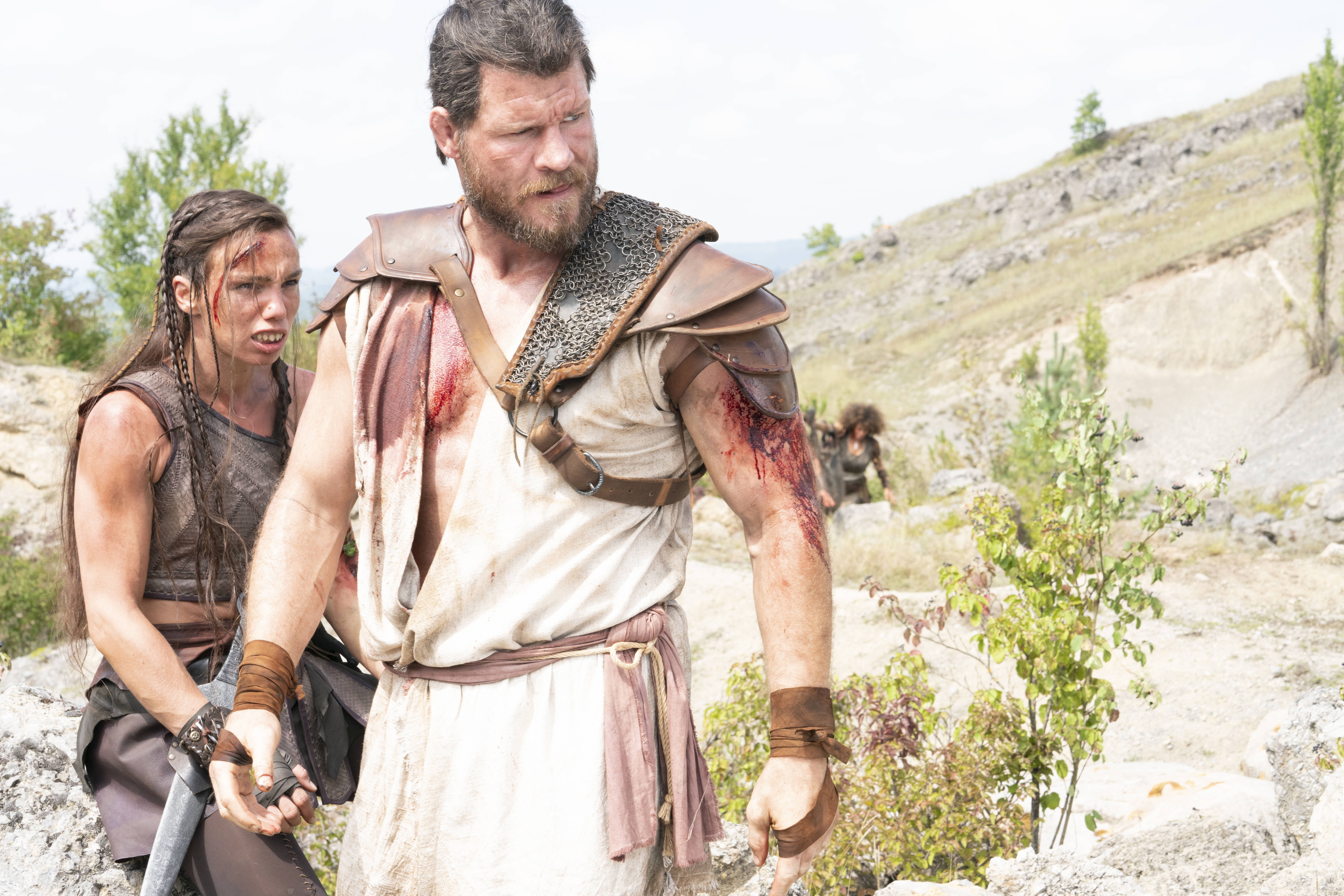
Directing is MJ Bassett, who directed a 2009 Howard adaptation I haven’t seen called Solomon Kane (it looks to be reasonably well-regarded, I just ran out of time). The film stars Matilda Lutz (star of Coralie Fargeat’s 2017 Revenge) as the heroine, introduced wandering a vast forest with her trusty horse, searching, for years, for the remnants of her tribe. She’s captured by the forces of an upstart Emperor and forced into a community of gladiators, whom she unites and leads in revolt against their captors. Her revolution spreads to the forest and, joining with her people at last, takes on the Empire as a whole. Being a low-budget genre film shot largely in Bulgaria, Red Sonja lacks the scale or CGI budget of the 2011 Conan, but makes up for it with a strong ensemble of actors, interesting characters who express real emotions, and actually good fight choreography filmed well. It’s reminiscent of recent low-budget woman-led action films like The Princess, Boudica: Queen of War, or In the Lost Lands) in its efficient use of limited resources to make top-notch, serious genre entertainment that emphasizes performance and action over spectacle and ironic distance. Lutz in particular is terrific as the lead: I hope all those people complaining in the youtube comments section for the film’s trailer that she isn’t big enough (physically, in terms of height and musculature) for the role actually watch it and realize that size isn’t everything. It’s a gritty and physical performance that effectively humanizes what is literally a cartoon character.

And that humanity, beyond the more primal pleasures of sword-fighting, giant-monsters, and silver bikinis, is what distinguishes this Red Sonja from any previous Howard-related film. Milius’s film works as well as it does because it stands against all modern sensibilities in favor of a world more primal than even classical notions of what it means to be human. His Hyborian Age is the Old Weird World, alien and therefore endlessly fascinating. This new film is in contrast wholly in keeping with the sensibilities of our modern world, concerned with technology and environmentalism and feminism and slavery and human rights and justice, concepts that exist only by accident in Howard and Milius but which are vitally important to us today. The villain in this Red Sonja is not the impassive God of Death played by James Earl Jones in the 1982 film, nor is it the embodiment of lesbian panic played by Sandahl Bergman in the 1985 film. Instead he’s a little guy, a tech genius turned capitalist, the prehistoric version of this year’s Lex Luthor as Elon Musk villain in Superman. His quest doesn’t involve magic or mystery or conquering the world of the dead like Stephen Lang’s villain from the 2011 film, but rather churning up natural resources (trees, people) for the sake of his own power and security. It’s not at all a subtle parallel to current events, but we don’t want subtle from this material. That’s how we end up with Wodehouse adapters writing our pulp fiction.
But beyond that, Barrett and screenwriter Tasha Huo, as well as actor Robert Sheehan, who plays Dragan the Emperor, give him a recognizable humanity. The 2011 film makes a courtesy nod in this direction with its villain, motivating Lang’s (otherwise finely snarling) bad guy with the sad story of a dead wife, but it plays like its something the film’s writers learned in a screenwriting manual. Dragan’s story is not especially original either, but it is given enough space to develop and breathe, and deftly weaves into Sonja’s story as well. Similarly, Sonja is paralleled by Annisia (played by Wallis Day), another former gladiator (she dresses all in white to match her white hair), She’s Sonja’s primary foil in Simone’s book as well, driven mad by the spirits of the people she’s killed and manipulated by the Emperor (in the film) to serve as his top killer. Unlike Rose MacGowan’s scary witch from the 2011 Conan, Day brings a humane confusion to the role of a mad killer. She and a half dozen other characters emerge as fully realized and complex beings, far more so than one would expect from low budget pulp filmmaking.

The result is a film that actually has something to say about the world, about how we’re all damaged and how we also all have choices about how we respond to the things in our past that make us who we are. Howard’s characters are determined, driven by forces beyond their control to rage against death while knowing it is inevitable: after all, their whole world is doomed to be erased from history, flooded by seas and crumbling to dust under rising mountains. This knowledge of their own doom dominates everything about how they behave and how we contextualize their adventures, with a kind of nihilist thrill in violence for its own sake that Milius taps into in a way few mainstream blockbusters ever have. Red Sonja’s world will ultimately share the same fate as the rest of the Hyborean Age. And Bassett’s heroes respond with violence for sure, glorious bloody violence, but never nihilistically. This is violence with a purpose. Violence to build a better world while they can, before their people, like their stories, are lost forever.
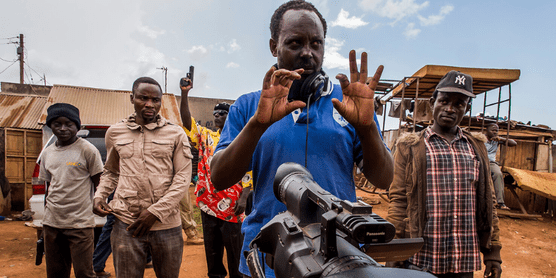
Once Upon a Time in Uganda (Cathryne Czubek, 2021)

Isaac Nabwana is one of the great under-recognized geniuses in contemporary cinema. With budgets numbering, at most, in the low hundreds of dollars, and the support of a community of friends and family, he’s built a film studio in the Wakaliga slum of Kampala, churning out ingenious comedy-action films with handmade props, low-fi computer graphics, and self-taught kung fu artists. Wakaliwood and its films are the ideal of DIY cinema, the fulfillment of digital technology’s promise of allowing anyone to be a filmmaker. Anyone may be able to cook, but it takes a visionary like Nabwana to not only see the possibilities of democratic filmmaking, but actually realize it in a way that is infectiously entertaining and delightful to audiences the world over. And even then, none of it would be possible without the community that has coalesced around him, prop-makers, wanna be actors, martial artists, and film enthusiasts. All of this is apparent in Cathryne Czubek’s documentary Once Upon a Time in Uganda, which chronicles close to a decade in the life of the studio, from the time it first drew international attention (a trailer for Who Killed Captain Alex? posted on YouTube in 2010) through Nabwana’s triumphant appearance at a Toronto Film Festival screening of Crazy World in 2019.

Czubek started filming Wakaliwood in 2012, not long after another westerner, Alan Hofmanis, himself enamored with the studio’s YouTube releases, left his home in America and traveled to Uganda in search of cinematic enlightenment. A longtime veteran of the industry (on sets, in marketing, and in festival programming), Hofmanis tells us he was inspired by what Nabwana and his team had done, and simply wanted to be a part of it. He was quickly adopted into the Wakaliwood family, appearing on-screen as the recurring white guy, the Mzungu, in films like Bad Black and the yet-to-be-released, but delightful looking, Eaten Alive in Uganda. Hofmanis also took on a role in promoting the company, focusing on getting Wakaliwood seen in the West, where his years of festival and marketing experience would prove helpful, though it would be an uphill battle considering that what most Western film festival directors (and therefore the critics and audiences that live downstream from them) want out of third world cinemas are anguished stories of poverty and deprivation, not lovably goofy paeans to the joys of making cinema. While Hofmanis focused abroad, Nabwana would concentrate on getting his films seen at home in Uganda, and that’s where the documentary’s real tension comes.

Nabwana explains that film in Uganda is not seen as a particularly prestigious activity, at least not among the elite classes that actually have the money that Wakaliwood desperately needs to expand and improve. He says that his true audience are the “peasants,” the poor people he grew up with and around in the chaotic years after the end of Idi Amin’s dictatorship and who still occupy the nation’s villages and slums, but, unfortunately, often they do not have access to DVD players. As has been the case in other emerging film cultures, there can be a kind of inferiority complex that certain communities have about their own art, and sometimes it takes recognition by outsiders for a people to appreciate what their own cinema has to offer**. To this end, Hofmanis’s efforts in getting Wakaliwood films seen and praised abroad helps raise Nabwana’s profile at home, leading to an offer from one of the local television moguls to make a Who Killed Captain Alex? TV series. Because Nabwana’s overarching goal is not international success or personal acclaim, but rather building a viable and sustainable film culture in his home country, training actors and filmmakers and seeing them succeed him with their own works, he necessarily devotes himself to the local production. But this in turn disrupts Hofmanis’s efforts at international promotion and distribution, ultimately leading to an awkward falling out between the two friends. But after some time apart, the family is reunited, leading to the heart-warming Crazy World premiere, because ultimately Nabwana and Hofmanis share the same love for what they are doing and hope for the future of cinema.

Czubek’s film is at its best showing the Wakaliwood crew at work. Nabwana directing and editing, almost always with big smile on his face. His wife Harriet doing a endless number of jobs, from feeding the crew with leftovers from the cake-making business she’s started to raise extra money, to casting and line producing and helping with every other aspect of the productions. We meet “Mad Prop Genius” Dauda Bisaso, who builds guns and helicopters and camera cranes out of scrap metal, and catch a glimpse of VJ Emmie at work, Wakaliwood’s most glorious contribution to film culture: a Video Joker who talks along with the film, one part Benshi-style narrator, four parts your most hilarious friend three drinks in cracking jokes alongside you as you watch a movie together. A magical sequence shows Nabwana, who had been a mud brickmaker before he became a filmmaker, assembling a film projector out of a couple of batteries, a string of wire, a small lightbulb and some aluminum foil. He uses it to show some local kids how film works, lighting up one frame of film at a time (it appears to be a scrounged reel of some version of Spider-Man), and running it through his hands, magical images projected on a crumbling concrete wall. 

Wakaliwood is currently running a crowdfunding campaign for Who Killed Captain Alex 2. If you love movies, contribute if you can. You can also by a deluxe BluRay edition of Bad Black and Who Killed Captain Alex from Vinegar Syndrome and the American Genre Film Archive. You won’t regret it.

  1. Eventually this dichotomy tends to turn in on itself, as those filmmakers most popular in the West are rejected by the next generation for not being authentic enough to their home culture. I’m thinking here about Kurosawa Akira winning an award at the Venice Film Festival at a time when no one outside of Japan and few people inside it considered it to be on a par with the cinemas of the West, only to then be derided as “too Western” by the next generation of Japanese filmmakers. It’s an endless argument that no one wins, except audiences who get to see great films made by all sides of the divide. ↩︎

The Killer (Choi Jaehoon, 2022)

Last night I picked up and started reading the first Jack Reacher book. I saw the first Tom Cruise movie years ago, and liked it well enough, and really enjoyed the Amazon series that premiered on Amazon earlier this year. My edition of the book includes an introduction by author Lee Child, where he describes how he came to be a writer in mid-life and how he designed his project deliberately to run counter to prevailing trends in suspense literature. Specifically, he wanted to make Reacher not a flawed protagonist, haunted by addiction or trauma or moral grayness, not a guy who loses over and over again until he somehow, barely, wins in the end, but rather the biggest, strongest, smartest, most capable person in every situation. He figured that audiences would grow tired of relatable heroes, that we’d much more enjoy seeing the forces of evil get what’s coming to them by a larger than life (literally), hero. I thought about that a lot while watching The Killer, the latest action thriller from Korean star Jang Hyuk.

Jang plays a retired professional assassin (the eponymous killer) who is tasked by his lovely wife with babysitting her friend’s teenage daughter while the two of them (wife and friend) go hang out at a beachside resort for three weeks. Because he’s a pushover, he accepts the job, only for the unfortunate teen to almost immediately fall into the hands of murderous sex traffickers. So he does what he does best: employ his fists, feet, knives, guns, automobiles, sticks, or whatever in tracking down the girl and killing all the bad guys in the way. Many many action scenes follow, a highly competent example of the dominant contemporary mode of action filmmaking outside the Hollywood blockbuster machine: flowing digital cameras in artificial sequence shots; bright colors (golds, neon pinks and greens) contrasting with deep blacks (the hero wears all-black, John Wick-style); reasonably creative choreography emphasizing physical impacts and speed but lacking the inspiration of the Hong Kong filmmakers at their best (no opera acrobatics or ingenious appropriations of found objects and natural environments) performed by competent stunt-people (with Jang apparently doing much of his own stunt-work). Above all the fights emphasize a forward momentum, paralleling Jang’s dogged pursuit of his quest. And, most interestingly, he never appears to get hurt.

For Jang’s killer is very much in the Reacher mold: he is quite obviously better (physically, intellectually, morally) than any of his opponents. This isn’t a crumbling kind of hero, like Mary Elizabeth Winstead in last year’s Kate, taking an unreal amount of abuse but staying the course until her enemy is defeated. Instead, we never believe Jang is in any real peril—our enjoyment of the action scenes comes not from suspense, but from the thrill of watching evil get punished. The only suspense there is in the film is the mystery of why the girl was kidnapped, but we can rest assured Jang will kill his way to a satisfactory answer. It’s not an enlightened approach to moral dilemmas to be sure, and the pacifist in me knows very well that it is not a good thing for individuals to run around murdering people, even if they are for an undoubted fact terrible human beings. But we’ve been living with gray areas in our action fiction for so long: anti-heroes and heroes who can’t win because the system is corrupt, and heroes who cling to a code of honor no longer relevant in our corrupted modern age, and heroes who sacrifice themselves for an infinitesimally small chance at a better tomorrow. Is it so bad to make believe ourselves into an excessively violent yet morally clear world for a little while? Yeah, probably. But it’s fun while it lasts.

Furie (Lê Văn Kiệt, 2019)

furie movie.jpg

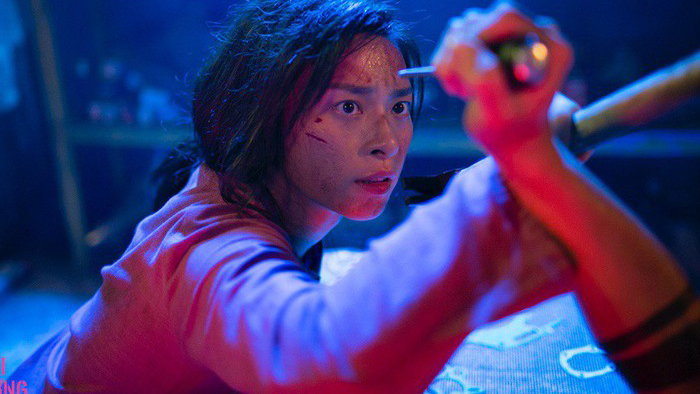
It’s not often we get a Vietnamese movie here on Seattle Screens, much less an action movie as kinetic and thrilling as Furie, a Taken-clone starring Veronica Ngô, the actress who stole the opening moments of The Last Jedi a few years ago. Like Ong-Bok: Muay Thai Warrior, from Thailand, and The Raid, from Indonesia, before it, Furie is a further marker in the spread of high quality martial arts cinema outward from Hong Kong and Japan across Southeast Asia at a time when the Hong Kong industry itself is having its lifeblood sucked away by the vast opportunities and resources but complicated politics of the Mainland Chinese market, like Jupiter stealing the Earth’s atmosphere in the biggest action hit of the year so far. Resolutely low-scale, Furie follows a mother’s quest from the pastoral countryside to the neon-lit criminal underbelly of Saigon in search of her ten year old daughter, kidnapped by an international cartel of organ harvesters. The plot is familiar, and its beats are nothing new, though the emphasis on the femininity of its heroes and ultimate villain is unusual. But the stunts, the stunts are terrific.

Unlike Tony Jaa and Iko Uwais, Ngô is more an actor than a martial artist, though like many a great actress before her (Michelle Yeoh, Zhang Ziyi, Kara Hui, Cheng Pei-pei) she is a dancer as well (she one the first season of Vietnam’s version of Dancing with the Stars). Director Lê Văn Kiệt, along with his stunt crew, do a fantastic job of covering any weaknesses as a fighter she might have, honestly I didn’t notice much of anything (unlike with Brie Larson in Captain Marvel, who just looks out of place in every fight). The fight scenes are fluid and brutal, in the bone-crushing-to-electronic-beats style that has dominated martial arts movies this century, ever since Donnie Yen discovered MMA at least. Best of all is that the fights actually build, they have a sense of rhythm and pace that is almost entirely missing from Hollywood filmmaking, and frankly from a lot of what comes out of Hong Kong these days. The final 15 minutes are spectacular without restoring to special effects or outlandish stunts: they’re simply the best fights in the movie, charged with emotion and skill and captured with a minimum of editing. It’s the best on-screen action since Paradox, and possibly since SPL 2: A Time for Consequences.

Other than that, and outside of Ngô’s soulful performance, which brings to mind some of Hui’s better work (the recent and very fine Mrs. K, for one), and the novelty (at least for us in the US) of seeing contemporary Vietnam on film, that there isn’t much to the movie. Where Paradox and SPL 2 complicate the simple missing kid/organ harvesting plots with complex conspiracies and some beautifully outlandish storytelling, Furie is a simple straight line: a mother doing the impossible for the sake of her daughter. But I’ll take the purity of this efficient, brutally exciting adventure any day over the bloated CGI artifacts and winking, middling politics of whatever corporate Hollywood blockbuster it is we’re supposed to be caring about this week.

Wolf Warrior 2 (Wu Jing, 2017)

3

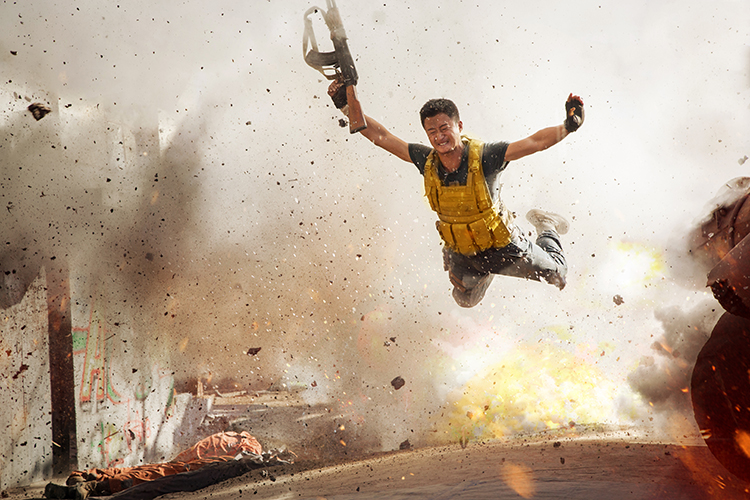
Somewhat surprisingly, Wu Jing’s Wolf Warrior 2 is smashing box office records across China, on pace to overtake last year’s The Mermaid as the number one Chinese film of all-time. Wu is probably the greatest Chinese martial arts star of his generation, best known here in the US for his starring role in SPL 2: A Time for Consequences, which the best action film to play here last year. He both stars and directs, as he did with Wolf Warriors, released in 2015. In the first one, he plays Leng Feng, a badass soldier who gets recruited into the Wolf Warrior brigade of the People’s Liberation Army, an elite special forces unit. During a training exercise, he and his squadmates are attacked by a multiethnic band of vicious mercenaries led by Scott Adkins who was hired by a drug lord seeking revenge on Leng for murdering his brother, and also as the cover for a scheme to steal a virus that only kills Chinese people. The film is an unabashed propaganda piece about the skills, technology and valor of the PLA, but it’s got a lot of cool jungle action and it moves along quickly.

Continue reading Wolf Warrior 2 (Wu Jing, 2017)”