
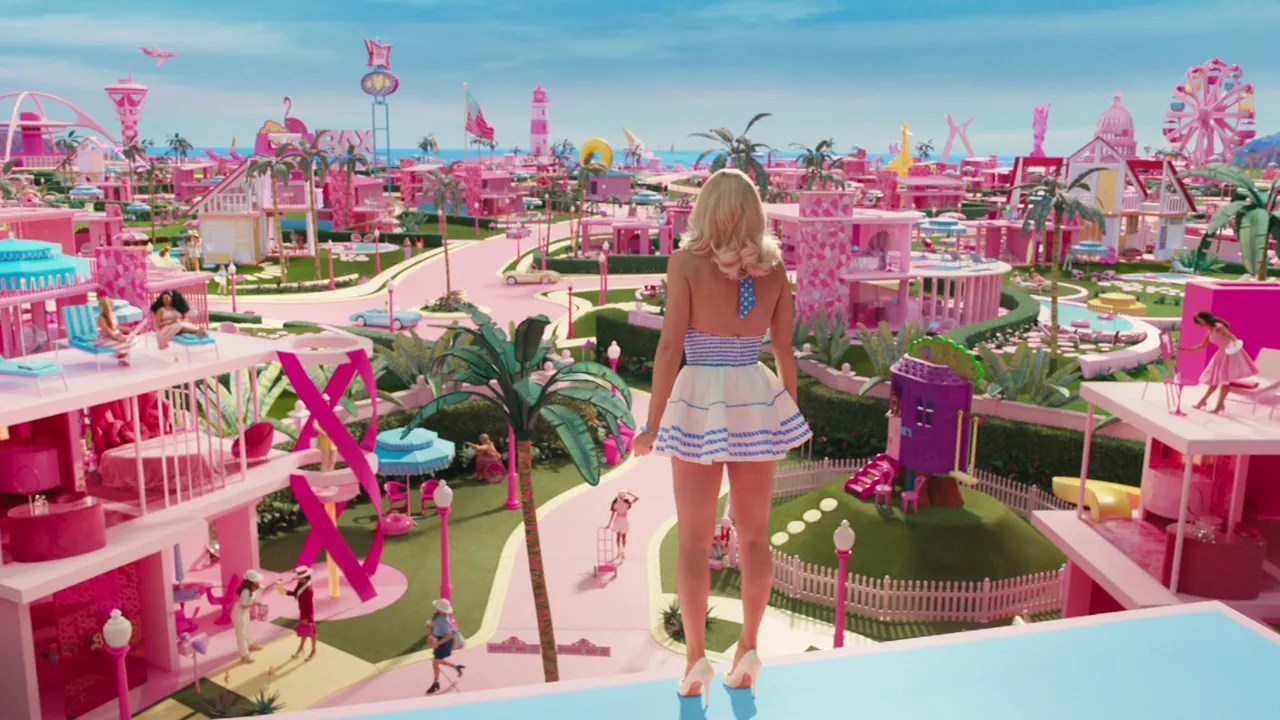
I took my daughter and one of her friends, a fellow tween ballerina, to the screening of Barbie last night. They were excited to see it, though my daughter at least never played with Barbies. She had only a brief doll phase as a toddler, but moved on pretty quickly to video games and drawing and dance. I was curious, then, what they thought about the film, given that it takes for granted the essential role of playing with dolls in the formation of a child’s consciousness, from the opening riff on 2001: A Space Odyssey, where the invention of the Barbie doll frees a generation of little girls who were beforehand only able to imagine themselves as mothers, to the whole philosophical crux of the film, which uses Barbie as a stand-in for our entire culture’s conception of women, both for good and for ill. They said they liked the movie: it was funny, some of it was inappropriate, but they had a great time with it. My daughter did express some exaggerated concern that unlike all the other Barbies in the film, she did not (yet) have a defined identity. Apparently “Tween Ballerina” is not enough to sum up the inchoate mass that is an 11 year old girl. When I pressed them for more specifics, trying to dig into their thoughts on some of the thornier issues, they ignored me and then proceeded to sing along to songs on playing on their phone to each other for the rest of the ride home. They did not listen to “Closer to Fine,” but they did have a lot of fun with “Baby Got Back.”
Barbie is a movie designed first and foremost to sell toys. It’s also a movie by one of the more accomplished Hollywood filmmakers of the last 20 years, one who as both an actress, writer, and director has demonstrated a unique and arresting artistic personality. Even though she doesn’t appear on screen, every word of Barbie sounds like it could have been said by a Greta Gerwig character, which I suppose puts her at least in this in sense, in the same class of auteur as Hong Sangsoo, Eric Rohmer, and Woody Allen. Noah Baumbach co-wrote the script with her, but other than the fact that the film ends up being the kind of thing one would imagine being created at the university in Baumbach’s version of Don DeLillo’s White Noise, the movie doesn’t really sound like him at all. It’s probably safe to say that while Baumbach directed them, it’s Gerwig who, as star and writer, was the true auteur of Frances Ha and Mistress America. Regardless, here this great artist is hard at work selling toys for a massive corporation. That contradiction is just one of many at the explicitly stated core of the film, and Gerwig’s refusal to resolve it, instead in fact to embrace the contradiction is what makes the film so successful as both art and commerce.
Margot Robbie’s “Stereotypical Barbie” lives in an idealized world with all the other Barbies (President Barbie, Doctor Barbie, Physicist Barbie, etc) and all the Kens (who exist only to bask in the light of the Barbies). It’s a perfect pink paradise until one day Stereotypical Barbie becomes self-aware and plagued by doubts about existence, death, and the nature of the universe. She and Beach Ken (Ryan Gosling) go on a quest to the real world to get answers from the girl who is playing with Barbie and thus projecting these ideas into her head, but things go wrong when Ken discovers patriarchy and the Mattel corporation tries to recapture Barbie and put her back in a box. Ken heads home to create a manly paradise while Barbie is rescued by a mom and daughter. The mom is played by America Ferrera, star of Sisterhood of the Traveling Pants, Ugly Betty, and Superstore, three works that collectively have as much if not more to say about being a woman under capitalism as Barbie does.
Beach Ken succeeds in quickly taking over Barbieland, brainwashing the Barbies into subservience while all the Kens enjoy manly pursuits like horses and talking about The Godfather and Stephen Malkmus. The trick Barbie and America discover is that the Barbie can be freed only through paradox, by recognizing the many, many contradictions in what society expects from women. The only way for them to be free is the knowledge that there is no way to be free, that there is no acceptable way to be a woman under patriarchy. The mechanics of this are fuzzy, but the scenes of deprogramming are funny, which basically goes for the movie as a whole. Every second is bright and joyous and weird, with some terrific musical sequences, a great supporting cast (including an all-time great Michael Cera role), and has such an infectious energy, even when it’s being dark and depressing. The embrace of contradiction extends to a critique of Mattel itself: a male-dominated company designing toys for girls. But the men are actually pretty cool and they’re led by Will Ferrell, who is still a funny guy, so maybe it’s OK, but yeah no they’re still going to run things. This is the fundamental conundrum with Barbie’s solution to existential unhappiness: accepting the contradiction is not the same thing as working to make the world a better place, in fact, by focusing our energies inward, it may actual foreclose the possibility of real change. Thus the film would make for a fascinating double feature with Soi Cheang’s Mad Fate, in which the hero, driven crazy by the contradictions of an arbitrary and capricious higher power does not simply accept them with a kind of pseudo-zen complaisance, but pours all his heart and soul into defying Fate in the hope of saving even just one life from degradation and murder. It’s hard to imagine Enlightened Barbie doing anything so rebellious, even if she gets a sequel.
Barbie is, among other things, the best example I’ve seen of “There’s No Ethical Consumption Under Capitalism: The Movie”. It’s absolutely true that the evils of society, patriarchy and capital prominent among them but by no means the only ones, are inescapable, that there’s really no way to live in society without compromising one moral value or another. Can a toy, or an artist for that matter, change the world? Probably not. So what’s a filmmaker to do? Preston Sturges answered that question more than 80s years ago in Sullivan’s Travels about as well as it can be answered. People lead hard lives, it’s OK to give them a chance to laugh at some silly moving pictures once in awhile.
 Seattle Screen Scene