In the Lost Lands (Paul WS Anderson, 2025)

Unfortunately, I don’t make it out to the movie theatre much these days. Between my day job driving my kids to and from baseball and ballet practices at least five times (each) a week and my writing about Chinese language films (which rarely play at theatres near me) over at The Chinese Cinema and my coverage of various international film festivals at InReview Online (which is entirely done via screener), there’s not a whole lot of time in my week for doing what I really love most: watching a movie, big. I did get to the Grand Illusion before it closed for a martial arts triple feature (and a tour around my old stomping grounds, which look almost nothing like they did the last time I worked in the U-District). And I made sure to catch Tsui Hark’s latest, which happened to be playing at one of the mall theatres nearby. Other than that, the last time I was in a theatre was for a self-made double feature of Furiosa and I Saw the TV Glow last summer. But of course I had to roll out opening weekend for Milla Jovovich and Paul WS Anderson’s latest.

When last we saw PWSA and Milla, they were remaking Hell in the Pacific along with Tony Jaa in the guise of a video game adaptation with Monster Hunter. This time, they take their stab at a George RR Martin-style bloody fantasy adventure by adapting a short story by. . . George RR Martin. The project originated with Jovovich, who, as Anderson says in this interviews with critics Rob Sweeney and Bilge Ebiri, has long been a huge fantasy fan and shepherded the project for years. Unlike Game of Thrones’s medieval high fantasy setting, however, this Martin story takes place in a post-apocalyptic future, one more reminiscent of George Miller’s Mad Max world than Lord of the Rings. That’s the visual approach Anderson adopts as well, blending real environments with computer-generated imagery in a cinematic unreality that recalls Furiosa as much as anything else.
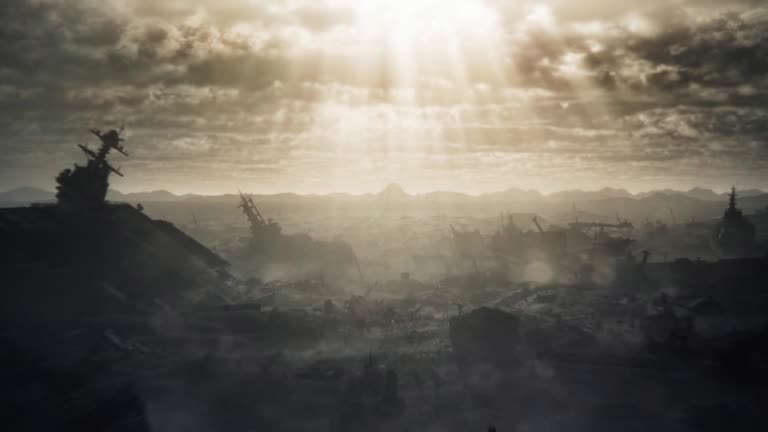
Eschewing the desert orange and open blue skies of Miller’s films, though, Anderson opts for a highly stylized and desaturated color palette, ranging from sepia to mud gray, with only occasional forays into blue or green (and very little red). Anderson has worked in this vein before, with Death Race and Resident Evil: The Final Chapter, and while its not a visual scheme that I find particularly appealing, it does make sense as his vision of the world after the fall is one of relentless bleakness and violence where nature, like humanity, has all the color drained out of it. Lost Lands, at least, is not as monochromatic as Death Race, as its variety of environments and settings allows for some alternation between gray and brown, just enough to keep things interesting.

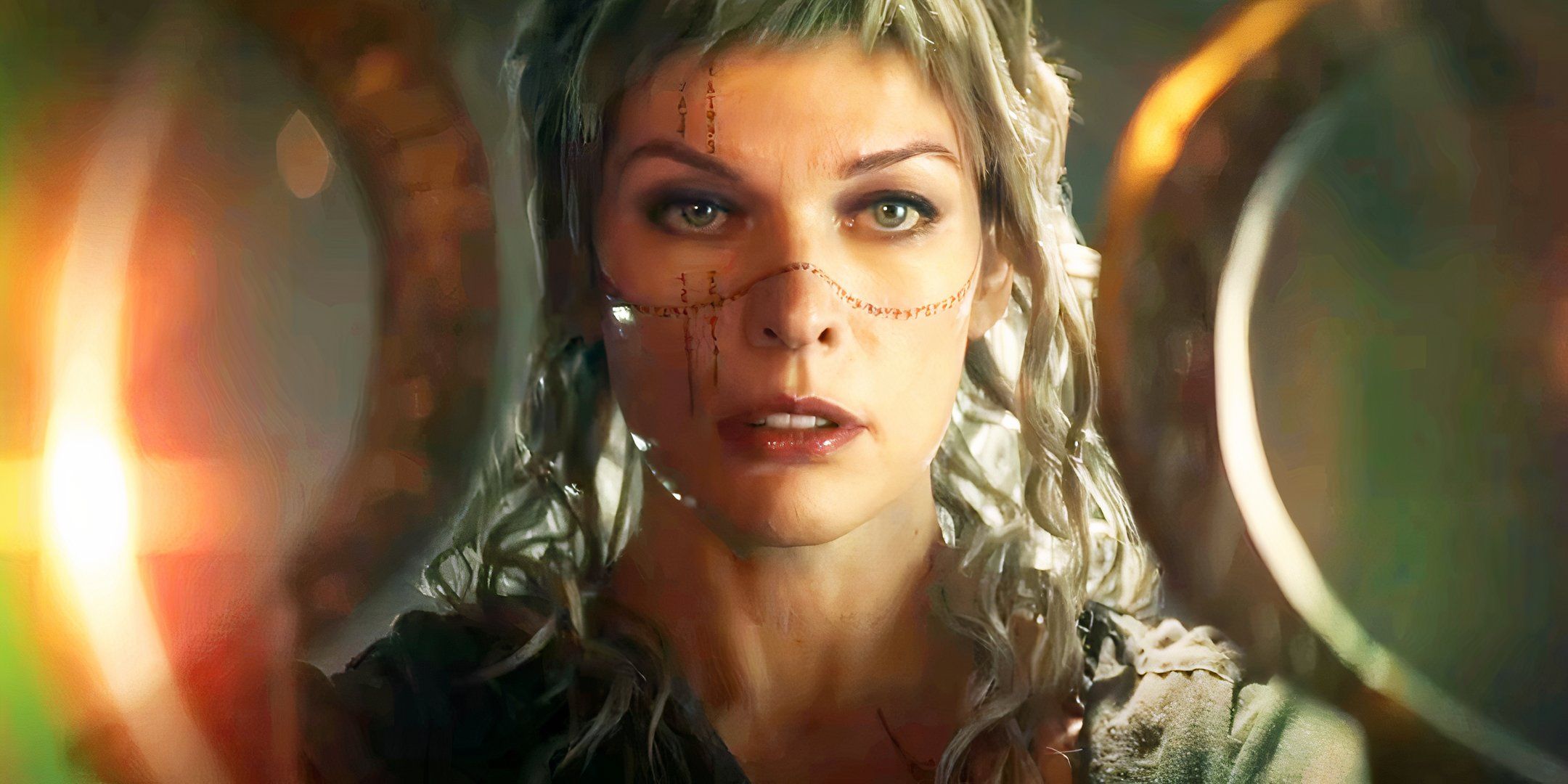
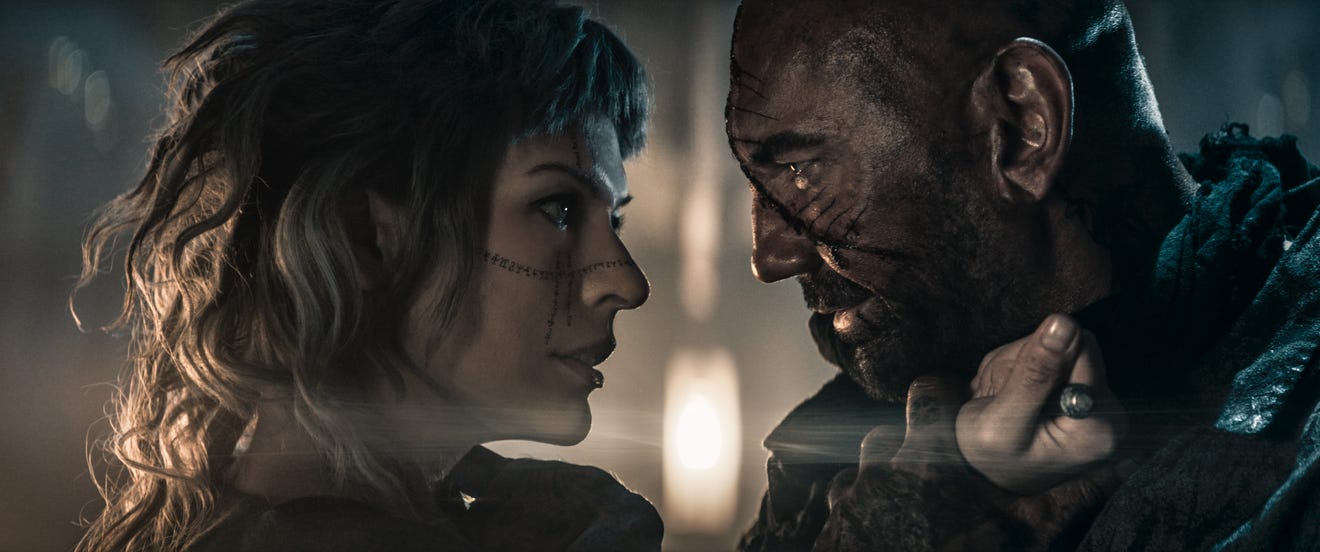
Those Lost Lands are the world outside of what is humanity’s last remaining city. The city is controlled by an Overlord and a Church. Jovovich plays Gray Alys (recall that she played many different Alices in the Resident Evil movies), a witch who is bound to grant the wishes of anyone who asks something of her (though it never works out how they’d hope). She’s tasked by the Queen to give her the power of a werewolf, so Alys enlists the help of a Hunter (Dave Bautista) to track down just such a beast in the Lost Lands so she can kill it and take its power. But the Church is hot on their trail as well, as Alys’s power is a direct affront to their religion, and her escape from their attempt to lynch her in the film’s prologue has inspired some potentially revolutionary energy among the downtrodden populace. The bulk of the film is then a simple quest/chase structure, with a ticking clock (Alys has only a week to complete her task).
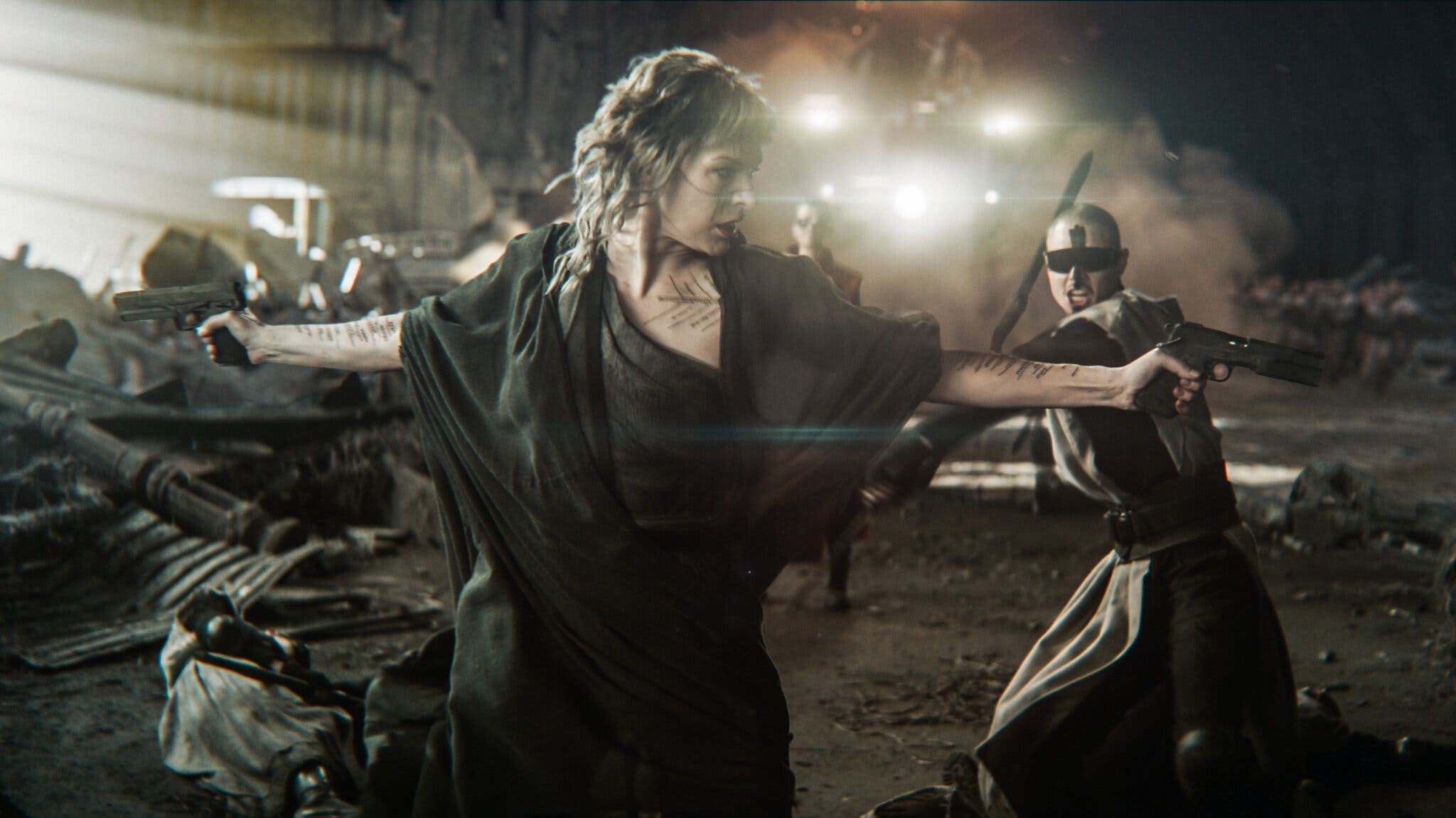
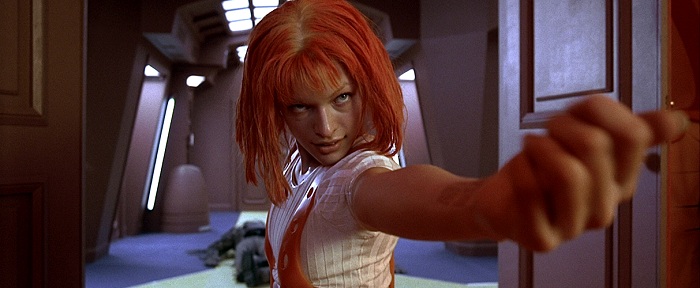
The film’s success rests on two things: the action sequences, which are up to Anderson’s usual standard of mid-budget audacity (Outlaw Vern compared Anderson to Albert Pyun on blusky, and that’s incredibly apt: he’s Pyun with all the money and backing of the Polish film industry); and the chemistry between Jovovich and Bautista, which, also per Anderson’s usual standard, works better visually than it does verbally. Anderson and Jovovich work so well together because he knows how to turn her weakness as an actress (her weirdly detached affect) in to a strength by positioning her as a person outside the norms of the regular world. In the Resident Evil movies she’s a manufactured super-hero; in The Three Musketeers she’s a schemer always a step ahead of heroes and villains alike, following her own agenda alone; in Monster Hunter she’s a human lost in a world she doesn’t understand with her lone companion being someone who literally doesn’t speak her language (Luc Besson understood this aspect of Jovovich as well, with two of her finest performances coming in his The Fifth Element and The Messenger).

Jovovich’s Gray Alys fits this template perfectly. Seemingly existing outside of time as well as outside the bounds of the spiritual and temporal powers of her world, Alys is both wiser than everyone around her and able to manipulate those lesser mortals merely by making eye contact with them (the joy I felt when Anderson opened the movie with a close-up of Jovovich’s eyeball!). She’s outside of their reality both in affect and literally in that she can remake the world they see to serve her own ends. This however does create some awkwardness in the quiet moments of the journey, when she and Bautista are bonding, forming what seems like it should be a romantic connection. While the images of the slight Jovovich curled up next to the hulking Bautista are effectively cozy, she’s never really convincing as someone who might fall in love, and thus their declarations of feeling ring somewhat hollow and unnatural.
That turns out to be, I suspect, by design, as the twists in the film’s final section, where Alys reveals the various levels of her plan which she had mapped out from the film’s very beginning, contain more levels of friendship and betrayal than the simple quest + romance structure had implied. These twists are quite effective, and stitch all the disparate threads of the plot together into a satisfying whole. To what end I’m not sure. Anderson as ever remains a distinctive stylist and reliable deliverer of genre entertainment. At his best, his films approach a coherent vision of a post-digital world where human life is devalued and ultimately redeemed through family (the Resident Evil series), romance (Pompeii), and friendship (Musketeers, Monster Hunter). In the Lost Lands is more of a mystery, a portrait of Milla Jovovich as a creator of reality, albeit one limited in her power to truly transform a world that has already died. As with almost all of Anderson’s best films (Pompeii being the obvious exception), he leaves us with the most important question of all: what happens next??

Wonder Women Monster Hunting

It’s been a bad year for movies of course, and an even worse one for superhero movies. The genre that has come to dominate the Hollywood blockbuster market, devouring its competitors like Orson Welles’s planet-devouring Unicron in Transformers: The Movie, or like his equally grotesque chili-devouring Hank Quinlan in Touch of Evil, has spent most of the year in frozen hibernation, waiting out the plague-induced shut-down of the nation’s multiplexes. But here at the tail-end of 2020, we have a Christmas miracle of sorts: Warners, in an apparent bid to burn down its theatrical arm in order to boost the subscription rate of its nascent streaming platform, and thus inflate the corporation’s stock value in the eyes of investors blinded by shiny things, is releasing its follow-up to 2017’s warmly-received Wonder Woman straight to HBO Max. At the same time, Sony has rolled out a hybrid theatrical/VOD release for its much-delayed adaptation of the Monster Hunter video game*, directed by the equally lauded and reviled Paul WS Anderson. Taken together, the two provide a convenient contrast of the different strains in the superhero genre: the white elephants of the MCU, Star Wars, and DC versus the termitic team of Anderson and his star/wife Milla Jovovich.

Patty Jenkins’s 2017 Wonder Woman was a solid entry in the MCU/DC wars, a reasonably deft origin-story movie that was helped enormously by the charm and absurd beauty of its two stars, Gal Gadot and Chris Pine. The sequel picks up 65 years later, with Diana Prince now working in the Smithsonian and Steve Trevor long dead. Kristin Wiig and Pedro Pascal show up, along with a magic rock that grants wishes. Everyone makes a wish: Wiig for Diana’s powers, which turn her into the amoral crazy cat lady Cheetah; Diana for Steve to come back, which he does in some guy’s body (Diana alone sees him as Pine); Pascal to become the stone himself, which gives him the power to grant everyone’s wishes, but also maybe drives him crazy and makes him bleed out of his nose, ears and eyes, for some reason. It’s a Monkey’s Paw story, as the characters explain to us, several times, stretched out for an unconscionable two and a half hours. The film has only a few action sequences, including a prologue that feels like an afterthought, like a studio note to include a scene back in the land of the Amazons, and a chase down a desert highway that neatly encapsulates the film’s wrong-headed approach to both action and color.

It’s baffling that a film set in the 1980s, fueled as they were by cocaine and Day-Glo synthetics, should take as its dominant tone the color beige. Color and shadow are drained out of nearly every scene leaving a bland, flat wasteland of boring dialogue and little emotion (though Pascal does his best to chew up all the scenery left untouched by Gadot, who never appears to be occupying the same space as the other actors). Clearly this color-scheme is intentional: a labored and unfunny montage of Pine in different 80s outfits ends in him dressed in light earth tones, while Pascal has his hair dyed dirty blonde and wears a beige suit throughout. It’s like going to the beach and staring at the sand. The highway chase, set in a Middle Eastern desert (maybe simply to remind people of Gadot’s IDF past?) is so monochrome it makes the dishwater gray finale of Endgame look vibrant. But even worse is the action itself, which feels absolutely weightless and frictionless: the stunts don’t thrill because nothing tangible actually touches anything else. Diana runs around, over, and through things with no substance, her lasso expands to whatever length the effect requires, a gold line on a computer screen, at one point contracting around a lightning bolt, the impossible physics of which would be cool if it didn’t so well epitomize the flashy nothingness of the movie’s stunts. It’s just all so boring.

And then there’s the film’s subtext, which at the end of this dreadful year of politics is hard to read as anything other than liberal left-punching. Wonder Woman 1984 is about abandoning hope, about the dangers of wishing for things to be better than the way they are. Charitably, it could be read as a paean to Obamaist pragmatism, that there are no shortcuts in life and that change takes hard work which manifests itself in facing hard truths and choosing to do very little about them. It’s hard to make a superhero fantasy movie about how better things aren’t possible, so I guess this is some kind of an accomplishment (and maybe in more subversive hands this idea would in some way connect to the year chosen for the film’s title: the story of a liberal totalitarianism in which the illusion of freedom is granted in exchange for the elimination of imagination). In a way, I kind of admire the perversity of making an 80s throwback movie without using any 80s music and the audacity of making a superhero movie that only Amy Klobuchar could love.

Monster Hunter, on the other hand, has very little in the way of political subtext outside of a vague ideal of people from different worlds uniting together to, well, hunt monsters. Milla Jovovich leads a team of Army Rangers on a search and rescue mission for some other lost soldiers in a desert specified only by longitude and latitude (PWSA does love his maps) but filmed in South Africa. They get lost in a weird sand and lightning storm and end up transported to some new world filled with giant monsters, which attack them almost immediately and eventually wipe-out everyone but Milla. She’s rescued/captured by Tony Jaa, apparently a native of this world, and the two work together to get past the giant beasts blocking their way to a mysterious tower that might send Milla home and unite Tony with his friends and family.

Like all of Anderson’s work, Monster Hunter is neatly structured and rife with cinematic homages. The opening scenes of army-bonding could come out of any war movie made over the past 70 years, gentle ribbing and gun-loading meant to establish character and camaraderie in anticipation of the loss of life to come. It’s here that the corniness of PWSA’s dialogue really shines, though for once his terrible sense of humor has had real consequences as one of his lame puns was taken as a racist insult by seemingly the entire nation of China, killing the film’s box office in that country and, as a result, probably any hope of a sequel in what could have been a promising franchise (the offending joke has been cut from the movie and was not in the screener I watched). The genericness of this opening is, for PWSA fans, part of its charm: he’s one of the few directors in Hollywood today who really believes in the power of cliche. It’s what makes his films feel so refreshing: not a hint of hypocrisy in PWSA’s pumpkin patch, nor cynicism nor smirking contempt for his subject or audience.

The army scenes are followed by a terrifying underground sequence (another PWSA hallmark: he’s suggested that his fear of/attraction to confined spaces has something to do with his youth in coal-mining country) that recalls Aliens at its best. Then the movie settles down for a long middle section that reminded me of nothing less than a remake of John Boorman’s great 1968 film Hell in the Pacific, but with Jovovich and Jaa in the Lee Marvin and Toshiro Mifune roles. The two start out as enemies, capturing and recapturing each other between fist fights, before finally deciding to work together toward their common goal, which, true to the source material, involves killing one monster to get parts to make a weapon to kill another, bigger monster.

It’s all a great deal of fun, and despite the artificiality of it all (the monsters are of course computer-generated) the action always looks coherent and real. Jovovich and Jaa are both marvelous physical actors and they have an uncanny ability to make the audience feel every kick, punch, stab, and tail-swipe, whether it comes from stunt performers or pixels. Anderson has long been noted for the coherence of his action scenes, a skill he has not lost as he and his editor Doobie White have adopted a faster-cutting aesthetic, which began with their last film, Resident Evil: The Final Chapter. It’s important to note that Anderson’s use of quick cuts is wholly different from what I’ll call the R. Scott/Greengrass/Nolan school of editing, which uses speed and shakiness to cover up deficiencies in performers, choreographers, and computers, using chaos to convey a dizziness that’s somewhat akin to the experience of watching action on film. Anderson though is working from what I’ll call the Ching Siu-tung tradition, which uses quick editing for that vertiginous effect while also staying spatially coherent and thus additionally providing the vicarious thrill of a performed stunt (physical or virtual or some combination thereof). When done well, as in Ching’s Swordsman movies, Tsui Hark’s The Blade, Neveldine/Taylor’s 2000s romps (where Doobie White got his start as an editor), and PWSA’s recent films, quick-cut action can be just as thrilling as the master-shot aesthetic of more athletically gifted directors and performers.

As the superhero film has taken over American blockbuster cinema, there’s been a lot of speculation over where this cycle fits with generic cycles of the past, for example the Westerns, musicals and noirs of the late studio era. The question is: are there superhero films that can be made in contrast to the dominant mode of the genre, thus revealing the personality of the person making them? In other words, where are the auteurist superhero films? Is it even possible, given the extent to which the monopolist conglomerates that produce them product-test and focus-group and micromanage their material, for a filmmaker to make the equivalent of Budd Boetticher’s Ranown cycle, or John Ford’s Wagon Master or Two Rode Together, or Robert Aldrich’s Kiss Me Deadly, or, to bring us full circle, Orson Welles’s Touch of Evil? I think Anderson’s work is the clearest example that such a thing is possible. Monster Hunter should be, I think, like the Resident Evil series before it, considered a part of the same sci-fi/fantasy genre as Wonder Woman, the MCU films and Disney’s Star Wars films. And in addition to its palpable strengths in production and execution, it certainly reveals the personality of its director in a way none of the elephantine superhero pictures do, embracing the structures and conceits of the genre while tuning them to his own idiosyncratic interests (maps, caves, helping Milla Jovovich look really cool, etc). Years ago, I wrote about Anderson and concluded that he was Lightly Likable, the George Sidney or Busby Berkeley of his time. Since then he’s made two of his finest films, Pompeii and Resident Evil: The Final Chapter, and made this promising beginning to a new cycle, one which I very much hope he’ll get the chance to continue. He’s moved himself into the expressively esoteric. “Less than meets the eye” doesn’t quite seem right for the WW84s of this cycle though, if only because in them what meets the eye is already so meagre.

*I guess the VOD part of the release hasn’t actually happened. There were rumors that it would be out at the time I wrote this, but I don’t know what the deal was.

Resident Evil: The Final Chapter (Paul WS Anderson, 2016)

Turning and turning in the widening gyre
The falcon cannot hear the falconer;
Things fall apart; the centre cannot hold;
Mere anarchy is loosed upon the world,
The blood-dimmed tide is loosed, and everywhere
The ceremony of innocence is drowned;
The best lack all conviction, while the worst
Are full of passionate intensity.

Surely some revelation is at hand;
Surely the Second Coming is at hand.
                               —William Butler Yeats “The Second Coming”

resident-evil-the-final-chapter-620x258

The long-awaited sixth film in Paul WS Anderson’s survival horror saga has finally arrived, and it’s everything his believers could have hoped for. When the last film in the series came out, Anderson attracted a lot of attention in certain quarters as a symbol of so-called “Vulgar Auteurism” sparked by comparison of Resident Evil: Retribution with The Other Paul Anderson’s The Master, released the same week in September of 2012. The White Elephant/Termite art comparisons were irresistible to the wags of film twitter, and thus a movement was born, or at least a trend piece. The next six months or so were abuzz with discussions pro- and contra- Auteurism such as the film world hasn’t seen since the heady days of the Paulettes and the Sarrisites, a veritable Algonquin Roundtable of blog posts and tweet threads. Not above drifting with the winds myself, and binging on contemporary action cinema in a desperate attempt to keep conscious while caring for a newborn, I wrote a multipart essay on the Resident Evil films, Anderson and Auteurism in general, using the director and his films as raw material for an application of the critical method as Andrew Sarris initially described it back in the 1960s. I concluded that Anderson hadn’t quite reached the highest echelons of Sarris’s scheme, because he hadn’t yet established the kind of tension between himself and his material that marks the nebulous “interior meaning” that is the hallmark of personal filmmaking. I therefore placed him in the “Lightly Likable” category and wrote:

Anderson’s films can more rightly be described as competent treading of well-worn terrain. His last few movies, however, show potential, and so I’m unwilling to write Anderson off as an impersonal filmmaker. Perhaps he has it in him to perform the auteurial jujitsu necessary to turn the generic qualities of his movies into virtues, into a truly compelling and original statement about the world and/or the cinema itself, merging the blankness and fungibility of his characters with the schematic structures of their worlds and the interchangeability of their dialogue to say something truly meaningful. But I don’t think he’s made that complete a filmic statement yet.

Well, it’s four years later, and Resident Evil: The Final Chapter is that statement.

Continue reading Resident Evil: The Final Chapter (Paul WS Anderson, 2016)”

The Fifth Element (Luc Besson, 1997)

The-Fith-Element

This week the Central Cinema, home of Seattle’s most adventurous double features, revives one of the key oddities of the late 1990s, Luc Besson’s The Fifth Element, as unstable a collection of genres, tones and actors as you’re likely to find in the mainstream cinema. 300 years from now, Bruce Willis, bleached but otherwise comfortably within his Die Hard star persona, is an ex-military agent who has the key to saving the universe fall into his lap (almost literally). That key is the by definition perfect form of Milla Jovovich, a genetically supreme being that is the fifth part of a machine some aliens have installed in the Egyptian desert as a device to defeat the periodically occurring onslaught of Evil, which takes the form of a planet sized black hole that devours everything like Orson Welles in Transformers the Movie. Because of Luke Perry, we’re not as prepared for Evil’s arrival as we should be and a bumbling priest (played by Ian Holm at the peak of the bumbling priest phase of his career) is the only one who knows what’s really going on: Evil has allied itself with Gary Oldman (playing Ross Perot with Hitler’s hair) to steal the magic rocks that make up the rest of the Milla-machine from an alien opera singer. And Chris Tucker is there playing Prince if Prince was really, really loud.

Continue reading The Fifth Element (Luc Besson, 1997)”