Questions of Innovation [THE BIG SICK & A GHOST STORY]

couple

Just past the halfway mark of this year of 2017, it should be apparent to any attentive observer that, at best, this theatrical release year has been subpar, and at worst it appears to be the worst year for film (not to mention the United States) in living memory. Though I won’t come close to claiming that I’ve seen anywhere near every major release – I have not, for example, seen either Edgar Wright’s Baby Driver or Albert Serra’s The Death of Louis XIV, among other presumably worthy titles – there has been a shocking dearth of any wholly satisfying films. Whether it be the usual batch of disappointingly overrated superhero films (Logan, Wonder Woman), a number of fascinating if flawed works from noted auteurs (Personal Shopper, The Beguiled, Staying Vertical), or other sundry curios (Get Out, Your Name, By the Time It Gets Dark), it is somewhat dismaying that my favorite film from this year still remains the admittedly stellar Resident Evil: The Final Chapter. This isn’t to say that certain films haven’t been very good, and I do greatly enjoy a more than a few of the films I just named, but when David Lynch is showing up the entirety of the theatrical selections every week on Showtime with Twin Peaks: The Return, there is more than a little cause for alarm.

Continue reading “Questions of Innovation [THE BIG SICK & A GHOST STORY]”

Our Time Will Come (Ann Hui, 2017)

img_5782-h_2017

The most anticipated, and almost assuredly the best, World War II film of the summer, by one of the greatest filmmakers of the past forty years, opens here tomorrow exclusively at the Pacific Place: director Ann Hui’s Our Time Will Come. Based on true events in the resistance against the Japanese occupation of Hong Kong, the film is so effective at its generic thrills, the suspense and action sequences and quiet moments of melancholy patriotism and laments for lost comrades that form the core of the resistance/war film, everything from For Whom the Bell Tolls to Army of Shadows, that one almost doesn’t notice that she’s radically revised one of the most masculine of genres into a story about the unbreakability of women.

Continue reading Our Time Will Come (Ann Hui, 2017)”

The Beguiled (Sofia Coppola, 2017)

group

Respectability, at least in the conventional cultural sense, is a slightly odd fit when discussing the idiosyncratic oeuvre of Sofia Coppola. After her breakthrough works, The Virgin Suicides and the Oscar-winning Lost in Translation, Coppola has increasingly moved along her own particular path, making films about well-off disillusioned youth in such disparate locales as 18th-century France (Marie Antoinette), modern Hollywood (Somewhere, The Bling Ring), and the Upper East Side (A Very Murray Christmas). In light of these works, The Beguiled may seem like a departure for the well-acclaimed auteur, who added a Best Director prize at Cannes this year to her not-inconsiderable collection. But the film is very much hers, albeit in a much different vein than before.

For starters, it is a remake, in this case of the 1971 film by the same name directed by Don Siegel and starring Clint Eastwood and Geraldine Page, which itself was based off the novel by Thomas P. Cullinan. The fertile premise, which Coppola’s version follows faithfully, is set during the latter half of the Civil War and involves a wounded Union soldier (John, played by Colin Farrell) who is found and taken care of by a Christian all-girls school in Virginia. Slowly, he begins to forge connections, some of which involve lust, with practically every remaining occupant of the school, including teacher Edwina (Kirsten Dunst), student Alicia (Elle Fanning), and headmistress/matriarch Martha (Nicole Kidman).

Continue reading The Beguiled (Sofia Coppola, 2017)”

Monterey Pop (DA Pennebaker, 1968)

Janis_Joplin_Leg_Up_low_res_l

Ruthlessly cut down to only 80 minutes of a three day festival, DA Pennebaker’s seminal concert film captures in celluloid the moment in 1967 when a whole generation was about to lose its mind, but with a killer soundtrack. As the festival sits in the transition between festivals of the past and the rapidly approaching future (it was the first major rock festival, modeled after various Jazz and Folk fests), so the film has one foot in the past and one in the future. In the rhythm of cutting between performers and audience, interstitial shots of people (with an especial focus on beautiful women, with whom this camera crew seem particularly obsessed) and the festival environment, it’s essentially Jazz on a Summer’s Day, the 1960 concert film of the 1958 Newport Jazz Festival. But at times it breaks into something far stranger, as in the cameraman who stares directly into a light during Otis Redding’s set, the silhouette of the star only occasionally breaking up the blinding whiteness, or in the particularly cruel cut from Canned Heat’s blistering “Rollin’ and Tumblin'” to Simon & Garfunkel’s simple syrup “The 59th Street Bridge Song”. It’s a culture on the edge, one which would reach it’s apotheosis in Woodstock and begin its rapid decline just a few months later with Gimme Shelter (whose co-director, Albert Maysles, served as a camera operator on Monterey Pop).

Most of the bands get only a single track in the film, and some big names are cut out entirely (including, famously, the Grateful Dead, who objected to the commercialism of the project). It’s a particular shame that we only get to see the incandescent finale of Jimi Hendrix’s brilliant set (you see watch most of it, his introduction to American audiences, in Pennebaker’s 1986 film Jimi Plays Monterey). Pennebaker’s decision to devote almost a quarter of the film’s runtime to Ravi Shankar is some kind of perverse genius. But with apologies to Hendrix and Shankar, the MVP of the film is Janis Joplin, without a doubt. Her performance of “Ball and Chain” is the reason we have music.

Weeds on Fire (Stevefat, 2016)

weedsonfire3-1600x900-c-default

One of the three new films playing at SIFF this weekend as part of their miniseries commemorating the 20th anniversary of the Handover of Hong Kong from Britain to China, along with Mad World and Cook Up a StormWeeds on Fire was one of the surprise hits of 2016 in Hong Kong. The based on true events story follows the founding of the Shatin Martins baseball team, and plays as a more or less conventional, and conventionally uplifting sports story, albeit with a harder edge to its story of high school youth than we see here in America. Think of it as A League of Their Own, but for the kids from Dangerous Encounters – First Kind (the English title is consciously recalling such rebellious Ringo Lam films as City on Fire and School on Fire, the film’s Chinese title means “Half a Step”, which is more generically sports-centric.)

Continue reading Weeds on Fire (Stevefat, 2016)”

Mad World (Wong Chun, 2016)

239de492-136c-11e7-8424-32eaba91fe03_1280x720_145323

For more than a hundred years, all of the world, what is taken to be serious cinema has been defined more often than not by content. Films for grown-ups are supposed to be sober examinations of the social and political issues of the day. These are the movies that win awards. They almost never last, because as society mutates through time, the films remain frozen into irrelevance. Of the social problem films that maintain their greatness, it is almost always because of their secondary characteristics: the craft of directors, actors, writers and others elevate films like The Best Years of Our Lives, I Was a Fugitive from a Chain Gang, On the Waterfront or Bigger than Life beyond the prisons of their own importance. But most fall by the wayside, only unearthed by future generations of box-checkers attempting to watch all the past award winners (for why else would anyone watch Gentleman’s Agreement today?) This dynamic is starkly present in histories of Hong Kong cinema, long haunted by the fact that what the colony/SAR has always been good at are genre films (musicals, martial arts and gangster films, low-brow comedies) featuring an embarrassing lack of social relevance. The narrative around the Hong Kong New Wave has largely been one of selling out: a group of young directors emerge tackling vital issues of the day then become corrupted by mainstream cinema into making impersonal works of goofy entertainment. Going back to the post-war 1950s, when musicals and kung fu serials were incubating a vast array of talent that would dominate the industry for the next 30 years, the films of import were considered to be the social problem films, especially a subgenre of family films revolving around relations between fathers and sons. A look at Taiwan’s Golden Horse Awards, given for more than 50 years to the best in Chinese language film reveals that only a handful of non-war action films have picked up the top prize, the first (as far as I can tell) being Crouching Tiger, Hidden Dragon.
madworld_01

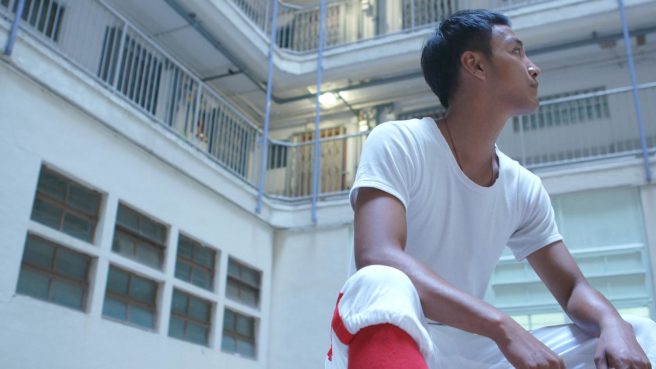
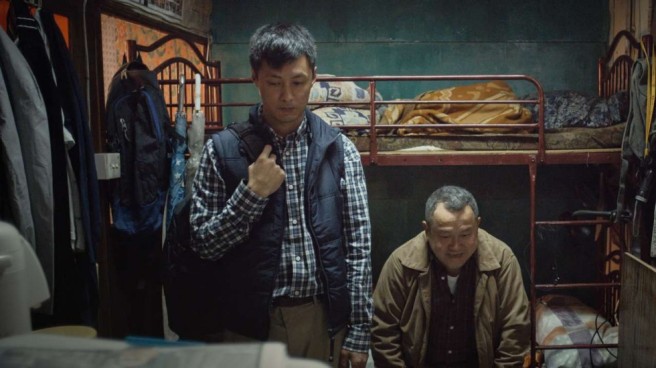
But I may be overstating this. The Hong Kong Film Awards, dating back to 1982, have been much more liberal in their tastes, and last year, confronted with the choice between Trivisa, a serio-comic crime saga from the Milkyway Image studio and Mad World, a Very Important Movie by first-time director Wong Chun about a father and his son and mental illness, they chose the gangsters. Mad World  kicks off a miniseries of Hong Kong films at SIFF this weekend, marking the anniversary of the 1997 Handover of the colony to Mainland China with a trio of new films and a pair of classics. Shawn Yue (an actor and former model last seen here a couple of months ago in Love Off the Cuff) plays a young man suffering from Bipolar Disorder who gets released after a year in a hospital into the custody of his father, an aging truck driver played by Eric Tsang. As Yue attempts to reenter society (and unadvisedly goes off his medication) flashbacks recount the events leading up to his breakdown: he quit his job to care for his elderly mother (Elaine Jin), who appears to have been afflicted with some form of dementia. This strains his relationship with his fiancée and ultimately leads to the mother’s accidental death, for which Yue is charged with manslaughter but found not guilty. The present tense structure of the film follows Yue in a number of attempts to recreate his former life, all of which fail miserably (a former coworker and friend flounders under a financial crisis, his fiancée ambushes him with recrimination at a prayer meeting, a friendship with the boy next door is undermined by the prejudice and gossip of his neighbors). It’s enough to drive anyone nuts.

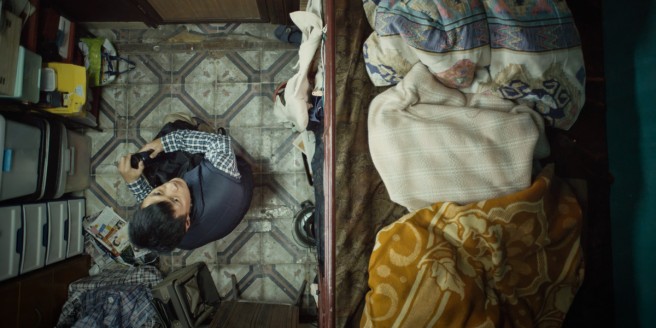
Wong’s film argues that it isn’t so much that there’s anything wrong with Yue, chemically or psychologically, but rather that given the social, material and familial conditions of contemporary society (along with perhaps a genetic inheritance from his mother), depression is not only reasonable, but inevitable. His former friends are materialistic and self-obsessed (and extremely rude at weddings). Everyone he meets makes fun of him for being crazy, there’s even a video of him having a breakdown in a convenience store that goes viral, because apparently everyone in Hong Kong is a monster. His father lives in the tiniest of apartments, an 8×6 room with bunkbed, a TV and a fold-up able, sharing a kitchen and bathroom with half a dozen neighbors. A cramped corner for forgotten people barely serving. With rigid, confining compositions and a sickly melancholic piano score, the film is an unrelenting lecture about the pathology of modern life, illustrated by a melodramatic slideshow demonstrating its devastating effects on a matinée idol.
madworld_05

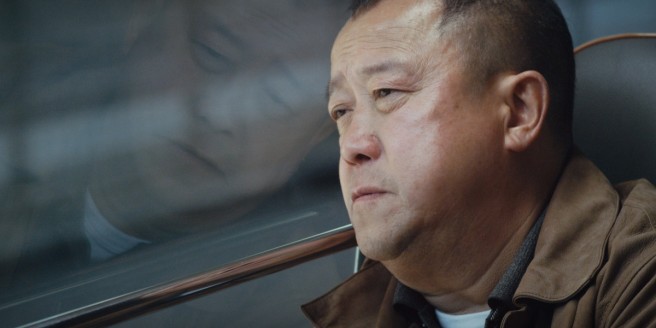
However, Eric Tsang, one of the key figures in Hong Kong cinema for the past 40 years, where he has served as director (Aces Go Places), writer (Tsui Hark’s All the Wrong Clues (for the Right Solution), producer (Drunken Master II, Golden Chicken, After this Our Exile) and actor both comic (as part of Sammo Hung’s Lucky Stars crew) and dramatic (as Maggie Cheung’s husband in Comrades, Almost a Love Story), brings a lived-in reality to the film that compensates for much of its contrivance. Where Yue plays depression as blankness and tears and Jin pushes dementia over the top, Tsang keeps things simple. A good-natured, under-educated man, his attempts to do what’s best for his son are heartbreakingly inadequate (at one point saying what seems exactly the opposite of how one should talk to someone with a mental illness: “Stop being negative. It’s all in your head. Think of something more cheerful. Can’t you be normal?”) At the Hong Kong Film Awards, Tsang won the Best Supporting Actor for his work, while Jin won Supporting Actress and Wong Best New Director. I suspect that, years from now, Tsang’s performance will be the only reason to watch this movie. And it might even be worth it.

Between Work: A Conversation on Claire’s Camera and The Day After

Claires-Camera-620x327

Evan Morgan: The sun’s out, palm trees are in sight, and we’ve temporarily traded in soju for sancerre. Hong Sang-soo is en vacance again. I don’t know about you Sean, but I’m always happy to see Hong in the literally and figuratively breezy mode that he takes up in Claire’s Camera. The seasons have long played a central role in the Hong project, though it seems that the tonal vacillation between his summer and winter films grows with each passing year. Hong’s sense of humor lilts along during the warmer months, and though it never goes entirely dormant in wintertime, it cools and takes on a serrated edge, like cracked ice. Claire’s Camera, in keeping with this seasonal dichotomy, might be his most amiable movie yet, defined as it is by Isabelle Huppert’s warm naiveté and the dabs of sunflower yellow provided by her summer frock. Huppert’s flightiness bleeds into the plotting too, which moves with a nonchalance that borders on amateurishness. I mean that as a compliment. It strikes me that Hong’s acceptance into the upper echelon of the art cinema world (the film unfolds during Cannes, after all) occurred simultaneously with his loosened production methods, and though the competition gatekeepers prefer the more somber Seoul films, the animating spirit of later Hong owes much to the laidback atmosphere of friends who vacation together and decide, ‘what the hell let’s make a movie.’ It’s not for nothing that this most amateur of Hong films is set against the backdrop of the world’s premier film festival.

Continue reading “Between Work: A Conversation on Claire’s Camera and The Day After

SIFF 2017: Nocturama (Bertrand Bonello, 2016)

terrorizers

Like a not-so-metaphorical bomb, one of the only truly exceptional films that played at the 43rd Seattle International Film Festival landed in the final weekend. That film was Bertrand Bonello’s Nocturama, the controversial and highly touted “thriller” (for lack of a better term) about a group of young terrorists who plan and execute a highly coordinated series of bombings around the City of Light. Bonello more or less eschews a concrete and obvious stab at relevancy – the group’s ideology is almost totally ambiguous, save for a likely anti-capitalist bent – in favor of something much more oblique, frightening, and ultimately powerful.

Bonello, who came to prominence for his acclaimed films House of Tolerance (2011) and Saint Laurent (2014), continues his penchant for stylish and meticulous direction, choreographing both the actual terrorist acts and the second half, a long unraveling of both team and sanity in a massive, labyrinthine department store, with the utmost precision. His Steadicam shots have a genuine sense of motion, snaking through subways and seemingly infinite hallways and watching intently for the slightest change in expression on a character’s face. These faces are key in a way; built from a group of relatively new actors, the diverse ensemble has a freshness and uncertainty about them that fits spectacularly well with the ambiguity about their personas and motives, even being conflated with store mannequins at several points. Nocturama has, as might be expected, a certain sort of cold-blooded brutality to it, but it also has vitality, driven forward relentlessly by a pulsing soundtrack and the vividly clear vision of Bonello.

SIFF 2017: A Ghost Story (David Lowery, 2017)

ghost

Note: as this film is under embargo until its release in the Seattle area, here are exactly 75 words.

Kudos to David Lowery for attempting to introduce fairly mainstream audiences to Weerasethakul, Tsai, Hou, etc. Unfortunately, his coopting of the slow cinema aesthetic has some of the outlines, especially when it comes to the picturesque settings and highly muted performances, but very little of the feeling and passion behind the great works of that style. Well-mounted and occasionally rather involving, A Ghost Story nevertheless ends up with a muddled, unclear sense of purpose.

SIFF 2017: Gook (Justin Chon, 2017)

gook

Note: as this film is under embargo until its release in the Seattle area, here are exactly 75 words.

Centering on the first day of the Rodney King riots in LA, Gook turns its eye to an underseen perspective on that monumental event: the Korean-American shop owners. The riot is used mostly as a backdrop to a small-scale story of familial bonds, a feint which works for better and worse. Writer-director-star Chon excels in the more comedic and subdued moments, but his film seems to escape his grasp in the self-consciously “lyrical” moments.