Alien: Covenant (Ridley Scott, 2017)

walter

Alien: Covenant, like the many offerings of that benevolent hydra known as the Marvel Cinematic Universe, depends to no small extent on the foreknowledge of its filmic predecessors, both directed by Ridley Scott: the landmark sci-fi horror touchstoneAlien, of course, but more obviously the unjustly maligned Prometheus from 2012. Fittingly, it borrows strands of DNA (as it were) liberally from both, melding the basic structure of both with the grimy, generally no-frills mode of the former and the sense of wonder and existential doubt of the latter. The result is something slightly uncanny, as initially shocking as the notably CGI aliens (a far cry from the hulking suit of the original film), but thrilling and hard-hitting all the same.

What sets Alien: Covenant apart from its forbears is its method for unleashing hell. Functionally speaking, it takes a two-pronged approach, conveniently divided into two halves. The first concerns the various crew members of the Covenant, a deep-space colony mission diverted by a mysterious transmission issuing from a heretofore unknown planet that seems completely suitable for life, including acting captain Christopher (Billy Crudup), second-in-command Daniels (Katherine Waterston), chief pilot Tennessee (Danny McBride), and android Walter (Michael Fassbender). The second picks up neatly after various survivors of the initial alien attack are assisted by David (Fassbender again), the android figure from Prometheus who has been dwelling on the hostile planet for ten years.


Continue reading Alien: Covenant (Ridley Scott, 2017)”

SIFF 2017: Cook Up a Storm (Raymond Yip, 2017)

COOK-UP-A-STORM-copy

One of only two Hong Kong films to be playing at SIFF this year is this cooking film from star Nicholas Tse and director Raymond Yip. It’s a Lunar New Year film, opening a week after the holiday both at home and abroad, to avoid box office competition from Tsui Hark and Stephen Chow’s Journey to the West: Conquering the Demons. It played here briefly at the Pacific Place, but SIFF is reviving it for the festival. I’m not exactly sure why, probably because of the food. Director Yip is strictly workmanlike, the guiding force behind the film is Tse, who has been one of the more figures in Hong Kong over the past twenty years. The son of star actor Patrick Tse (Story of a Discharged Prisoner), he began as a popular singer before moving into movies (Time and Tide, Jade Goddess of Mercy, Bodyguards & Assassins) and television (where he hosts and cooks on a popular foodie show called Chef Nic) and a series of romantic entanglements with Faye Wong and Cecilia Cheung. Cook Up a Storm appears to be an attempt to extend the Chef Nic brand, as Tse plays a local Cantonese chef challenged by a European-trained, Michelin-starred chef who opens an upscale restaurant across the street. Both Nic and the new chef (a truly international man: half-Korean and half-Chinese, raised and trained in Europe, he’s played by Korean singer/actor Jung Yong-hwa) have secrets which they must overcome to win a game show-style culinary competition.

Continue reading “SIFF 2017: Cook Up a Storm (Raymond Yip, 2017)”

Baahubali: The Conclusion (S.S. Rajamouli, 2017)

baahu 3

S.S. Rajamouli’s Baahubali: The Beginning (dutifully reviewed here at SSS) was a work of grand spectacle, visual wonder and narrative simplicity. It found Rajamouli delivering a shot across the bow, if you will, announcing his intent to deliver a film worthy of the epics which drive the mechanics of the plot, and could stand side by side with Hollywood. But it is Baahubali 2: The Conclusion which truly delivers on that promise.

Continue reading Baahubali: The Conclusion (S.S. Rajamouli, 2017)”

The Happiest Day in the Life of Olli Mäki (Juho Kuosmanen, 2016)

weigh

When considering the standard cultural landmarks of the peculiar but plentiful subgenre of the boxing movie – Raging Bull, Rocky, Ali – a pattern seems to emerge. The genre seems to invite, by dint of the sport’s popularity, prominence, and propulsive energy, either big emotions or big narratives, whether it be emotional self-flagellation, the archetypal underdog, or a sense of the central figure influencing the national zeitgeist. The Happiest Day in the Life of Olli Mäki, surprisingly, deals with all of these ideas to one extent or another, but this entry into the subgenre eschews virtually all sense of grandeur in favor of an intensely lowkey and somewhat light character study.

Winner of the Un Certain Regard Award at the 2016 Cannes Film Festival, The Happiest Day in the Life of Olli Mäki follows the true story of the eponymous Finnish boxer (Jarkko Lahti) as he trains to fight for the World Featherweight Title, the first world championship bout held in Finland. His training is followed with intense interest by his fellow countrymen, who hold his title challenge as a major source of national pride. Olli is essentially besieged as he attempts to focus on the match – and lose enough weight to become a lightweight – by many, including coach/manager/slightly antagonistic friend Elis (Eero Milonoff), who invites a documentary film crew to film Olli’s progress and continually forces him to attend dinners to accrue sponsors. All the while, he is bolstered by his growing love for his friend Raija (Oona Airola), something frowned upon by Elis.

Continue reading The Happiest Day in the Life of Olli Mäki (Juho Kuosmanen, 2016)”

Guardians of the Galaxy Vol. 2 (James Gunn, 2017)

team

It is mostly accurate to say, without hyperbole, that the Marvel Cinematic Universe is simultaneously the most overpraised and the most unfairly maligned blockbuster franchise of modern times. Rarely has any strictly commercial film or series of films inspired such reams of glorification or barbs of hatred, as both sides seem to hail the MCU as alternatively the lifeblood and the death knell of cinema. Both of these extremist positions are, of course, ridiculous; the idea that one series, even the most profitable, could make or break American blockbuster cinema, let alone world cinema, is intensely narrow-minded. Perhaps a more rewarding and certainly more revealing approach is considering each incarnation, pros and cons, as its own discrete unit, despite Marvel’s insistence on making them blend together in a maze of references and character continuities.

Such dueling intentions typify, for better or worse, the latest such entry in the series: Guardians of the Galaxy Vol. 2. The rather fascinating sequel to the 2014 film follows its eponymous protagonists a few months after the events of its predecessor, as they experience all of the camaraderie and squabbling that befits a team that has stayed together that long. It is a surprisingly non-narratively focused film, though, in the MCU tradition, it ends up being just as high-stakes as normal. Functionally speaking, it is split into two plotlines. One follows Peter Quill (Chris Pratt), Gamora (Zoe Saldana), and Drax (Dave Bautista) as they explore the planet that comprises Peter’s father who abandoned him as a child, a cosmic being known as Ego (represented in a humanoid form by Kurt Russell). The other follows Rocket Raccoon (Bradley Cooper) and Baby Groot (Vin Diesel) as they are separately captured by a faction of the Reavers, headed by Yondu (Michael Rooker), Peter’s adopted father who seeks to regain his standing within the Reavers as a whole.

Continue reading Guardians of the Galaxy Vol. 2 (James Gunn, 2017)”

Love Off the Cuff (Pang Ho-cheung, 2017)

love_off_the_cuff_07-h_2017

Love Off the Cuff starts with a horror movie, a tale set in the recent past about a village terrorized by a monster that eats children. As creepy as it is ridiculous, it functions as a none-too-subtle allegory for the crisis at the heart of the relationship between Cherie (Miriam Yueng) and Jimmy (Shawn Yue), which we’ve seen grow from its beginnings at shared cigarette breaks in Love in a Puff to the inevitable break-up/reunion cycle in Love in the Buff. Seven years on from the first film (which remains arguably the best romantic film of the decade), Cherie and Jimmy are comfortably living together back in Hong Kong, but visits from long-lost family members serve to highlight the rut they’ve found themselves in. Cherie’s father, who abandoned her, her mother and her brother years ago, shows up with a very young bride-to-be and looks to party with Jimmy. While Jimmy’s visiting godmother turns out to be a much younger woman (“She’s from Canada, they’re very liberal there. What if she prances about in her bra?” Cherie fearfully exclaims). The two visits inspire insecurity in Cherie: she’s jealous of the younger woman and fearful that Jimmy will turn out like her lecherous father, but more devastatingly they highlight the degree to which she was already dissatisfied with Jimmy’s childishness.

Continue reading Love Off the Cuff (Pang Ho-cheung, 2017)”

This Is Not What I Expected (Derek Hui, 2017)

好吃20161008_004 copy

One of two romantic comedies that tried and failed to unseat the powerhouse Fast & the Furious 8 at the Chinese box office this past May Day weekend, This Is Not What I Expected opens here on Friday, a week after its counter-part Love Off the Cuff. It’s a totally pleasant film that surfs gently on the charm of its lead actors, recalling at times the softer screwballs of the 1930s, or more exactly the modern imitations of those classics. It’s essentially You’ve Got Mail, but where the two leads secretly communicate not via letters or emails, but through food. Zhou Dongyou, who was exceptional last year in Derek Tsang’s SoulMate, plays a manic pixie who repeatedly runs afoul of aloof billionaire Takeshi Kaneshiro (aging nicely more than 20 years after Chungking Express and Fallen Angels). Kaneshiro is a fastidious foodie, a buyer and seller of hotels who checks into an aging inn somewhere in Shanghai and finds all of the food lacking. Except, that is, for a soup made by Zhou, known to Kaneshiro only as the woman who mistakenly vandalized his truck in an act of revenge for her roommate. Kaneshiro and the chef refuse to meet each other, instead using the peculiar qualities of food to bond.

Continue reading This Is Not What I Expected (Derek Hui, 2017)”

My Entire High School Sinking Into the Sea (Dash Shaw, 2016)

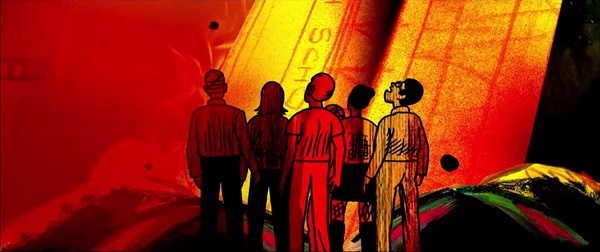
The debut feature of comic book artist Dash Shaw, My Entire High School Sinking Into the Sea, begins by firmly zeroing in on the concerns of young adult fiction: the new school year, the character’s social status, and all the insecurities that are inherent in being a teenager. But these early moments soon take backseat to what is basically a disaster film in miniature, inserting small nuggets of character detail and humor into what is a tired narrative. However, the stock scenario does nothing to derail from the wondrous sensibility of the animation, which is relentlessly inventive.

Continue reading My Entire High School Sinking Into the Sea (Dash Shaw, 2016)”

The Lost City of Z (James Gray, 2016)

lostcityofz-hunnam-jungle-hat

…a voice, as bad as Conscience, rang interminable changes
On one everlasting Whisper day and night repeated—so:
“Something hidden. Go and find it. Go and look behind the Ranges—
“Something lost behind the Ranges. Lost and waiting for you. Go!”

–Rudyard Kipling, “The Explorer”

And the women all were beautiful
And the men stood
straight and strong
They offered life in sacrifice
So that others could go on.

Hate was just a legend
And war was never known
The people worked together
And they lifted many stones.

They carried them
to the flatlands
And they died along the way
But they built up
with their bare hands
What we still can’t do today.

And I know she’s living there
And she loves me to this day
I still can’t remember when
Or how I lost my way.

He came dancing across the water
Cortez, Cortez
What a killer.

–Neil Young, “Cortez the Killer”

James Gray’s adaptation of the story of early 20th Century British explorer Percy Fawcett, based on a New Yorker article and subsequent book by David Grann, is as beguiling, beautiful and ultimately confounding as the Amazonian jungle in which it is largely set. Shot on actual film by the great Darius Khondji (Seven, My Blueberry Nights) the film has a granular opulence rarely seen in the Hollywood cinema today, lush details of both the rain forest wilderness and the rich dark warmth of the woods and leathers of English libraries that are overwhelmingly tactile and mesmerizingly immersive, which, combined with the film’s languorously fluvial pacing washes away all the gaps and inconsitencies and oddities in the screenplay, leaving only the impression of the grace and tragedy of the human impulse toward transcendence.

Continue reading The Lost City of Z (James Gray, 2016)”

Graduation (Cristian Mungiu, 2016)

two

There is a seemingly inconsequential moment roughly a quarter into Graduation where the protagonist, Dr. Romeo Aldea (Adrian Titieni), enters the office of his friend, the police inspector (Vlad Ivanov), and sees two bowls filled with marbles. The inspector explains with no small degree of weary acceptance that he uses them to symbolize two time-based demarcators and to reflect on his current state of affairs. The first represents the amount of days he has lived, and the second is for the amount of days before he can retire at 65, something he quickly states could change based on a revision in Romania’s laws.

This moment of interaction, perhaps the least plot-related moment in an otherwise intensely focused movie, is a kind of key to Cristian Mungiu’s Graduation. The Romanian director burst out into the world cinema stage with his 2007 Palme d’Or winning film 4 Months, 3 Weeks and 2 Days, a singularly harrowing and powerful movie about a woman’s struggle to obtain an illegal abortion for her friend in 1987 Romania. In many ways, Graduation functions as an elaboration of that film’s immensely compressed dealings with the nature of bureaucracies and corruption–something, it should be noted, that forms a primary concern for various filmmakers in the Romanian New Wave.

Continue reading Graduation (Cristian Mungiu, 2016)”