Arrival (Denis Villeneuve, 2016)

arrival

The best science fiction films are often praised for what may seem like the antithesis of the genre: the essential humanity and drama in the face of spectacle and grandeur. So it is perhaps no surprise that Arrival, a film of no small ambition, takes as its subject nothing less than the human race, filtered through the unique perspective of expert linguist Louise Banks (Amy Adams). It is an alien invasion movie without an invasion, and indeed it seems as if Denis Villeneuve is almost totally uninterested in the extraterrestrials except as vaguely benign, abstract concepts. Instead, he first focuses with minute detail on the great unknown of the potential threat of the pods (the twelve cavernous spaceships that land in seemingly random places around the globe) before lurching into grand displays of emotion that culminate in an entirely unexpected conclusion that radically recontextualizes practically the entire film.

Villeneuve’s strength is in his gift for immersive suspense, which he only truly gets to display in the first venture of Louise and her compatriots, including Ian Donnelly (a caring, amusing Jeremy Renner) and Colonel Weber (a stolid Forest Whitaker), into the pod. Elsewhere, his sensibility comes off as too dour, particularly in the opening scenes which lean too hard into the panicked yet muted reactions of the public at large. Adams provides a welcome counterpoint throughout, infusing Louise with equal parts sensitivity and determination and a dash of ingenuity that almost feels like a light in the darkness of the unknown.

Continue reading Arrival (Denis Villeneuve, 2016)”

Old Stone (Johnny Ma, 2016)

oldstone

A year or two ago, reports began circulating chronicling a disturbing phenomenon in contemporary China. The nature of the insurance industry there was mangled such that people involved in car accidents where another person was injured had been incentivized to kill the accident victim, because if they lived the individual at fault for the accident would be responsible for their medical bills in perpetuity, and even if that person themselves died, the debt would pass on to their surviving family. The story of just such a murder opens Old Stone, the debut feature from Chinese-Canadian director Johnny Ma. It’s heard over a car radio, and the film opens with a man stalking a motorcyclist through crowded streets. His name is Lao Shi, which, as far as I can tell, translates to “old stone”, hence the title. “Laoshi” also means “teacher” and this is a film meant to teach us a lesson. (This is also where I point out that I don’t speak Chinese at all.) We flashback to three months earlier and Lao, a cab driver, has accidentally run over a motorcyclist. After calling an ambulance he decides to take the man to the hospital himself, urged on by a crowd of on-lookers, some of whom advise him not to do anything, others who insist the man will die if he isn’t hospitalized right away (a fact later confirmed by the emergency room doctor). This proves to be a mistake however, as in moving the victim, Lao has given his insurance company an excuse not to pay the man’s medical bills, leaving Lao and his family responsible. For most of the rest of the film, we follow Lao’s increasingly desperate attempts to navigate the legal system, raise money for the victim, and find anyone willing to take his side. In true noir fashion, it’s the story of a man who made a mistake, once, and must suffer the consequences.

Ma sticks close to Lao Shi throughout the film, the movie’s perspective becoming increasingly shallow and fuzzy as systemic torments drive our hero off the edge. Chen Gang is very strong in the role. Tall and angular, with beaten down shoulders and sad eyes, he is the embodiment of the everyman ground down by impersonal bureaucracy. An Nai as his wife, a day care operator hoping to expand whose dreams are ruined because of her husband’s foolish altruism is very good as well, and Jia Zhangke regular Wang Hongwei has a supporting role as one of Lao Shi’s not particularly supportive taxi driver friends. Ma has a good feel for the actuality of the Chinese city, its crowded streets, its small gestures of respect and camaraderie and indifference (often involving the sharing of cigarettes), it has all the specificity that Ringo Lam’s Sky on Fire (also opening this week) so frustratingly lacks. Unlike the bureaucratic satire of I am Not Madame Bovary, Ma doesn’t seem to find much humor in the absurdities of the system. As the film reaches its inevitable conclusion, the sense of accumulated doom is palpable: there’s no respite to be found, no outside perspective that might provide for some possibility of hope and change. We’re locked into the system with Lao Shi; all we can do is take a drink and face the on-coming headlights that, unmercifully, won’t ever arrive.

The Love Witch (Anna Biller, 2016)

pentagram-love-witch

An enigmatic woman descends upon a town, drifting in like a sultry, slinking fog. She moves into a room in a Victorian mansion, where she cooks up home brews of potions and soaps, some of which she sells at the local hippie enclaves. Other mixtures end up in the bodies of lustful men who fall madly in love–or just simply go mad–for this femme fatale in knee high boots and miniskirts. This is Elaine. She’s the heroine of Anna Biller’s latest feminist phantasm, The Love Witch. It’s groovy and gaudy. It’s the second film of the year to track the doomed pursuit of love through the Tarot, the first being Terrence Malick’s Knight of Cups. A wallop of a double feature these two would make.

Continue reading The Love Witch (Anna Biller, 2016)”

Tower (Keith Maitland, 2016)

tower

Approaching the subject of one of the first mass shootings in American history is by nature a tricky undertaking. In the case of the UT Austin clock tower shooting, it seems even more so; compared to other, more recent shootings, which usually take place in confined spaces like a movie theater, a club, or a school campus, this one took place in the wide expanses of downtown Austin, where no one seemed safe during the prolonged, two-hour standoff. So Keith Maitland’s approach comes as somewhat of a surprise: instead of seeking to paint a comprehensive portrait of this shocking day, it is a story primarily in anecdotes, from people who in all likelihood would only connect in events as shattering as this.

The most striking aspect is, undoubtedly, the almost entirely rotoscoped aesthetic of Tower. It almost purposefully eschews photorealism for a more impressionistic, almost faded effect, exaggerating the expressions and emphasizing the details, like the beads of sweat in the summer Texan heat or the sudden flashes of light from bullets on the sides of buildings. Even more radical is the mixing of archival footage with this animation. Particularly in the opening—before the shooting occurs—Maitland splices in animation interacting directly with the footage, the bright colors of the cars pulling up to the curb or people walking through the UT campus contrasting with the monochrome photography. But after the shooting happens, in an admittedly spurious but incredibly effective creative choice, the colors bleed out of the animation. Each person gets their own “loss of innocence” moment as they learn about the shooting (no matter how far it is into the actual events), and crucially the color never returns after the fact; when recalling certain memories the color returns to only further accentuate this point.

Continue reading Tower (Keith Maitland, 2016)”

I Am Not Madame Bovary (Feng Xiaogang, 2016)

2f83f0a0c246f24146904366bca04933

A comedy of bureaucracy like many a film of the Romanian New Wave, but rather than the drab and bleak institutional ironies of the Eastern Bloc, Feng Xiaogang’s satire is bright and sprightly, bouncing along its tunnel visions for two and a half hours of contradiction made irresolvable by a society’s fundamental lack of belief in the primacy of actuality over appearance. Fan Bingbing plays a rural peasant woman who wants to undo and then redo her divorce. She and her husband, she claims, only pretended to get divorced in order to qualify for an apartment near the factory where he works, while keeping her house in another town (a year later they would remarry and get both properties). But then her husband took up in that apartment with another woman, and claiming the divorce was real, kicked Fan out.

Continue reading I Am Not Madame Bovary (Feng Xiaogang, 2016)”

Ixcanul (Jayro Bustamante, 2015)

ixcanul_01

(This review was originally published in 2015 as a part of the Vancouver Film Festival coverage.)

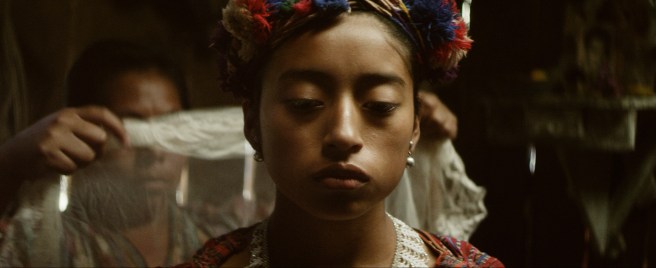
Ixacanul opens on a young woman’s passive form and impassive face. Her name is Maria (María Mercedes Coroy), and her mother (María Telón) dresses her and then smooths, parts, and plaits her hair, securing a crown-like garland upon her head. The two Mayan women, alone together in their home, near a volcano, an ixcanul, in a remote region of Guatemala, both absorbed and silent in the exclusive intimacy of their shared activity, indicate that they inhabit a world with which they are familiar, and I am not. I guess, as I first look at them, that Maria is not quite happy to be so taken in hand by her mother – or perhaps she is not quite happy with the event, unknown as yet to me, for which she is being prepared. Continue reading Ixcanul (Jayro Bustamante, 2015)”

VIFF 2016: Notes on Ta’ang (Wang Bing, 2016)

201607407_1_img_fix_700x700

The cinema of Wang Bing is one that seems, even if a documentary, one where the physical body of a director has been removed, and the camera is guided solely by compassion. With this in mind, there is very little one can analyze or really write about – as my colleague Andy Rector stated quite astutely regarding this new work: “You’re with real people now – Essential cinema.” Wang shares an affinity with the Portuguese director Pedro Costa – both have found themselves making representational films but with the complete awareness and understanding of the potential pitfalls of such an approach. (Costa is even on record stating that Wang is his favorite contemporary filmmaker) Firstly, this appears to stem from the desire to document what otherwise would go undocumented. If there is another serious similarity – it’s that they both have found a way to remove a subject from any point of representational stasis; they have found ways to film with making those in-front of them subjects to their cameras. But while Costa seems to have moved in another direction since, Wang seems to be capable of doing this in a form that is impossibly natural. And while Costa aestheticizes and blurs (if not make entirely unnecessary) the lines between fiction and nonfiction, Wang gives us solely the world as is, more importantly the faces in it, and most importantly makes no attempt towards dialecticism within filmed reality and moreover makes no attempt to reconstitute it either. (Not that Costa necessarily does these things, but to discuss that would drift too far from the work at hand.)

Continue reading “VIFF 2016: Notes on Ta’ang (Wang Bing, 2016)”

VIFF 2016: Notes on Paterson (Jim Jarmusch, 2016)

tumblr_inline_o8siszxo6i1shjv1j_540

“…I dreamt that we would have twins..”

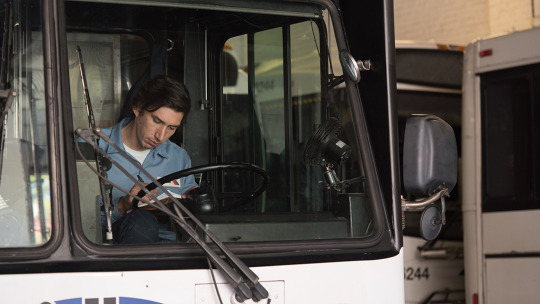
I didn’t catch these opening lines until my second viewing of the film, & as elegant and moving as the initial one was, the film opens up considerably once these added dimensions are openly defined. The film is frequently introducing us to twins or doubles, not within dreams but in reality, culminating with Paterson being given ‘new’ pages by what is in essence, a spiritual twin. Does the ‘real’ then, become influenced by our own subjective impressions, rather than our impressions be designed by the real? Or is there a kind of middle ground whereupon these are arbitrary forces? Paterson only writes in isolation, almost in secret – yet this writing manifests as both compression/paring down of the outside world to abstract essentials, and amplification/elaboration of romantic feelings into romantic gestures.

Continue reading “VIFF 2016: Notes on Paterson (Jim Jarmusch, 2016)”

Moonlight (Barry Jenkins, 2016)

moonlight

The only true constant in Moonlight is its look. It is an odd sort of luminescence, bringing out the vibrancy of the subject while turning everything not in the immediate foreground into a impressionistic haze of blurred colors. The effect is definitely one of immediacy, but crucially, it is immediacy that belongs to all time periods: apart from some signposts in the form of cars, cell phones, and music, the setting of the film, Miami, doesn’t seem to change all that much. The background of run-down homes, barred windows, and an moonlit beach stay the same, while the people and their changes are highlighted in stunning detail.

The movie’s visual style mirrors Barry Jenkins’ approach towards his main character, Chiron. The story of Chiron’s growth during three decades in Miami, Moonlight functions less like a biography and more like a series of snapshots. Each section, denoted by the name Chiron goes by in each section (Little, Chiron, and Black, respectively), is set over a few consecutive days, and the events are at once the most consequential and yet seem like transitions to different stages of Chiron’s life. They are formative moments, in a sense, and they come together over the course of the film to gather a quiet, cumulative force that dazes the viewer, making them feel as lost yet as at home as Chiron does.

Continue reading Moonlight (Barry Jenkins, 2016)”

The Alchemist Cookbook (Joel Potrykus, 2016)

screenshot-2016-11-06-at-12-20-18-am

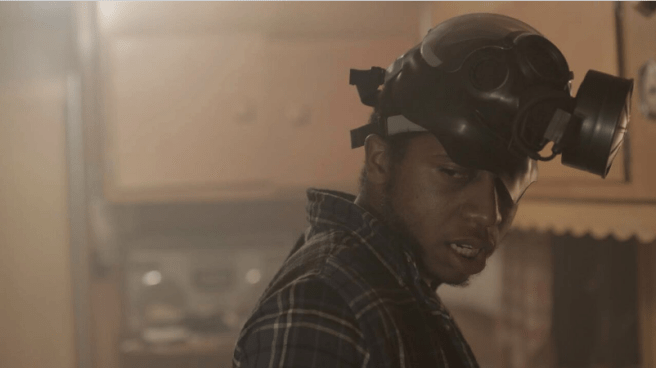
The Alchemist Cookbook is like The Martian if Matt Damon was living in a rusty trailer deep in the Michigan woods and he decided to pseudo-science the shit out of spare cleaning chemicals because he wasn’t smart, just insane. Call it The Michiganian. The Martian was a clarion call for humanity’s aspirational best. The Alchemist Cookbook is the sobering reality that 99% of us would quickly go nuts if left to our own devices.

Continue reading The Alchemist Cookbook (Joel Potrykus, 2016)”