Mekong Hotel (Apichatpong Weerasethakul, 2012)

OLYMPUS DIGITAL CAMERA

Cemetery of Splendour, the latest feature from acclaimed Thai director Apichatpong Weerasethakul, debuts this week exclusively at the Northwest Film Forum. We’ll be talking about his work this weekend on The Frances Farmer Show, and if I can find the time I may actually review the new movie (short version: it’s pretty great, don’t miss it). But as a neat little bonus, the Film Forum is paring Cemetery of Splendour with Weerasethakul’s 2012 short feature Mekong Hotel, one of those movies that, at about 60 minutes in running time, was too long to be considered a short and too short to get a proper theatrical or home video release (see also Hong Sang-soo’s Hill of Freedom, which might have been his most popular film in North America if only it was 20 minutes longer). Mekong Hotel plays only twice, at 6:45 on Friday the 18th and again at 6:45 on Thursday the 24th. I caught it at the Vancouver International Film Festival back in 2012, and here is the brief review I wrote then:

Mekong Hotel was one of my most anticipated films coming into the festival, the first feature by Apichatpong Weerasethakul (Joe) since his Cannes-winner Uncle Boonmee Who Can Recall His Past Lives (which I saw here at VIFF 2010). It’s partly bits of a story Weerasethakul had written years ago about a young couple who are haunted by a pob ghost throughout their lives (pob ghosts are spirits that eat the entrails of animals and humans, like a Thai chupacabra I guess), but most of the film is simply Joe and his actors and composer hanging out at the titular hotel overlooking the Mekong River, the border between Thailand and Laos, chatting about politics and how high the water will rise in this year’s floods. The composer, Chai Dhatana, noodles his score on a guitar throughout the movie, an ambling, aimless tune with hints of Southern blues that evokes not only the endless flow of the Mekong, but the Mississippi as well, both rivers oft-flooded borderlands conducive to lazy afternoon conversations and where the line between myth and reality is a little more porous than it probably should be. I have written down in my notes the line “device to allow your spirit to wander”. I don’t remember the context, who said it or what the device is, but it seems to me that that describes Joe’s movies pretty perfectly.
Kiki’s Delivery Service (Hayao Miyazaki, 1989)

This review was originally published in 2014 on the author’s old blog.

kiki tombo flying

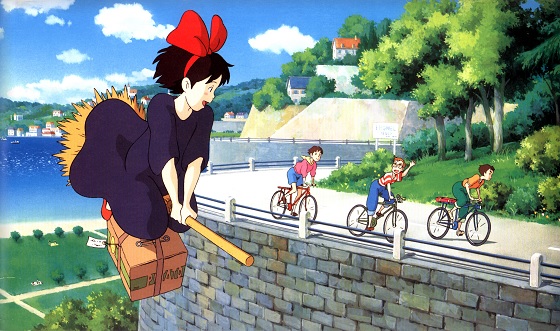
A young witch coming of age arrives in a seaside town to master her abilities. To do so she has left behind her family and her home, with nothing but a broom, a bag, and a cat by her side. The girl is a romantic and a bit of a klutz, longing for the ocean whilst crashing into trees. She is taken in by a kind woman on the verge of motherhood, who gives her a job and a home. An enthusiastic and indefatigable boy falls for her and pesters the young woman to be his friend. The witch makes pancakes. It is wonderful. Continue reading Kiki’s Delivery Service (Hayao Miyazaki, 1989)”

Rise of the Legend (Roy Chow, 2014)

rise_of_the_legend_still

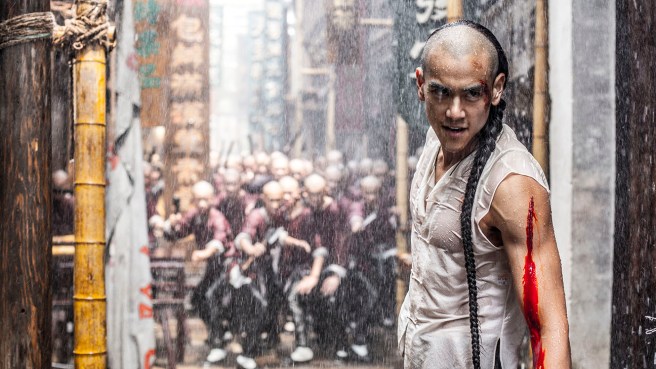
Every generation gets the Wong Fei-hung they deserve. A fin-de-siècle doctor and martial arts instructor, the real life Wong has been inspiring cinematic incarnations for most of the history of Hong Kong’s film industry. The first was in a series of productions running form the late 1940s to the mid 1960s, where Wong was played by Kwan Tak-hing as the embodiment of Confucian masculine values. Dignified, somewhat aged, even-handed and scrupulous, Kwan played Wong in an astounding 77 films (at least), between 1949’s The True Story of Wong Fei-hung: Whiplash Snuffs the Candle Flame and 1981’s Dreadnaught, which is some kind of a record. A generation of actors and stuntmen, choreographers and directors (most notably Lau Kar-leung and Yuen Woo-ping) got their starts training on the Wong Fei-hung films, which served roughly the same role for Hong Kong action cinema that Roger Corman’s exploitation films did for the New Hollywood. Lau Kar-leung put his twist on the character with Gordon Liu starring as a young student Wong in Challenge of the Masters in 1976 and as a somewhat older man striving after nonviolent resolutions to the deadly rivalries of the kung fu world in 1981’s Martial Club. Yuen Woo-ping and his father Yuen Siu-tien, who also worked on the Kwan Tak-hing series, upended the Wong Fei-hung mythos in 1978 with Drunken Master, in which a young Jackie Chan plays Wong as an impetuous, vulgar, undisciplined youth who is beaten into shape by the eponymous instructor (the elder Yuen), kicking of an era of irreverent kung fu comedy hybrids and launching Chan as a superstar. Tsui Hark revising the legend again in 1991 with his Once Upon a Time in China series, in which Jet Li played the hero with a mix of Kwan’s grace and nobility,  Chan’s youthfulness and Li’s own awkward romanticism. Now, Roy Chow gives us Rise of the Legend, with Eddie Peng playing Wong as a brooding, blood-spattered young warrior, desperately fighting against the nihilistic hell that is Guangzhou’s Pearl River Delta in the late 19th Century.

Continue reading Rise of the Legend (Roy Chow, 2014)”

Requiem for the American Dream (Peter Hutchison, Kelly Nyks, Jared Scott, 2016)

RequiemfortheAmericanDream

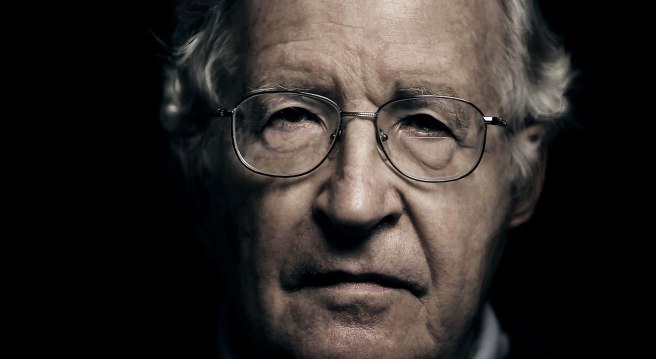
Requiem for the American Dream should be required viewing on every college campus in the nation. This is not just because of the film’s concise and lucid overview of the thinking of its interview subject, American intellectual Noam Chomsky, on a critically important topic, the erosion of American democracy and the subsequent rise of income inequality and decline of individual and communal rights and freedoms. This overview is of enormous value, but the film’s other gift to its audience is a model of what political discourse can sound like. At the present moment of rage politics and deafeningly loud appeals to the lizard-brain of the American voter, Chomsky’s quiet, humane voice and deeply informed, thoughtful perspectives provide a badly needed antidote to the prevailing culture of dumbed-down, amped-up public speech. Continue reading Requiem for the American Dream (Peter Hutchison, Kelly Nyks, Jared Scott, 2016)”

Knight of Cups (Terrence Malick, 2015)

bale party knight

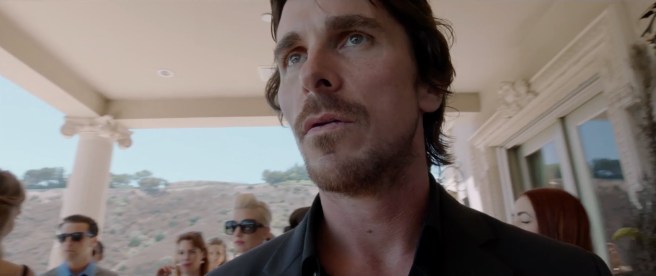
Terrence Malick is incapable of creating an ugly image. But with Knight of Cups he has assembled hundreds of vulgar ones. This is nothing like the brutal poetry found in The Thin Red Line which explored the horrors of combat. Knight of Cups is after an abstract debauchery. Its perverse vulgarity comes from beautiful people, all of them lithe (save Brian Dennehy), several of them nude (thankfully not Brian Dennehy) as they wander through the fucked up orbit of Christian Bale’s screenwriter Rick. These are models, actresses, and strippers frolicking through the sprawling decadence of Los Angeles, a city willed into existence by dreamers in the middle of the desert.  Continue reading Knight of Cups (Terrence Malick, 2015)”

The Witch (Robert Eggers, 2015)

large_the-witch

A more harrowing or dread-inducing film you’re not more likely to find this year on Seattle Screens than Robert Eggers’s colonial fantasy The Witch. Set in 1630 and with dialogue partially based on diaries from the time, Eggers tells of a Puritan family living alone in a deep dark wood, and the evil that preys upon them there. Long a metaphorical vehicle for all manner of issues (the hunting of witches being analogized most famously as anti-Communism in The Crucible, while more recently witches themselves have become celebrated as free-thinking proto-feminists) or moral lessons, Eggers strips away the subtext of his folktale in favor of an experiential trip inside the mind of Puritan true believers. It is established right from the opening scenes that there are witches and that they are of the purest evil. It remains for us to suffer along with a people whose darkest imaginings are made manifest.
Continue reading The Witch (Robert Eggers, 2015)”

Boy and the World (Alê Abreu, 2013)

This is a revised and expanded review based on a post from the critic’s defunct blog.

boy and the world hanging

Brazilian director Alê Abreu’s charming feature Boy and the World finally gets a regular theatrical run after playing the festival circuit for the last couple of years. The film previously played in Seattle 20 months ago as part of the 2014 Seattle International Film Festival. Over those myriad screenings the film has garnered a windfall of goodwill, including winning numerous audience awards. In a sign of the diversity in this year’s Best Animated Feature field, it is conceivable that if Pixar’s Inside Out was not in the running, Boy and the World would have a legitimate chance at the Oscar.  Continue reading Boy and the World (Alê Abreu, 2013)”

It’s Already Tomorrow in Hong Kong (Emily Ting, 2015)

Emily Ting’s romantic comedy opens this week at the Varsity Theatre, but we saw it last fall at the Vancouver International Film Festival (The title has inexplicably misplaced its “It’s” since then, which we are choosing to ignore). Here’s what we wrote about it back then:

Sean’s Review:

Emily Ting’s It’s Already Tomorrow in Hong Kong is a different kind of fantasy, one of ex-patriates in Hong Kong and, more distressingly, of indie filmmakers weaned on Before Sunrise. Jamie Chung plays an American from Los Angeles (her grandparents emigrated from Hong Kong) lost in the city who runs into a fellow American named Josh. He’s the Joshiest Josh in film history, working in finance but really, an aspiring novelist. Actor Bryan Greenberg looks like the child of Michael Rappaport and John Krasczinski, but with even worse hair than that implies. He shows her around, lets slip way too late in the evening that he has a girlfriend and the couple splits. . . only to reunite a year later for another walk (once again hitting places best seen in Wong Kar-wai and Johnnie To films) and faux-naturalistic conversation (and a trip to a bar to see a Hong Kong knock-off of Arcade Fire, which is exactly as appalling as that sounds). After a century of Parisian dominance, it’s clear to me that Hong Kong is the most cinematic city in the world, and it certainly doesn’t let Ting down. The film is gorgeous, the bright lights of Hong Kong providing enough inherent pleasure that one is able to overlook the constructed obviousness of the script and the bland nothingness that is Greenberg’s performance. Chung fares better, her lines are just as generic but she sells them with big eyes and a world-saving smile. Pretty as the city is, it’s a problem when during the romantic climax of your film, the most interesting thing on screen is the multi-layered play of lights on a taxi cab window. Not even a cameo from the great Richard Ng can bring it to life.

Mike’s Review:

White guy living in Hong Kong meets an American woman of Chinese descent. The two hit it off but complications ensue when it is discovered they have other attachments. As a travelogue for the gorgeous city of Hong Kong, this works well enough, with depictions of the majestic skyline and bustling streets. As a romance or a comedy or a showcase for the art of acting, it is a failure.

From Vegas to Macau III (Wong Jing, 2016)

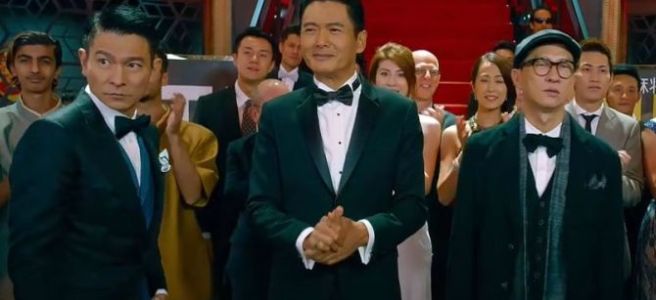
Relentless director Wong Jing’s latest farce has less of a plot than either of the first two films in the series, and is even less tethered to reality, in action, story, setting or character. It’s a bunch of shiny effects thrown at aged stars of the 90s, old movie and TV references (Chow Yun-fat spends awhile thinking he’s in Heaven Sword and Dragon Sabre, a ping-pong match with Jacky Cheung calling back to Johnnie To’s The Eighth Happiness, a little joke about Nick Cheung’s award-winning performance in Unbeatable, a whole sequence set in a prison with leftover costumes from Prison on Fire, even the central romance is Jacky Cheung’s unrequited love for Carina Lau, ala Days of Being Wild, etc etc*).

Of course the whole thing is a riff on the God of Gamblers series, with Chow playing a dual role as the original character and this newer farcical incarnation, kind of as if his amnesia-induced split personalities in that first film had developed into two separate realities. Andy Lau unites them (as he did the original series and Steven Chow’s parody of it), reprising his role as the Knight of Gamblers, but his performance bears no relation to that original character: he’s merely a vehicle for dumb slapstick jokes (a literal pie in the face, peeing baby robots) and inside jokes about Lau’s own career. It’s a movie that breaks into a song or an extended effects-driven bit of action, or a series of dumb mostly unfunny jokes at any opportunity. But there’s something liberating about Wong’s indifference to normalcy.

*Movie loses a half a star because the two dying robots didn’t crawl past each other like at the end of The Killer.

Hail, Caesar! (The Coen Brothers, 2016)

hail-caesar

The latest from multi-hyphenate siblings Joel & Ethan Coen is a kaleidoscopic extravaganza of half-formed thoughts and half-forgotten genres, a mishmash of Late Movie references and late night insights, a career-summarizing work that pairs the yearning search for metaphysical certainty in a violently random universe that has marked their 21st Century output with a ramblingly digressive celebration of the cinematic creativity that stands so boldly in denial of the dissolution of meaning that is the modern world. With a rollicking energy they haven’t employed since O Brother Where Art Thou, Hail, Caesar! shifts madly across the spectrum of studio-era Hollywood genres: musical numbers, screwball exchanges, singing cowboys, fedoras and shadows, drawing room dramas and celebrity gossip swirl around 28 hours in the life of Eddie Mannix, studio executive, as he navigates crises both large (the kidnapping of the star of his sword and sandal biblical epic by a ring of Communist screenwriters) and small (the unmarried pregnancy of an established star, the acting challenges and fledgling romance of a budding one), while weighing a job offer from outside the industry and trying to reconcile his devout Catholicism with the truth-stretching demands of his profession.

Continue reading Hail, Caesar! (The Coen Brothers, 2016)”