2016 Oscar-Nominated Animated Short Films

world of tomorrow

We are living in a glorious age of animation. Some of the best programs on television are animated. From the great Gravity Falls to the always awesome Adventure Time and on to the fractured genius of Rick and Morty, animation has been fertile ground for visionary storytellers as of late. Cinema has not been ignored either. Heralded auteurs Wes Anderson and Charlie Kaufman have both made the move to stop-motion features. Kaufman’s Anomalisa is one of five films duking it out in this year’s Best Animated Feature race. For all of the flack the Academy has received for its homogenized choices this year, the Oscars should be commended for their Animated Feature field which sports five idiosyncratic films, only one with talking animals. Three of the five nominees come from foreign countries, two are stop motion and only one is completely computer generated. One! The days of dominance from the big studios like Dreamworks and Disney are over, at least temporarily.

bear story

Then why are most of this year’s five nominees for Best Animated Short so pedestrian? It’s odd that the features are more adventurous in their narratives and visual style than the shorts. There are certainly novel elements to the short films, whether it is the fluid “one-shot” look of the hand-drawn Prologue or the eye-popping color of Sanjay’s Super Team from Pixar. But some of these films feel like half an idea or their mission statement overwhelms the narrative itself. Both are the case with Bear Story from Chilean director Gabriel Osoro. The film is about a toy-making bear who builds a box that cranks out a mechanical version of his imprisonment in the circus and eventual escape back to his family. The animation is solid for the toy sequences but a little too flashy at other spots (Osoro really likes showing off the computer’s ability to generate dust floating in sunbeams) and the whole thing doesn’t quite gel.

prologue

While Osoro’s well-placed abhorrence of the circus can be seen as heavy-handed in Bear Story it’s got nothing on Prologue‘s clunky treatise on the inhumanity of war. Director Richard Williams tells a silent tale with just pencil and paper that begins with a leaf before flying across the page to a centuries-old battle with shields and swords. Naked men thrust at one another, slicing arteries and severing genitalia, all gruesome images seen by a young child who runs back to the safe confines of their mother’s dress. The end. There isn’t anything more to it than that. And while the hand-drawn style is sweeping in its motion, freezing any frame in the battle would just look like something out of that stoner kid in high school’s notebook.
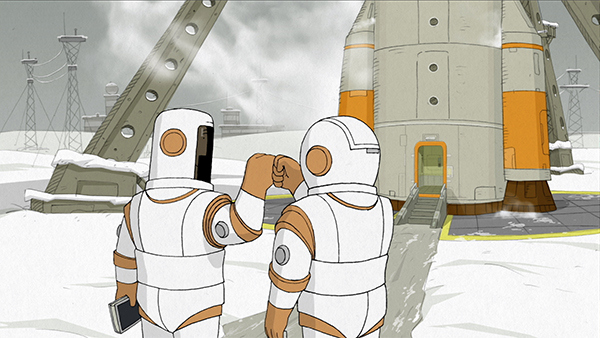
We Can't Live Without Cosmos short film


More effective and affecting is the Russian curio We Can’t Live Without Cosmos from Konstantin Bronzit. The film is about two cosmonauts who are inseparable. They share a deep love of space and one another. The film begins with some goofy humor as the duo work their way through their rigorous training regimen before the film turns into an exploration of loss. There are some indelible images contained within, if not any impressive animation. The turn of events from the thrill of exploration to the dull of devastation is interesting but not necessarily better than the deadpan antics that came before it.
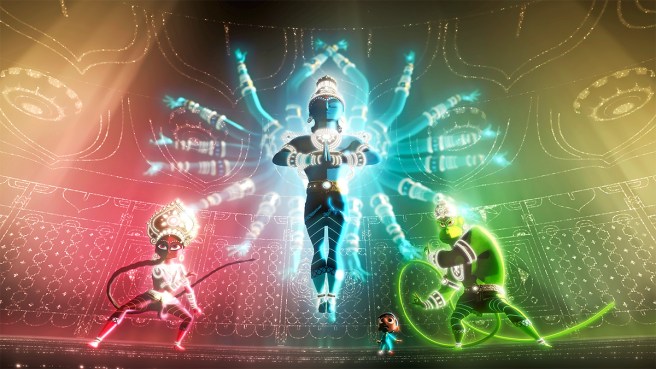
sanjay

Longtime Pixar animator Sanjay Patel gets his first directing credit on the personal Sanjay’s Super Team. The title character is a restless boy who daydreams that he teams up with Hindu gods to defeat a villain demolishing a temple. It’s no surprise coming from Pixar that the short looks fantastic. The sound design is equally stunning with a great blending of the musical score with the action onscreen. If anything Sanjay’s Super Team should have been longer than its seven minutes, as the film brings up some great possibilities that are left mostly unexplored. If you’re searching for an animated look at the complexity of Hindu culture, stick with Nina Paley’s Sita Sings the Blues.

world of tomorrow snow

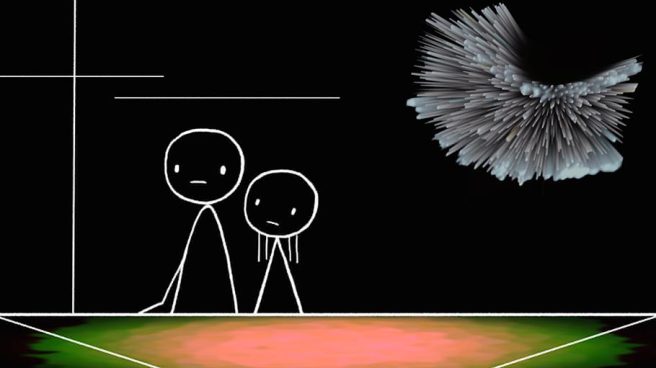
Which leaves us with Don Hertzfeldt’s World of Tomorrow. Hertzfeldt’s film, about a young girl being visited by a clone of herself from the future, is the only nominee that can hold its own with the aforementioned animated features. In a mere 16 minutes World of Tomorrow manages to cram in meditations on love, identity, and loss across a distinctively designed digital landscape. There is enough narrative here for a feature. Hertzfeldt’s decision to keep it confined to a short means that it’s bursting at the seams with ideas. The film is heartrendingly sad yet it brims with a resounding sense of wonder. It’s a film of bleak humor that doesn’t much care if we laugh at it, at ourselves, or at the world. World of Tomorrow is not just the best animated short of the year, it’s one of the very best films–animated, short, or otherwise.

(The 2016 Oscar-Nominated Animated Short Films play exclusively at Landmark’s Guild 45th for two weeks beginning January 29. Note that the program includes an additional four shorts non-nominated that were not available for review.)
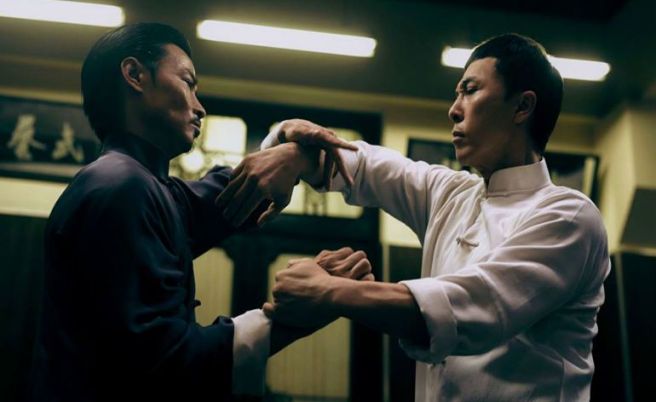
Ip Man 3 (Wilson Yip, 2015) and Monster Hunt (Raman Hui, 2015)

Ip-Man-photo-2

The disaporic film program at the AMC Pacific Place this week features two of the hottest Chinese-language films of the past year: the latest in Donnie Yen’s series about Wing Chun Master Ip Man and the CGI monster-wuxia that took the Chinese box office by storm last summer, breaking records on its way to becoming the highest-grossing local film in the Mainland’s history. The two films represent state of the art variations on the two oldest forms of the Chinese martial arts film, kung fu and wuxia tricked out with digital manipulations and effects, packed with enough celebrity cameos and show-stopping stunts to make even the most generic or implausible story a lot of fun.

Continue reading Ip Man 3 (Wilson Yip, 2015) and Monster Hunt (Raman Hui, 2015)”

Anomalisa (Charlie Kaufman & Duke Johnson, 2015)

anomalisa

One of the last major 2015 releases to find its way to Seattle Screens opens this week at the Guild 45th (we still have 45 YearsArabian NightsIn the Shadow of Women and Knight of Cups to come over the next several weeks), with the release of the latest film from Hollywood’s favorite self-loathing narrative-tangler, Charlie Kaufman. Teamed with co-director Duke Johnson and producers Dino Stamatopolous and Dan Harmon (among others), Kaufman has adapted his own play into a stop-motion animated film about a man (voiced by David Thewlis) who travels to Cincinnati for a conference. Lonely and depressive, he first tries to reconnect with an old flame, then finds himself attracted to a woman in the hotel. She catches his ear (and eye, eventually) because, unlike everyone else (besides him) in his world, she doesn’t look like Michael Ian Black and she doesn’t talk like Tom Noonan: she’s the voice of Jennifer Jason Leigh. A touching night of human (well, puppet) connection is followed by some explicit puppet sex, followed by a nightmare and then a nightmarish world. Like all of Kaufman’s films (both as a director and a screenwriter) it’s an uneasy mix of weird humor and sadness, and like all of them Kaufman refuses to give us the happy ending.

Continue reading Anomalisa (Charlie Kaufman & Duke Johnson, 2015)”

13 Hours (Michael Bay, 2016)

13hours8-1200x500
The prospect of a Michael Bay movie about Benghazi is contemporary American absurdity at its finest. The maker of hugely successful disasters, overblown, crude, racist, misogynistic, incomprehensible, telling the story of one of the most ridiculous issues of our time, a tragedy crudely trumped up into an inane scandal by the basest elements of our political culture. After the jingoistic marketing around Clint Eastwood’s hit American Sniper a year ago (which I believe completely misrepresented that film), how could 13 Hours, in the hands of a far less sophisticated and nuanced filmmaker, hope to be anything but a wildly offensive distortion of history at best, and a piece of vile propaganda at worst? Well, I’m somewhat happy to say that 13 Hours is not nearly as racist as you’d expect it to be. It is crude, it is overblown, it does completely lack subtlety, but Bay, true to his only real belief as a filmmaker (that his movies should amass a fortune), has attempted to make a film that will appeal to all audiences, it sidesteps the kind of cartoonish racism one would expect in a war film set in North Africa and instead appeals to much deeper, much broader base instincts in the American audience: our love of firepower, our distrust of government, our isolationism.

Continue reading 13 Hours (Michael Bay, 2016)”

The Revenant (Alejandro González Iñárritu, 2015)

angry dicaprio.png

There is a moment in Terrence Malick’s To the Wonder where Rachel McAdams and Ben Affleck are inexplicably surrounded by a herd of bison. The pair stand at their car and are awed by the majesty of the moment. And so are we, the audience. In Alejandro González Iñárritu’s new film The Revenant there is also a scene featuring a character stumbling upon some bison. The moment strives for a similar feeling of, well, wonder, but fails to deliver. It’s the approaches of these two filmmakers that spells all the difference. In Malick’s world an experience like that feels like luck, a chance encounter with real, live animals. And it’s also fleeting, a moment in a waterfall of moments that burns in your brain because it feels so fragile. In The Revenant everything is so rigorously composed, from the camerawork (filmed by longtime Malick associate Emmanuel Lubezki) to the herd itself, a computer-generated stampede heading to the end of the frame before disappearing, literally, forever.

It’s these moments in The Revenant that manage to shoot an otherwise pretty decent survivalist Western in the foot. When González Iñárritu is committed to the straightforward nature of his simple story, which is about a trapping scout who has to brave the elements to save his life and avenge a loved one, the film works well. There is a great sense of atmosphere and the occasional thrill. But whenever he grasps at poetry or pulls out a flashy camera trick–both of which happen often–the film flounders.

The film opens with a raid on a poacher’s encampment in which González Iñárritu throws the camera right in the middle of the action with sweeping, unbroken takes. While the technique is intended to feel visceral and immediate, it comes off like playing a video game. A similar problem crops up when steam or blood appears on the camera lens. Attempting to provide a thrilling verisimilitude, these elements just remind the viewer that there is a camera there, a move more distancing than inviting.

revenant mountain

González Iñárritu is a competent director but he’s a far too confident one for his capabilities. His misplaced desire to make this film more important than it is sabotages its better qualities. The same could be said for star Leonardo DiCaprio who grimaces, grunts, and groans his way through increasingly desperate–and subsequently sillier–circumstances. DiCaprio plays the story so straight that it teeters on the brink of collapse. Early on he fights a bear and it is terrifying. Two hours later, after being chased, shot at, abandoned, and nearly frozen, he falls off a cliff with his horse. By this point it has gone from harrowing to hilarious.

All of the issues with The Revenant are best summed up by its final moments. As the film comes to its entirely expected conclusion, Lubezki’s camera lingers on a shot of a snowy bank and an icy river. There is nobody in the frame, just the frigid water and a pool of blood. It’s a perfect shot to end a movie about the harsh worlds of nature and man. Instead González Iñárritu tacks on two more shots, closing with the worst decision in the entire film. In an effort to make something serious and smart, González Iñárritu ended up with something dopier than dumb and fun.

Mr. Six (Guan Hu, 2015)

mr-6

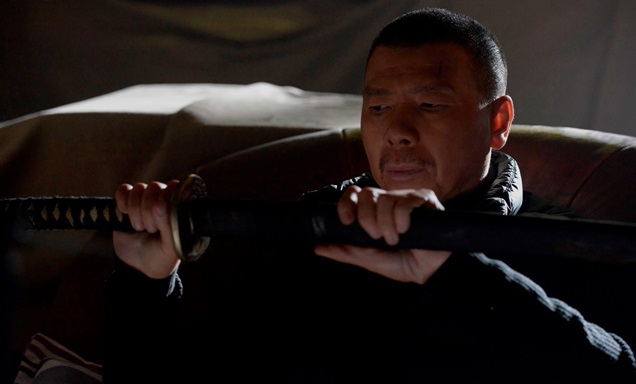
Playing this week at the Pacific Place is Mr. Six, a gangster drama which earned star Feng Xiaogang the Best Actor award at this past Golden Horse Awards (which are held annually in Taiwan and honor Chinese-langauge film). Feng plays Mr. Six, an aging Beijing street tough, now in his late 50s, who gets caught in a rivalry with a much younger gang. With the deliberate pace of Sixth Generation realism, director Guan Hu deemphasizes the more lurid elements of the Chinese gangster film, focusing instead on Mr. Six’s character and the ways in which he interacts with a Beijing vastly different than the one he dominated in the 1980s. As such, the film provides a wonderful showcase for Feng, a director of popular comedies and occasional actor, whose best known work in the US is probably his dark and very serious 2006 Hamlet variation The Banquet, which starred Zhang Ziyi, one of the overblown period films that followed the success of Crouching Tiger, Hidden Dragon and Hero early in this century. His Mr. Six is amiable and steely, a quiet authority barely concealing depths of anger and disappointment.

Continue reading Mr. Six (Guan Hu, 2015)”

The Hateful Eight (Quentin Tarantino, 2015)

hateful jackson

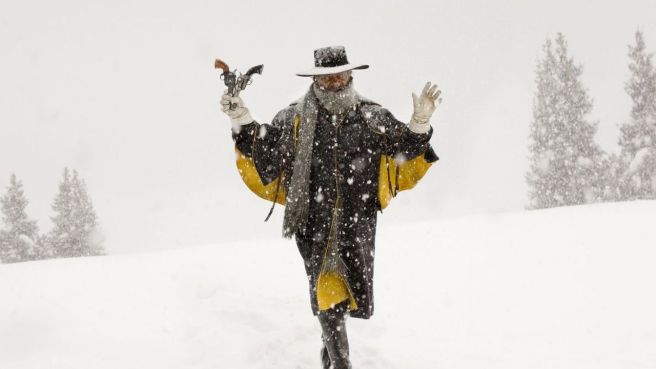
Quentin Tarantino returns to screens this winter with the ultra-violent Western, The Hateful Eight. The story brings together a despicable coterie of villains and pits them against one another in a remote snowed-in outpost. As with every Tarantino film, The Hateful Eight is violent, verbose, and visually sumptuous. This one is also a movie of reflection, a conscious callback to the single setting bravura of the filmmaker’s debut, Reservoir Dogs. The film reunites the director with Dogs co-stars Michael Madsen and Tim Roth, as well as a who’s-who of other acolytes including Kurt Russell, Zoe Bell, and the ubiquitous Samuel L. Jackson.

The film is reportedly also about Tarantino working through his feelings about John Carpenter’s horror film, The Thing, released in 1982. The Hateful Eight contains many conscious nods to the previous film, including its frigid setting, the casting of Carpenter favorite Kurt Russell, gruesome imagery, and best of all, the return of cinema’s greatest composer, Ennio Morricone, who in addition to creating new music for the film, incorporated unused elements from his Thing score. The current three-hour roadshow version begins with a traditional overture, with Morricone’s haunting melodies playing out uninterrupted as the theatre lights dim. This is one of life’s greatest pleasures.

Continue reading The Hateful Eight (Quentin Tarantino, 2015)”

Mustang (Deniz Gamze Ergüven, 2015)

Mustang girls in car

“Are you afraid?” said the North Wind.

“No!” she wasn’t.

                –“East of the Sun and West of the Moon”

It might be tempting to read Deniz Gamze Ergüven’s beautifully confident feature film debut, Mustang (France’s official entry to the Academy Awards), exclusively as a portrait of the situation women face in Turkey today.  The situation, while it should  continue to concern those interested in in women’s rights , however, is too complex to be contained by a film that traces the story of one family of daughters in one part of Turkey, and I do not believe Erguven’s film should be, or is even intended to be, reduced to an examination of the particular issues faced just by women in the filmmaker’s own country, however much the story is, in fact, inspired by her experiences there and by her concern for Turkish women. She has noted  for example, that the inciting incident at the film’s beginning is one very similar to an episode in her own childhood, and she has also said that she “put many . . . stories that I heard in Turkey into the film.”

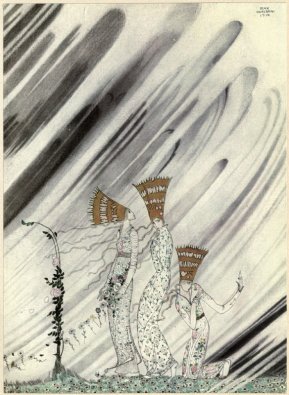
So while the film is, certainly, culturally specific in significant ways, it reads more as a fairy tale or a folk tale than as a slice of life story.  As such, its themes resonate as much for me, an American woman, as they might for anyone. Folk tales invite us to consider direct applications for the readers, and here, viewers might do the same, apply and identify. The five sisters at the center of the story and living at the edge of the Black Sea are very much like the sisters you might find in the Norwegian tales of East of the Sun and West of the Moon  collected by Peter Christen Asbjørnsen and Jørgen Engebretsen Moe, a book, gorgeously illustrated by Kay Nielsen, that I grew up with and pored over, and, embracing any hints of fantastical Other, identified with.

Three Princesses of Blue Mountain

Continue reading Mustang (Deniz Gamze Ergüven, 2015)”

Concussion (Peter Landesman, 2015)

will_smith.0.0

I was a most unlikely football player. As a 5’10”, 110 lb, 14 year old high school freshman, I literally knocked myself out for a few seconds attempting a tackle. The coaches didn’t let me play the rest of the game, or much of any other game, after that. I was mad at the time, all I wanted to do was play, but in retrospect, they probably saved my brain a lot of damage. The thing is, if I was 50 pounds or so bigger, they probably would have sent me right back on to the field.

Anyway, Concussion, opening this week just in time for the final two weeks of football season, is kind of terrible. It stars Will Smith in an Oscar-grubbing performance as Dr. Bennet Omalu, a Nigerian immigrant pathologist who first discovered evidence of brain damage in former NFL players (he did the autopsies for former Pittsburgh Steelers Mike Webster and Terry Long). Not content to be a scientific procedural, a social problem film along the lines of Spotlight, the film grafts an inspirational biopic onto the story. As with The Theory of Everything, Hollywood can’t seem to tell the story of a man of science without framing him as an instrument of specifically Christian theology (Omalu is apparently a practicing Catholic). In fact, more than anything the film is a Christian parable about a man who is tested by God: shown a glimpse of a Truth, he is tested in his resolve to defend and promulgate (evangelize) that Truth. That this serves to make the scientific findings of a Nigerian doctor more palatable for Red State apple pie God and Football moms in the Real America is surely not lost on the filmmakers. It just makes the whole thing very creepy.

Continue reading Concussion (Peter Landesman, 2015)”

Mojin: The Lost Legend (Wu Ershan, 2015)

la-et-mn-capsule-mojin-movie-reviews-20151218

International treasure Shu Qi stars in this blockbuster effects-action film out of China, opening this week at the Pacific Place. One of a trio of grave robbers, Shu and her compatriots Chen Kun and Huang Bo find themselves roped into a scheme to dig up a MacGuffin from an ancient tomb by a creepy cult leader and her armed gang of nobodies. Deadly traps, zombies, colored lights and CGI adventure follow, with all the weightless, personality-free sheen of 21st century Chinese digital cinema. Directed by Wu Ershan, the man behind 2012’s Painted Skin: The ResurrectionMojin has some potentially intriguing ideas at its core, but one has to dig deep to find them.

Continue reading Mojin: The Lost Legend (Wu Ershan, 2015)”