SIFF 2015 Preview: Week Two

Screen Shot 2015-05-10 at 11.11.58 PM

The 2015 edition of the Seattle International Film Festival continues this week and we here at Seattle Screen Scene are planning more extensive coverage. We’ll be watching and reviewing as many festival films as we can over and highlighting some you may want to check out. As a preview, here’s a list of some of our most-anticipated films from the festival’s second week. We’ll add links to the titles here as we review them.

Week of May 22 – May 28:

Unexpected – The second of two films starring Cobie Smulders at this year’s festival. She plays a teacher who becomes pregnant and bonds with a student who is also pregnant. Directed by Kris Swanberg.

Dreams Rewired – An exploration of our technological anxieties and dreams, with archival clips from hundreds of films and newsreels and narration by Tilda Swinton.

Heaven Knows What – A gut-punch of a movie from Joshua and Ben Safdie about homeless junkies featuring a stunning performance from Arielle Holmes, the film is based on her own memoir.

The Golden Era – Hong Kong great Ann Hui’s lovely biopic about 1930s writer Xiao Hong features an excellent lead performance from Tang Wei and a subtly unusual approach to the literary biopic genre.

The Apu Trilogy – Probably the event of the festival, if not the year, as restored versions of Satyajit Ray’s three films play back-to-back at the Pacific Place on Sunday.

Overheard 3 – The third in a series of films about cops using listening devices to track financial misdeeds in contemporary Hong Kong, with Don’t Go Breaking My Heart stars Louis Koo and Daniel Wu. You don’t need to have seen the first two: each film in the series follows completely new characters and stories.

The Dark Mirror – Robert Soidmak’s film noir from 1946 in which Olivia DeHavilland plays twins one or both of whom may have committed a murder.

Caught – Another noir, this one from Max Ophuls and starring Barbara Bel Geddes as a woman trapped in a marriage with James Mason.

Kurmanjan Datka: Queen of the Mountains – Historical epic from Kyrgyzstan about a woman who unites various warring tribes.

Don’t Think I’ve Forgotten – Documentary about pop and rock musicians in Cambodia in the days before, during and after the Khmer Rouge.

Satellite Girl and Milk Cow – This Korean animated film probably has the best title of the festival, and it doesn’t even mention the enchanted toilet paper roll.

Mistress America – A last minute add is the local premiere of the latest collaboration between Noah Baumbach and Greta Gerwig, the creators of Frances Ha.

SIFF 2015 Report #1: Results, Back to the Soil, Beyond Zero 1914-1918, Natural History

This is part of our coverage of the 2015 Seattle International Film Festival.MV5BMjI4MjczMzU4Nl5BMl5BanBnXkFtZTgwMDgwNjQ3NDE@._V1._SX640_SY346_

Quickly recapping the first weekend of the 2015 Seattle International Film Festival, here’s what I managed to catch:

Results – Andrew Bujalski’s follow-up to the highly-acclaimed Computer Chess takes a left-turn into conventionality with a rom-com packed with recognizable Hollywood stars, but one that happily retains the goofy spirit of its more experimental predecessor. Cobie Smulders (“the other woman from The Avengers” as I overheard her defined in the pre-show line-up) plays a personal trainer working for and occasionally sleeping with Guy Pearce, a nice guy who genuinely believes his self-help mantras, even though they’re spoken in Pearce’s always-weird-sounding (to me) natural accent. They’re hired by the recently-divorced and now surprisingly wealthy (an unexpected inheritance) Kevin Corrigan, who, having failed in his own clumsy attempts to woo Smulders, schemes to get the two beautiful people together. Light and ambling, the film has a gentle rhythm that allows ample time for the cast (rounded out by such reliable Hollywood eccentrics as Anthony Michael Hall and Giovanni Ribisi) to have fun as the plot, such as it is, slowly unfurls. Rather than driven by situation as most contemporary Hollywood romantic comedies are, cursed by the conventions of television, Results flows instead out of the weirdness of its characters, the relationships and motivations between them falling into place so gradually that their inevitability goes unnoticed for much of the film. It isn’t as obviously wild as Computer Chess, but it’s just as unusual a creature in the contemporary film world: a classical romantic comedy.

Back to the Soil – In this short film, experimental filmmaker Bill Morrison reedits his grandfather’s filmed account of Jewish settlers in the Soviet Union in the late 1920s. The landscapes look disastrously harsh, though that may just be the grainy black and white making lush fields of wheat look like vast, featureless plains of mud and rock. As it’s the repurposing of another person’s footage, not only are we attempting to figure out what the people in the images are thinking (grim determination, the spirit of bold adventure, hope, desperation?) but also what the filmmaker was thinking: why did he choose to capture these images? On-screen titles denote the locations, the number of settlers and the total acreage of the colony for every space, an actuarial foundation for ghostly images.

IHfZ6F3

Beyond Zero 1914-1918 – Matched with that is Bill Morrison’s feature, showing harrowing found footage of World War I as it survives in various states of decay. Edited into a kind of narrative order (buildup to war, some fighting, casualties, machinery: tanks and aircraft) at one remove thanks to the dissolution of the celluloid (what we’re seeing are digital images of film frames). The analogy of the disintegrating film and our societal forgetfulness is obvious but no less compelling. Same goes for the score performed by the Kronos Quartet (Morrison apparently (these are the only two of his films I’ve seen) often works with contemporary and avant-garde composers, this score is by Aleksandra Vrebalov). The film begins and ends with its best shots: first, ghostly tanks rumbling in and out of a blue mist; second, an aerial dogfight filmed from the ground, the loser parachuting into the void, floating through the clouds and never reaching the ground, a shot that remained me of no less than the final shot of Ran.

natural history – James Benning’s latest was greeting with a sense of frustration by the SIFF Film Center audience. No less than 14 people walked out of the auditorium, which, given the intimate space’s uncovered wooden floors, added much to the film’s soundtrack. A series of static shots of spaces and things behind the scenes at the Museum of Natural History in Vienna, held for varying lengths of time for no immediately apparent reason (though I suspect there is a precise logic to it), the first walkouts began 10 minutes in and continued in a steady stream for the next half hour or so (I wonder what would happen if you mapped the space between the walkouts to the time-length of the various shots of the film). But what can I say, I thought the movie was really funny. Some of the fun was simply in making alien seemingly simple shapes, the extreme length of the take forcing me to abstract a shot of a room into its constituent visual elements, finding weirdness in the mundane. Some seem like tricks: staring at a shot of stuffed polar bears for five minutes, I began to wonder what size they were: given the context around them (some shelves, a power outlet) they seem much smaller than they should. Some just seem like a kind of playful torture for my desire for order: why isn’t that one butterfly lined up straight? Fix it! Also: Pig-Man! I don’t know about the half the audience that stayed through the whole thing, because I didn’t hear anyone else laughing, but I thought it was delightful.

SIFF 2015: Snow on the Blades (Setsurô Wakamatsu, 2014)

This is part of our coverage of the 2015 Seattle International Film Festival.

SnowOnTheBlades_Still02

A measured, thoughtful samurai film set in the transition years between the fall of the Tokugawa Shogunate and the rapidly modernizing Meiji period, in 1860s Japan, Snow on the Blades follows a lone samurai’s quest for redemption as the world changes around him. Sporting the glossy sheen that’s become the dominant visual style of historical epics in recent years, every snowflake a brilliant white, every earth tone deep and rich, every camellia a signifier, it presents a sharp ideological break with its forebears, the contemplative samurai epics of the 1950s and 60s, most especially Masaki Kobayashi’s Harakiri (and its 2011 remake by Takashi Miike). Rejecting the simple one-to-one allegory of the samurai ethos as stand-in for the military dictatorship that so disastrously led Japan into World War II, director Setsurô Wakamatsu’s film seeks out a kind of middle ground, condemning the brutality at the heart of the code while extolling the heroism of the men and women who killed (themselves and others) to enforce it.

Continue reading “SIFF 2015: Snow on the Blades (Setsurô Wakamatsu, 2014)”

SIFF 2015: Seoul Searching (Benson Lee, 2015)

This is part of our coverage of the 2015 Seattle International Film Festival.seoul searching ladies

Seoul Searching is set in 1986 at a summer camp created for foreign-born Korean teens to get reacquainted with the culture of their ancestors. Kids from all over the world are flown in to learn of Korean traditions and history. The opening voiceover explains that the program, which was indeed an actual project undertaken by the government, was ultimately abandoned because the unruly youth were too much to handle. Their counselors and teachers could not keep the kids in check. There’s a lot of potential here for comedy in the cultural clash and drama in the generational divide. Unfortunately, Seoul Searching chooses to rely on tired tropes instead of showing us something–frankly, anything–new. Continue reading “SIFF 2015: Seoul Searching (Benson Lee, 2015)”

SIFF 2015: Virtuosity (Christopher Wilkinson, 2014)

This is part of our coverage of the 2015 Seattle International Film Festival.

virtuosity clapboard

Every four years the best young pianists in the world descend upon Fort Worth, Texas for the Cliburn Competition, the World Series of people playing impossibly complex classical music. The eventual winner is bestowed with an instant career of studio recordings and global performances. The losers get by, biding their time before entering their name again 48 months later. Christopher Wilkinson’s serviceable if occasionally busy documentary tracks roughly a half dozen contestants at the 2013 competition.

Documentaries that shine a light on a specialized subset of society have become so commonplace that it feels as though every two-bit convention and cult oddity has already been unearthed and overexposed. With this saturation comes a familiarity with the narrative’s conventions. To Virtuosity‘s detriment, we can tell just by the camera’s focus who is going to make the finals, long before the names are announced. On the other hand, the film has a natural villain hanging out on the margins and it chooses to let him recede, sidestepping an easy angle. (It would have been a fun bit of schadenfreude to see this confident man fail, however, had he been given more opportunities to hang himself.)

Screen Shot 2015-05-10 at 10.55.03 PM

While the film is mostly focused on the performances and the personalities of the pianists (“artists” doesn’t feel like the right word for these technically impressive but creatively quiet individuals) the narrative does find time to wander down a few side avenues. The most interesting thread highlights two different critical analyses of the same performer that basically exposes the whole notion of competition at this expert level as a sham, dependent upon the fickle whims of an older generation the world has already passed by.

Speaking of getting passed by, the most tantalizing story here is the one left untold. What happens to these talented individuals once the competition ends? What paths do these kids follow once they’re considered simply the the sixth best pianist in the world? One character alludes to being dropped back on the street. That is a sequel worth paying to see. Call it Reality.

(Virtuosity plays 5/20 at SIFF Cinema Uptown, 5/21 at the Harvard Exit, 5/24 at Lincoln Square.) 

SIFF 2015: Temporary Family (Cheuk Wan-chi, 2014)

This is part of our coverage of the 2015 Seattle International Film Festival.19912102

Reading the description for this comedy about people in the Hong Kong forced to share a luxury flat while they try to flip it in an over-competitive bubble market, I was hoping for a Hong Kong version of The More the Merrier, the 1943 George Stevens movie in which Jean Arthur and Joel McRea are forced to share an apartment in wartime Washington DC and are maneuvered into love by their third roommate, the portly, angelic goofball Charles Coburn. And my hopes were more or less fulfilled. Like the Stevens film, it’s a screwball but with a slower pace and deeper heart that its immediate generic predecessors (for the earlier film, the verbal anarchy of Howard Hawks and Preston Sturges; for the new one, the tangled webs of Wai Ka-fai and Johnnie To’s consumerist rom-coms like The Shopaholics or the Don’t Go Breaking My Heart movies). Both movies have thin premises stretched almost farther than they can go, a delicate balance of cynical humor and dopey romanticism with a liberal amount of schmaltz.

Continue reading “SIFF 2015: Temporary Family (Cheuk Wan-chi, 2014)”

The Triplets of Belleville (Sylvain Chomet, 2003)

triplets-of-belleville

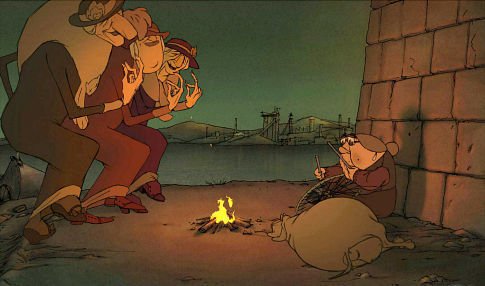
We at Seattle Screen Scene find ourselves deep in preparation for the Seattle International Film Festival (we’re planning extensive coverage, look for our preview sometime early next week), but before we start rolling that out, here’s our Featured Film of the week, Sylvain Chomet’s 2003 Oscar nominee for Best Animated Film, The Triplets of Belleville. Like that year’s Oscar winner, Finding Nemo, the movie is about a parent searching for their lost child, questing through a strange and wondrous world, having adventures and finding help along the way. But otherwise the two films couldn’t be more different, Bellville abandoning the impressive photo-realism of Pixar’s crisp computer images for a highly stylized reality, bodies and shapes distended and distorted in extreme art nouveau parodies of pale yellows, browns and greens, earthy and bilious, daring you to call it ugly.

It opens, as all great films do, with a cartoon. A black and white parody of the 1930s Warner Bros animated shorts that featured celebrity caricatures, with a Django Reinhardt (who looks weirdly like William Powell), a Josephine Baker (the men in the audience, transformed by the eroticism of her dance, turn into psychotic monkeys who rush the stage and steal all the bananas off her skirt) and Fred Astaire who tap dances right out of his shoes, which then grow mouths and devour him like carnivorous Cronenbergian beasts. Right away you know you’re in for something special.

triplets-of-belleville-french-waiter-youtube

The quest plot follows a woman’s search for her grandson. He’s kidnapped while cycling in the Tour de France and she (along with his faithful dog Bruno) follow his abductors to the city of Belleville, a version of New York City. She’s aided in the search by the eponymous trio, elderly jazz musicians (they sang in the opening cartoon, in their youth) who find rhythm in unlikely household objects and have questionable dietary practices. Food is actually pretty disgusting throughout the film, a part of Chomet’s twin critiques of French and American culture: America is fat and disgusting, the source of overcrowded and soulless modernity; France is pretty gross too, but at least has an appreciation for the finer things in life like wine, jazz and bicycling.

Almost entirely lacking in dialogue (what there is it isn’t necessary to translate), the film is nevertheless resolutely aural, every effect a calculated addition to the symphonic whole, following in the tradition of Jacques Tati (even if you didn’t know Chomet would go on to adapt Tati’s The Illusionist, the reference is obvious: Belleville prominently features a M. Hulot’s Holiday poster, a weather vane in the shape of Tati from Jour de fête and even an actual clip from that same film (in which Tati plays a bicycle-riding mailman)). Similarly, while severely distorted, the bodies in the film follow a ruthlessly inviolable logic: giant mobsters with huge upper bodes and tiny legs dwarf the cars they ride in, as they stand through the sun-roofs of those cars in the final chase sequence, the balance of the vehicle is thrown off and sharp turns cause them to flip over, the villains doomed by their own enormity; a maitre’d so literally spineless in his obsequity that he literally leans over backwards, his head flopping back-to-front and side-to-side. What appears to be simple chaotic weirdness is in fact carefully constructed and calculated to achieve a specific effect, which I guess is a reasonably good definition of jazz.

A wickedly funny, strangely poignant and wildly inventive film, The Triplets of Belleville plays Friday through Tuesday this week at the Central Cinema, whose clever programmers have paired it with another classic about bicycling, the 1986 Hal Needham BMX film, Rad, with Lori Laughlin.

Clouds of Sils Maria (Olivier Assayas, 2014)

sils-maria02

The latest from French director Olivier Assayas finally makes its way to Seattle screens this week, opening at Landmark’s Seven Gables Theatre. It stars Juliette Binoche as a very Binochian actress, highly accomplished in both the commercial and artier realms of her trade, as she reluctantly takes on a role in a play by the writer who gave her her big break at age 18. The play is about the toxic relationship between an older businesswoman and her ambitious young intern, and Binoche, having played the young half 20 years earlier, is now asked to take on the older part, a character whose weakness she despises. Kristen Stewart plays Binoche’s assistant, young and plugged into the world, who encourages Binoche to see the play and its characters in a new light. The bulk of the film follows their discussions as they practice lines in the picturesque Swiss Alps, and their relationship draws some expected parallels and unexpected divergences from the play itself.

Continue reading Clouds of Sils Maria (Olivier Assayas, 2014)”

Kung Fu Jungle (Teddy Chan, 2014)

kfj-pics-1The latest acclaimed Hong Kong film to sneak onto Seattle Screens at the AMC Pacific Place (following Johnnie To’s Don’t Go Breaking My Heart 2 and Tsui Hark’s The Taking of Tiger Mountain, among other recent hits) is a new collaboration between director Teddy Chan and star/choreographer Donnie Yen. The two were previously paired in Chan’s 2009 period adventure film about Sun Yat-sen, Bodyguards and Assassins, but this new film is more in line with Yen’s present-day cop films SPL and Flash Point, both made with director Wilson Yip. Yen plays a kung fu expert serving a prison sentence for accidentally killing a man in a duel. Three years into his term, the cops are on the hunt for a serial killer, one who appears to be targeting kung fu experts. Donnie volunteers his services to track down the killer, but of course he knows more than he’s letting on. As with the Yip films, the action is brutally physical, aided in no small measure by CGI special effects, the impact of which is still working its way uneasily through the language of Hong Kong action cinema.

Continue reading Kung Fu Jungle (Teddy Chan, 2014)”

Oklahoma! (Fred Zinnemann, 1955)

7bcd91571fc1119e87d81e1054255e73_567x210

The Cinerama’s Saturday Classics series concludes this weekend with the laser projection of 1955’s smash hit musical Oklahoma!. The following is the review I wrote of the film last year, after finally bringing myself to watch it all the way through.

Richard Rodgers and Oscar Hammerstein II are generally credited with ushering in a Golden Age of musical theatre, this 1943 play marking the first truly integrated show, with music, lyrics and story seamlessly interwoven. Of course it wasn’t the first (Show Boat did much the same thing 15 years earlier, to say nothing of the operettas from the 19th century onward that did as well, but whatever), but it was a huge hit, inspiring many imitators, some of which are actually good. Similarly, the 1955 film adaptation was followed by a new form of musical film: more or less direct translations of stage musicals, often excruciatingly long, presented as roadshow extravaganzas (more expensive tickets, super widescreen formats, elaborate sets and locations). These films, increasingly bloated and dull, eventually killed the musical as a viable American film genre and played no small role in bankrupting the studio system that had been in place in Hollywood since the 1920s.

Continue reading Oklahoma! (Fred Zinnemann, 1955)”