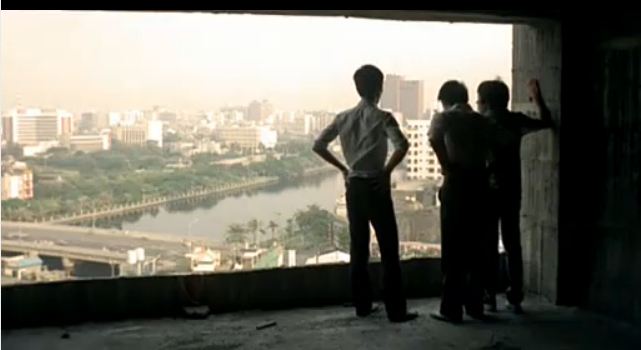
The Boys from Fengkuei (Hou Hsiao-hsien, 1983)

6a014e86c28c66970d01675f0c40cb970b-800wi Seattle’s Hou Hsiao-hsien Retrospective kicked off last night with his fourth feature and self-proclaimed “first real film”. It followed a trio of totally pleasant romantic comedies starring Hong Kong pop star Kenny Bee, who was then trying to make it as an actor in Taiwan. Already in those films Hou was demonstrating some of the tropes that would recur in his later work, most especially an emphasis on space and the placing of characters within their environments, explicitly the theme of two of those films, Cute Girl and The Green, Green Grass of Home, with their contrasts of rural and urban life. But after a pair of fortuitous and near-simultaneous meetings (with author Chu Tien-wen and the young directors that would make up the New Taiwanese Cinema) that would turn into career-long collaborations, Hou began a sharp move away from the generic and formal strictures of mainstream cinema toward a more personal and idiosyncratic vision.

Continue reading The Boys from Fengkuei (Hou Hsiao-hsien, 1983)”

The Seattle Hou Hsiao-hsien Retrospective

23cp_outtakes_hou__1307319g

My pick as one of the Top Three Greatest Living Motion Picture Directors, Hou Hsiao-hsien, gets the retrospective treatment over the next ten days at a trio of terrific venues across Seattle. It’s a truncated version of the complete retrospective organized by Richard I. Suchenski (Director, Center for Moving Image Arts at Bard College), in collaboration with the Taipei Cultural Center, the Taiwan Film Institute, and the Ministry of Culture of the Republic of China (Taiwan), that has been traveling the world for the past six months. The Grand Illusion and the Northwest Film Forum have joined forces to present five of Hou’s very best films on 35mm (each movie plays one night at each theatre), while Scarecrow Video supplements the series with five additional movies, presented on video free of charge in its Screening Lounge. I’ll even be there introducing movies at each venue, covering six movies in total over the next nine days.

Continue reading “The Seattle Hou Hsiao-hsien Retrospective”

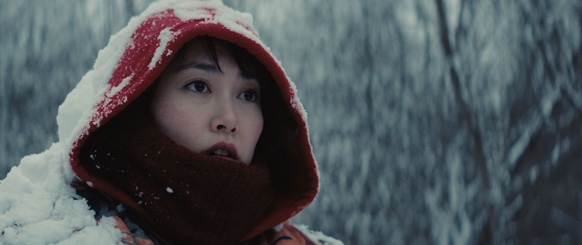
Kumiko, the Treasure Hunter (David Zellner, 2014)

kumiko snow

There is a lot to like about Kumiko, the Treasure Hunter. The hypnotic soundtrack by The Octopus Project is a delight. At its center is a wonderful performance from Rinko Kikuchi. Best of all is the premise. The film, based on a true story, is about a Japanese woman who believes the events depicted in her VHS copy of Fargo are real and that somewhere in the Midwest lies a bunch of money, buried in the snow by a bloodied Steve Buscemi.

An engaging opening twenty minutes establishes Kumiko as a fish-out-of-water in her homeland. She steadfastly refuses the hollow aspirations pinned on her by family and society, be they marriage or a cushy job. When tasked with watching a child for a few minutes, Kumiko panics and runs away. Unfortunately, the film becomes much more obvious once she arrives as a fish-out-of-water in America. From here, the movie mostly deals in scenes of the fanatical, clearly demented young woman (we never once explore Kumiko’s very real pain) as she gets a blitz-in-a-blizzard of Minnesota nice.  Continue reading Kumiko, the Treasure Hunter (David Zellner, 2014)”

Hitchcock at the Uptown

tumblr_mx1nuirpOe1qhsqm1o1_1280Without much fanfare, The SIFF Uptown this week is playing five of the greatest movies ever. Perhaps the lack of publicity (it isn’t even mentioned in this week’s SIFF newsletter (Edit: well, it wasn’t in the first one I got for this week, it was in the second one)) is due to the fact that these films are hardly strangers to Seattle screens, or perhaps because they’re all screening digitally instead of on film. But regardless, the fact remains that there are few better ways to spend your cinematic weekend than watching a half dozen Alfred Hitchcock films in a movie theatre.

Continue reading “Hitchcock at the Uptown”

Wild Tales (Damián Szifron, 2014)

WildTales000077-0-800-0-450-crop

Two of the nominees for this past year’s Academy Award for Foreign Language Film see Seattle Screens for the first time this week, with the Grand Illusion showing Germany’s Beloved Sisters while the Seven Gables opens the Argentine film Wild Tales. It’s somewhat of an identity shift for the two venerable U-District theatres, because (as Charles Mudede points out on The Stranger’s blog) as one would expect to find the lushly costumed biopic of a famous poet thrilling the aged crowds of Landmark’s living room while the none-more-black revenge tale sextet would find a natural home on the GI’s genre-freaky calendar. But times change and with today’s diminished Landmark (a mere three first-run screens, down from 24 when I started working for them oh so many years ago), tough programming choices must be made. Not having seen the German film, I’m pretty sure Landmark made the right call, as Wild Tales is the kind of movie that should be a decent hit, if it can find its audience.

Continue reading Wild Tales (Damián Szifron, 2014)”

Ballet 422 (Jody Lee Lipes, 2014)

ballet422

Ballet 422, which opens this week at the Sundance, owes a very great debt to the great documentarian Frederick Wiseman (seen recently haunting Seattle Screens with his National Gallery) especially his dance films (Ballet, La Danse and Crazy Horse). The film follows 25-year-old dancer/choreographer Justin Peck as he has two months to put together the New York City Ballet’s 422nd original production, his first choreographic work on such a large scale. As in the Wiseman films, the movie consists mostly of length footage of people at work, proceeding from the early rehearsal stage through the final performance, with occasional looks at the backstage workers (particularly the wardrobe department) and “pillow shots” (prominently close-ups of shoes, a favorite subject in the Wisemans as well) providing syncopating breaks in the narrative. As with Wiseman, there are no direct-to-camera interviews or explanatory voiceovers; the cinematic apparatus remains for the most part invisible (though there is a moment when the cameraman hilariously realizes he can see himself in a rehearsal mirror and quickly reframes himself out of the shot). Lipes does employ a very few un-Wiseman-like explanatory title cards, which are necessary in the beginning to set the story, but also serve to mark time as the clock ticks on our hero’s deadline.

Continue reading Ballet 422 (Jody Lee Lipes, 2014)”

Buzzard (Joel Potrykus, 2014)

BUZZARD_Still3

Marty Jackitansky works as a temp at a mortgage company. He takes three-hour breaks, reads comic books at his desk, and orders office supplies so he can flip them for a cash refund. His life is an endless parade of desperate scams that net him $20 here, $30 there, the effort of which is clearly not worth the payoff. But Marty keeps doing it anyway because he believes he’s sticking it to the Man. And because he’s a total moron. Marty is like an adult Butt-head who grew up without a Beavis by his side. He listens to metal, eats terrible microwaveable food, and makes stupid decision after stupid decision.

Marty also happens to be the subject of writer-director Joel Potrykus’s new film, Buzzard. The film begins with a lingering shot of star Joshua Burge’s face. Rarely does the camera leave it for the next ninety minutes. Burge’s excessive features give Marty an alien look, well-suited for his character’s isolation. His bulging eyeballs are frequently deployed to convey Marty’s relentless desperation.

Continue reading Buzzard (Joel Potrykus, 2014)”

12 Golden Ducks (Matt Chow, 2015)

16373802198_ccb18997c2_b  As one Matt Chow movie leaves AMC’s Pacific Place this Thursday, another one opens on Friday, as his collaboration with director Wilson Yip Triumph in the Skies leaves Seattle screens and is replaced by 12 Golden Ducks (both films were released on February 19th in China, part of the Lunar New Year festivities that are the peak of the Chinese movie-going season, like if the US crammed all their releases between Memorial Day and Independence Day into one single week). I haven’t had a chance to see it yet, because it’s so new and because it’s playing as part of AMC’s Asian-Pacific Film program, which doesn’t ever seem to advertise or screen anything for mainstream audiences or critics (this has been the case with several releases in recent months, including major films such as Johnnie To’s Don’t Go Breaking My Heart 2 and Pang Ho-chung’s Women Who Know How to Flirt are the Luckiest and (more or less) Tsui Hark’s The Taking of Tiger Mountain). Given the lack of attention the release of 12 Golden Ducks is likely to receive, we hope this preview post will be somewhat helpful, absent an actual review.

Continue reading 12 Golden Ducks (Matt Chow, 2015)”

Maps to the Stars (David Cronenberg, 2014)

Screen-Shot-2014-06-25-at-11.35.27-AM

The latest from Canadian director David Cronenberg finds him, for the first time, working in America (well, he was here shooting for five days, which is not nothing). Specifically Hollywood, which is a kind of America only in the very loosest sense. He finds it a tangled wasteland of venality and corruption, naturally enough, but one especially marked by all manner of family relationships gone horribly wrong. Julianne Moore (in a performance that might have won her the Oscar in an alternate world where such awards don’t automatically go to the most diseased performance) plays an aging actress trying to win a role that her mother played 30 years earlier. Said mother is now deceased, having died in a fire some years before, and may have sexually abused Moore as a child. She works through these issues with her therapist, John Cusack (his technique with her is talking-while-massaging, though he appears to make his money primarily via infomercials  and airport speaking engagements). Cusack and his wife, Olivia Williams, struggle to maintain their 13 year old son’s acting career while dreading the reappearance of their daughter (Mia Wasikowska), who has been in a sanitarium for seven years after she tried to marry her brother while setting the family home on fire. Wasikowska, through her internet-friendship with Carrie Fischer (playing herself, I guess), gets a job as Moore’s personal assistant and carries on a tentative romance with a chauffeur played by Robert Pattinson (a demotion from his starring role in the last Cronenberg film, Cosmopolis, in which he spent most of the film being driven around town in a limo). Drugs, violence, more incest and more fire ensue.

Continue reading Maps to the Stars (David Cronenberg, 2014)”

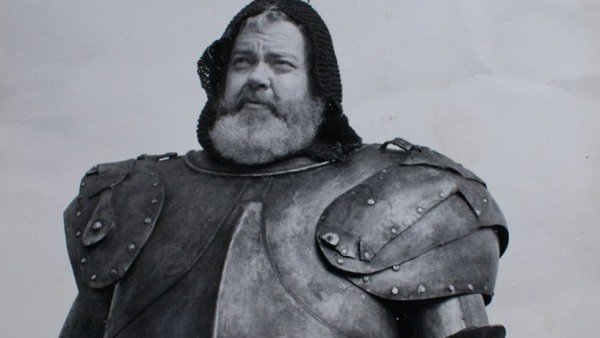
Chimes at Midnight (Orson Welles, 1965)

nm-nh15film-20120405-001

This Thursday, Orson Welles’s most-underseen masterpiece Chimes at Midnight is coming to the Scarecrow Video Screening Lounge. Welles, of course had a legendarily messy filmmaking career, one that can be reasonably-evenly divided between his studio films and his independent productions. The studio films are the most famous, featuring also the former consensus all-time #1 Citizen Kane, the butchered masterpiece The Magnificent Ambersons and the too-twisted-for-Hollywood noirs The Lady from Shanghai and Touch of Evil. His independent films include the dishonest documentary F for Fake, the schizophrenic and multiform funhouse Kane Mr. Arkadin, an adaptation of Kafka’s The Trial (which Welles quite rightly notes is a comedy) and three Shakespeare films: Macbeth, Othello and the greatest of them all, Chimes at Midnight, in which Welles combines parts of the two Henry IV plays with bits from Henry V to tell one story about the fat, blustery rogue Sir John Falstaff.

Continue reading Chimes at Midnight (Orson Welles, 1965)”