SIFF 2017: I, Daniel Blake (Ken Loach)

daniel blake

Note: as this film is under embargo until its release in the Seattle area, here are exactly 75 words.

The unexpected recipient of the Palme d’Or at last year’s Cannes, I, Daniel Blake is a shotgun marriage of the social critique and character study. It is an often funny, sometimes touching, occasionally intensely preachy affair, following the eponymous character and a young single mother caught in a catch-22 relating to the government’s healthcare benefits. The film finds its footing in the little, earnest interactions, while stumbling somewhat with the larger issues at stake.

SIFF 2017: Ma’ Rosa (Brillante Mendoza, 2016)

ma rosa

Amid the kerfuffle over the generally baffling awards given by the jury headed by George Miller at last year’s Cannes Film Festival, a fair bit of attention was paid to the award for Best Actress, which was given to Jaclyn Jose, the ostensible lead of Ma’ Rosa, the film directed by Filipino director Brillante Mendoza. This arose for relatively transparent reasons: among the unusually crowded field vying for the award were a plentitude of truly astonishing performances from the likes of Isabelle Huppert (Elle), Sonia Braga (Aquarius), Sandra Hüller (Toni Erdmann), Adele Haenel (The Unknown Girl), and Kim Tae-ri and Kim Min-hee (The Handmaiden), all of which were films that ultimately went home empty-handed. Of course, tearing down a film based on what it beat for fairly ephemeral awards is usually unfair, provided of course that said film is worthwhile in its own right.

Unfortunately, Ma’ Rosa is something less than a mixed bag, although there are certain elements that transfix in a way that the whole is unable to sustain. Mendoza’s film concerns itself with a family which owns a convenience store in the depths of Manila headed by the eponymous matriarch, who acts as a third-level crystal meth dealer. Early in the film, she and her husband are arrested for drug dealing on an anonymous tip by clearly corrupt cops, who take them to a back-alley police station and proceed to offer deals to let the couple go. They are forced to first give up their immediate superior and then raise 50,000 pesos ($1000 in US money), a task which is delegated to their three teenage children roughly halfway through the film. They each adopt different tactics, some more drastic than others: begging relatives and friends, selling household items, and even (in the case of the teenage son) prostituting themselves for ambiguous reasons.

Ma’ Rosa takes place in this highly compressed span of roughly 24 hours, which in this instance seems to act more as a stumbling block than anything else. Mendoza and company’s characterization of these people ultimately feels paper-thin, existing more as cogs in the machine that drives what is apparently a hellhole of a city. For her part, Jose appears in what feels like little more than half of the film, and her presence is only slightly less flattened than the rest of the cast.

An additional issue is the frankly ugly cinematography, which almost looks as if it hadn’t been color-corrected at all. This clearly digital look occasionally produces some striking effects, but otherwise is headache-inducing, as the camera careens through crowds and relentlessly tracks one anonymous figure after another.

Perhaps inevitably, there is a slight bit of pathos and interest to be found in Mendoza’s journey through hell. Such single-minded focus, however misguided and unintentionally voyeuristic it feels at times, has a certain amount of merit, and when Mendoza settles down completely (notably in the final scene) something deeper than the surface instinct to survive is conjured. These moments are few and far between, buried among the muddy characterizations and even muddier camerawork, but they are there. Whether that is enough is difficult to judge.

SIFF 2017: Mr. Long (Sabu, 2017)

201713905_5_IMG_FIX_700x700

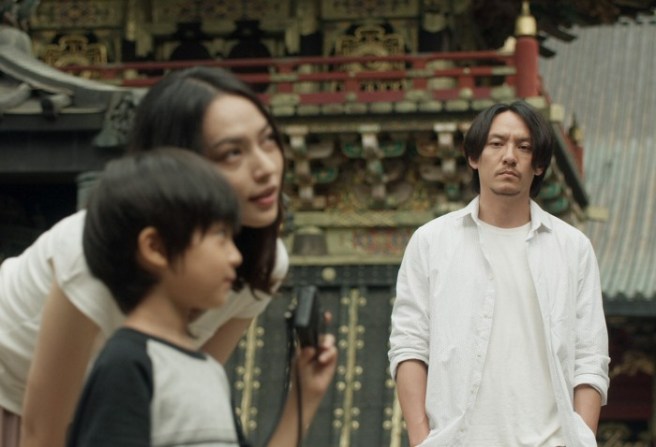
The SIFF program describes this as “Yojimbo meets Tampopo“, which definitely has an “I can only think of two Japanese movies” vibe, in that it isn’t really like either of those movies except its main character is a man who slices up people for hire and also sometimes makes noodles. It’s more akin to Johnnie To’s Where a Good Man Goes, but I’m probably only saying that because I’m the kind of person who compares everything to a Johnnie To movie.

Chang Chen’s a hitman in Kaohsiang who gets sent to Japan to kill someone. The job gets botched and he barely escapes. Recovering in a dilapidated slum, he’s befriended by a young boy (whose mom is a junkie) and eventually a whole community of locals, who figure out that he’s an excellent cook and, in like two days, build him an apartment and a noodle cart, while at the same time he helps the mom kick her heroin habit. It’s a story of rebirth fostered by community, and its portrait of the unity of people living on the margins recalls the spirit of no less than Sadao Yamanaka’s Humanity and Paper Balloons. The fairy tale approach is leavened by a harder edge, but director Sabu (last seen here as Samurai #1 in Scorsese’s Silence) keeps things brisk and light, with long wordless stretches scored jauntily by Junichi Matsumoto. Chang’s deadpan performance is a delight, even as his hair comes perilously close to “Gary Oldman in The Fifth Element”. Befuddled as to why the locals seem to like him, the kid explains “it’s because you keep cool and don’t say anything”. Taiwanese actress Yao Yiti is unconvincing as a junkie (she cleans up into super-adorable way too quickly), but shines in her extended flashback, providing the unlikely link between her and Chang. That that link should go undiscovered by the characters involved is one of the many small idiosyncrasies of Sabu’s storytelling, one which defies both Hollywood notions of causality and Hong Kong traditions of cosmic coincidence.

SIFF 2017: Week Four Preview

a-ghost-story-rooney-casey

This weekend the 2017 Seattle International Film Festival comes to an end, with three more days featuring another handful of interesting titles. here are some of the ones we’re anticipating.

The DoorRogue One star Jiang Wen’s brother Jiang Wu (A Touch of Sin) stars in this interdimensional comedy about a mechanic who discovers a time-portal.

The Feels – Constance Wu stars in Jenée LaMarque’s film in which “a lesbian bachelorette weekend goes awry when one of the brides admits she’s never had an orgasm.”

A Ghost Story – In one of the year’s most-anticipated American films, Casey Affleck plays a white-sheeted ghost haunting his wife, Rooney Mara.

The Witches – SIFF-honoree Anjelica Huston stars in Nicholas Roeg’s 1990 Roald Dahl adaptation, which is apparently a kind of touchstone for people younger than me.

Free and Easy – A variety of oddballs and conmen interact in a Northern Chinese town in Jun Geng’s film. SIFF compares it to Jarmusch and Kaurismaki.

Taste of Cherry – The late Abbas Kiarostami’s most famous film, winner of the 1997 Palme d’Or, about a man looking for someone to bury him after he kills himself. Stick a jazz band on my hearse wagon/Raise hell as I stroll along.


SIFF 2017: Columbus (Kogonada, 2017)

john-cho-at-miller-house-and-garden-555

Note: as this film is under embargo until its release in the Seattle area, here are exactly 75 words.

20 days into #SIFF2017 and this is the first time I’ve seen something truly unique, a new cinematic voice. An elegant mashup of Ozu (the plot: convincing a young woman to move on with her life), Linklater (a man and a woman talk about art and life) and Antonioni (architecture!), a Platonic romance with lovely performances from John Cho and Haley Lu Richardson (and Parker Posey!), Kogonada’s debut feature is precise and warm but never sentimental.

SIFF 2017: Have a Nice Day (Liu Jian, 2017)

201718718_2_IMG_FIX_700x700

Note: as this film is under embargo until its release in the Seattle area, here are exactly 75 words.

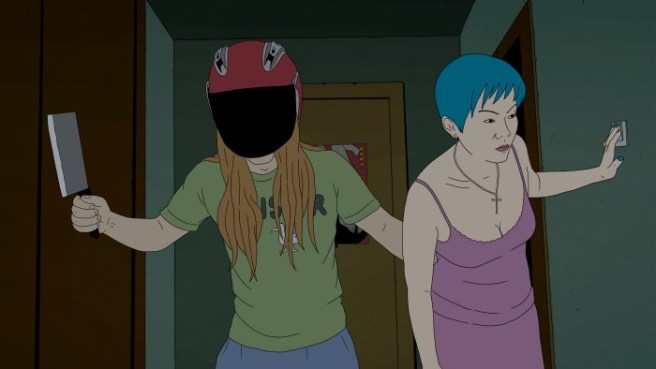
The second feature from director Liu Jian is an animated network-noir that in its amoral glee at the interconnected machinations of crooks and losers recalls early Tarantino, or at least his Korean imitators. A bag of money is stolen and passes through many vicious hands in dingy, bleak sections of a city at night (the pale, grimy animation recalls a hungover Duckman), a world away from the glitzy capitalist paradises of recent Chinese urban rom-coms.

SIFF 2017: The Little Hours (Jeff Baena, 2017)

lh_0

Note: as this film is under embargo until its release in the Seattle area, here are exactly 75 words.

No doubt parallels abound between Boccaccio’s plague-ridden Renaissance and our own apocalyptic present, so surely the time is ripe for this adaptation of a story from The Decameron, about vulgar nuns fighting the patriarchy the only way they can: sex, alcohol and witchcraft. Very funny, with Aubrey Plaza, Alison Brie, Kate Micucci leading the improv-ed script. Dave Franco is adequate, but fortunately his role mostly just requires being yelled at and looking pretty.

SIFF 2017: Wind River (Taylor Sheridan, 2017)

jeremy-renner-wind-river-sundance-film-festival

Note: as this film is under embargo until its release in the Seattle area, here are exactly 75 words.

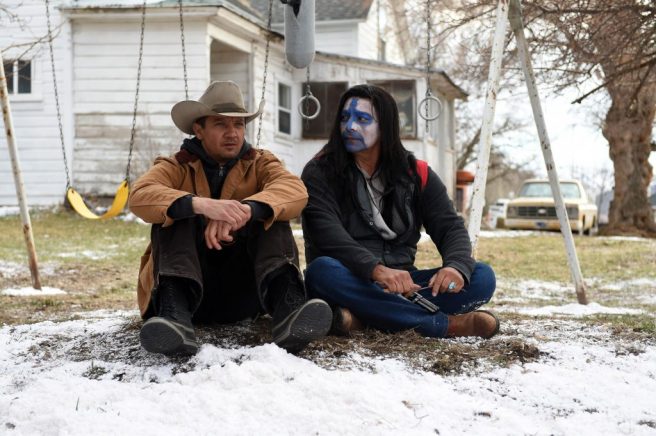
Like Hell or High Water and Sicario, for which he wrote the scripts, Taylor Sheridan’s second feature is the story of manly men and women doing manly things in a manly genre and a manly wilderness. This time, it’s a park ranger (Jeremy Renner) helping an FBI agent (Elizabeth Olsen) track down a murderer on a reservation. The ending’s a disaster, but strong performances from Native actors Gil Birmingham and Graham Greene almost redeem it.

SIFF 2017: Landline (Gillian Robespierre, 2017)

Landline - Still 1

Note: as this film is under embargo until its release in the Seattle area, here are exactly 75 words.

Following up their excellent 2014 rom-com Obvious Child, director Robespierre and star Jenny Slate reunite for a family comedy set in 1995. Slate and her teenage sister (Abby Quinn) discover their father (John Turturro) is cheating on their mom (Edie Falco) and spiral out of control into comic misadventures. Robespierre’s films resemble much of 21st century Hollywood comedy in their openness, vulgarity and spontaneity, but they have an emotional depth and maturity that the Apatows can’t fathom.

SIFF 2017: Week Three Preview

LOVE-AND-DUTY-5-580x433

We’ve passed the halfway point of the 2017 Seattle International Film Festival, and there are still a number of interesting films to come. Here are some of the ones playing this week, between June 2 and June 8:

Soul on a String – Director Zhang Yang returns with what appears to be a genre companion to last year’s Paths of the Soul, about a Buddhist traveling through Tibet.

I, Daniel Blake – Ken Loach’s 2016 Palme d’Or winner is about one man struggling to work a computer and other failures of Britain’s public welfare system.

Gook – Justin Chon’s comedy about two Korean-American brothers caught up in the Rodney King riots.

Mr. Long – Chang Chen plays a hitman hiding out cooking noodles in a small Japanese town in this film from Sabu. SIFF calls it “Yojimbo meets Tampopo“.

The Reagan Show – Archival footage takes us back to the first fake presidency of my lifetime. Should be fun.

The Dumb Girl of Portici – Archival presentation of silent film director Lois Weber’s adaptation of the opera that inadvertently helped spark the Belgian Revolution. Stars superstar ballerina Anna Pavlova.

My Journey through French Cinema – Bertrand Tavernier’s amiable history lesson loses  focus in its final third, but is nonetheless a fun and insightful idiosyncratic look at mid-Century French film. Will make you want to watch Eddie Constantine films.

Landline – Director Gillian Robespierre and star Jenny Slate, who’s Obvious Child is one of the better Hollywood romantic comedies of this decade, reunite for this film about two sisters who discover their father is having an affair.

Wind River – Hell or High Water writer Taylor Sheridan directs this backwoods policier with Jeremy Renner and Elizabeth Olson investigating a murder in snowy Wyoming.

Brainstorm – Douglas Trumbell’s 1983 mind-bender starring Christopher Walken and Louise Fletcher as scientists attempting to keep their brain-recording virtual reality device from the military.

Love and Duty – Archival presentation featuring Ruan Lingyu, one of the greatest of all silent film stars, in a romantic melodrama directed by Bu Wancang. With live piano accompaniment by Donald Sosin.

Columbus – Video essayist and critic Kogonada’s debut feature stars John Cho and Haley Lu Richardson a couple who meet and travel through Columbus, Indiana.

Nocturama – Director Bertand Bonello’s film about young leftist terrorists hanging out in a shopping mall.