SIFF 2017: Chronicles of Hari ( Ananya Kasaravalli, 2016)

The film begins with a series of Yakshagana artists readying themselves for the show. They sit still and silent as makeup is applied to their faces, and rituals are performed to bless their performances. In an interview, a man backstage explains that in a Yakshagana performance, men play the female roles. He extols that some performers’ movements are so feminine that they are mistaken for women. He is questioned off-camera about a particular performer who might or might not have worn women’s clothing at all times, and committed suicide. After a few more questions, the camera gives us the reverse shot, showing two young filmmakers huddled over a camera, listening to the interview subject.

These early sequences depict the film’s strengths and also its limitations: its fascination with these performers and their pathologies is earnest and often illuminating, but the film layers on a critical distance which feels unproductive and tacked on, rather than organic in approach. It posits the main character, Hari (Shrunga Vasudevan), as a sort of enigma – the film’s narrative does a great job of shading in the detail of this particular person, but the film’s conception casts him as a host of contradicting details and stories, reduced to what might or might not have happened to him.

still-hari-1_orig

Hari is a young star in his rural theater troupe who specializes in playing female roles. However, after his request to play male roles is rebuffed, he becomes more unsure about who he is. He begins to wear a skirt which causes trouble at home (his younger’s brother marriage proposal is laughed off because of Hari’s reputation). He finds himself sharing a house with another man so the neighbors threaten to take them to the authorities. His struggles with his identity haunt him and Vasudevan’s performance is wonderfully mopey, but more often than not the film sits there on the screen, its dynamics and conclusions set in stone.

This is the first film of  Ananya Kasaravalli, the daughter of famous Kannada filmmaker Girish Kasaravalli, and she acquits herself well for the most part. Most of the interest here is in Vasudevan’s performance, the slow rhythms of the rural villages of Karnataka, and the strange, stylized rituals of the Yakshagana art. But the film truly sabotages itself with the frankly useless conceit of the filmmakers trying to find out more about Hari and his life. The ending is as ill-judged as I’ve seen in a long time, essentially commenting on the film’s emotional high point (a long shot of a character walking into the middle of a lake, followed by a stunning look at the camera) and rendering the emotional fallout of these images as meaningless. The film’s failures are crystallized in its final image: two useless characters stare out at the ocean, deflating the drama, and putting the whole thing in quotation marks. Why wasn’t Hari’s story enough?


SIFF 2017: Sami Blood (Amanda Kernell, 2016)

Outsider status in gymnI long for the land that isn’t
For all that is I’m tired of wanting

Sami Blood, Sami-Swedish writer-director Amanda Kernell’s debut feature, opens on a black screen and the sound of a lonely, whistling wind. Then, a knocking, as the introductory credits, white on black, appear, and a man’s voice: “Mom?” More knocking. The same voice: “Christina?” The first image appears, an elderly woman, alone, in close-up profile, lighting a cigarette, looking out a window, ignoring the voice. It’s a haunted space with that blackness, the wind, the disembodied voice, and the woman, turned away, hiding from both the voice of her son and our public prying eyes. It’s a space that sets the stage for the film to follow, the story of the girl who becomes that woman, a woman who is, indeed, haunted, hiding, and alienated from those closest to her and from the larger world, too, a world, she fears, might stare at her too much and too long.

Christina

In the opening scenes, the elderly Christina (Maj-Doris Rimpi), reluctantly guided by her son and accompanied by her granddaughter, attends the funeral of her long estranged sister. It is a Sámi funeral, following the traditions of that complex and internally diverse people group indigenous to Sweden, and it is clear that Christina, living in Swedish dress and speaking the Swedish language, feels deeply uncomfortable within the Sámi community. She speaks to no one and even shields her face with her hand while she sits silently at the post-funeral meal, away from her son and granddaughter, who are eating and talking with ease with those around them. The intimacy of family-community bonds juxtaposed with the individual isolation of Christina, separate and silent, is what strikes us most immediately. It is one thing to feel alone among strangers, wholly another to be alone among kin. Continue reading “SIFF 2017: Sami Blood (Amanda Kernell, 2016)”

Baahubali: The Conclusion (S.S. Rajamouli, 2017)

baahu 3

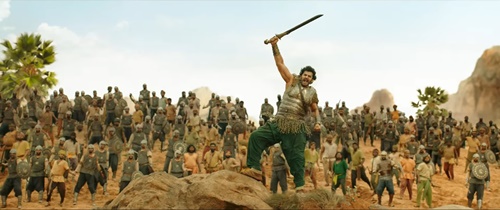
S.S. Rajamouli’s Baahubali: The Beginning (dutifully reviewed here at SSS) was a work of grand spectacle, visual wonder and narrative simplicity. It found Rajamouli delivering a shot across the bow, if you will, announcing his intent to deliver a film worthy of the epics which drive the mechanics of the plot, and could stand side by side with Hollywood. But it is Baahubali 2: The Conclusion which truly delivers on that promise.

Continue reading Baahubali: The Conclusion (S.S. Rajamouli, 2017)”

My Entire High School Sinking Into the Sea (Dash Shaw, 2016)

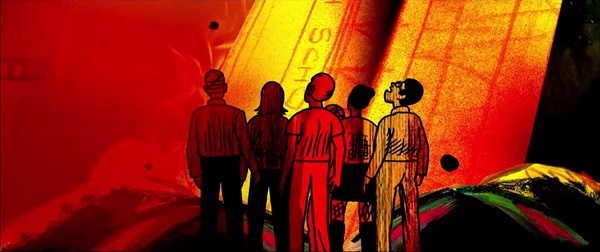
The debut feature of comic book artist Dash Shaw, My Entire High School Sinking Into the Sea, begins by firmly zeroing in on the concerns of young adult fiction: the new school year, the character’s social status, and all the insecurities that are inherent in being a teenager. But these early moments soon take backseat to what is basically a disaster film in miniature, inserting small nuggets of character detail and humor into what is a tired narrative. However, the stock scenario does nothing to derail from the wondrous sensibility of the animation, which is relentlessly inventive.

Continue reading My Entire High School Sinking Into the Sea (Dash Shaw, 2016)”

On the Beach at Night Alone (Hong Sang-soo, 2017)

201713061_1

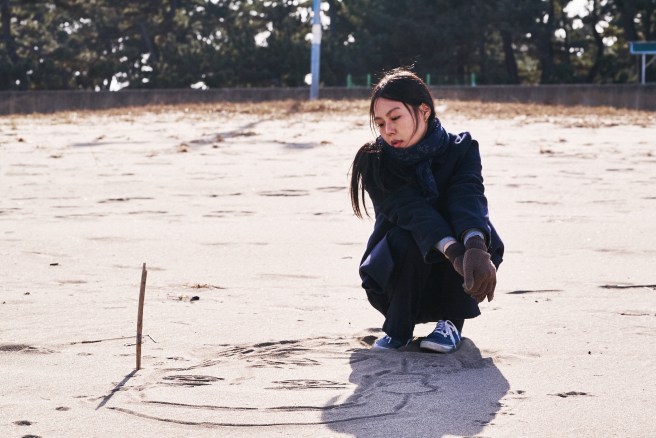
First, what On the Beach at Night Alone is not. And because Hong often, though not always, makes films in pairs that profit from their proximity, let’s take Yourself and Yours as the template from which to trace the variations. Yourself and Yours arguably employed Hong’s loopiest structure in some time: there’s no intradiegetic scaffolding—a la Hill of Freedom—to guide the narrative’s many double helixes and it lacks the log-line neatness of Right Now, Wrong Then, with its rewind-to-be-kind backpedaling. By comparison, this newest work is not a labyrinthine construct. Yes, On the Beach at Night Alone redeploys the bifurcation that defined Hong’s biggest hit, but it hardly counted as innovation when he used it there either; Hong has long displayed an affinity for warped mirror halves. And anyways, the chapters that split On the Beach at Night Alone in two are, if taken at face value, drawn more sharply on geographical and temporal lines than metaphysical or meta-fictional divisions (though more on that later).

Continue reading On the Beach at Night Alone (Hong Sang-soo, 2017)”

The Lure (Agnieszka Smoczynska, 2015)

the-lure-club

“What is that fishy smell?”

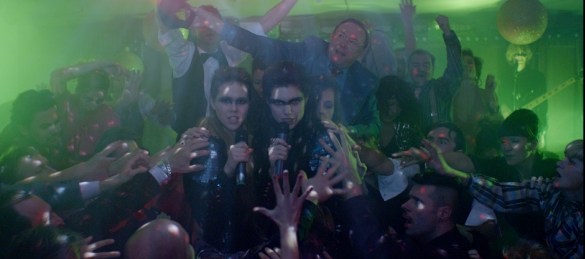
Agnieszka Smoczynska’s debut feature film functions as a pastiche of “The Little Mermaid,” but it comes to us by way of smoky cabaret clubs of a Warsaw in the 80’s, New Wave synthpop music videos, and the queasy glamour of capitalistic excess. It’s a gritty fairy tale of slyly telepathic sister-mermaids whose siren calls satisfy carnivorous tastes – until one sister falls in love with her prey, and their world and their sisterly bond begins to disintegrate.

It’s more grim Grimm than gentle Hans Christian Andersen: no swift and bloodless magic here, just buzzing grinding surgeon’s tools, human legs and mermaid tails on beds of ice. But the surgeon drunkenly dances and the mermaid sings until her voice wheezes dry, and I remember I always did prefer the intoxicating horror of Grimm to Andersen anyway.

Does it all add up to a fairy tale moral or even a thematically cohesive whole? I’m not sure it does, but it does fully commit to its individual scenes: carnal, sordid, crunchy, or sexy, and like the immersive quality of a vivid dream, its overall sensations linger, far into the waking hours.

 mermaid-on-ice

The Lure plays at Grand Cinema on February 24 and 25. 

(Note: This review is adapted from my notes on 5/25/16 on Letterboxd.) 

Daughters of the Dust (Julie Dash, 1991)

Before Ava DuVernay, before Dee Rees, before Gina Prince-Bythewood, before Kasi Lemmons, there was Julie Dash. Dash’s Daughters of the Dust earned its place in the history of film by becoming the first feature film directed by an African-American woman to gain general theatrical release and distribution—and it earned that place in the shockingly recent year of 1991. It is a remarkable piece of work not only for its place in cultural history but also for its distinctive aesthetics and for the story it tells: a story of hope, grief, and transition set among the Gullah people, a group of African Americans living on the islands off the South Carolina and Georgia coast. Somewhat isolated from the continental United States, as the film’s prologue tells us, the Gullah retained elements of their original African languages, values, and ways of life long after African culture was violently suppressed in the lives of mainland African Americans. Dash tells a graceful, dreamlike story of one Gullah family reuniting in 1902 before departing for life on the mainland—and for a nation on the brink of modernity.

Continue reading Daughters of the Dust (Julie Dash, 1991)”

VIFF 2016: Nine Behind (Sophy Romvari, 2016)

ninebehind

This guest-review was written by Vancouver critic Josh Hamm.

“To be rooted is perhaps the most important and least recognized need of the human soul. It is one of the hardest to define… [and] preserves in living shape certain particular treasures of the past and certain particular expectations for the future.”

– Simone Weil, The Need For Roots

Sophy Romvari’s debut short film is a mature, fully formed contribution to cinema; a film imbuing the trivial and mundane with the weight they deserve. The opening sequence of shots almost channel a Yangian rhythm: an extended take captures a young woman, Nora, (Noémi Fabian) in her routine and establishes the mise-en-scène with a slow pan; a cursory glance at the bookshelf conjures up images of the past and present on film, of a woman enraptured by the silver screen. The soft sounds of a bubbling kettle and the slow drip from the sink into a pile of dishes as she pours a cup of tea and settles into her chair and grabs a phone, her leg an almost abstract reflection on the front of the dishwasher– there’s fully formed minutiae and sense of a person through a mere two minutes of seemingly unimportant actions. Yet they also have the steady rhythm of ritual and home-brewed comfort.

Still, Nine Behind is not a film about ritual, or the mundane, per se. It’s propelled by the woman’s conversation with her grandfather in Budapest (the title presumably referring to the time difference between there and Vancouver), a one-sided dialogue that reveals a filial ache for connection and tradition; a yearning for a nostalgia-filled future.

Continue reading “VIFF 2016: Nine Behind (Sophy Romvari, 2016)”

2016 Year in Review: Part 4

elaine-love-witch

And here we are, the end of the end. Only two brave writers left standing, willing to take on my weakest questions. It’s all a bit deflating but so was this year. If you missed the past three days of erudite discussion, please head here.

Q: We’ve talked about the disappointment of blockbusters but what about genre pictures with more meager budgets? La La Land is playing now and receiving fairly positive praise despite the burden foisted upon it by the media to singlehandedly revive the Hollywood musical. This year saw its usual share of modest westerns and the occasional horror surprise. For my money, Green Room was a solid siege picture that I’m eager to revisit now that I think it presciently captured my emotional state on election night. And the Coens’ wonderful Hail, Caesar! was a great genre picture because it was a picture about genres. What do you think, which genre was best served in 2016?

Continue reading “2016 Year in Review: Part 4”

2016 Year in Review: Part 3

cemeteryofsplendor_trailer1

Our autopsy on the still-living body of 2016 continues with a discussion about the year’s best performances. Our previous entries tackled themes and surprises.

Q: As a rank-and-file auteurist, I often fail to adequately acknowledge onscreen work when writing about film. There are exceptions of course. I was quick to acknowledge Zhao Tao’s generous performance as one of the great strengths of Mountains May Depart. I am thankful that wonderful film saw a belated release in Seattle because I can include it in my year-end write-ups (especially since I am woefully behind in the bumper crop of Oscar bait currently invading theatres). Which 2016 performances stood out to you?

Continue reading “2016 Year in Review: Part 3”