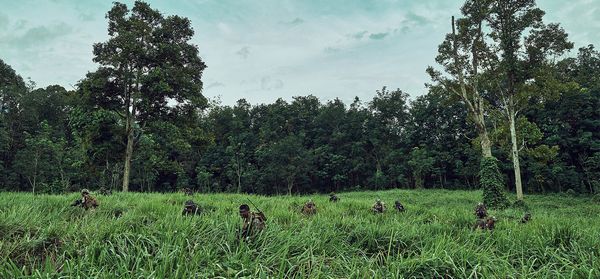
VIFF 2016: Never Eat Alone (Sofia Bohdanowicz, 2016)

nea

Of the three films in VIFF’s new Future // Present series that I’ve seen thus far, the program Sunday night of Toronto filmmaker Sofia Bohdanowicz’s new feature paired with three of her short films is the standout. The feature is a fictionalization of the story of her maternal grandmother, Joan Benac, playing herself, who in the early 1950s, appeared as a singer and actress on a kitschy television show. Remembering this in a dream, she tasks her granddaughter Audrey (played by Deragh Campbell, in one of her three films at VIFF this year) with finding the show and tracking down the boy she co-starred with and had dated briefly. She does, she thinks, and writes the man a letter. He’s living on the other end of the country, in a small town where he lives alone and teaches a choir. Audrey writes the man a letter, asking him to call, but he never manages to connect with the women in Toronto (he’s played by George Radovics, Bohdanowicz’s producer’s grandfather). The bulk of the film cuts between the three principals, usually as they’re eating, alone. The television episode is interspersed throughout, and there’s a digressive slideshow of the grandmother’s trip to the Bahamas, both of which are actual artifacts. But wholly fictionalized scenes abound as well, such as one where Audrey tries on a bunch of old clothes her grandmother is trying to get rid of while the two delicately balance familial niceness with the desire not to give or receive these gifts. It’s a found-footage film, using bits and pieces of the past to build a collage of a fictionalized history, an alternate reality version of her family’s history. It bears a kind of inverse relationship to Liu Jiayin’s Oxhide films, which use a highly structured script and compositional style to document her family’s life, their work and routines and relationships as they go about various tasks: cleaning the house, making leather goods, cooking dumplings. Bohdanowicz in contrast films with an off-hand directness, emotionally straightforward compositions chronicling wholly improvised interactions (both Campbell and Benac receive screenplay credits).

Even more astonishing though, are the three short films paired with the feature, chronicling Bohdanowicz’s paternal grandmother. The first, A Prayer, is a short documentary, following said grandmother around her house has she does various chores (and eats a meal, alone, naturally). The second, An Evening, is something special: a tour of the grandmother’s house shortly after her death, patiently documenting its spaces while one of her records plays on the stereo, intermittently marred by a broken needle, from late afternoon until the space disappears into the darkness of night. It’s a film Chantal Akerman would be proud of. The third, Another Prayer, replays the first short, but superimposed over the now empty spaces of the woman’s home, completely silent. Each film is prefaced by a poem composed by Bohdanowicz’s great-grandmother, and the cumulative effect of the trilogy together is devastating.
VIFF 2016: Toni Erdmann (Maren Ade, 2016)

toni-erdmann4

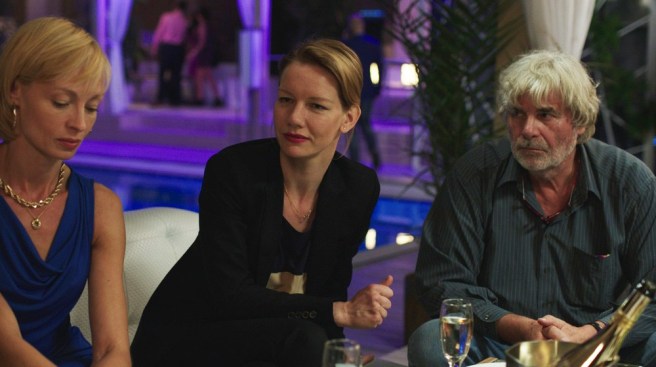
The talk of the Cannes Film Festival, where it received as rapturous a critical response as any film is likely to get (no less than Amy Taubin said it was one of her ten favorite films of all-time on Film Comment’s festival podcast), Toni Erdmann is finally making its run through the fall festival circuit, and here in Vancouver it capped my first day at the festival. And what is surely a great surprise, it’s a film that lives up to the hype. A nearly three-hour screwball comedy about a father, a daughter, and international capitalism, it’s the best film made about parenthood since Yasujiro Ozu died, and surely the funniest German film ever made. Peter Simonischek plays the father, a large, gregarious and goofy older man, a music teacher with a penchant for pranks of the false teeth and bad wig variety. His daughter, played by Sandra Hüller, is a high-ranking consultant working in Bucharest to help a corporation outsource its workforce. She’s too busy to notice how miserable she is, but after a perfunctory visit home, dad drops in on her life unannounced, generally being foolish and weird and embarrassing. At the halfway point she sends him home, only for him to return in disguise as Toni Erdmann, a life coach who insinuates himself among her friends at parties and work functions. The film is a symphony of double takes, as every character, great and small, is stunned by Toni’s oddity, his eyes twinkling mischievously whenever someone plays along with his games. The final third of the film escalates, in classic screwball style, through a masterful series of set-pieces, as hilarious as they are devastating. It’s difficult to describe the achievement of this film to someone who hasn’t seen it, the way it impossibly negotiates the simultaneous absurdity and despair of life, the way it captures the pride we have in our children and our overwhelming sorrow when they’re in pain. Watching it at VIFF, in a 1,000 seat auditorium, feeling the entire vast room captivated and rapturous with every twist and shock and small poignancy, is one of the great movie-going experiences I’ve ever had.

VIFF 2016: The Intestine (Lev Lewis, 2016)

intestinethe

Dark digital grain and hard lines of white light divide Lev Lewis’s The Intestine in two, separating the poor from the economically ascendant, the city from the suburb, night from day. But make no mistake, though these contrasts form roughly equal parts of the film’s ungainly shape, Lewis’s debut is haunted by the shadowier half; the ethos of night rules all things, even when the sun streams in through the windows.

Lewis’s heroine Maya, a twenty-something reject of late capitalism, steps out from her dingy surroundings one night and awakens the next day in an abandoned modernist money-pit somewhere in the ‘burbs. The cut that bridges the space between Maya’s evening on the town and her sudden emergence amidst bright bourgeois sterility suggests, initially, a particularly bewildering morning-after and nothing more. But things progress into stranger territory as Lewis conjures up some dreamy images—a refrigerator stocked solely with a boar’s head stands out, both for its strangeness and as a barb pointed at the foodie pretensions of the 21st century’s finer-living set. The hard-lit morning-after starts to look like a portal to another reality, a rabbit hole which unearths the phantasmagoric pleasures of the moneyed class. It’s no wonder that Maya grows increasingly unwilling to vacate her new digs.

This shapeshifting debut insists—a bit precociously—on inscrutability, but what finally emerges is a vision of contemporary young adulthood as life lived in envy of other people’s spaces. Eventually unemployed but always unradicalized, a single brush with prosperity is enough to spark Maya’s exurban aspirations (“I can’t go back to my apartment”). Maya finally makes the place her own, but as she sits on her bed repeating her name through the phone to a listener who cannot hear it, she appears to be drifting back towards the void. The light is fading, and a gleaming new home can only ward off the darkness for so long.

VIFF 2016: Beautiful 2016 (Hideo Nakata; Alec Su; Stanley Kwan; Jia Zhangke, 2016)

beautiful2016__cutline__onedayinourlivesof

There are always one or two duds in these omnibus things, so let’s get those out of the way. Beautiful 2016’s first short is an embarrassing Ozu homage that repurposes his hometown (Kamakura) and his one-time actress (Kyoko Kagawa), though if you’re going to steal from the master, at least do us the favor of making off with some of his good humor. A dull banality best left forgotten. Dama Wang Who Lives on Happiness Avenue is quite possibly already forgotten. An indistinct void focused on a spritely, well-coiffed older woman jazzercising her way through Shangahi, Alec Su’s debut short is mercifully, well, short.

A real sense of artistry kicks in with One Day in Our Lives of…Director Stanley Kwan crafts some lovely images of nocturnal Hong Kong, his sense of texture undiminished even after a decade or so out in the wilderness. Distorted Wongian clocks, vertiginous tilts, and a weirdly haunting pop song provide the primary pleasures, though the Day for Night behind-the-scenes antics feel a bit stale. Kwan, once an inheritor of Hong Kong’s art-film tradition, seems to have lost opportunities as the industry shifted production modes this century, though it’s perhaps equally plausible that Kwan’s open life as a gay man curtailed his early promise. Whatever the case, One Day in Our Lives of… should prod those who’ve ignored Kwan for a decade or more (guilty as charged!) to give films like Everlasting Regret a belated look.

Jia Zhangke, on the other hand, is at the apex of his career. He comes swinging into Beautiful 2016—and I do mean swinging—with the swagger of a filmmaker who recognizes his own mid-career mastery. That self-knowledge is not, however, a straight-jacket for Jia. If anything, he’s discovered a more elastic vision of himself as an artist, willing to let in a kind of looseness that he kept at bay with the more static, calling-card early films. Last year’s Mountains May Depart proved that definitively, so it’s not coincidental that The Hedonists begins with a snatch of melancholic score from the prior feature. The presence of Jing Dong Liang as Liangzi, the poor miner destined for destruction in Mountains May Depart, also reiterates that we’re in a pre-established world. But without wasting time, Jia reconfigures the melodrama of his 2015 masterpiece into a buddy comedy. The transition plays subtly at first, until an uproarious cameo from the director himself, equipped with cigar and sunglasses and shouty bravado, brings down the house. Jia’s sense of play extends to the camera too, which he mounts on a newly acquired drone. Given that Jia helped reorient the Chinese film industry around digital technology, it shouldn’t come as a surprise that he employs the newest tech better than just about anyone else. But when a standard tracking shot suddenly achieves lift off and ascends to the heavens, a genuine sense of wonder sets in. At this point in Jia’s career, you can only marvel at the corporeal and artistic weightlessness.

Operation Mekong (Dante Lam, 2016)

movie_015739_185447

Opening this week at the Regal Meridian is the latest action film from director Dante Lam, whose Beast Cops and Jianghu: The Triad Zone were two of the better Hong Kong films to come out during the industry trough that followed the colony’s handover to China in the late 1990s. More recently, his MMA film Unbeatable earned a handful of acting prizes for its star, Nick Cheung, back in 2013. Operation Mekong is a procedural programmer based on true events, starring Eddie Peng (Rise of the Legend) and Zhang Hanyu (The Taking of Tiger Mountain, Mr. Six). Thirteen Chinese citizens are killed on the Mekong River, in the notorious no-man’s land known as the Golden Triangle, the intersection of Burma, Thailand and Laos that has long been the headquarters for the drug trade and action movies using the drug trade as a plot motivation (see, for example, John Woo’s Heroes Shed No Tears from way back in 1986). It’s meth now, rather than heroin, but the more things change, the more they’re exactly the same. Suspecting drug lord involvement, the Chinese government convinces the other three nations to cooperate, and sends in an elite squad of heavily-armed cops to expose, capture and, if necessary, kill the bad guys.  Zhang heads the squad, all of whom are given code names from Greek mythology, except for their remarkable German Shepherd, who is named “Bingo”. Peng serves as their local contact, an intelligence officer who has been working the area with an impressive array of fake mustaches for five years.

What follows are all the familiar beats of a high-explosive action film. Strong extended set-pieces packed with carnage, leavened with stretches of exposition and character-building. There’s a scene where every member of the team introduces themselves around a communal meal, a scene where one muses about his daughter back home, another one where a cop has a tragic backstory relived in flashbacks which will come back to haunt him at a narratively-convenient time. The remarkable thing about Johnnie To’s Drug War is that he didn’t bother with any of this stuff, trusting the tightness of his plot and sequence construction to carry the audience through the running time of the film. Lam and his team of screenwriters though settle for the typical, thus no matter how good the actors and the action is, and they’re pretty good for the most part, the movie is ultimately is just treading water, doing everything we’ve seen before, just a bit louder, and with more drone-mounted cameras. As an homage and update to the heyday of Cannon Films-era actioners, it doesn’t get much slicker.

VIFF 2016: The Unknown Girl (Jean-Pierre and Luc Dardenne, 2016)

unknowngirlthe

The architecture of the thriller suits the Dardennes more comfortably than it might first appear. In spite of their naturalism, the Belgian brothers construct intricate scaffolding for their films to rival many of their more outwardly formalist peers, and The Unknown Girl is perhaps more open about the structural blueprint than anything they’ve produced recently. A generic—in every sense of the word—tale of bad conscience gets the trademark handheld treatment in the dreary world of Liège, but it could just as well emerge from the wet streets of a 40s noir.

Guilt comes knocking, as it must, at the door of Dr. Jenny Davin. An unidentified African girl running from something sinister pleads entry into the safety of Davin’s clinic, though the young doctor is too busy lecturing her intern on the finer points of the profession to bother with the noise down the hall. The girl’s body is found nearby, and distraught at the consequences of her indifference, Davin hits the detective beat, searching for the girl’s name in an effort to offer her a modicum of dignity in death that the final moments of her life denied. Ratiocination unveils a web of guilt ensnaring everything in the doctor’s orbit, as if all of Liège harbors some complicity in this original sin, which, given the ethnic lines that divide here, suggests a reckoning with Belgium’s colonial past and present woes, though the capital ‘C’ Catholic Dardennes make it clear that no one escapes the fearful symmetry of guilt’s trap.

Trapped, certainly, but not unmovable. Jean-Pierre and Luc Dardenne may be clandestine formalists, but they’re also heart-on-the-sleeve humanists. The maze-like geometry of The Unknown Girl points towards noirish cynicism only to refute it. An embrace—with responsibility, with other people—is enough to open up a way out.

Friday September 30 – Thursday October 6

Featured Film:

The 2016 Vancouver International Film Festival

Most of the Seattle Screen Scene staff is going to be in Vancouver for the next couple of weeks, covering one of he best film festivals in North America. From acclaimed international festival hits like Toni ErdmannThings to ComePersonal Shopper, ElleAquarius, and A Quiet Passion (among many others), to cutting edge Canadian films like WerewolfNever Eat Alone and Maliglutit, anticipated American movies such as PatersonManchester by the SeaShort Stay and The Love Witch, to the best program of Asian films in North America, featuring The HandmaidenYourself and YoursCrosscurrent, GodspeedBy the Time it Gets Dark and more, we’ll have dozens of reviews and maybe even the long-awaited return of The Frances Farmer Show coming soon.

Playing This Week:

AMC Loews Alderwood:

The Age of Shadows (Kim Jee-woon) Fri-Thurs Our Review
Monty Python and the Holy Grail (Terry Gilliam & Terry Jones, 1975) Fri & Sat Only Quote-Along

Ark Lodge Cinemas:

Hunt for the Wilderpeople (Taika Waititi) Fri-Thurs

Central Cinema:

Singin’ in the Rain (Stanley Donen & Gene Kelly, 1952) Fri-Weds
The Shawshank Redemption (Frank Darabont, 1993) Fri-Weds

SIFF Egyptian:

The Beatles: 8 Days a Week (Ron Howard) Fri-Thurs
Multiple Maniacs with Mink Stole in person (John Waters, 1970) Fri Midnight Only with Mink Stole in person

Century Federal Way:

The Age of Shadows (Kim Ji-woon) Fri-Thurs Our Review
M.S. Dhoni (Neeraj Pandey) Fri-Thurs
Nikka Zaildar (Simerjit Singh) Fri-Thurs

Grand Cinema:

The Beatles: 8 Days a Week (Ron Howard) Fri-Thurs
The Hollars (John Krasinski) Fri-Thurs
A Tale of Love and Darkness (Natalie Portman) Fri-Thurs
Café Society (Woody Allen) Fri-Thurs
Lo and Behold, Reveries of the Connected World (Werner Herzog) Tues Only
Tacoma Film Festival Starts Friday Full Program

Grand Illusion Cinema:

The Quiet Earth (Geoff Murphy, 1985) Fri-Thurs
I Drink Your Blood (David E. Durston, 1970) Sat Only
Digimon Adventure tri. Chapter 1: Reunion (Keitaro Motonaga) Fri-Weds
Kampai! For the Love of Sake (Mirai Konishi) Sat & Sun Only
up, up, and away (Andy Liotta) Thurs Only live music & video

Landmark Guild 45th:

A Man Called Ove (Hannes Holm) Fri-Thurs
Captain Fantastic (Matt Ross) Fri-Thurs
Rurouni Kenshin Part III: The Legend Ends (Keishi Ohtomo) Tues & Weds Only

Cinemark Lincoln Square:

M.S. Dhoni (Neeraj Pandey) Fri-Thurs
Hyper (Santosh Srinivas) Fri-Thurs
Majnu (Virinchi Varma) Fri-Thurs
Pink (Aniruddha Roy Chowdhury) Fri-Thurs

Regal Meridian:

Soulmate (Derek Tsang) Fri-Thurs Our Review
Operation Mekong (Dante Lam) Fri-Thurs Our Review
M.S. Dhoni (Neeraj Pandey) Fri-Thurs
L.O.R.D. – Legend of Ravaging Dynasties 3D (Guo Jingming) Fri-Thurs

Northwest Film Forum:

The 19th Local Sightings Film Festival Fri-Sat Full Program
Moving History: An Archival Screening Night Weds Only
MEMORY Presents: Program No. 2 Thurs Only Free, Curators in Attendance
Desert Cathedral (Travis Gutiérrez Senger) Thurs Only

AMC Oak Tree:

The Hollars (John Krasinski) Fri-Thurs

AMC Pacific Place:

I Belonged to You (Zhang Yibai) Fri-Thurs

Regal Parkway Plaza:

Pink (Aniruddha Roy Chowdhury) Fri-Thurs
No Manches Frida (Nacho Garcia Velilla) Fri-Thurs
M.S. Dhoni (Neeraj Pandey) Fri-Thurs
Barcelona: A Love Untold (Olivia Lamasan) Fri-Thurs

Seattle Art Museum:

The Chase (Arthur Ripley, 1946) Thurs Only 35mm

SIFF Film Center:

Dying to Know: Ram Dass & Timothy Leary (Gay Dillingham) Fri-Sun

Sundance Cinemas:

Don’t Think Twice (Mike Birbiglia) Fri-Thurs
The Lovers and the Despot (Ross Adam & Robert Cannan) Fri-Thurs

SIFF Cinema Uptown:

Cameraperson (Kirsten Johnson) Fri-Thurs Our Review Our Other Review
A Man Called Ove (Hannes Holm) Fri-Thurs
Phantasm (Don Coscarelli, 1979) Sat Only
Promised Land (The Salcedos) Tues Only
Cameraperson (Kirsten Johnson) Weds Only Skype Q & A

Varsity Theatre:

Hunt for the Wilderpeople (Taika Waititi) Fri-Thurs
Seattle Latino Film Festival Sat-Weds Full Program

VIFF 2016: The Lockpicker (Randall Okita, 2016)

lockpickerthe

The promise of summer comes early in The Lockpicker in the form of a sailing trip, a post-diploma work opportunity that doubles, more importantly, as a dream of warmth and far-flung travels, a balm for the bleakness of winter. And Hashi could clearly use a lodestar to navigate his way through his final months of high school, which find him in an unsustainable cycle of drugs and outbursts. As conceived by director Randall Okita and played by Keigian Umi Tang, Hashi embodies a familiar vision of teenage masculinity: haunted, but sensitive, confrontational at times, but more out of hurt than genuine ill-will.

Okita’s film charts the teenage mind’s limited horizon, where just one school semester seems an uncrossable chasm between the present and the future. Admittedly, the present does look pretty dull. A slushy gray tone dominates the film and the soft textures of DP Jackson Parrell’s cinematography turn this small Canadian town into a blurred no-place. Only the crushed blacks of night provide an escape, although Hashi’s evenings morph into baroquely staged nightmares just as frequently as they take the form of drunken revelry. Okita is most at home with these party scenes; he understands how intoxicants heighten juvenile braggadocio, but also how those boasts paper over pain and vulnerability. The pain, however, proves too much for Hashi. His high school days end in violence and he’s cast out into unceasing winter, the film finally giving into the grim cliche it earlier strived to avoid. It needn’t end this way. A little more wisdom, and a little more time, might be enough to convince all involved that summer always, inevitably rolls around.

Cameraperson (Kirsten Johnson, 2016)

29003id_002-960x0-c-default

Kirsten Johnson’s Cameraperson provides an extraordinary experience for viewers—those already familiar with her body of work and those new to it alike. Johnson is a documentary cinematographer best known to most for her work on Fahrenheit 9/11 (dir. Michael Moore, 2004), Pray the Devil Back to Hell (dir. Gini Reticker, 2008), and the Oscar-winning Citizenfour (dir. Laura Poitras, 2014). Those who have seen these films will know to expect bracing, sometimes unsettling, sometimes even devastating images, but they might not be as aware of Johnson’s eye for scenes of almost unbearable beauty and joy. The images Johnson assembles in Cameraperson reveal the full range of her remarkable gifts, in all their weight and force and radiance.

Continue reading Cameraperson (Kirsten Johnson, 2016)”

The Age of Shadows (Kim Jee-woon, 2016)

2016-the-age-of-shadows-thumb-860xauto-62812

Hot off its premiere at the Venice Film Festival and the announcement of its being chosen as South Korea’s submission for the Foreign Language Academy Award, the latest film from director Kim Jee-woon (The Good, The Bad, The WeirdI Saw the Devil) opened this past Friday. But not in Seattle: it’s only playing at the Alderwood Mall AMC in Lynnwood and the Cinemark theatre in Federal Way, another example of the mixed-blessing that is the state of Asian film distribution in the United States. On the one hand, were this exact same film French or German, you could expect it to be picked up by one of the major art house distributors and get a nationwide roll-out, eventually playing somewhere like SIFF or a Landmark theatre. Along with that would go critical attention and a much wider audience. Instead, as Korean, Chinese, Filipino and Indian films are increasingly only released in the US in small runs targeted at diasporic and immigrant communities, with no advance publicity and little advertising to the public at large, it’s likely that if The Age of Shadows does develop an American following, it will come only once the movie is widely available to stream on the internet. But on the plus side, for those of us that happen to live near a major urban center, we get to see some of the best movies in the world in a theatrical setting, with no waiting.

Continue reading The Age of Shadows (Kim Jee-woon, 2016)”