VIFF 2017: Future//Present

sofia20rv3

The Future//Present program at VIFF has quickly become one of the most dynamic and interesting streams the festival has to offer, adding to the festival’s longtime commitment to the cutting edge in Asian cinema an exploration of the burgeoning Canadian independent film scene, offering showcase opportunities to young filmmakers from Nova Scotia to Vancouver. This year’s program was even better than last year’s inaugural offering, and provided some of the festival’s most interesting, engaging and challenging films.

Last year’s program was lead by a feature and a trilogy of shorts from director Sofia Bohdanowicz, who returns this year with her documentary Maison du bonheur. Filmed on a Bolex over 30 days during a stay with a friend’s mother in Paris, the film is both the story of a woman and the way she does things (makes bread, gets her hair styled) and the story of a woman making a film about a woman she finds fascinating. While not as explicitly meta-cinematic as Never Eat Alone, Bohdanowicz continually leaves in her own attempts to erase herself from her movie (telling her subject how to answer questions when the questioner won’t be heard, or telling people not to look directly at the camera or acknowledge her presence), and at times simply can’t help but take it over, including snippets of her nightly audio journal entries, or taking a side trip to Deauville, the site of some unexplained unhappiness in her past, for which this trip, this film project, seems in some way designed to, if not exactly erase, then somehow compensate for: she wants new memories. It’s a warm, fascinating film from one of the best young filmmakers in the world today.
Continue reading “VIFF 2017: Future//Present”

VIFF 2017: Forest Movie (Matthew Taylor Blais, 2017) and Prototype (Blake Williams, 2017)

ForestMovie

Two tricks of the eye:

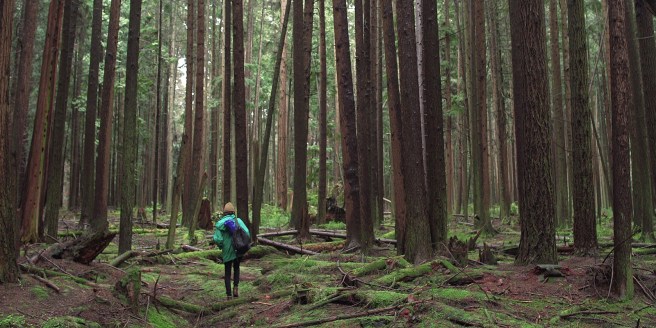
Matthew Taylor Blais’s Forest Movie focuses attention on the center knowing that you’ll likely miss what’s happening at the margins. The pivotal shot that comprises nearly half the film’s runtime works explicitly on this principal. After tracking a young woman on a half hour stroll through the forest, Blais sits her and his camera down to stare at a patch of woods for thirty straight minutes in a fixed, Academy ratio long take, a la James Benning. Anyone who’s had a brush with the work of that august American avant-gardist will know that the pleasures offered by an image like this lie in the shifting textures of light and the peripatetic impulse of the human mind to drift elsewhere when confronted with something this still; he will also know that Benning got there first and has fruitfully mined similar landscapes for nearly a half century. But keep watching and Blais’s distinctive spin on the set-up reveals itself around the edges of the frame: the aspect ratio is slowly expanding over the duration of the shot, widening from 4:3 to 1.85 widescreen. Blais hides the change by framing a circular stump dead center, which naturally draws the eye away from the edges and obscures the movement happening on the periphery, where our vision is less sensitive. The moment of realization will arise differently for each viewer, though Blais wakes up even the most hypnotized (or bored) viewer with a hard cut back to Academy ratio. I’m not entirely sure what to make of this wonderfully deployed trompe l’oeil in context of the rest of the film, which for better or worse melted from my thoughts the longer I gazed at the screen, but there’s no denying the primal (and very physical) awe inspired by Forest Movie’s slow-cinema sleight of hand.

PrototypePrototype, which also showed as part of VIFF’s Future//Present series, plays even more directly with the anatomy of human vision. Blake Williams, like gran-père Godard before him, explodes the possibilities of modern 3D—and early twentieth century American history for good measure—with his science fiction rendering of the 1900 Galveston hurricane. Archival stereoscopic images of the disaster open the film before a tidal wave of light bends towards the audience and seemingly merges past with present (or is it Future//Present?). Five TV screens then materialize against the void and flicker with found footage both directly and indirectly connected to the subject historical event. The result is a virtual gallery space where up to five images exist simultaneously within the frame, each image itself split in two, across the left and right eye. The densest moments offer no less than ten possible images, which are only accessible individually by closing one eye and then the other. With both eyes open, more information hits the retina than the mind can process. Williams clearly delights in the pleasure/pain dichotomy that arises from such a deluge of visual data, which partly explains Prototype’s final plunge into complete abstraction. The found footage breaks into pulsating white swatches which swirl around an unseen center, and the images Williams previously layered on top of one another (and across the eyes) decouple feverishly. Matter, time, and history have come apart at the seams.