
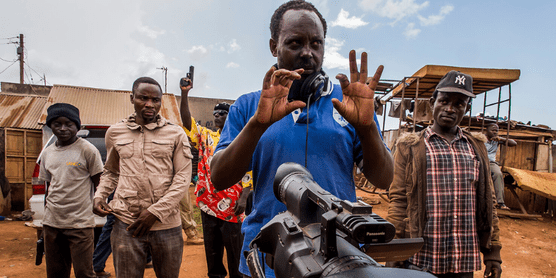
Isaac Nabwana is one of the great under-recognized geniuses in contemporary cinema. With budgets numbering, at most, in the low hundreds of dollars, and the support of a community of friends and family, he’s built a film studio in the Wakaliga slum of Kampala, churning out ingenious comedy-action films with handmade props, low-fi computer graphics, and self-taught kung fu artists. Wakaliwood and its films are the ideal of DIY cinema, the fulfillment of digital technology’s promise of allowing anyone to be a filmmaker. Anyone may be able to cook, but it takes a visionary like Nabwana to not only see the possibilities of democratic filmmaking, but actually realize it in a way that is infectiously entertaining and delightful to audiences the world over. And even then, none of it would be possible without the community that has coalesced around him, prop-makers, wanna be actors, martial artists, and film enthusiasts. All of this is apparent in Cathryne Czubek’s documentary Once Upon a Time in Uganda, which chronicles close to a decade in the life of the studio, from the time it first drew international attention (a trailer for Who Killed Captain Alex? posted on YouTube in 2010) through Nabwana’s triumphant appearance at a Toronto Film Festival screening of Crazy World in 2019.
Czubek started filming Wakaliwood in 2012, not long after another westerner, Alan Hofmanis, himself enamored with the studio’s YouTube releases, left his home in America and traveled to Uganda in search of cinematic enlightenment. A longtime veteran of the industry (on sets, in marketing, and in festival programming), Hofmanis tells us he was inspired by what Nabwana and his team had done, and simply wanted to be a part of it. He was quickly adopted into the Wakaliwood family, appearing on-screen as the recurring white guy, the Mzungu, in films like Bad Black and the yet-to-be-released, but delightful looking, Eaten Alive in Uganda. Hofmanis also took on a role in promoting the company, focusing on getting Wakaliwood seen in the West, where his years of festival and marketing experience would prove helpful, though it would be an uphill battle considering that what most Western film festival directors (and therefore the critics and audiences that live downstream from them) want out of third world cinemas are anguished stories of poverty and deprivation, not lovably goofy paeans to the joys of making cinema. While Hofmanis focused abroad, Nabwana would concentrate on getting his films seen at home in Uganda, and that’s where the documentary’s real tension comes.
Nabwana explains that film in Uganda is not seen as a particularly prestigious activity, at least not among the elite classes that actually have the money that Wakaliwood desperately needs to expand and improve. He says that his true audience are the “peasants,” the poor people he grew up with and around in the chaotic years after the end of Idi Amin’s dictatorship and who still occupy the nation’s villages and slums, but, unfortunately, often they do not have access to DVD players. As has been the case in other emerging film cultures, there can be a kind of inferiority complex that certain communities have about their own art, and sometimes it takes recognition by outsiders for a people to appreciate what their own cinema has to offer**. To this end, Hofmanis’s efforts in getting Wakaliwood films seen and praised abroad helps raise Nabwana’s profile at home, leading to an offer from one of the local television moguls to make a Who Killed Captain Alex? TV series. Because Nabwana’s overarching goal is not international success or personal acclaim, but rather building a viable and sustainable film culture in his home country, training actors and filmmakers and seeing them succeed him with their own works, he necessarily devotes himself to the local production. But this in turn disrupts Hofmanis’s efforts at international promotion and distribution, ultimately leading to an awkward falling out between the two friends. But after some time apart, the family is reunited, leading to the heart-warming Crazy World premiere, because ultimately Nabwana and Hofmanis share the same love for what they are doing and hope for the future of cinema.
Czubek’s film is at its best showing the Wakaliwood crew at work. Nabwana directing and editing, almost always with big smile on his face. His wife Harriet doing a endless number of jobs, from feeding the crew with leftovers from the cake-making business she’s started to raise extra money, to casting and line producing and helping with every other aspect of the productions. We meet “Mad Prop Genius” Dauda Bisaso, who builds guns and helicopters and camera cranes out of scrap metal, and catch a glimpse of VJ Emmie at work, Wakaliwood’s most glorious contribution to film culture: a Video Joker who talks along with the film, one part Benshi-style narrator, four parts your most hilarious friend three drinks in cracking jokes alongside you as you watch a movie together. A magical sequence shows Nabwana, who had been a mud brickmaker before he became a filmmaker, assembling a film projector out of a couple of batteries, a string of wire, a small lightbulb and some aluminum foil. He uses it to show some local kids how film works, lighting up one frame of film at a time (it appears to be a scrounged reel of some version of Spider-Man), and running it through his hands, magical images projected on a crumbling concrete wall.
Wakaliwood is currently running a crowdfunding campaign for Who Killed Captain Alex 2. If you love movies, contribute if you can. You can also by a deluxe BluRay edition of Bad Black and Who Killed Captain Alex from Vinegar Syndrome and the American Genre Film Archive. You won’t regret it.
- Eventually this dichotomy tends to turn in on itself, as those filmmakers most popular in the West are rejected by the next generation for not being authentic enough to their home culture. I’m thinking here about Kurosawa Akira winning an award at the Venice Film Festival at a time when no one outside of Japan and few people inside it considered it to be on a par with the cinemas of the West, only to then be derided as “too Western” by the next generation of Japanese filmmakers. It’s an endless argument that no one wins, except audiences who get to see great films made by all sides of the divide. ↩︎




 Seattle Screen Scene