Phoenix (Christian Petzold, 2014)

Nelly and rubble

Ash, ash–
You poke and stir.
Flesh, bone, there is nothing there–

A cake of soap,
A wedding ring,
A gold filling. 

. . .

Out of the ash
I rise with my red hair
And I eat men like air.

~Sylvia Plath, “Lady Lazarus”

I confess, I found myself a bit disappointed when I learned Christian Petzold’s new film, Phoenix, would be “about the Holocaust.” There is a certain weariness that arises out of the fact that so many use or have used the events of the Holocaust as a reference point, whether artistically, for a film’s central story (see Sophie’s Choice, Schindler’s List, The Pianist, among others) or socially, for a cheap point in a debate gone awry (see my Facebook feed). I wondered whether I was up for seeing yet another movie centering around the much-documented tragedy.

But great artists work familiar things in such unfamiliar ways that even the cliché can take on unexpected, fresh resonance, and I see the familiar thing as I had not seen it before. It is both old and wholly new.  Continue reading Phoenix (Christian Petzold, 2014)”

Ricki and the Flash (Jonathan Demme, 2015)

Ricki

Meryl Streep’s joie de vivre is undeniable. She throws herself into the roles she chooses with thoroughness and vigor, and even in her more serious roles, she seems to perform with a kind of joy that’s always flowing just under the surface. One feels she truly loves her craft, and no matter the role, she’s in it, with all her heart. And she’s good, of course. The best, maybe. Everybody knows that. She can play it camp, she can play it serious, she can play it comic. She’s a master of voices and tones, on screen and off screen, big roles and small (my children and I love her superb narration of the Kevin Henkes’s picture book, Chrysanthemum). And she sings, too, with that same mastery and joy we see in her acting. Her early training, as she told Terry Gross on Fresh Air in 2012, included opera, and she’s proved her vocal quality and her skill in musical performance in films like Postcards from the Edge, A Prairie Home CompanionMamma Mia!, and Into the Woods. Never mind her acting, I’d go to a concert just to hear Meryl Streep sing.

And that’s a lot of what we get in Jonathan Demme’s latest film, Ricki and the Flash: a Meryl Streep concert film, featuring full length, live performance songs, where Streep not only sings but plays guitar, and she performs with professional musicians: Rick Springfield, Rick Rosas, Joe Vitale, and Bernie Worrell.  Extraordinarily, she seems like one of them. It’s unfortunate perhaps, then, that the film isn’t fully a concert film, that it’s not a kind of fictional version of the documentary concert films Demme made early in his career – Stop Making Sense (1984) – and has made within the past decade or so: Enzo Avitabile: Music Life (2012); Kenny Chesney: Unstaged (2012)and a trio of Neil Young films, Neil Young: Heart of Gold (2006), Trunk Show (2009), Neil Young Journeys (2012). It’d be an odd concert film, to be sure – an actress playing and singing cover songs with professional musicians in front of a fictional audience comprised of a collection of extras – but that sort of film is possible; it’s very close, for example, to what Robert Altman did so delightfully with Streep, a part of an ensemble cast, in A Prairie Home Companion. Demme, surely, could do something in the same vein, particularly if he had the caliber of musical performers he has in Ricki. I’d like to see it. Continue reading Ricki and the Flash (Jonathan Demme, 2015)”

Tangerine (Sean Baker, 2015)

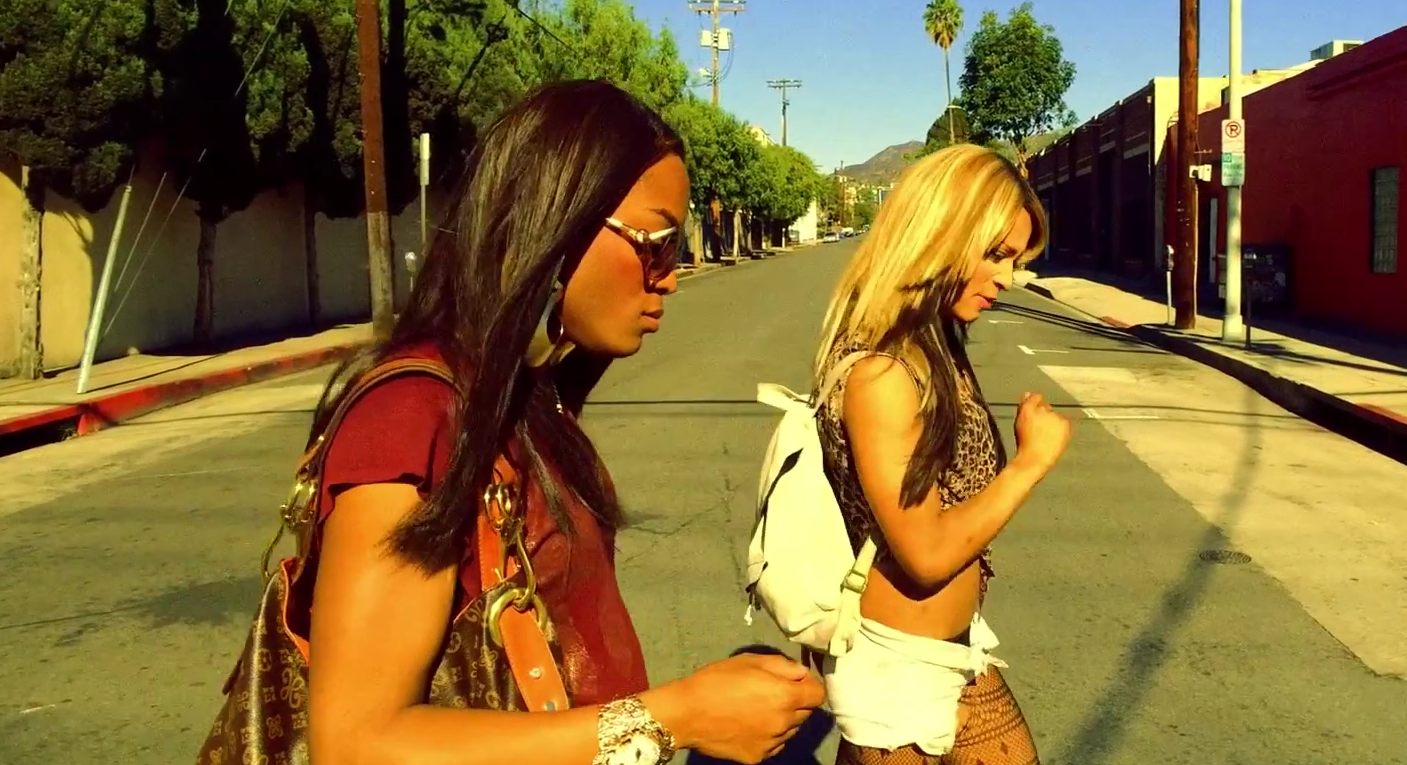
girls on street walking

It is Christmas Eve in Hollywood, a day in Tinseltown when everything is even more brightly showy than usual. It’s a town of glitz and dreams and fantasies, where stars soar higher than high and multitudes of others scramble below to make a living in those stars’ dusty grit. A few golden names will get a terrazzo or brass star on Hollywood Boulevard, an aspirational spot on the ground that is, perhaps ironically, open to be trod on by anyone in need of a sidewalk. And there is something of that sly irony in Sean Baker’s newest film, Tangerine, for Baker is a good deal more interested in those doing the treading on those stars, those who walk on and work in the streets, than in those who have their names emblazoned into them. And indeed, as the film opens – a shot of two pairs of hands clasping and exchanging a doughnut over a table at Donut Time, a place that couldn’t be farther from the showiness of the Walk of Fame – I am a good deal less curious about the stars whose names I might recognize than I am about to whom those hands on the table belong.

The hands are Sin-Dee’s (Kitana Kiki Rodriguez) and Alexandra’s (Mya Taylor), two friends, two transgender sex workers, whose journey, set all in one day in the Los Angeles streets and in the day-to-day haunts of those who make a living on the streets, invites us to question what we know, or what we think we know, about Los Angeles and those who live in it. Is the city, and by extension its inhabitants, as one character in the film puts it, a “beautifully wrapped lie”? Continue reading Tangerine (Sean Baker, 2015)”

Gemma Bovery (Anne Fontaine, 2014)

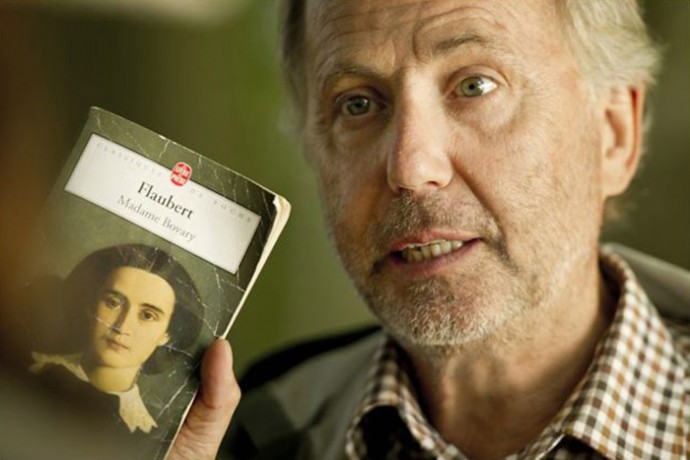
Martin and Bovary

The premise of the newest film from director Anne Fontaine, Gemma Bovery, holds a good deal of promise for lovers of both the cinematic and the literary, particularly for those who welcome witty or playful re-tellings of classic works of literature. Adapted from Posy Simmonds’s graphic novel of the same name (a novel originally conceived as a serial in The Guardian), the film’s story centers around perceived parallels between the literary characters in Gustave Flaubert’s Madame Bovary – particularly Emma Bovary, her husband, Charles Bovary, and Emma’s lovers –  and the film’s characters. When Gemma Bovery (Gemma Arterton) and her husband, Charles ( Jason Flemyng), move from London to a small town in Normandy, the town’s excitable, bourgeois baker, Martin Joubert (Fabrice Luchini), is certain Gemma is the real life equivalent of the fictional Emma, and he makes it his mission to discover her in love affairs and prevent the tragic suicide that plays out in the novel.

Such a set up has all the ear marks of wonderfully droll farce or of a sly satire, a satire that could work on any number of levels – critiquing, perhaps, the often fraught French-English relationship; or the middle class, provincial prejudices; or literary pretensions; or male-female relationships.  The premise also suggests the story might hold some genuine pathos, a tender examination of love, heartbreak, and misunderstandings, perhaps.  And by many accounts (here’s one, for example), Simmonds’s original work does function on all those levels. (After watching the movie, I immediate ordered the graphic novel.) Continue reading Gemma Bovery (Anne Fontaine, 2014)”

Rebels of the Neon God (Tsai Ming-Liang, 1992)

TV screen red dress on bed TV screens, arcade game screens, mirrors, windows – all of these offer reflective surfaces, some more and some less reflective, some promising immersion into another sort of state, some seeming to immerse but offering very little in the way of escape from lonely self and quotidian present. These surfaces are everywhere in Tsai Ming-Liang’s newly restored and re-released feature debut of 1992, Rebels of the Neon God, a quietly absorbing film that suggests a set of startlingly germane meditations on the modern self, a thing that is simultaneously isolated and connected, revealed and covert.

The story centers around the lives of two people: one, a 20-something young man, Ah Tze, living by petty theft and residing in a lonely, constantly flooded apartment, and one, a teenaged boy, Hsiao-Kang, chafing at his bondage in cram school and living at home in uncommunicative silence with his anxiously watchful parents.  Both Ah Tze and Hsiao-Kang, though they have companions who surround them – a parent or a brother, a friend or a girlfriend – and though they pass through the teeming city of Taipei, stand as alienated figures, whose selves ricochet in the mirroring surfaces surrounding them.

Continue reading Rebels of the Neon God (Tsai Ming-Liang, 1992)”

Me and Earl and the Dying Girl (Alfonso Gomez-Rejon, 2015)

Me and Earl and the Dying Girl

I am suspicious of my enjoyment of Me and Earl and the Dying Girl in spite of the fact that the film, premiering at Sundance in 2015, received the U.S. Grand Jury Prize and the Audience Award for U.S. Drama, and I am not alone in such enjoyment. Directed by Alfonso Gomez-Rejon, a director until now primarily known for his TV work (Glee, American Horror Story) and based on a YA novel by Jesse Andrews, the film follows Greg (Thomas Mann), the titular “Me,” who, under non-negotiable orders from his mother, befriends a high school classmate, Rachel (Olivia Cooke), who is diagnosed with leukemia; Greg is to be a companion to her through the ordeals of her illness and treatment. And so Greg, with his childhood friend and fellow film-buff, Earl (RJ Cyler), entertain Rachel in large part with the films the two boys make together, short films that cleverly pun around with titles of classic and foreign cinema: The 400 Blows becomes a film about “The 400 Bros”; 8 ½ becomes “Ate ½ (of my Lunch)”; A Clockwork Orange becomes “A Sockwork Orange.”

Continue reading Me and Earl and the Dying Girl (Alfonso Gomez-Rejon, 2015)”

The Wolfpack (Crystal Moselle, 2015)

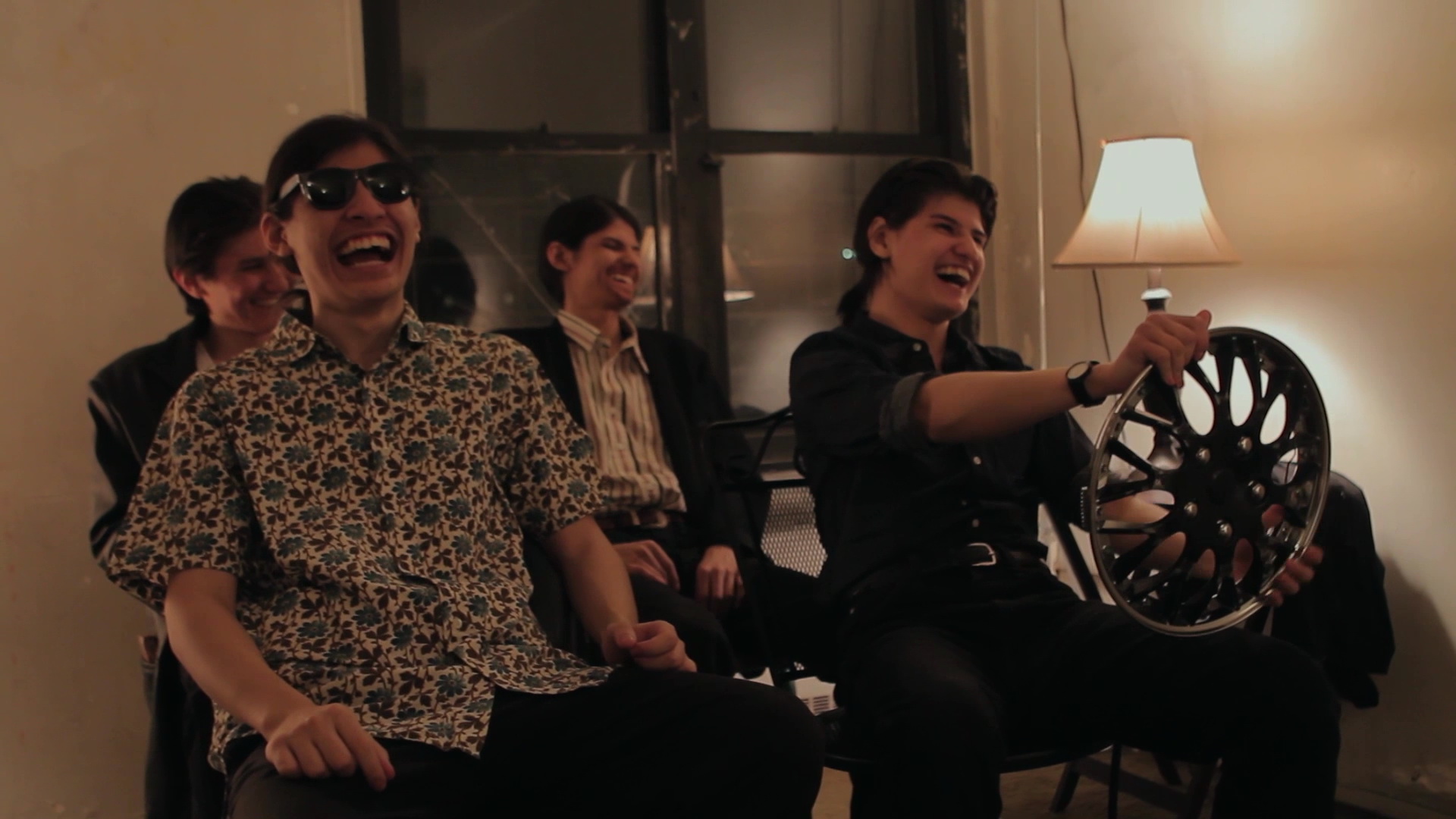
Reservoir dogs

Premiering at Sundance in 2015, where it won the U.S. Documentary Grand Jury Prize, The Wolfpack is a maddening documentary for opposite, simultaneous reasons: chaotic story framing and contrived framing. The film, from first time director Crystal Moselle, records scenes in the life of the Angulo family, a life confined – under the demands of a dictatorial father – to a small New York apartment. The mother and the 7 homeschooled children, 6 boys and 1 girl, are essential prisoners in their own home, where the boys’ only relief and only window to an outside world lies in the access they are granted to recorded movies, which they constantly watch and then elaborately reconstruct, acting out scenes from the likes of Reservoir Dogs, Pulp Fiction, and Goodfellas.

Continue reading The Wolfpack (Crystal Moselle, 2015)”