SIFF 2017: Beach Rats (Eliza Hittman, 2017)

img_1483-1

Note: as this film is under embargo until its release in the Seattle area, here are exactly 75 words.

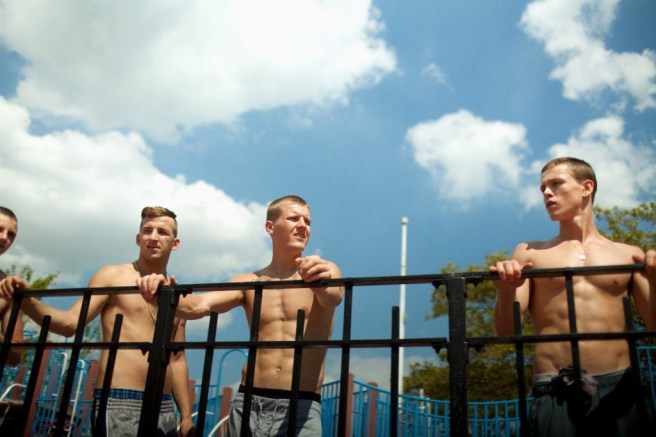
Abstracted images of abs and biceps open Beach Rats, appearing to the flashbulb rhythm of iPhone selfies. The body is Frankie’s, a closeted teenager whose father dies outside his bedroom while his attraction to virile middle-aged men awakens. Director Eliza Hittman mingles thanatos and eros, ethnography and moralism unproductively, aiming for balance but arriving at regressive parallelism. Beach Rats instructs Frankie about the dangers of living in the middle. Hittman should take her own advice.

SIFF 2017: By the Time It Gets Dark (Anocha Suwichakornpong, 2016)

BYTHETIMEITGETSDARK_05

Note: as this film is under embargo until its release in the Seattle area, here are exactly 75 words.

Boundaries are under attack in Anocha Suwichakornpong’s Thailand. The 1976 Thammasat University massacre infiltrates past and present, people and personhood, eating away at the tissue that divides. What’s left over is anyone’s guess: By the Time It Gets Dark shape-shifts into a unclassifiable design, the root contagion ultimately wreaking havoc beyond Suwichakornpong’s control. A kaleidoscopic final shot throws acid, though it seems that the film might spore on, finding forms both banal and beautiful forever.

SIFF 2017: Knife in the Clear Water (Wang Zuebo, 2016)

knife-in-the-clear-water-busan

What does it mean to program a film like Knife in the Clear Water in 2017? And lest there be any confusion, Wang Xuebo’s film is not, as the title suggests, a Polanskian exercise in triangulated sexual tension. There aren’t even enough points here to form a triangle; the only relationship of note is between man and cow. I’ll resist the flippant impulse to label the movie itself as bovine, but suffice it to say that if you’ve been to a film festival in the last 30 years, you’ve encountered Wang’s chosen mode: the lumbering, slow, dull art movie, the kind of cinema constructed around underrepresented peasant classes, devoid of incident save the barest whisper of conflict, composed exclusively in long take, and, bonus points, in 4:3.

The film follows a farmer who resists sacrificing his beloved beast of burden in order to fulfill the burial rites initiated by his wife’s death. Shot in China’s harsh mountain region Ningxia, Knife in the Clear Water understands itself to be a hard-eyed glimpse into the lives of the Hui people who call this place their home. At least in terms of texture, the film does manage to capture something: the way that atmosphere, earth, and skin mingle together as if cut from the same ashen cloth suggests the bond shared between the landscape and its inhabitants. On the other hand, I wonder the extent to which any of the filmmaking choices here emerge from lived experience. I cannot presume to know how the Hui community in the film would choose to depict themselves, either collectively or through the peculiar eye of a homegrown artist, and for all I know what’s on display here is that vision, but the fealty with which Knife in the Clear Water adheres to every stylistic cliche of the festival circuit, its total alignment with the demands of the market (and let’s be clear, it is a market), raises some doubts. Hou Hsiao-hsien and co.—inarguably the progenitors of the style—can count many sons and daughters among the filmmakers most favored by programmers worldwide, which must be considered a coup given the initial modesty of their project, and yet by transforming an economic limitation into an aesthetic they bequeathed to a generation of cash-strapped artists a safe, bankable blueprint. The blame for slow cinema’s status as a lazy generic default can’t be laid at their feet or even Wang’s, really. But après Hou, le déluge; year after year the market is flooded.

A film like Knife in the Clear Water exists because filmmakers and festivals lack a vision of the future. Both ran the numbers, looked at what got slotted before, and traded in the danger of artistic risk for the well-worn laws of supply and demand. There’s a reasonable hope that, like any economy, the glut of product might be cut short if we stopped consuming it. But alas: to program Knife in the Clear Water in 2017 means programming it, under a different and presumably less tantalizing title, again and again and again.

On the Beach at Night Alone (Hong Sang-soo, 2017)

201713061_1

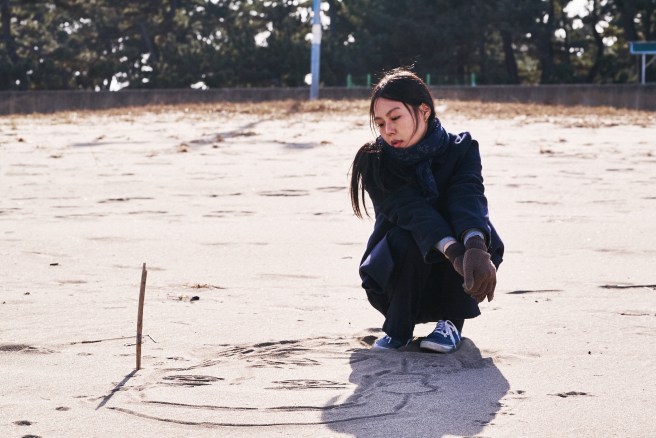
First, what On the Beach at Night Alone is not. And because Hong often, though not always, makes films in pairs that profit from their proximity, let’s take Yourself and Yours as the template from which to trace the variations. Yourself and Yours arguably employed Hong’s loopiest structure in some time: there’s no intradiegetic scaffolding—a la Hill of Freedom—to guide the narrative’s many double helixes and it lacks the log-line neatness of Right Now, Wrong Then, with its rewind-to-be-kind backpedaling. By comparison, this newest work is not a labyrinthine construct. Yes, On the Beach at Night Alone redeploys the bifurcation that defined Hong’s biggest hit, but it hardly counted as innovation when he used it there either; Hong has long displayed an affinity for warped mirror halves. And anyways, the chapters that split On the Beach at Night Alone in two are, if taken at face value, drawn more sharply on geographical and temporal lines than metaphysical or meta-fictional divisions (though more on that later).

Continue reading On the Beach at Night Alone (Hong Sang-soo, 2017)”

Certain Women (Kelly Reichardt, 2016)

certain-women-e1452217189427

Kelly Reichardt’s films speak with a particular and rather outmoded cadence, a sort of clenched-jaw Western laconism. American movies and American culture writ large no longer appear interested in such restraint; heroic pauciloquy died with Gary Cooper, or something like that. Our present heroes—and orange skinned villains—fill the air with unceasing clamor, armed with the gift of gab and hair-trigger. Not that there’s anything wrong with that per se. A mythic America of tight-lipped fortitude probably never existed anyways, but it did form a national pop mythos as recently as a half century ago. As it fell out of vogue, cinema’s true believers largely retreated from multiplex screens and into the avant garde, though Clint Eastwood’s Sully was rightly hailed as a recent norm-deviating revival. Non-narrative cinema continues to offer modes of production and consumption amendable to restraint as an aesthetic and moral principle. The problem is that Peter Hutton’s or James Benning’s American landscapes probably aren’t coming to a theater near you (unless you live in Seattle, where the Northwest Film Forum is presenting a one-night-only, attendance-required selection of Hutton’s films next month). Their respective corpuses could not exist without the trail first blazed in Hollywood by someone like John Ford, himself an artist with a tendency to careen between laconism and good old Irish loquaciousness, but neither Hutton nor Benning possesses a conventional interest in storytelling that allowed Ford to thrive in a commercial industry. Enough with those pretty pictures, the people demand characters! Where is our Wyatt Earp? Where have all the strong, silent types gone? Kelly Reichardt knows.

Continue reading Certain Women (Kelly Reichardt, 2016)”

VIFF 2016: Aquarius (Kleber Mendonça Filho, 2016)

aquarius

In the span of just two features (I can’t speak for the shorts) Brazilian director Kleber Mendonça Filho has developed a truly indelible mise-en-scène. Architecture’s contour and form take center stage in front of Filho’s camera, his eye ever attuned to man’s geometric impositions on the world. Cavernous widescreen images locate everything within environmental context; it’s not enough to say that Filho’s characters are defined by the spaces they occupy. The spaces occupy them.

Filho’s dynamics of power concern primarily the dominance of hearth and home. In Neighboring Sounds, one familial clan holds sway over an entire city block, the ill-begotten gain of an unexplained original sin. There the family’s grip on their petty empire comes under attack from within by infiltrators lurking in the compound. Dona Clara, the materfamilias of Aquarius, is under siege from without. Greedy real estate developers have their eye on the eponymous apartment complex where she remains the last holdout. Clara’s life is housed in the walls of the Aquarius and Filho imbues every nook and every piece of furniture—including a particularly memorable dresser—with one woman’s personal history. Clara’s commitment to this place gets sketched out by Filho’s cartographic camera, but equal credit goes to the fire burning in Sonia Braga’s eyes. The legendary Brazilian actress almost seems to fight against Filho’s architectural sensibilities. Her hair alone is capable of commanding the screen, enveloping the widescreen frame in swaths of undulating black. It even demands its own chapter. Braga’s place in the mise-en-scène nurtures a productive friction between actor and director. But Filho occasionally opts for a smoother course elsewhere. To call Aquarius safe seems patently false: it caused some notable controversy in its home country after its premiere, though that’s possibly a result of the cast and crew’s public politics at Cannes more than the overt announcements of the film itself. But Filho doesn’t hide his aims either, and trying to cleave a wedge between the red carpet protest and what’s on screen is a fool’s errand. The struggle to control one old flat speaks volumes for Filho. If anything Aquarius‘s premise plays too neatly as metaphor—less, uh, termite, more white elephant. Not every film needs clandestine subtext, however, and Filho certainly isn’t the first auteur to use his second at-bat as a pretext for stylistic and thematic clarification, though I wonder if expansion rather than distillation might’ve made for a knottier movie. Still, methinks Filho has a masterpiece in him, so, thanks in large part to Braga’s ferocious performance, we’ll just have to settle for Aquarius being merely very good.

VIFF 2016: Yourself and Yours (Hong Sang-soo, 2016)


A comedy of remarriage as only Hong Sang-soo could imagine it, Yourself and Yours rearranges the familiar building blocks of social anxiety, sex, and—most of all—soju to tell the story of one couple’s breakup and reunion. Or, given that this is Hong’s protean world, perhaps it’s not a reunion at all but a new couple, newly formed. Key to this Hongian puzzlebox is Minjung, a young woman with a well-known love of drink recently sworn off the sauce at the behest of her boyfriend. Rumors of soju recitivism split the couple up and Minjung encounters two different men who profess to know her from the past. Minjung, for her part, claims no memory of them, offering up a suspicious twin sister look-a-like story or blank stares in response. The exact nature of these  misidentifications forms the film’s core mystery. It’s certainly possible that Minjung’s penchant for drink has obliterated these men from her mind, though it’s equally plausible that the self is an infinitely branching set of traits, often repeated and therefore identifiable, but always shifting emphasis, shape, and order, so also essentially unstable. Sounds like Hong’s movies.

Unlike his other recent features, Yourself and Yours offers no structural blueprint at the outset. Hill of Freedom‘s jumbled letters explain that film’s disorganized narration and Right Now, Wrong Then‘s initial title card (the inverted Wrong Then, Right Now) clues the attentive Hong viewer into the game being played. The dissipated dreaminess that governs Nobody’s Daughter Haewon comes closest, but with a crucial difference: Minjung does not appear to be dreaming. None of the strange happenings emanate from her consciousness. If anything, the unblinking earnestness of actress You-Young Lee’s performance ensures that Minjung remains a fixed point, no matter the cognitive dissonance she inflicts on the men around her. She is a mystery to others but never to herself.

That self-assurance allows Minjung to act the Hongian sage, the one character with sufficient wisdom to proffer extra-filmic advice: “Knowing is not as important as we think.” Perhaps that’s the only explanation for this hall of mirrors, though if this is a Stanley Cavellian comedy, as the final moments suggest, it’s one that takes his idea of transformation literally: “I am changed before your eyes, different so to speak from myself, hence not different. To see this you will have to correspondingly suffer metamorphosis.” Is Minjung’s mutable personhood just a screwball game to win back her lover, to make him transform? He can’t deny his partner’s true self (I drink therefore I am) and expect to keep her. So she wins. Is her victory a consequence of drunken forgetfulness, a spatiotemporal rupture, farcical roleplay? The beauty of Hong’s cinema lies in never having to choose.

American Honey (Andrea Arnold, 2016)

americanhoney

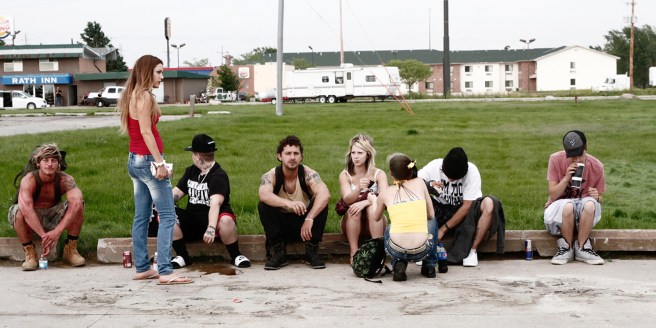
American Honey finds British filmmaker Andrea Arnold roughing it with the impoverished class of 21st century America, imagining life at the lower-rungs as a procession of scams and brutal poetry, strip malls and butterflies, and insisting with all of her not inconsiderable filmmaking power that this world and its inhabitants are worth taking seriously. Or, to summon up a different vision of American poverty: “Attention must be paid.” An admirable goal to be sure, but urgency and good intentions do not a movie make. Arnold bets the house on the compassion borne from her closely-hewn style, which locks into the perspective of Star, a young woman running from a broken home and towards her meager dreams, via a tight Academy ratio frame and shallow-focus close ups. This closeness ensures that no matter how flagrantly grating the behavior gets—and whoo-boy does it grate—our complicity with the events on screen remains intact. It’s shorthand for empathy; a stylistic shortcut particularly common to the aesthetic Arnold adopts, which she employs unceasingly over the film’s extended running time. Realism shouts and spits in your face, apparently. And with so many moments constructed to put the audience in a confrontational position (either step up or step out), it’s worth asking: when does a repeated plea for empathy become a form of condescension? Tell us over and over again that these caricatures are worth taking seriously as people and I might wonder if you yourself have some doubts.

Continue reading American Honey (Andrea Arnold, 2016)”

VIFF 2016: A Quiet Passion (Terence Davies, 2016)

aquietpassion

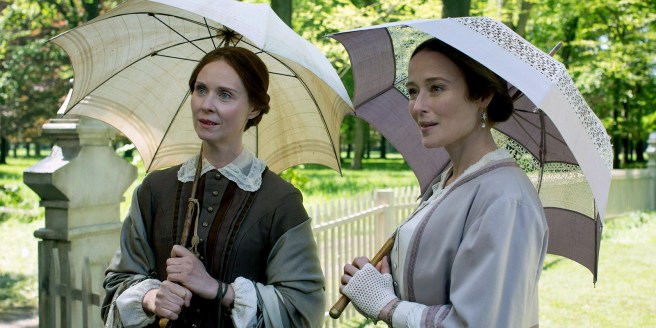
If Sunset Song, Terence Davies’s other recent feature, is a film of the enduring earth, than A Quiet Passion is a film of the withering body, the mortal coil that wheezes and shakes and is finally shuffled off. Human fragility, of both the corporeal and spiritual variety, haunts Emily Dickinson from the opening moments, in which a puritanical interrogator questions the young poet about her relationship with God and the promise of hell. Religion’s frightening specter shadows even the warmest moments in Davies’s cinema—the terror is a scar, an old spur in his bones—though here it takes on a specifically American character. Quoth New England theologian Jonathan Edwards: “The God that holds you over the pit of hell, much as one holds a spider, or some loathsome insect over the fire, abhors you, and is dreadfully provoked.” A gossamer-thin suspension is all that holds Emily Dickinson above the eternal flames.

The signal achievement of A Quiet Passion is to render the world of Dickinson’s New England with burnished clarity, to conjure the specifics of time, place, and ideology from which her art emerges. The intellectual foment of 19th century New England arguably represents the earliest maturity of American thought, a spiritual founding to echo the political founding a half century earlier. Dickinson’s poetry claims a clear piece of this lineage. Less clear are the narrative possibilities offered by her life’s story. Dickinson rarely left the house and Davies’s eye does not violate this cloister. A swirling camera and symphonic music are the director’s instruments, which can elevate even the hard-scrabble existence of a young Liverpudlian to heights of poetry, and here they transfigure the space of the Dickinson estate into a expanse of wallpaper and candlelight, and most importantly, they give remarkable sonorousness to an otherwise hushed life. The spirit of the age lives alone in a room upstairs.

On paper this sounds theoretical—more The American Scholar than “Tell all the truth and tell it slant”—but Davies is constitutionally incapable of making something so dry, and in addition to his trademark romanticism, A Quiet Passion also possess more wit than any other movie this year, save perhaps for Love and Friendship. Early passages provide Ms. Dickinson, and actress Cynthia Nixon, with a roundelay of able sparring partners. The barbs that fly in these scenes occasionally best Whit Stillman at his own game. But if we’re sticking with cinematic references, George Cukor might be more apropos. The classical auteur’s ability to reveal depth of character beneath each perfectly-timed quip gets taken up by Davies here, who understands that Emily Dickinson’s inner life is profoundly rich, though just out of reach for those around her. Humor opens up a window into the poet’s soul, and the fear and trembling that finally beset her are all the more tragic for the spirit they trample out.

A Quiet Passion’s parade of exits (“they all go” is the poet’s summation of solitude) rounds out with Dickinson’s own. The biopic ends where it must, at the grave’s hard, eternal earth, though it should be clear as we arrive at this final resting place that A Quiet Passion is as personal as anything in Davies’s career. Even a cursory knowledge of his life reveals the connection to Dickinson’s: his struggles with his sexuality, his trembling before the void, and the necessary—though always inadequate—consolation provided by his art. “You have your posterity,” Emily’s sister says to comfort her. “And you have your life,” she responds. Dickinson seems willing to trade all the glories of her poetry for a few hours of certain joy and one wonders if Davies, in his old age, might do the same. The world is richer for their abiding beauties, but in the face of mortality the afterlife of art is cold comfort for all their departed, unhappy days.

VIFF 2016: Werewolf (Ashley McKenzie, 2016)

werewolf

It’s already too late for someone. A rope is pulled down from a tree and strung back up again. Two shots, and a cloud of suicidal despair rolls in over the coming proceedings. The film stops briefly to introduce itself—the title appears as if clawed across the screen—and just as quickly director Ashley McKenzie plunges back into the lives of two lovers and recovering drug addicts living on the fringes of society.

Werewolf is an addiction movie. And like many films in the genre, its drama orbits around the twin poles of drugs and romance. The compulsive behavior brought on by both intoxicants proves an irresistible symmetry for filmmakers interested in that sort of thing. Narcotics as l’amour fou, or vice versa. The more clinical term is, I believe, co-dependency, and although Werewolf plays freely with the established image of the addict lovers, it distinguishes itself by honing in on the pharmacological ties that bind this relationship. Methadone treatment isn’t just a metaphor here, but a very real medical regime with rules, regulations, lockboxes, and psych evals, all of which are administered and enforced by the faceless social workers who hover around the edges of the rigid frame, abstracted as benignly indifferent voices or anonymous limbs. Snatches of poetry do enter this antiseptic world through McKenzie’s eye, and her Denis-like fascination with skin— real skin, not the finely polished alabaster of most movie actors—keeps things pulsing with humanity. Human moments, however, give way always to the exhausting task of navigating the social order of recovery, and the film remains steadfastly committed to depicting the same degrading ritual time and again: hauling yourself up to the pharmacist’s counter to guzzle down one more dose, the humiliation nearly unbearable save for the fact that it’s shared.

The tragedy, as the opening shots warn us, is that this life can’t be shared forever, and so Werewolf is finally a diverged path, a fork leading two places, one deathly definitive and the other indeterminate, lonely, but not entirely without hope.