VIFF 2015: The Thoughts That Once We Had (Thom Andersen, 2015)

millennium-mambo-still

Part of our coverage of the 2015 Vancouver International Film Festival.

Thom Andersen’s new essay film, The Thoughts That Once We Had is a proudly idiosyncratic interpretation of French philosopher Gilles Deleuze’s thoughts on cinema. Deleuze’s two volume set, The Movement Image and The Time Image, are the springboard for Andersen’s patented excursions into cinema’s past, built on a foundation of film clips both obscure and ingrained. Andersen’s film flits around Deleuze’s dense concepts, often teasing the first portion of a line with a resulting set-up clip, before transcribing the larger idea and presenting a montage representing it. I wouldn’t claim to understand what the hell Deleuze (and by extension, Andersen) is going on about half the time–it’s all very abstract and anyway, the quotations are onscreen for the briefest of seconds–but by gum, the thing works wonders despite the less learned background of the viewer. (In fact, the film’s biggest drawback will be the inevitable embrace by the high-falutin’ intellectual cognoscenti.)

Continue reading “VIFF 2015: The Thoughts That Once We Had (Thom Andersen, 2015)”

A VIFF-ing We Will Go!

VIFF2015_eblast

Our coverage begins today of the 2015 Vancouver International Film Festival. Over the next week and a half, Sean, Melissa, and I will be posting reviews, recording podcasts, and getting lost in the wilds of British Columbia. We’ll be catching some of the most anticipated films of the year, including new works from Hong Sangsoo, Guy Maddin, and Hou Hsiao-hsien.

For the most up-to-date information, keep your eyeballs affixed to the Seattle Screen Scene Twitter. Elsewhere in the 140charactersorless-verse, Sean can be found at theendofcinema, Melissa at oneaprilday, and Sean agreed to do my laundry if I finally post stuff at geosandersshow. Don’t worry, I plan on getting my clothes really dirty.

strangebrew

O Canada!

An Interview with Penelope Spheeris

DECLINE Producer Anna Fox and Director Penelope Spheeris
DECLINE OF WESTERN CIVILIZATION Producer Anna Fox and Director Penelope Spheeris

One of the most heralded home video releases of the year has been the long overdue appearance of director Penelope Spheeris’s underground music trilogy, The Decline of Western Civilization. Spheeris is touring the country in support of the release and will be at SIFF Cinema Uptown on September 18 as part of their “Women in Film” series. SIFF will be screening the first installment of Decline, which features performances from seminal L.A. punk bands Black Flag, X, and The Germs. The screening will be followed by a Q&A with Spheeris moderated by director Lynn Shelton. Afterwards Spheeris will introduce a screening of her mega-hit Wayne’s World.

Penelope Spheeris was kind enough to answer a few questions via email in advance of her Seattle appearance.

Continue reading “An Interview with Penelope Spheeris”

This Is Spinal Tap (Marty DiBergi, 1984)

“Have a good time, all the time.” — Viv Savage

viv zombie

Much has been written about the career of Spinal Tap, the second greatest rock band to ever come out of England, apologies to The Rolling Stones. The longevity of the band, their expert songwriting, and their general loudness have all become the gold standard for nearly every musician that has followed in their wake. Often referred to as “Heavy Metal’s Susan Lucci”, Spinal Tap’s annual snubbing by the Rock ‘n’ Roll Hall of Fame is a travesty of monumental proportions, especially considering the band has written two of the very best songs with the Hall’s name in the title, Rock ‘n’ Rolls “Creation” and “Nightmare”.

While the core personnel has been the same since the 1960s, and principal songwriters David St. Hubbins and Nigel Tufnel have a relationship going “all the way home” back to childhood, one of the most famous elements of the band is their constant retinue of replacement players. Drummers in particular. And while these performers have ranged from the perfunctory (“Gimme Some Money” percussionist John “Stumpy” Pepys) to the incongruously virtuosic (Nigel’s temporary replacement, Ricky, “the hottest lead guitarist in San Francisco”), some of these musicians made lasting contributions with the band and they deserve to be remembered. None more so than keyboardist Viv Savage.

Continue reading This Is Spinal Tap (Marty DiBergi, 1984)”

The Iron Ministry (J.P. Sniadecki, 2014)

Screen Shot 2015-08-28 at 8.03.47 AM

The Iron Ministry is the first film in many years to begin with an overture. Particularly popular with the opulent studio productions of the 1950s and ’60s, the practice of including an orchestral score as prelude to the narrative was intended to provide gravitas to the proceedings as well as act as a transition from the real world to the cinematic. The overture in The Iron Ministry definitely provides the latter, but unlike films such as Ben-Hur, the music is not grasping at majesty. In fact, it’s not really music. As the droning sound plays out we discover that it is not a string section but the straining sound of metal on metal of a train moving along its tracks.

Filmed between 2011 and 2013, The Iron Ministry takes place entirely on trains traversing through China on the world’s largest railway network. The film is another project released under the Sensory Ethnography Lab, whose ascendence among cinephiles has been astronomical in recent years, thanks to a string of well-received releases such as Leviathan and Sweetgrass. The Ethnography Lab’s immersive documentaries have provided some of the most unexpected thrills in cinema as of late and The Iron Ministry is no exception. The film does not possess the formal rigor of something like the glorious gondola ride of Manakamana but that is not what this subject calls for. In fact, it needs the opposite, an embracement of movement and messiness.

Continue reading The Iron Ministry (J.P. Sniadecki, 2014)”

Straight Outta Compton (F. Gary Gray, 2015)

press soc

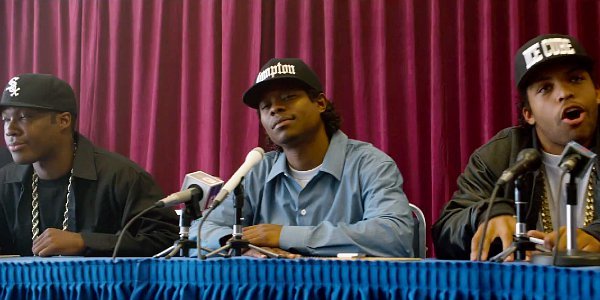
While they sold tons of records and the content of their songs grabbed a lot of headlines, there was never enough appreciation for the look of N.W.A. Their late-’80s ensemble of black sweatshirts and Los Angeles sportsgear doesn’t get as much traction as Beatle boots but it is just as iconic. Certainly the group worked because it was comprised of astonishingly talented individuals, but they also looked the part. F. Gary Gray’s new film, which tackles the meteoric rise and enduring impact of N.W.A., also looks the part. That goes a long way in selling this story. Not all the way, but pretty close.

Continue reading Straight Outta Compton (F. Gary Gray, 2015)”

Gremlins (Joe Dante, 1984)

gremlins present

It all started with a little trouble in Chinatown. There a young boy said, “I told you everything was real”. That’s important. Christmas is closing in and a kind-hearted father is looking for the perfect gift for his son. In a basement junk shop he spies a creature that sounds like Howie Mandel. Like any sane person he feels compelled to adopt this “mogwai”. Then all hell breaks loose. Tying together strands of The Twilight Zone, the boomer ascendency, and the dominant milieu of executive producer Steven Spielberg, Joe Dante’s Gremlins transcends them all to become a masterpiece of mayhem.

Continue reading Gremlins (Joe Dante, 1984)”

A Pigeon Sat on a Branch Reflecting on Existence (Roy Andersson, 2014)

pigeon dance

Seven years after You, the Living, which itself came seven years after Songs from the Second Floor, the revered Swedish director Roy Andersson delivers the final film in his “Living Trilogy”, A Pigeon Sat on a Branch Reflecting on Existence. For those familiar with either of its forebears, Pigeon is more of the same. It is 100 minutes of deftly composed black comic vignettes, each detailing an indignity upon a loosely connected group of people. Critics like to relish in the depictions of capitalistic foibles and other vaguely political themes. Andersson himself claims the film was inspired by a 16th century painting. One’s enjoyment of A Pigeon Sat on a Branch Reflecting on Existence may depend on how much you are willing to believe that.

Continue reading A Pigeon Sat on a Branch Reflecting on Existence (Roy Andersson, 2014)”

Bill & Ted’s Excellent Adventure (Stephen Herek, 1989)

bill and ted circle k

Bill & Ted’s Excellent Adventure is a hilarious and hopeful tale of friendship, full of great dialogue and memorable scenes. It is also a terrible history lesson. Well, depending on what angle you choose to view history. The film certainly doesn’t pause to get all the details right as Bill and Ted traverse the Circuits of History in their time machine, “bagging” influential human beings for help on their high school final project. There are those in any given audience that will always shake their head at an Abraham Lincoln who speaks in an inaccurate baritone (shh, don’t tell anyone but he also yells, “Party on, dudes!”) but in its way, Bill & Ted’s Excellent Adventure does accurately capture history.

Continue reading Bill & Ted’s Excellent Adventure (Stephen Herek, 1989)”

When Marnie Was There (Hiromasa Yonebayashi, 2014)

marnie moon

Spirits are nothing new for Studio Ghibli. Anyone that’s ridden the train with No-Face or enjoyed the amenities of Yubaba’s bathhouse knows that. But the company’s latest — and possibly last — feature, When Marnie Was There, is their first film that feels like a genuine ghost story. The film is certainly not out for scares, nor is it shocking. In fact, the closest thing it resembles might be Joseph L. Mankiewiecz’s The Ghost and Mrs. Muir. This is the platonic, animated, Japanese version of that. For kids.

Continue reading When Marnie Was There (Hiromasa Yonebayashi, 2014)”