The Age of Shadows (Kim Jee-woon, 2016)

2016-the-age-of-shadows-thumb-860xauto-62812

Hot off its premiere at the Venice Film Festival and the announcement of its being chosen as South Korea’s submission for the Foreign Language Academy Award, the latest film from director Kim Jee-woon (The Good, The Bad, The WeirdI Saw the Devil) opened this past Friday. But not in Seattle: it’s only playing at the Alderwood Mall AMC in Lynnwood and the Cinemark theatre in Federal Way, another example of the mixed-blessing that is the state of Asian film distribution in the United States. On the one hand, were this exact same film French or German, you could expect it to be picked up by one of the major art house distributors and get a nationwide roll-out, eventually playing somewhere like SIFF or a Landmark theatre. Along with that would go critical attention and a much wider audience. Instead, as Korean, Chinese, Filipino and Indian films are increasingly only released in the US in small runs targeted at diasporic and immigrant communities, with no advance publicity and little advertising to the public at large, it’s likely that if The Age of Shadows does develop an American following, it will come only once the movie is widely available to stream on the internet. But on the plus side, for those of us that happen to live near a major urban center, we get to see some of the best movies in the world in a theatrical setting, with no waiting.

Continue reading The Age of Shadows (Kim Jee-woon, 2016)”

Cameraperson (Kirsten Johnson, 2016)

cameraperson-620x348

When I first heard about the significant buzz surrounding Cameraperson, it seemed heavily reminiscent of Sans soleil, Chris Marker’s 1983 magnum opus that I regard as the greatest film I’ve ever seen. The description, detailing how it was comprised of outtakes from various documentaries all shot by the same cameraperson, Kirsten Johnson, was intriguing, only slightly removed from the other film’s freewheeling examination of the human condition and memory using footage shot mostly in Tokyo, Guinea-Bissau, and San Francisco. But it took me more than half the runtime to realize that the film is not Sans soleil, and that it was just one of the many, many aspects that makes Cameraperson the stunning, quietly revolutionary work that it is.

Continue reading Cameraperson (Kirsten Johnson, 2016)”

Soulmate (Derek Tsang, 2016)

unspecified-4

A young woman, Ansheng, is tasked by her boss with tracking down the author of an in-progress serialized web novel, as their company would like to option it for a movie adaptation. (This is a thing that happens: the best film of 2014, Fruit Chan’s The Midnight After (now streaming on Netflix) was adaptaed from an unfinished serialized web novel written by an entity known as PIZZA.) She’s given this assignment because one of the main characters is apparently based on her: it’s an account of Ansheng’s lifelong friendship with a woman named Qiyue, from their instant communion as middle-schoolers to their inevitable growing apart over twenty years. The bulk of Derek Tsang’s film is the text of this novel, which has the appearance of a flashback, but with a few key subjective elisions and time-warping montages, hints that reality is not as reliable as it appears. One of those montages is scored by the title track from Faye Wong’s Restless (Fuzao), which speaks to the film’s excellent taste within a fundamentally unoriginal framework.

Continue reading Soulmate (Derek Tsang, 2016)”

Max Rose (Daniel Noah, 2013)

max rose 3

Max Rose marks Jerry Lewis’ first starring role in a film in about 20 years. It tells the story of the eponymous character, an 87-year-old former jazz pianist whose wife has recently died. While going through her belongings, he finds evidence of a possible relationship his wife had with another man.
This is the material of a somber drama, but the film never quite arrives there. This is mostly because first time director Daniel Noah’s script is rather banal and trite. The film’s insights into marriage are sketched out in a series of flashbacks of Max with his wife, Eva (Claire Bloom), which are simply clichés of what a long-term companionship consists of. There’s nothing unique at all about their interactions, or about their conception. The film also throws in Max’s relationship with his son Christopher (Kevin Pollak) and his granddaughter Annie (Kerry Bishé). The former has some sharp moments; primarily, a tense, awkward scene where Max refuses to say “I love you” to Christopher. The latter is downright maudlin and has Bishé be reduced to putting on a clown nose and trying to get Max to smile. Noah’s staging is also flat and usually cut up into a series of unnecessary reaction shots which betray a lack of visual imagination (the film’s final shot is a catastrophe). The lighting at points reminds of a bad TV movie.

Continue reading Max Rose (Daniel Noah, 2013)”

Kensho at the Bedfellow (Brad Raider, 2016)

bedfellow

Kensho at the Bedfellow, the feature debut film, starring, and written and directed by, Brad Raider, opens with a bang. A literal bang. And a cat. A towering, talking puppet cat, who, when the man we will come to know as our main character, Dan (Raider), staggering, asks, “Is this a dream?”, answers, “It’s an opportunity – to know thyself.”  It seems preposterous, of course: what can an over-sized puppet with whiskers have to say about the ontological questions of the self? And on another, more meta, level, a cinema-goer, in the age of slickly immersive computer graphics and special effects, might ask, why am I sitting here looking at a stuffed animal, creakily moving its pretend mouth? Something like Falkor, the Luckdragon, from The Neverending Story, certainly has its place in a children’s movie, in fondly nostalgic memory, or in the evolution of visual effects, but now? This kind of thing in 2016 in a film for adults?

The very audaciousness and seeming ridiculousness of such an opening prepares us for the journey and tone of the film, winding as it does down unexpected paths and embracing both playfulness and seriousness. Even further, the opening gets at the heart the film’s central questions: who am I and why am I here, and how can art – which might not look like life but like only a crude, perhaps silly, representation of life – have anything to say to those fundamental questions of self?

The film explores these questions as it follows a few days in the New York City life of Dan, a one-hit wonder playwright turned Bedfellow hotel doorman, an appropriate career for a man who cannot decide where he belongs and who does not really have a home but co-opts the bed  and apartment of a long-suffering friend who gets only promises, not rent-money.   Dan’s habit of taking freely from his friends extends into other parts of his life as well: borrowing from his own body’s health, he consumes diet pills and gorges on desserts; carelessly using the women around him – a woman staying at the Bedfellow, a troubled ex-girlfriend – he takes sex and the women’s emotional investment as his right, leaving them behind when convenient. Continue reading Kensho at the Bedfellow (Brad Raider, 2016)”

Mia Madre (Nanni Moretti, 2015)

Shots from "Mia Madre"

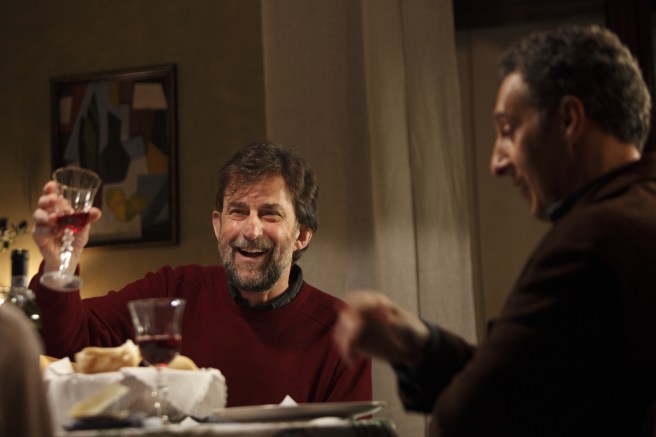
Mia Madre, Nanni Moretti’s latest film, tells the story of Marguerita (Marguerita Buy), a filmmaker in the middle of making a political drama about a factory strike. She’s dealing with her mother’s failing health and other personal relationships. The film is reportedly based on Moretti’s experiences with dealing with the death of a loved one while making We Have a Pope. So, in essence, Marguerita is something of a Moretti stand-in but the character has shades that wouldn’t quite fit if Moretti played the role, and allows for new wrinkles to Moretti’s cinema (three generations of women). Instead, Moretti settles for a supporting role as Marguerita’s brother, who seems to have abandoned his job in order to care for their mother. His scenes and performance act as counterpoint to the work/life balance difficulties of Marguerita. Mia Madre finds Moretti in European Master mode with measured compositions, Arvo Pärt strings and a general tastefulness that makes the whole project somewhat bland.  And yet it remains of interest.

Continue reading Mia Madre (Nanni Moretti, 2015)”

Yourself and Yours (Trailer) (Hong Sangsoo, 2016)

CpP1yitUIAAzR-A
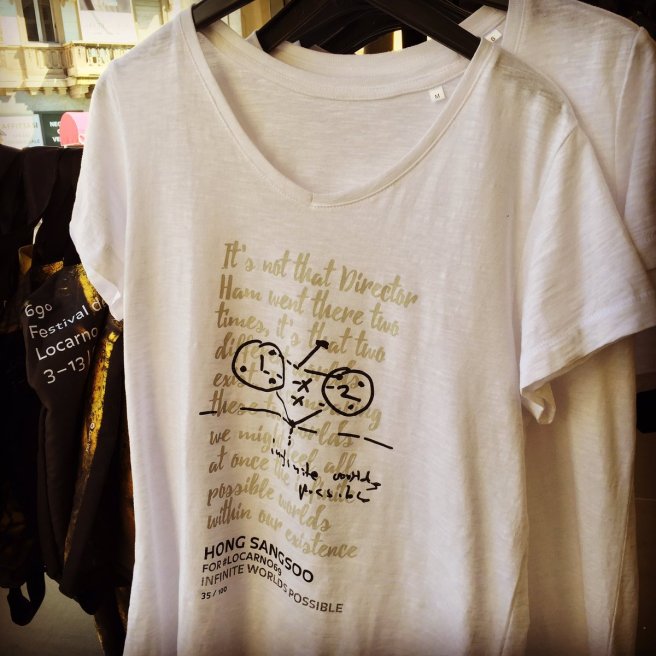
Hong Sang-soo has a t-shirt. As reported by the seemingly omniscient Hong Sang-soo Web Twitter account, the 2016 Locarno Film Festival featured some sartorial branding inspired by last year’s top-prize recipient. If you were lucky enough to spend your August in a palatial Swiss town and decided that nothing said “European Summer” like shuffling between darkened movie theaters, you might have been lucky enough to snatch up one of the shirts, fittingly adorned with a tipsy sketch by the Korean master scrawled above the Hongian pseudo-motto: “Infinite Worlds Possible.” And just like that, with a major European festival prize now under his belt and branded UNIQLO-lite duds, it seems Hong has officially become an event.

Of course, we’re talking about the niche of the niche here. 18 films into his career Hong’s audience has grown more than some of the long-time loyalists likely thought possible, though he’s not exactly setting the box office ablaze. The yearly anticipation for his new film feels a bit more communal than it once did, still rolling around with the same regularity but with greater pomp among the ever-important Film Twitter cognoscenti. What self-respecting cine-kid doesn’t want a Hong shirt this time of year? It’s festival season. It’s Hong time. And right on cue, we got a trailer.

Continue reading Yourself and Yours (Trailer) (Hong Sangsoo, 2016)”

Our Little Sister (Hirokazu Kore-eda, 2015)

vlcsnap-2016-05-13-13h45m07s90

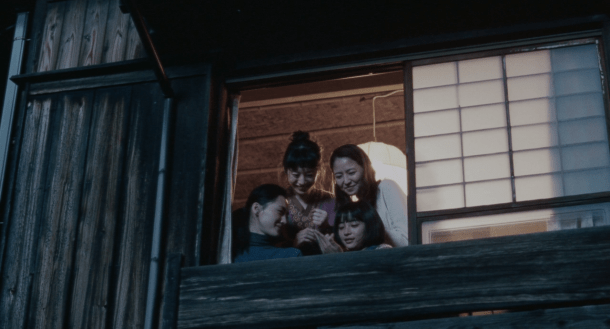
At the center of Hirokazu Kore-eda’s Our Little Sister is a house, and in the garden of the house is a plum tree. It is an old tree; generations of the family have seen it blossom and bear fruit, season by season. It is a tree at the heart of a house tradition, too, the making, storing, and consuming of umeshu, a sweet and sour green plum liqueur that is allowed to ripen to perfection over nine months beneath the floorboards. The family members prick their initials into the plums and these sit, soaking, as uniquely individual parts of the collective brew.

A family. A messy, powerful organism and a thing that Kore-eda, over the course of his film career, has continued to explore and expose, its raw bitternesses and its loving tendernesses. In earlier films, like Nobody Knows, heartbreak and tragedy are the centers of feeling; in more recent films, like I Wish, buoyant, infectious hope permeates. Our Little Sister tends towards the warmth of these latter films, and like the joyous, crucial moment of the speeding train in I Wish, there is a similarly ebullient defining moment in Our Little Sister, where two children on a bike fly through an avenue of blooming cherries.

Continue reading Our Little Sister (Hirokazu Kore-eda, 2015)”

For a Few Bullets (Pan Anzi, 2016)

forafewbullets_trailer1

Opening yesterday here in Seattle after debuting a week ago in China, For a Few Bullets is a goofy adventure film, mishmash of references as haphazardly assembled as its not-quite Leone title. Set in 1940, it’s a treasure hunt chase, with a con man enlisted by a Chinese secret agent to prevent the Japanese military from stealing a MacGuffin, the imperial seal used by the first Qin Emperor. Influenced by decades of knock-offs of the Indiana Jones and Mission: Impossible films, it mixes a series of elaborate heists with a budding romance between the toothy, supercilious Lin Gengxin and the tough, serious-minded agent, Zhang Jingchu. She’s the best thing in the film, tightly-coiled and super-competent in the first half, but, inevitably, sadly, melting into a flowing-tressed, red-dressed, damsel in distress in the second. She literally spends the climactic scene chained to a rock like Andromeda facing the Kraken, while Lin faces-off against the film’s master villain. He’s a monster straight out of a comic book, gas-masked and leather-jacketed, a WWII-era Vader with unexplainable supernatural powers and a collection of severed heads to rival the Faceless Men of Braavos.

bulltets1

After a dizzying opening twenty minutes, with exposition and character background flashing on screen in comic book panels, text captions and quick, almost sensible actions scenes, the film settles down to a hectic, but comprehensible rhythm. Lin and Zhang meet up with the long lost King of Hustlers, played by Mongolian singing superstar Tengger. He’s a likable presence, an Eric Tsang type, smirking and smarter than he looks. The three travel from Northwest China across the country to Shanghai and Nanjing, trying to capture the MacGuffin as it is transported by train. This gives ample opportunity to show off some stunning locations, desert landscapes and Central Asian steppes that have only rarely been seen on-screen, the colors digitally-enhanced to fantastical levels, a slick, luminous beauty that’s as insubstantial as it is picturesque. The humor is broad, the action quick and polished, if not particularly athletic, and a healthy amount of anachronism, most obviously some elaborate Scooby-Doo-style mask work. This is film as confection, a cotton candy picture that looks neat, has some fun action-heist sequences, pretty pictures, prettier people and nothing of any real substance. Last year’s Mojin: The Lost Legend attempted to tap this same treasure-hunting vein, far less successfully as an adventure, done in as it was by murky special effects. But that film also reached back to the Cultural Revolution and forward to immigrant life in America in creating some depth for its central romance. For a Few Bullets has no such ambitions. It’s nice enough though, and everyone looks like they’re having a good time. We can tell because they’re smiling all through the movie, and in the end-credits blooper reel.

One Night Only (Matt Wu, 2016)

unspecified-2

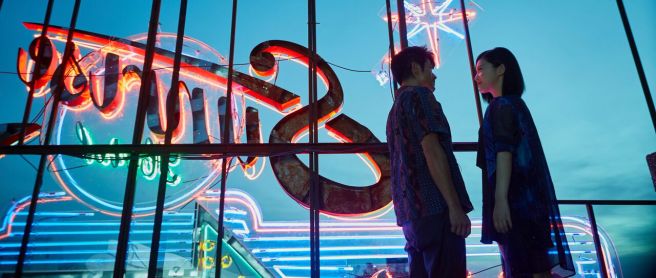
An Aaron Kwok movie is opening on Seattle Screens for the second time in three weeks, as the now venerable pop star/actor follows up his taciturn performance as the cooly rational police bureaucrat in Cold War 2 with a turn as a compulsive gambler with unresolved family issues in Matt Wu’s One Night Only. It’s the Taiwanese Wu’s directorial debut and also stars his wife, Yang Zishan, who starred in Three actress Zhao Wei’s directorial debut So Young a few years ago, an unrelated sequel to which called Never Gone opened last week at the Pacific Place. Like a lot of debut films, One Night Only is positively bursting with ideas and influences, its a work of exuberant cinephilia, pulling together elements of films as disparate as Nights of Cabiria, Rebel Without a Cause, 2046, One Night in Mongkok, the Fast and the Furious series and what I imagine Nicholas Sparks films are like into a movie that resolutely refuses to simply be one thing, but rather changes shape every reel or so in a way that never quite holds together, but is nonetheless fascinating in its audacity. It recalls last year’s under-the-radar gem of diasporic Chinese cinema, Go Away Mr. Tumor, a film that juggled the demands of the cute CGI rom-com and the cancer melodrama far more successfully than it had any right to. One Night Only doesn’t hang together quite as well, or at all even, but it’s got more energy than almost any movie you’re likely to see at the multiplex this summer.

Continue reading One Night Only (Matt Wu, 2016)”