SIFF 2016: Angry Indian Goddesses (Pan Nalin, 2015)

efa515fd86af2c4f53550c52d3d1ba5d

Contemporary Hindi cinema is not the most hospitable place for women’s stories. Bollywood largely casts them as doting mothers or arm candy for buff heroes. Angry Indian Goddesses begins with an actress (Amrit Maghera) being told by a director to make sure her hips and butt are shaking while she’s struggling against her captors. She blows up at him, declares Bollywood to be fake, and storms off. So, the film explicitly positions itself as a realistic alternative to this brand of escapist cinema which sees women only as sex objects, and a society that mistreats them at every turn. The other opening vignettes show the other main characters lashing out at their oppressors as well.

Billed as India’s first all-out female buddy film, Angry Indian Goddesses concerns the relationship between a group of friends gathering at a bungalow in Goa in order to celebrate the wedding of Freida (Sarah-Jane Dias) to a mystery suitor. This allows for director Pan Nalin to let a host of personalities bounce off each other and let things flow from there. Indeed, it is a pleasure to see these talented actresses inhabit the screen together, free of the pressures of the roles they might have in a normal Bollywood production. It’s a shame that this is such a rare sight.

Continue reading “SIFF 2016: Angry Indian Goddesses (Pan Nalin, 2015)”
Louder Than Bombs (Joachim Trier, 2015)

Isabel

“The best weapons are the stories, and every time the story is told, something changes. There are no photographs to be introduced as evidence[.]”

“All we can depend on are slow-motion replays of our lives.”
                                                                          ~Sherman Alexie, “Captivity”

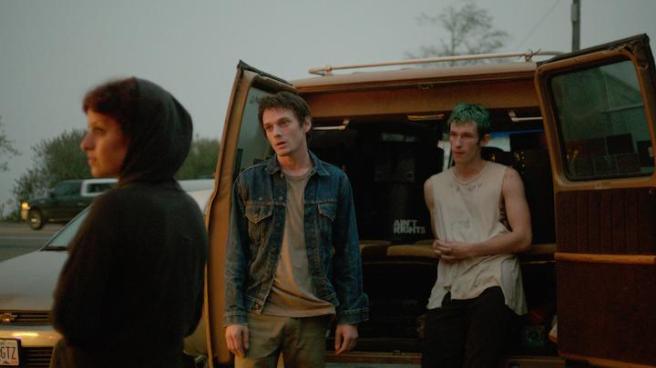
Joachim Trier, in his newest and third feature film, is interested in story-telling and in the peculiar power of stories, a theme he explores by way of a particular family, a man and his two sons, struggling with the loss of a wife and mother.  Each survivor constructs and reconstructs their memories of the dead woman, reconstructions that reveal the particular viewpoints and obsessions of each, perhaps more than they reveal the woman’s own story and identity, for each character, we see, is adrift in his own life, alienated and unsure, and the reach back to the past, to the memories of this woman, is a way of coping with the present, a way of constructing a sense of self.  Continue reading Louder Than Bombs (Joachim Trier, 2015)”

Fan (Maneesh Sharma, 2016)

fan 3

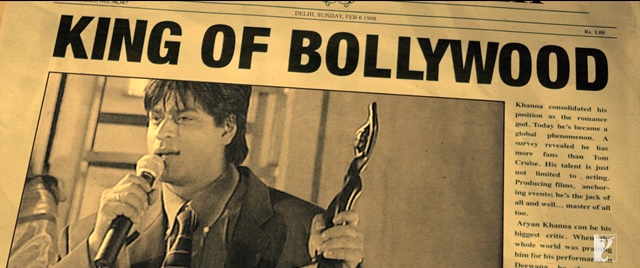
One of the interesting things about actors who have worked for a long time (and have a recognizable on-screen persona) is that when they get older, they begin to interrogate those personae, and what they mean. Clint Eastwood has been doing this since the 70s. In Fan, the latest film by director Maneesh Sharma, the subject is Shah Rukh Khan, arguably the most famous Indian actor of the last 25 years.

Shah Rukh Khan is a great ham. He’s a shameless entertainer, doing anything to ensure that the films he’s in work. SRK is great because you can see the effort behind his work, the flop sweat. It’s been that way since the beginning. SRK began acting in films in the early 90s in a series of villainous roles (BaazigarAanjam) before becoming more of a romantic hero. His iconic role in Dilwale Dulhania Le Jayenge  paved the way for a new type of hero (and film) that directly addressed the Indian diaspora. The films in this period with SRK in the Swiss alps, his arms outstretched waiting for his love, often fell into cliched territory, but SRK always gave everything to the role. He’s branched out from these roles to become an action hero, a comedian, all while finding time to work with prestigious directors (Mani Ratnam, Kamal Hasaan). While the last few films have seen him make a few lazy choices (his work with Rohit Shetty is pretty uninspired), Fan acts as something of a rejuvenation for him. He hasn’t been this engaged in quite a while.

Fan stars Shah Rukh Khan in a dual role. He plays Aryan Khanna, the biggest Bollywood star in the world, as essentially himself. He also plays Gaurav Chandna, Aryan’s biggest fan, in a performance aided by visual effects that transforms him into a slightly askew version of his younger self. Gaurav moonlights as an Aryan impersonator, and it’s his dream to one day meet him. So, one day he sets out to the big city in order to accomplish this. Things get complicated from there.

Continue reading Fan (Maneesh Sharma, 2016)”

Knight of Cups (Terrence Malick, 2015)

Bale stairs

Here, Sisyphus meets John Bunyan’s Christian.

Or something like that.

Terrence Malick, for me, is a bit like T. S. Eliot, a forager through resonant, mythic fragments, pieced together into something that, while offering a reader a whole Thing and an often intensely emotional experience, also spins that reader off into multiple directions at once.

With something like “The Hollow Men,” for example, I first trace the Fisher King threads, and then I follow a Dante and Beatrice path, and then I’m sent to re-think Kurtz in Heart of Darkness, and then to grasp at remnants from Julius Caesar. All of these literary references are in “The Hollow Men,” and knowing them enriches my experience of the poem. But then, I also find that the poem works on a level that doesn’t seem to need any particular literary knowledge. Many of my students who’ve never read any of those other works love Eliot’s wasteland vision, those hollow whispering men; they can take the line “not with a bang but a whimper” and savor it. Just for itself. That line reaches directly into the feelings.

And so there’s meaning and there’s meaning and there’s meaning. Eliot is someone I will read my whole life and still find dark corners – that will very suddenly light up. Even Eliot himself, when a reader noted that he must have taken the “shadow” lines in “Hollow Men” from a poem by Ernest Dowson, agreed, “This derivation had not occurred in my mind, but I believe it to be correct, because the lines… have always run in my head.” It delights me to understand that even an artist cannot know everything contained in their own work. Eliot was an artist who was a receptacle who then poured himself into his work, at a conscious and unconscious level.

Malick is like that, I think, an artist, giving himself to his work utterly, and the result is a rich work that grows only richer. It is a richness that will make watching and re-watching and re-watching his films a life-long pleasure.  Continue reading Knight of Cups (Terrence Malick, 2015)”

Francofonia (Alexander Sokurov, 2015)

maxresdefault-2

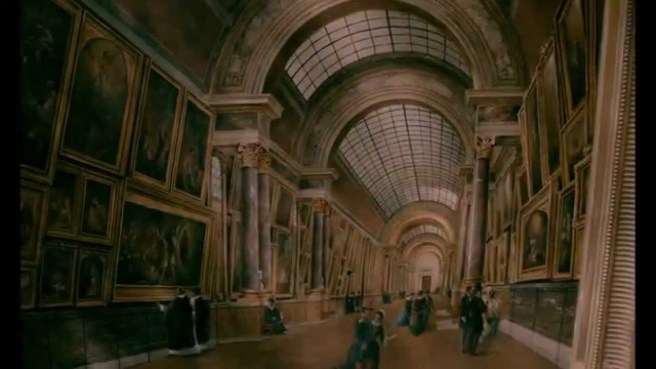
Playing for the next two weeks at the SIFF Uptown is Russian director Alexander Sokurov’s look at The Louvre, a companion piece to what remains his most well-known film in this country, 2002’s Russian Ark. That film, shot in an elaborate and still impressive single-take, weaved through The Hermitage, the museum in St. Petersburg, crossing seamlessly through Russia’s past and present, a guided tour of the fluidity of culture and the ways art, and our collections of art, keep the past alive into the future. Francofonia is no less thematically ambitious, though the single-take approach is abandoned in favor of more conventional shifts between documentary-style glides through the galleries, dramatic recreations, and meta making-of looks at those recreations. The film is framed with a film director (Sokurov himself) in the editing stage of the movie we’re watching, attempting to talk to a ship’s captain caught in a storm at sea (Captain Dirk, seriously). The ship is apparently transporting precious works of art, an extension of the final image of Russian Ark, with the museum as a ship floating in seas of time. Captain Dirk has a bad Skype connection, so the director ruminates about the museum itself, covering, in somewhat random order, its founding as an anti-Viking fortress, its various expansions and decorations, its transformation into a museum filled with the spoils of imperialism and finally its modern state. Taking up the bulk of the film is the story of how the museum’s director (Jacques Jaujard) and the Nazi in charge of cultural artifacts (Franz Wolff-Metternich) kept the collection safe and out of Hitler’s hands during the Second World War.

Continue reading Francofonia (Alexander Sokurov, 2015)”

Everybody Wants Some!! (Richard Linklater, 2016)

getsomeblog-1457953225779_large

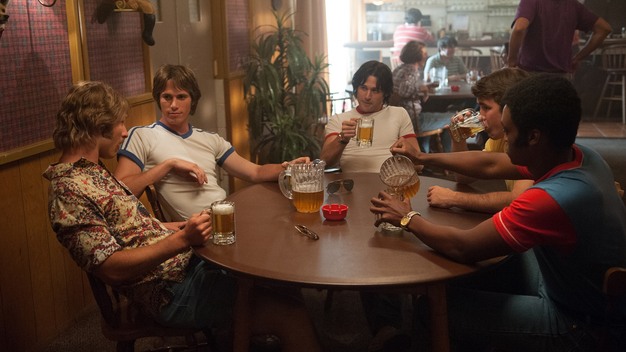
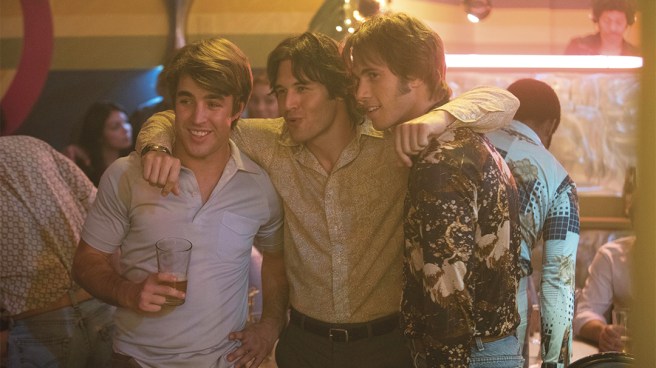
In what is essentially a sequel to his greatest film, 1993’s Dazed and Confused, director Richard Linklater again sketches an ethnography of baseball-playing Texans in the Carter years. With in-coming freshman Jake (Blake Jenner), tall, broad of shoulder and square of jaw, the most all-American Jake there ever was, as our guide to the world surrounding the off-campus housing of the Southeast Texas University baseball team, the film begins hitting every known beat of the college film, taking cues especially from the juvenile romps of the late 70s and early 80s. The first of five days in the film introduces the team and establishes their various personalities and approaches to life, the end goals of which are universally baseball, woman and beer, and not necessarily in that order. Jake affably meets smooth-talking Finnegan (Glen Powell), somewhat dim Plummer (Temple Baker), henpecked farm boy Beuter (Will Brittain) and apparently insane Niles (Juston Street) among a host of other tall, healthy, reasonably handsome, hyper-competetive men. They spend their first night together drinking and dancing at a local disco and hooking up with a steady supply of casually available women. It’s exactly the kind of obnoxious fantasy of college life you’d imagine 18 year old athletes dream about. But rather than spend a whole film indulging this fantasy, Linklater expands and deepens his film, creating a film that is as much a dumb frat comedy as Dazed and Confused is a stoner comedy, which is to say not at all.

Continue reading Everybody Wants Some!! (Richard Linklater, 2016)”

Everybody Wants Some (Richard Linklater, 2016)

everybody disco

Major League Baseball returns this week. There is nothing like the arrival of a new season, timed to coincide with the inviting sunshine of spring, to fill one’s heart with hope and excitement. The helmets are shiny, not a disgusting buildup of pine tar on a single one. Heroes are about to be made. Arriving on cinema screens at the same time is director Richard Linklater’s new comedy Everybody Wants Some, a raunchy reminiscence of life among college baseball players in pre-AIDS 1980. It’s here to remind us that baseball players are rarely heroes. They’re usually just unfunny jerks, entitled and annoying. Thanks a lot, Dick. Continue reading Everybody Wants Some (Richard Linklater, 2016)”

Chongqing Hot Pot (Yang Qing, 2016)

chongqinghotpot_

The latest Chinese import to grace Seattle Screens, now playing at the Regal Meridian, is an absurdist thriller about trio of friends who own a failing underground restaurant and who accidentally tunnel into a nearby bank vault. After a tense prologue that recalls any number of Hong Kong gangster thrillers, men in black wearing Journey to the West masks arrive at a bank during a torrential downpour. The getaway driver has a tense run-in with a traffic cop, leading to panic in the bank as the robbers are soon surrounded and desperate for a way out. The camera tracks into the vault and discovers a hole in the ground, leading us down through a cave and into the restaurant, and back in time to the events leading up to the standoff. We’re told that the city of Chongqing (alternately “Chungking”), in southwestern China, is famous for its hot pot restaurants, and that lately people have been adapting the city’s network of caves and bomb shelters into trendy eating locales. Three old school friends have done just that, but the business is failing and they’re rapidly trying to unload it. To jack up their asking price, they try to extend the tunnel themselves, and that’s how they get into the bank. The bulk of the film revolves around their schemes to fix the hole without anyone finding out what they’ve done, while avoiding the temptation to steal the money.

Continue reading Chongqing Hot Pot (Yang Qing, 2016)”

Born in Flames (Lizzie Borden, 1983)

tumblr_ml8zghrlik1qc2cbbo1_500

Everything you’ve heard is true. Lizzie Borden’s Born in Flames is, in many ways, a really terrible movie. Performances by the mostly amateur cast are stiff and awkward, the editing is clumsy, the script consists entirely of polemic and exposition, and the soundtrack ranges from being simply unlistenable to becoming a source of torment of the kind expressly prohibited by the Geneva Convention. Some of the film’s flaws can be excused as being the result of its ultra-low budget, but others are inherent in its project, which is almost entirely political and only incidentally artistic. Continue reading Born in Flames (Lizzie Borden, 1983)”