Baahubali (SS Rajamouli, 2015)

baahubali 4

One of the biggest movie events of the year happened this past weekend, but you wouldn’t know about it if you read any of the biggest English language film publications around. Baahubali: The Beginning, the latest film from SS Rajamouli, was just released. The New York Times didn’t deem it worthy of a review. Variety publishes stories of its box office success and gigantic marketing push, but can’t throw a freelancer at it. A cursory search reveals a couple of reviews from English-language publications at best. It’s a rather sad state of affairs for one of the modern cinema’s best mainstream filmmakers.

SS Rajamouli has, over the last few years, steadily upped his scope and ambition. No longer content to tuck his most lavish and improbable images into narrative side trips or flashbacks (Yamadonga‘s trip to hell, Magadheera‘s flashback structure), Rajamouli in his last two films has focused his attention on utilizing his considerable gifts to giving shape to impossible images. His preferred tool is the CGI image, and he’s possibly one of the only filmmakers currently working not bound to traditional ideas of realism – for Rajamouli, each image is fantastic. So Eega, his fly revenge film, becomes not just about its technological advances (Rajamouli is proud of his special effects and wants to show them off – his Zemeckis or Cameron side, if you will), but about how the technology can enhance the film’s devilish sense of humor (the film shares DNA with Tex Avery and Joe Dante all while successfully invoking and playing around with the idea of the Telugu film hero). Baahubali successfully creates a world and aims for a sense of realism in its battle scenes, but will often drop an image of such iconic and mythic stature that any thought that realism is the end game here is quickly dispelled. Rajamouli demands more.
Continue reading Baahubali (SS Rajamouli, 2015)”

Gemma Bovery (Anne Fontaine, 2014)

Martin and Bovary

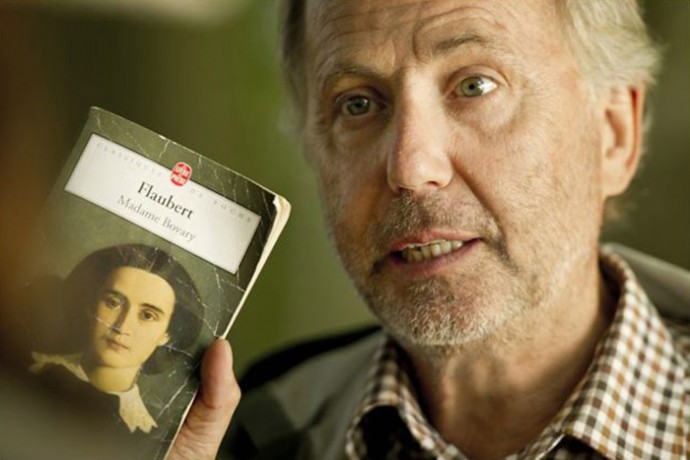
The premise of the newest film from director Anne Fontaine, Gemma Bovery, holds a good deal of promise for lovers of both the cinematic and the literary, particularly for those who welcome witty or playful re-tellings of classic works of literature. Adapted from Posy Simmonds’s graphic novel of the same name (a novel originally conceived as a serial in The Guardian), the film’s story centers around perceived parallels between the literary characters in Gustave Flaubert’s Madame Bovary – particularly Emma Bovary, her husband, Charles Bovary, and Emma’s lovers –  and the film’s characters. When Gemma Bovery (Gemma Arterton) and her husband, Charles ( Jason Flemyng), move from London to a small town in Normandy, the town’s excitable, bourgeois baker, Martin Joubert (Fabrice Luchini), is certain Gemma is the real life equivalent of the fictional Emma, and he makes it his mission to discover her in love affairs and prevent the tragic suicide that plays out in the novel.

Such a set up has all the ear marks of wonderfully droll farce or of a sly satire, a satire that could work on any number of levels – critiquing, perhaps, the often fraught French-English relationship; or the middle class, provincial prejudices; or literary pretensions; or male-female relationships.  The premise also suggests the story might hold some genuine pathos, a tender examination of love, heartbreak, and misunderstandings, perhaps.  And by many accounts (here’s one, for example), Simmonds’s original work does function on all those levels. (After watching the movie, I immediate ordered the graphic novel.) Continue reading Gemma Bovery (Anne Fontaine, 2014)”

Rebels of the Neon God (Tsai Ming-Liang, 1992)

TV screen red dress on bed TV screens, arcade game screens, mirrors, windows – all of these offer reflective surfaces, some more and some less reflective, some promising immersion into another sort of state, some seeming to immerse but offering very little in the way of escape from lonely self and quotidian present. These surfaces are everywhere in Tsai Ming-Liang’s newly restored and re-released feature debut of 1992, Rebels of the Neon God, a quietly absorbing film that suggests a set of startlingly germane meditations on the modern self, a thing that is simultaneously isolated and connected, revealed and covert.

The story centers around the lives of two people: one, a 20-something young man, Ah Tze, living by petty theft and residing in a lonely, constantly flooded apartment, and one, a teenaged boy, Hsiao-Kang, chafing at his bondage in cram school and living at home in uncommunicative silence with his anxiously watchful parents.  Both Ah Tze and Hsiao-Kang, though they have companions who surround them – a parent or a brother, a friend or a girlfriend – and though they pass through the teeming city of Taipei, stand as alienated figures, whose selves ricochet in the mirroring surfaces surrounding them.

Continue reading Rebels of the Neon God (Tsai Ming-Liang, 1992)”

Christmas in July (Preston Sturges, 1940)

CHRISTMAS-IN-JULY_470x350

Tonight the Seattle Art Museum kicks off its latest series of 35mm film presentations, this one devoted to writer-director Preston Sturges, who with a handful of masterpieces in the early and mid-1940s brought the screwball comedy era to its magnificent conclusion. The museum is presenting six of his films, playing every Thursday night through August 13. We’ll be covering them all here at Seattle Screen Scene, along with recording an episode of the They Shot Pictures podcast devoted to Sturges, which we should have up in two weeks or so.

First up is the least well-known, unfairly I think, Christmas in July, in which Dick Powell plays a wannabe adman who is tricked by some fellow workers into believing his submission in a coffee company’s slogan contest has won the $25,000 grand prize. A series of misunderstandings gets him the big check, a promotion and an engagement, and before the truth can come out he’s showered his whole neighborhood with gifts and toys. Deftly sketching the generational layers of the mid-century immigrant class system, Sturges gives as subtle a portrait of the disasters and fantasies provoked by capitalism as you’ll find in Hollywood, a far cry from the sentimentality and privileged condescension of his future avatar John L. Sullivan. The tone is delicately balanced between screwball and melancholy, the warm loneliness of Powell and his girl (Ellen Drew) dreaming on a rooftop leavened by the ten minutes it takes him to explain his slogan to her (“It’s a pun” is his hopeless refrain). Sturges would never again be this relaxed.

Continue reading Christmas in July (Preston Sturges, 1940)”

Bill & Ted’s Excellent Adventure (Stephen Herek, 1989)

bill and ted circle k

Bill & Ted’s Excellent Adventure is a hilarious and hopeful tale of friendship, full of great dialogue and memorable scenes. It is also a terrible history lesson. Well, depending on what angle you choose to view history. The film certainly doesn’t pause to get all the details right as Bill and Ted traverse the Circuits of History in their time machine, “bagging” influential human beings for help on their high school final project. There are those in any given audience that will always shake their head at an Abraham Lincoln who speaks in an inaccurate baritone (shh, don’t tell anyone but he also yells, “Party on, dudes!”) but in its way, Bill & Ted’s Excellent Adventure does accurately capture history.

Continue reading Bill & Ted’s Excellent Adventure (Stephen Herek, 1989)”

Me and Earl and the Dying Girl (Alfonso Gomez-Rejon, 2015)

Me and Earl and the Dying Girl

I am suspicious of my enjoyment of Me and Earl and the Dying Girl in spite of the fact that the film, premiering at Sundance in 2015, received the U.S. Grand Jury Prize and the Audience Award for U.S. Drama, and I am not alone in such enjoyment. Directed by Alfonso Gomez-Rejon, a director until now primarily known for his TV work (Glee, American Horror Story) and based on a YA novel by Jesse Andrews, the film follows Greg (Thomas Mann), the titular “Me,” who, under non-negotiable orders from his mother, befriends a high school classmate, Rachel (Olivia Cooke), who is diagnosed with leukemia; Greg is to be a companion to her through the ordeals of her illness and treatment. And so Greg, with his childhood friend and fellow film-buff, Earl (RJ Cyler), entertain Rachel in large part with the films the two boys make together, short films that cleverly pun around with titles of classic and foreign cinema: The 400 Blows becomes a film about “The 400 Bros”; 8 ½ becomes “Ate ½ (of my Lunch)”; A Clockwork Orange becomes “A Sockwork Orange.”

Continue reading Me and Earl and the Dying Girl (Alfonso Gomez-Rejon, 2015)”

The Wolfpack (Crystal Moselle, 2015)

Reservoir dogs

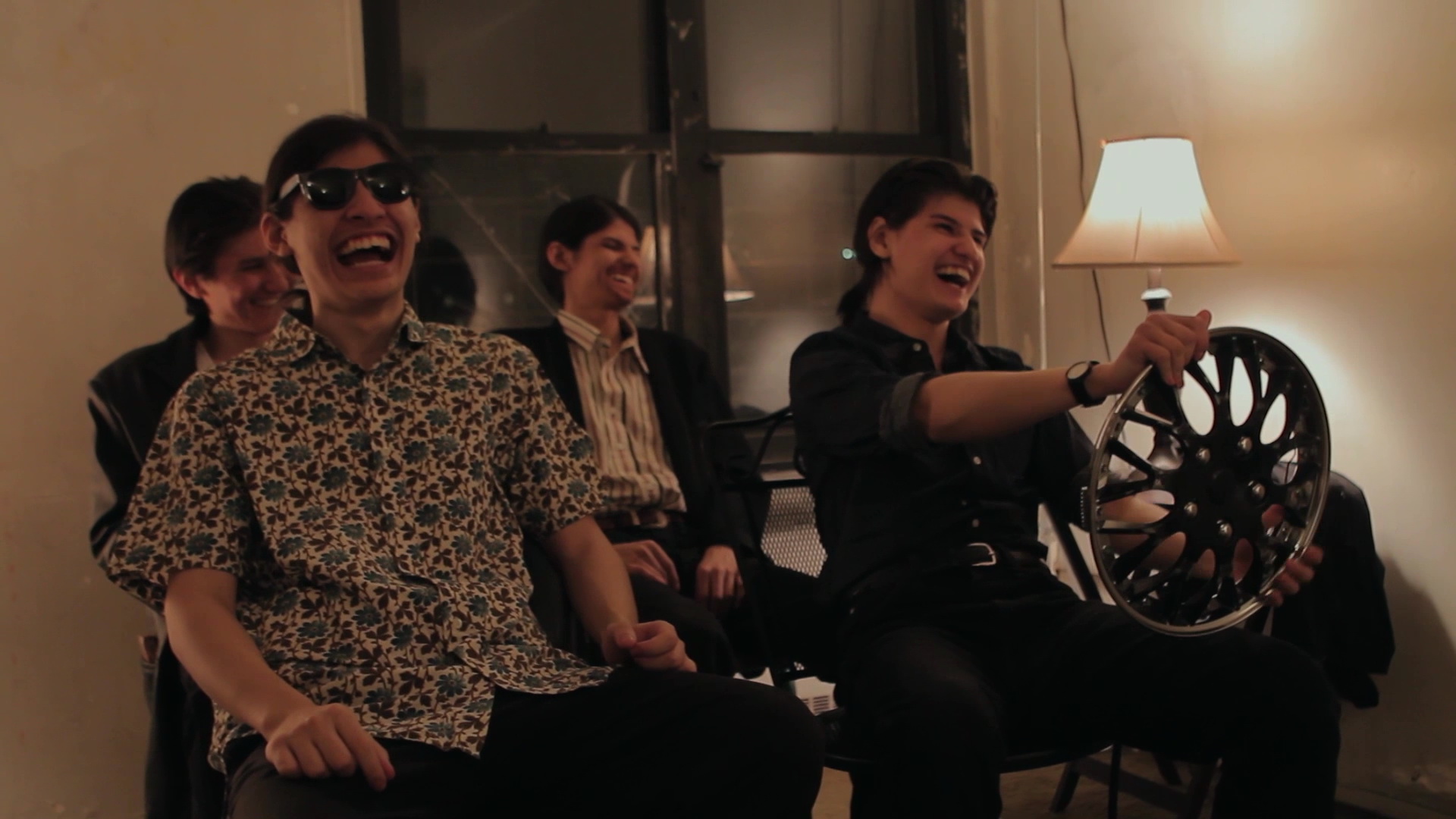
Premiering at Sundance in 2015, where it won the U.S. Documentary Grand Jury Prize, The Wolfpack is a maddening documentary for opposite, simultaneous reasons: chaotic story framing and contrived framing. The film, from first time director Crystal Moselle, records scenes in the life of the Angulo family, a life confined – under the demands of a dictatorial father – to a small New York apartment. The mother and the 7 homeschooled children, 6 boys and 1 girl, are essential prisoners in their own home, where the boys’ only relief and only window to an outside world lies in the access they are granted to recorded movies, which they constantly watch and then elaborately reconstruct, acting out scenes from the likes of Reservoir Dogs, Pulp Fiction, and Goodfellas.

Continue reading The Wolfpack (Crystal Moselle, 2015)”

When Marnie Was There (Hiromasa Yonebayashi, 2014)

marnie moon

Spirits are nothing new for Studio Ghibli. Anyone that’s ridden the train with No-Face or enjoyed the amenities of Yubaba’s bathhouse knows that. But the company’s latest — and possibly last — feature, When Marnie Was There, is their first film that feels like a genuine ghost story. The film is certainly not out for scares, nor is it shocking. In fact, the closest thing it resembles might be Joseph L. Mankiewiecz’s The Ghost and Mrs. Muir. This is the platonic, animated, Japanese version of that. For kids.

Continue reading When Marnie Was There (Hiromasa Yonebayashi, 2014)”

Yes, Madam! (Corey Yuen, 1985)

yes1Of the members of the Seven Little Fortunes Peking Opera troupe to become major figures in the Hong Kong film industry in the last 20 years before the colony’s handover to China, Corey Yuen is the least well known. Unlike Jackie Chan, Sammo Hung and Yuen Biao, he stayed mostly behind the camera, though he does have some memorable supporting turns in a few films, most notably in the Yuen Biao vehicle Righting Wrongs and as one of Hung’s Eastern Condors. He’s best known for his directorial work, on some of Jet Li’s best films (the Fong Sai-yuk series), on All for the Winner (the 1990 film that made Stephen Chow a superstar), and on the films that launched Jason Statham and Jean-Clude Van Damme into the action world (The Transporter and No Regret, No Surrender, respectively). With 1985’s Yes, Madam! he launched two careers (Michelle Yeoh and Cynthia Rothrock) and a whole subgenre of the Hong Kong action cinema (the Girls with Guns cycle).

Continue reading Yes, Madam! (Corey Yuen, 1985)”

A Better Tomorrow (John Woo, 1986)

a-better-tomorrow

After an up and down decade as a director for hire in the last days of the Shaw Brothers, working alternately in the wuxia and wacky comedy genres, John Woo finally hit it big in 1986 when he teamed up with Tsui Hark and the Cinema City studio to remake Patrick Lung Kong’s 1967 drama The Story of a Discharged Prisoner. One of the most influential films of the past 30 years, A Better Tomorrow established the formal and thematic template for a new era of crime movie: everything that has followed, from Woo’s follow-up masterpieces The Killer and Hard-Boiled to the triad films of Johnnie To, to myriad international imitators, has in some way been a response to it. Its impact on the Hollywood film has been less specific but no less real: raising the stakes of athleticism and complexity in action sequences, the bullet ballet being much more adaptable to the limited physical skills of American actors than Jackie Chan’s kung fu.

Continue reading A Better Tomorrow (John Woo, 1986)”