American Honey (Andrea Arnold, 2016)

americanhoney

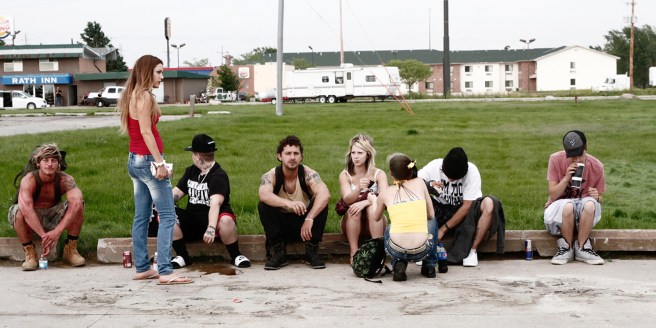
American Honey finds British filmmaker Andrea Arnold roughing it with the impoverished class of 21st century America, imagining life at the lower-rungs as a procession of scams and brutal poetry, strip malls and butterflies, and insisting with all of her not inconsiderable filmmaking power that this world and its inhabitants are worth taking seriously. Or, to summon up a different vision of American poverty: “Attention must be paid.” An admirable goal to be sure, but urgency and good intentions do not a movie make. Arnold bets the house on the compassion borne from her closely-hewn style, which locks into the perspective of Star, a young woman running from a broken home and towards her meager dreams, via a tight Academy ratio frame and shallow-focus close ups. This closeness ensures that no matter how flagrantly grating the behavior gets—and whoo-boy does it grate—our complicity with the events on screen remains intact. It’s shorthand for empathy; a stylistic shortcut particularly common to the aesthetic Arnold adopts, which she employs unceasingly over the film’s extended running time. Realism shouts and spits in your face, apparently. And with so many moments constructed to put the audience in a confrontational position (either step up or step out), it’s worth asking: when does a repeated plea for empathy become a form of condescension? Tell us over and over again that these caricatures are worth taking seriously as people and I might wonder if you yourself have some doubts.

Continue reading American Honey (Andrea Arnold, 2016)”

VIFF 2016: Never Eat Alone (Sofia Bohdanowicz, 2016)

nea

Of the three films in VIFF’s new Future // Present series that I’ve seen thus far, the program Sunday night of Toronto filmmaker Sofia Bohdanowicz’s new feature paired with three of her short films is the standout. The feature is a fictionalization of the story of her maternal grandmother, Joan Benac, playing herself, who in the early 1950s, appeared as a singer and actress on a kitschy television show. Remembering this in a dream, she tasks her granddaughter Audrey (played by Deragh Campbell, in one of her three films at VIFF this year) with finding the show and tracking down the boy she co-starred with and had dated briefly. She does, she thinks, and writes the man a letter. He’s living on the other end of the country, in a small town where he lives alone and teaches a choir. Audrey writes the man a letter, asking him to call, but he never manages to connect with the women in Toronto (he’s played by George Radovics, Bohdanowicz’s producer’s grandfather). The bulk of the film cuts between the three principals, usually as they’re eating, alone. The television episode is interspersed throughout, and there’s a digressive slideshow of the grandmother’s trip to the Bahamas, both of which are actual artifacts. But wholly fictionalized scenes abound as well, such as one where Audrey tries on a bunch of old clothes her grandmother is trying to get rid of while the two delicately balance familial niceness with the desire not to give or receive these gifts. It’s a found-footage film, using bits and pieces of the past to build a collage of a fictionalized history, an alternate reality version of her family’s history. It bears a kind of inverse relationship to Liu Jiayin’s Oxhide films, which use a highly structured script and compositional style to document her family’s life, their work and routines and relationships as they go about various tasks: cleaning the house, making leather goods, cooking dumplings. Bohdanowicz in contrast films with an off-hand directness, emotionally straightforward compositions chronicling wholly improvised interactions (both Campbell and Benac receive screenplay credits).

Even more astonishing though, are the three short films paired with the feature, chronicling Bohdanowicz’s paternal grandmother. The first, A Prayer, is a short documentary, following said grandmother around her house has she does various chores (and eats a meal, alone, naturally). The second, An Evening, is something special: a tour of the grandmother’s house shortly after her death, patiently documenting its spaces while one of her records plays on the stereo, intermittently marred by a broken needle, from late afternoon until the space disappears into the darkness of night. It’s a film Chantal Akerman would be proud of. The third, Another Prayer, replays the first short, but superimposed over the now empty spaces of the woman’s home, completely silent. Each film is prefaced by a poem composed by Bohdanowicz’s great-grandmother, and the cumulative effect of the trilogy together is devastating.

VIFF 2016: The Intestine (Lev Lewis, 2016)

intestinethe

Dark digital grain and hard lines of white light divide Lev Lewis’s The Intestine in two, separating the poor from the economically ascendant, the city from the suburb, night from day. But make no mistake, though these contrasts form roughly equal parts of the film’s ungainly shape, Lewis’s debut is haunted by the shadowier half; the ethos of night rules all things, even when the sun streams in through the windows.

Lewis’s heroine Maya, a twenty-something reject of late capitalism, steps out from her dingy surroundings one night and awakens the next day in an abandoned modernist money-pit somewhere in the ‘burbs. The cut that bridges the space between Maya’s evening on the town and her sudden emergence amidst bright bourgeois sterility suggests, initially, a particularly bewildering morning-after and nothing more. But things progress into stranger territory as Lewis conjures up some dreamy images—a refrigerator stocked solely with a boar’s head stands out, both for its strangeness and as a barb pointed at the foodie pretensions of the 21st century’s finer-living set. The hard-lit morning-after starts to look like a portal to another reality, a rabbit hole which unearths the phantasmagoric pleasures of the moneyed class. It’s no wonder that Maya grows increasingly unwilling to vacate her new digs.

This shapeshifting debut insists—a bit precociously—on inscrutability, but what finally emerges is a vision of contemporary young adulthood as life lived in envy of other people’s spaces. Eventually unemployed but always unradicalized, a single brush with prosperity is enough to spark Maya’s exurban aspirations (“I can’t go back to my apartment”). Maya finally makes the place her own, but as she sits on her bed repeating her name through the phone to a listener who cannot hear it, she appears to be drifting back towards the void. The light is fading, and a gleaming new home can only ward off the darkness for so long.

Friday September 30 – Thursday October 6

Featured Film:

The 2016 Vancouver International Film Festival

Most of the Seattle Screen Scene staff is going to be in Vancouver for the next couple of weeks, covering one of he best film festivals in North America. From acclaimed international festival hits like Toni ErdmannThings to ComePersonal Shopper, ElleAquarius, and A Quiet Passion (among many others), to cutting edge Canadian films like WerewolfNever Eat Alone and Maliglutit, anticipated American movies such as PatersonManchester by the SeaShort Stay and The Love Witch, to the best program of Asian films in North America, featuring The HandmaidenYourself and YoursCrosscurrent, GodspeedBy the Time it Gets Dark and more, we’ll have dozens of reviews and maybe even the long-awaited return of The Frances Farmer Show coming soon.

Playing This Week:

AMC Loews Alderwood:

The Age of Shadows (Kim Jee-woon) Fri-Thurs Our Review
Monty Python and the Holy Grail (Terry Gilliam & Terry Jones, 1975) Fri & Sat Only Quote-Along

Ark Lodge Cinemas:

Hunt for the Wilderpeople (Taika Waititi) Fri-Thurs

Central Cinema:

Singin’ in the Rain (Stanley Donen & Gene Kelly, 1952) Fri-Weds
The Shawshank Redemption (Frank Darabont, 1993) Fri-Weds

SIFF Egyptian:

The Beatles: 8 Days a Week (Ron Howard) Fri-Thurs
Multiple Maniacs with Mink Stole in person (John Waters, 1970) Fri Midnight Only with Mink Stole in person

Century Federal Way:

The Age of Shadows (Kim Ji-woon) Fri-Thurs Our Review
M.S. Dhoni (Neeraj Pandey) Fri-Thurs
Nikka Zaildar (Simerjit Singh) Fri-Thurs

Grand Cinema:

The Beatles: 8 Days a Week (Ron Howard) Fri-Thurs
The Hollars (John Krasinski) Fri-Thurs
A Tale of Love and Darkness (Natalie Portman) Fri-Thurs
Café Society (Woody Allen) Fri-Thurs
Lo and Behold, Reveries of the Connected World (Werner Herzog) Tues Only
Tacoma Film Festival Starts Friday Full Program

Grand Illusion Cinema:

The Quiet Earth (Geoff Murphy, 1985) Fri-Thurs
I Drink Your Blood (David E. Durston, 1970) Sat Only
Digimon Adventure tri. Chapter 1: Reunion (Keitaro Motonaga) Fri-Weds
Kampai! For the Love of Sake (Mirai Konishi) Sat & Sun Only
up, up, and away (Andy Liotta) Thurs Only live music & video

Landmark Guild 45th:

A Man Called Ove (Hannes Holm) Fri-Thurs
Captain Fantastic (Matt Ross) Fri-Thurs
Rurouni Kenshin Part III: The Legend Ends (Keishi Ohtomo) Tues & Weds Only

Cinemark Lincoln Square:

M.S. Dhoni (Neeraj Pandey) Fri-Thurs
Hyper (Santosh Srinivas) Fri-Thurs
Majnu (Virinchi Varma) Fri-Thurs
Pink (Aniruddha Roy Chowdhury) Fri-Thurs

Regal Meridian:

Soulmate (Derek Tsang) Fri-Thurs Our Review
Operation Mekong (Dante Lam) Fri-Thurs Our Review
M.S. Dhoni (Neeraj Pandey) Fri-Thurs
L.O.R.D. – Legend of Ravaging Dynasties 3D (Guo Jingming) Fri-Thurs

Northwest Film Forum:

The 19th Local Sightings Film Festival Fri-Sat Full Program
Moving History: An Archival Screening Night Weds Only
MEMORY Presents: Program No. 2 Thurs Only Free, Curators in Attendance
Desert Cathedral (Travis Gutiérrez Senger) Thurs Only

AMC Oak Tree:

The Hollars (John Krasinski) Fri-Thurs

AMC Pacific Place:

I Belonged to You (Zhang Yibai) Fri-Thurs

Regal Parkway Plaza:

Pink (Aniruddha Roy Chowdhury) Fri-Thurs
No Manches Frida (Nacho Garcia Velilla) Fri-Thurs
M.S. Dhoni (Neeraj Pandey) Fri-Thurs
Barcelona: A Love Untold (Olivia Lamasan) Fri-Thurs

Seattle Art Museum:

The Chase (Arthur Ripley, 1946) Thurs Only 35mm

SIFF Film Center:

Dying to Know: Ram Dass & Timothy Leary (Gay Dillingham) Fri-Sun

Sundance Cinemas:

Don’t Think Twice (Mike Birbiglia) Fri-Thurs
The Lovers and the Despot (Ross Adam & Robert Cannan) Fri-Thurs

SIFF Cinema Uptown:

Cameraperson (Kirsten Johnson) Fri-Thurs Our Review Our Other Review
A Man Called Ove (Hannes Holm) Fri-Thurs
Phantasm (Don Coscarelli, 1979) Sat Only
Promised Land (The Salcedos) Tues Only
Cameraperson (Kirsten Johnson) Weds Only Skype Q & A

Varsity Theatre:

Hunt for the Wilderpeople (Taika Waititi) Fri-Thurs
Seattle Latino Film Festival Sat-Weds Full Program

Kensho at the Bedfellow (Brad Raider, 2016)

bedfellow

Kensho at the Bedfellow, the feature debut film, starring, and written and directed by, Brad Raider, opens with a bang. A literal bang. And a cat. A towering, talking puppet cat, who, when the man we will come to know as our main character, Dan (Raider), staggering, asks, “Is this a dream?”, answers, “It’s an opportunity – to know thyself.”  It seems preposterous, of course: what can an over-sized puppet with whiskers have to say about the ontological questions of the self? And on another, more meta, level, a cinema-goer, in the age of slickly immersive computer graphics and special effects, might ask, why am I sitting here looking at a stuffed animal, creakily moving its pretend mouth? Something like Falkor, the Luckdragon, from The Neverending Story, certainly has its place in a children’s movie, in fondly nostalgic memory, or in the evolution of visual effects, but now? This kind of thing in 2016 in a film for adults?

The very audaciousness and seeming ridiculousness of such an opening prepares us for the journey and tone of the film, winding as it does down unexpected paths and embracing both playfulness and seriousness. Even further, the opening gets at the heart the film’s central questions: who am I and why am I here, and how can art – which might not look like life but like only a crude, perhaps silly, representation of life – have anything to say to those fundamental questions of self?

The film explores these questions as it follows a few days in the New York City life of Dan, a one-hit wonder playwright turned Bedfellow hotel doorman, an appropriate career for a man who cannot decide where he belongs and who does not really have a home but co-opts the bed  and apartment of a long-suffering friend who gets only promises, not rent-money.   Dan’s habit of taking freely from his friends extends into other parts of his life as well: borrowing from his own body’s health, he consumes diet pills and gorges on desserts; carelessly using the women around him – a woman staying at the Bedfellow, a troubled ex-girlfriend – he takes sex and the women’s emotional investment as his right, leaving them behind when convenient. Continue reading Kensho at the Bedfellow (Brad Raider, 2016)”

Cosmos (Andrzej Zulawksi, 2015)

cosmos-zulawski

At the end of his life and career, Andrzej Zulawski brooked no wasted time. His Cosmos screams into existence at a howling pitch and hurtles forward unhindered. The Polish director’s final film immediately thrusts frustrated young law student Witold—Jonathan Genet, as limber and deranged as the film itself—into a warped pan-European bed and breakfast populated by cranks and character actors. A galaxy of ideas orbits Witold’s extended stay, emanations from a mind wracked by scholarly frustrations and writerly ambitions (he shares both his name and aspired-to profession with Witold Gombrowicz, author of the novel on which Zulawski based his film). The mossed old lodgings and Witold’s attempts at writing form the only real center for the strange events that unfold in Cosmos, but even that center cannot hold for long. Things break into increasingly fragmentary pieces: Buñuelian doubles appear, characters invent their own linguistic code, and the filmmaking process itself eventually takes center stage. Attempting to divine a clearer narrative path is a fool’s errand, and rather beside the point.

Continue reading Cosmos (Andrzej Zulawksi, 2015)”

A Quiet Place in the Country (Elio Petri, 1968)

quiet_shot9l1

First, a contradiction: deafening Ennio Morricone music screams in over the title card. A promise of quiet immediately dashed, the flippant tone established at the outset. And then: shirtless Franco Nero tied to a chair in a modernist flat, the colors and lines à la Mondrian, the gentle torture courtesy of a prowling Vanessa Redgrave. So begins Elio Petri’s caustic 1968 thriller, with Nero’s frustrated artist already under attack by the forces of femininity and commerce, both embodied and entwined in Redgrave’s bottom-line gallery agent, Flavia. Naturally, he’s fantasizing about killing her.

The opening fever-dream awakens to a calmer register just briefly enough to sketch out the basics. Nero’s Leonardo needs some peace to get his work back on track so Flavia can keep the upper-crust buyers in Milan and New York flush with fresh product. A country retreat is in order. But the first villa comes pre-equipped with an exhibition and the accompanying hangers-on intent on a good deal (“I admire your work…and it’s a good investment”). A second villa must be acquired if anything is to be done, though the murder of the town’s “nympho” countess 25 years prior on the same grounds proves a more supernatural hindrance to the artistic process.

Continue reading A Quiet Place in the Country (Elio Petri, 1968)”

The Sea of Trees (Gus Van Sant, 2015)

image

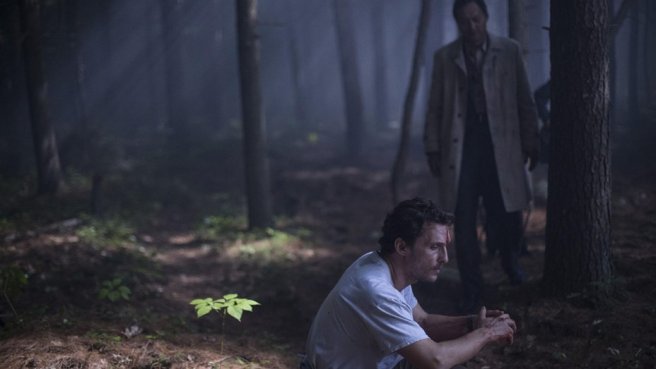
In our era of endless Letterboxd discoveries and Twitter reclamation projects (full disclosure: I am part of the problem), the whiplash responses that await troubled films often operate according to a kind of critical Newtonian physics: each dismissal creates an equal and opposite reappraisal. So it’s something of a surprise that The Sea of Trees met such a vicious critical drubbing when it premiered at Cannes last year with nary a supporter in sight of the Croisette willing to take up its defense…except, it must be assumed, Thierry Frémaux. The Cannes director likes to lob a bomb or two into the competition, but, even by those standards, Gus Van Sant’s latest film appeared a baffling inclusion, and critics responded accordingly. The intervening year has brought the film at least a modicum of relief: it’s finally getting a release, sneaking into theaters thanks to distributor A24. And yet, Monsieur Fremaux’s choice to include it in the competition still seems the prerogative of a man adrift in a thicket of red carpet photo ops and star junkets, desperate to find a Hollywood production worthy of inclusion in the world cinema festival par excellence, but lacking any fellow travelers able to guide him to critical safety.

It’s rather appropriate, then, that The Sea of Trees zeroes in on the life of middling adjunct professor Arthur, recently bereft of his wife, as he heads to Japan and loses himself in the notorious and densely wooded Aokigahara forest. Notorious, the film reminds us with a bit on-screen Googling, as a favored location for suicides. Of course that’s what Matthew McConaughey’s depressed academic is there to accomplish, until a raving Ken Watanabe crosses his path and provides him a traveling companion, a mission to escape the maze-like forest, and a reason for living.

Continue reading The Sea of Trees (Gus Van Sant, 2015)”

Our Little Sister (Hirokazu Kore-eda, 2015)

vlcsnap-2016-05-13-13h45m07s90

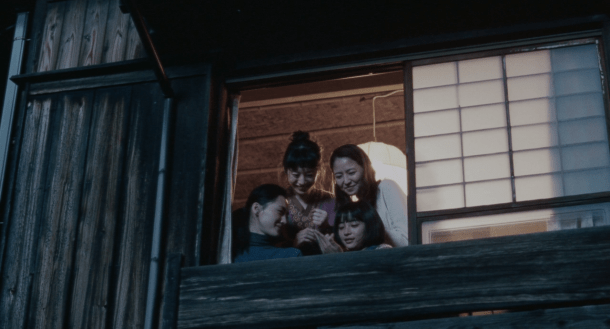
At the center of Hirokazu Kore-eda’s Our Little Sister is a house, and in the garden of the house is a plum tree. It is an old tree; generations of the family have seen it blossom and bear fruit, season by season. It is a tree at the heart of a house tradition, too, the making, storing, and consuming of umeshu, a sweet and sour green plum liqueur that is allowed to ripen to perfection over nine months beneath the floorboards. The family members prick their initials into the plums and these sit, soaking, as uniquely individual parts of the collective brew.

A family. A messy, powerful organism and a thing that Kore-eda, over the course of his film career, has continued to explore and expose, its raw bitternesses and its loving tendernesses. In earlier films, like Nobody Knows, heartbreak and tragedy are the centers of feeling; in more recent films, like I Wish, buoyant, infectious hope permeates. Our Little Sister tends towards the warmth of these latter films, and like the joyous, crucial moment of the speeding train in I Wish, there is a similarly ebullient defining moment in Our Little Sister, where two children on a bike fly through an avenue of blooming cherries.

Continue reading Our Little Sister (Hirokazu Kore-eda, 2015)”

Swiss Army Man (Dan Kwan & Daniel Scheinert, 2016)

hank and manny on beach

(NOTE: I also reviewed this film with Adam Kempenaar on the Filmspotting podcast, when I was a guest host for the show. You can take a listen here.) 

It isn’t a new idea, the idea that mental health and happiness are related to accepting yourself as you are. We could reference Free To Be You and Me, that album of the 70’s that challenged gender norms and promoted a celebration of individuality –

Come with me, take my hand, and we’ll run
To a land where the river runs free
To a land through the green country
 . . .
 To a land where the children are free
 And you and me are free to be

Don’t be afraid, the song encourages children. There’s no shame in anything that you are. Just be yourself. Celebrate that.

It’s a message that you can find everywhere now.  Children’s movies, in particular, often contain some version of this idea. If you have short term memory loss like Dory in Finding Dory, if you’re a bunny like Judy Hopps in Zootopia, you are still just as important, just as valuable as anybody else.

In Swiss Army Man, the debut feature film from Dan Kwan and Daniel Scheinert, we have a return to this essential kind of story and these themes. It centers on a man called Hank (Paul Dano), who can’t live with himself anymore. He’s alone, literally and figuratively. He feels bad about life, he feels bad about himself. He feels like “broken,” “dirty,” “trash.” He lacks the courage to seek out a relationship with the woman he admires. He’s ashamed of his desires and his own corporeal reality. And that’s his basic problem. He can’t stand himself and his disgusting body and “weird,” disgusting self.  The film’s journey is, then, about the way he struggles with coming to terms with himself and all of the weird, gross, socially unacceptable bits.

So far, so good.  And so far, a lot like something we’ve seen or heard before.

The film has received attention though for the conceit it employs to tell its story. You’ve probably heard about it already: it’s the farting corpse movie.  The story isolates Hank in the wilderness and gives him a dead body for a companion (Daniel Radcliffe), a companion whose most socially uncomfortable bodily functions take center stage. It is through his interactions with this embarrassing corpse, whose name is Manny, and a very literal dealing with bodily functions, that Hank has to face himself. In Manny, he sees his corporeal, death-fated human reality, and ultimately, must decide, whether or not he will reject it or embrace it. Continue reading Swiss Army Man (Dan Kwan & Daniel Scheinert, 2016)”