VIFF 2017: 24 Frames (Abbas Kiarostami, 2017)

ocean poles

The frame holds me.
Straining to see beyond,
I sleep,
caught between
tension & peace.

In the sleep, I dream,
The dream, a window
into what is
and what could be. 
      –(Adapted from the original tweet, 9/29/2017)

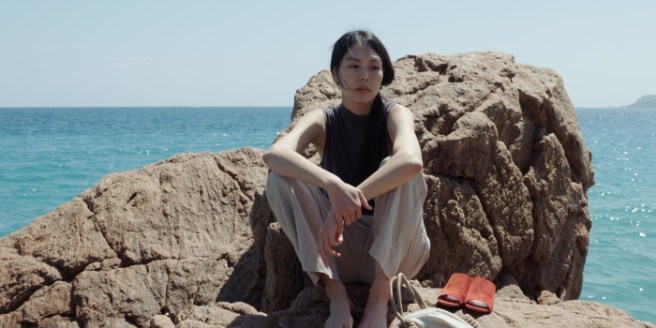
An inevitable sort of melancholy hangs over a beloved filmmaker’s last film, and one feels a certain pressure to love it, whatever it is. Going into the screening of the final film of Abbas Kiarostami (1940-2016), 24 Frames, I couldn’t ignore the nostalgia associated with the endeavor. I am not sure, ultimately, if it will ever be possible for me to disassociate the film from the cinema experience of sitting in the dark, grieving a film lover’s grief and thinking, “This 120 minutes will be the last new footage I will ever see.”  But sitting there, even so intensely aware of the experience as a memento mori, Kiarostami’s film–flickering relentlessly forward through those precious minutes–took on its own weight. Like all of his films have done for me, it slowly removed me from self-consciousness and immersed me in itself.

24 Frames is certainly unique within Kiarostami’s oeuvre. It’s the sort of thing you might expect to find in an exhibition at the MoMA, where you can study an art piece for a while and then wander away. It’s not the sort of thing you’d expect to sit in the dark and watch for two hours. But then, Kiarostami has always been playing with the idea of cinema, his films so often reflecting back on themselves and on the act of filmmaking, and in these reflections, he has continually made his audiences consider again what cinema is and what it could be.

Continue reading “VIFF 2017: 24 Frames (Abbas Kiarostami, 2017)”

The Killing of a Sacred Deer (Yorgos Lanthimos, 2017)

the-killing-of-a-sacred-deer-1200x520

This is the first movie I’ve seen from celebrated Greek director Yorgos Lanthimos, and it’ll likely be the last. A bearded Colin Farrell plays a surgeon whose patient dies during an operation. The patient’s son (Barry Keoghan, super creepy) first tries to get Farrell to hook up with his mother (Alicia Silverstone, sad and sadly underutilized) to take the dead father’s place, but when that doesn’t work out, begins supernaturally torturing his family in an attempt to force Farrell to choose which one of his two kids should die as compensation for the boy’s dead father. It’s an adaptation of the story of Iphigenia, the daughter of Agamemnon who is commanded to be sacrificed after her father kills a deer beloved of the goddess Artemis. But in adapting the story into the bleak world of Euro-art house cruelty, Lanthimos drains the story of its humanity and its tragedy, leaving instead a deeply cynical, and exceedingly dumb, black comedy. Farrell and Nicole Kidman, playing his wife, speak and relate with an affectless precision, which is funny and weird when playing up their bizarre oversharing at parties or depressing bedroom antics, but serves no other apparent purpose. A satire of bourgeois zombiism dressed up with a classical education. Lacking belief in either the cause or the tragedy of Iphigenia’s sacrifice, all that’s left is a cheap mockery of humanity. An adaptation of myth from the point of view not of the people who strive and suffer, but through the eyes of an imperious god, tormenting foolish, hubristic mortal souls. A film almost wholly lacking empathy.

Friday October 20 – Thursday October 26

Featured Film:

The Florida Project at the SIFF Egyptian and the Lincoln Square

Normally I’d use this space to highlight the Northwest Film Forums presentation of an unearthed, uncut 35mm print of Dario Argento’s classic horror film Suspiria, with star Jessica Harper in attendance. But they’re playing it one night only and both shows have been sold out for weeks. So if, like me, you’re shut out of the movie event of the fall, you should go see what is quite probably the best American film of 2017 so far, Sean Baker’s The Florida Project. We like it so much, we reviewed it twice in a single day. Here’s Ryan’s take on it and here’s mine.

Playing This Week:

AMC Alderwood:

The Fortress (Hwang Dong-hyuk) Fri-Thurs
The Bachelors (Kurt Voelker) Fri-Thurs

Ark Lodge Cinemas:

Death Bed: The Bed that Eats (George Barry, 1977) Thurs Only

Central Cinema:

Notorious (Alfred Hitchcock, 1946) Fri-Mon   Our Review
The Cabin in the Woods (Drew Goddard, 2012) Fri-Mon
The Nightmare Emporium (Various) Tues Only

SIFF Egyptian:

The Florida Project (Sean Baker) Fri-Weds Our Review Our Other Review

Century Federal Way:

The Fortress (Hwang Dong-hyuk) Fri-Thurs
Secret Superstar (Advait Chandan) Fri-Thurs
A Nightmare on Elm Street (Wes Craven, 1984) Sun & Weds Only

Grand Cinema:

Lucky (John Carroll Lynch) Fri-Thurs
The Last Dalai Lama? (Mickey Lemle) Fri-Thurs
Dolores (Peter Bratt) Fri-Thurs
Young Frankenstein (Mel Brooks, 1974) Sat Only
The Exorcist (William Friedkin, 1973) Sat Only
California Typewriter (Doug Nichol) Tues Only
Turn It Around: The Story Of East Bay Punk (Corbett Reford) Thurs Only
The Road to Nickelsville (Derek Armstrong McNeill) Thurs Only

Grand Illusion Cinema:

The Old Dark House (James Whale, 1932) Fri, Sat, Mon & Weds
The Witch (Robert Eggers, 2015) Fri-Thurs Our Review
Rawhead Rex (George Pavlou, 1986) Sat & Thurs Only
2nd Annual Scarecrow Video Weirdo Horror Triple Feature Sun Only VHS
Damsels of Doom: Horror B-Movie Double Feature Tues Only 16mm

Cinemark Lincoln Square:

The Florida Project (Sean Baker) Fri-Thurs Our Review Our Other Review
Loving Vincent (Dorota Kobiela & Hugh Welchman) Fri-Thurs
Golmaal Again!!! (Rohit Shetty) Fri-Thurs
Secret Superstar (Advait Chandan) Fri-Thurs
Goodbye Christopher Robin (Simon Curtis) Fri-Thurs
Mersal (Atlee Kumar) Fri-Thurs
Raja the Great (Anil Ravipudi) Fri-Thurs
Tokyo Ghoul (Kentarô Hagiwara) Sat Only
A Nightmare on Elm Street (Wes Craven, 1984) Sun & Weds Only

Regal Meridian:

Golmaal Again!!! (Rohit Shetty) Fri-Thurs
Wind River (Taylor Sheridan) Fri-Thurs Our Review
Mother! (Darren Aronofsky) Fri-Thurs Our Review

Northwest Film Forum:

4 Days in France (Jérôme Reybaud) Fri-Thurs
King of Jazz (John Murray Anderson, 1930) Sun Only
Rat Film (Theo Anthony) Starts Weds
Suspiria (Dario Argento, 1977) Thurs Only Jessica Harper in Attendance Sold Out

AMC Pacific Place:

Never Say Die (Yang Song & Chiyu Zhang) Fri-Thurs

Regal Parkway Plaza:

Golmaal Again!!! (Rohit Shetty) Fri-Thurs
Wind River (Taylor Sheridan) Fri-Thurs Our Review

AMC Seattle:

Dina (Antonio Santini & Dan Sickles) Fri-Thurs
The Departure (Lana Wilson) Fri-Thurs

Seattle Art Museum:

Kiss of Death (Henry Hathaway, 1947) Thurs Only

SIFF Film Center:

Night of the Living Dead (George Romero, 1968) Fri-Sun

SIFF Uptown:

Loving Vincent (Dorota Kobiela & Hugh Welchman) Fri-Thurs
Lucky (John Carroll Lynch) Fri-Thurs
Seattle Polish Film Festival Fri-Sun Full Program
Halloween (John Carpenter, 1978) Fri, Mon & Tues Only
Night of the Living Dead (George Romero, 1968) Mon & Tues Only
The Fall (Tarsem Singh, 2006) Weds Only

Varsity Theatre:

Jungle (Greg McLean) Fri-Thurs
Walking Out (Andrew J. Smith & Alex Smith) Fri-Thurs
Leatherface (Alexandre Bustillo & Julien Maury) Fri-Thurs

In Wide Release:

Blade Runner 2049 (Denis Villeneuve) Our Review

The Florida Project (Sean Baker, 2017)

Florida-Project-NYTimes

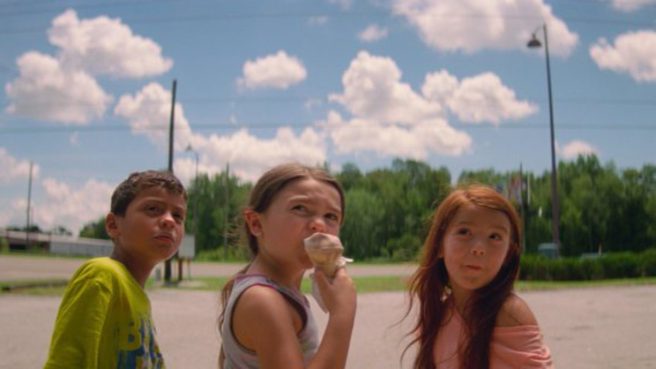
Tangerine director Sean Baker returns to Seattle Screens this week with another tale of life on the margins of 21st century capitalism. Set entirely around the vicinity of the cheerfully purple Magic Castle motel, a semiurban wasteland of hotels, abandoned houses and oversized promotional mascots bordering the unapproachable dream of Disney World, Baker takes for his heroes a small group of children, led by Moonee (Brooklynn Prince), an amoral, loudmouth innocent trying to entertain herself over summer break. The first half of the film mostly follows her adventures with the neighbor kids in the motel (begging for change to buy ice cream, playing hide and seek in the motel office, exploring empty houses and what passes for countryside amid Orlando’s sprawl). The second half focuses more on Moonee’s mother, just as loud, but more amoral, as she resorts to increasingly inappropriate ways of earning the weekly rent cash. Uniting it all is the weary presence of Willem Dafoe, motel manager, a good man trying to do his job with compassion and honor.

Like Tangerine, Baker films with a sun-dappled luminosity that’s all but anathema in the European art house tradition of films about poverty. Being poor isn’t supposed to look nice, or fun, and the easiest way to convey that is with a drab grunginess. The Florida Project rejects that approach, but also the kind of somber mysticism that makes things like Beasts of the Southern Wild* or George Washington palatable for a mass audience. His models instead go back further, to the Depression: Hal Roach and the Little Rascals are thanked in the credits, and the influence of those stories of kids being poor but nonetheless being kids is clear. I was reminded as well of Frank Borzage’s classic No Greater Glory, about unsupervised children recreating the martial ideologies and conflicts of their parents’ generation, with tragic consequences. The kids in The Florida Project aren’t playing war games, but are instead learning their parents’ approaches to failing in capitalism: acting out against things, not people – they vandalize objects of wealth, a car, a house. One of their first acts of terror is literally turning off power. Poverty in The Florida Project never looks fun, it looks brutal and crushingly sad (the unseen face of the boy forced to give away all his toys because they don’t fit in his father’s car when they’re moving away). But it’s still sunny in Florida, and there is ice cream and cows and maple syrup to be found.

*Spoiler Ahead*

Continue reading The Florida Project (Sean Baker, 2017)”

VIFF 2017: Milla (2017, Valérie Massadian)

Still—Milla

Milla opens in a state of languor: a young couple snuggled up together, camping in their car. In our very first sight of Milla (Séverine Jonckeere) and Leo (Luc Chessel), condensation on the car windows forms a natural softening filter between the lovers and their audience, bathing their morning idyll in a haziness never to be seen again. Later, they eat a cobbled together breakfast in the forest, a lushly composed scene of domestic and romantic peace. It’s worth noting these early moments of leisure for they provide the first inkling of unfussy and unsentimental consideration that permeates Milla, a work of patient and heart-aching metamorphosis.

Continue reading “VIFF 2017: Milla (2017, Valérie Massadian)”

VIFF 2017: The Florida Project (2017, Sean Baker)

dafoe

It seems fair to say that one of the biggest breakouts in the film world during these past few years was 2015’s Tangerine, co-written and directed by Sean Baker. Garnering almost as much attention for its empathetic, energetic focus on trans female sex workers in Los Angeles as it did for its ultra-low-budget shooting style on three iPhone 5Ss, one could easily assume that the movie was Baker’s directorial debut. But in point of fact, the movie was his fifth feature, and with his sixth and latest film, The Florida Project, Baker returns to his favored shooting format of 35mm, this time in the at once fantastical and sober environs of Orlando, Florida.

Whereas Tangerine aimed for an almost abrasive, unapologetic energy, with its narrative confined to the drama of a web of relationships on Christmas Eve, The Florida Project‘s goal is something more sprawling and languorous. The film takes place over a summer at the Magic Castle, a motel-cum-extended-stay complex in the shadow of Disney World, focusing on Moonee (Brooklynn Prince, remarkable), a wild six-year-old, and Halley (Bria Vinaite), her equally uncontrolled mother. What framework of a narrative unspools at a leisurely pace, mostly content to observe as Moonee plays with a set of friends around the alternately pastoral and urban area surrounding the motel.

Continue reading “VIFF 2017: The Florida Project (2017, Sean Baker)”

The Frances Farmer Show #15: VIFF 2017 Recap

claires_camera_1-1

We talk about many of the movies we saw at the Vancouver International Film Festival. Films discussed include: Maison du bonheur, Milla, Caniba, 24 Frames, Claire’s Camera, The Square, The Killing of a Sacred Deer, the Future//Present program (Fail to Appear, Mass for Shut-Ins, Still Night Still Light, Prototype, Black Cop, Scaffold, Forest Movie), Faces Places, Top of the Lake: China Girl, 120 Beats per Minute, Bad Genius, Wonderstruck, The Florida Project, and SPL: Paradox.

You can listen to the show by downloading it directly, or by subscribing on iTunes or the podcast player of your choice.

Friday October 13 – Thursday October 19

Featured Film:

The Princess Bride in Wide Release

Our VIFF coverage is on-going though the festival has come to an end, and there’s good stuff to be seen on the art house circuit (the TWIST film festival, Ex Libris at the Grand, Days of Heaven at SAM), and I wouldn’t normally feature one of these TCM/Fathom Events repertory showings, but it’s my wife’s birthday week and this is her favorite movie, an adaptation of the book by her favorite author. If you haven’t seen it, don’t miss it this Sunday and Wednesday at any of several multiplexes around the region. If you have seen it, you might as well watch it again. It never, ever gets old.

Playing This Week:

Admiral Theatre:

Rooted in Peace (Greg Reitman) Mon Only

AMC Alderwood:

Brave (Brenda Chapman & Mark Andrews, 2012) Fri-Thurs
The Outlaws (Kang Yoonsung) Fri-Thurs

Central Cinema:

Dial M for Murder (Alfred Hitchcock, 1954) Fri-Tues
Hausu (Nobuhiko Obayashi, 1977) Fri-Tues
Get Out (Jordan Peele) Thurs Only

SIFF Egyptian:

TWIST Seattle Queer Film Festival Fri-Thurs Full Program

Century Federal Way:

Bailaras (Ksshitij Chaudhary) Fri-Thurs
The Princess Bride (Rob Reiner, 1987) Sun & Weds Only

Grand Cinema:

Lucky (John Carroll Lynch) Fri-Thurs
Rosemary’s Baby (Roman Polanski, 1968) Sat Only
Ex Libris: New York Public Library (Frederick Wiseman) Tues Only Our Review
The Lady Vanishes (Alfred Hitchcock, 1938) Weds Only

Grand Illusion Cinema:

M.F.A. (Natalia Leite) Fri-Thurs
Finding Joseph I: The HR from Bad Brains Documentary (James Lathos) Sat Only
Danger Diva (Robert McGinley) Sat & Weds Only
EXcinema Group Show Tues Only

Cinemark Lincoln Square:

Judwaa 2 (David Dhawan) Fri-Thurs
Raju Gari Gadhi 2 (Omkar) Fri-Thurs
Mahanubhavudu (Maruthi) Fri-Thurs
Kaafi Thota (T. N. Seetharam) Sat & Sun Only
The Princess Bride (Rob Reiner, 1987) Sun & Weds Only

Regal Meridian:

Chasing the Dragon (Wong Jing & Jason Kwan) Fri-Thurs
Wind River (Taylor Sheridan) Fri-Thurs Our Review
Mother! (Darren Aronofsky) Fri-Thurs Our Review

Northwest Film Forum:

Tasveer South Asian Film Festival Fri-Sun Full Program
TWIST Seattle Queer Film Festival Fri-Thurs Full Program

AMC Pacific Place:

Brave (Brenda Chapman & Mark Andrews, 2012) Fri-Thurs
City of Rock (Dong Chengpeng) Fri-Thurs
Never Say Die (Yang Song & Chiyu Zhang) Fri-Thurs

Regal Parkway Plaza:

Judwaa 2 (David Dhawan) Fri-Thurs
Last Night (Bb Joyce Bernal) Fri-Thurs
Til Death Do Us Part (Chris Stokes) Fri-Thurs
Wind River (Taylor Sheridan) Fri-Thurs Our Review

AMC Seattle:

The Big Sick (Michael Showalter) Fri-Thurs Our Review
So B. It (Stephen Gyllenhaal) Fri-Thurs
The Secret Scripture (Jim Sheridan) Fri-Thurs

Seattle Art Museum:

Leon Morin, Priest (Jean-Pierre Melville, 1961) Weds Only
Days of Heaven (Terrence Malick, 1978) Thurs Only

SIFF Film Center:

Wasted! The Story of Food Waste (Anna Chai & Nari Kye) Fri-Sun
Crash Kids Sat Only
The Painting (Jean-François Laguionie, 2011) Weds Only

AMC Southcenter:

Brave (Brenda Chapman & Mark Andrews, 2012) Fri-Thurs

SIFF Uptown:

Dolores (Peter Bratt) Fri-Thurs
Lucky (John Carroll Lynch) Fri-Thurs
International Ocean Film Tour Thurs Only

Varsity Theatre:

Columbus (Kogonada) Fri-Thurs Our Review Our Other Review
Walking Out (Andrew J. Smith & Alex Smith) Fri-Thurs
The Princess Bride (Rob Reiner, 1987) Weds Only

In Wide Release:

Blade Runner 2049 (Denis Villeneuve) Our Review

VIFF 2017: Faces Places (2017, Agnès Varda & JR)

truck

At this point, it seems moot to emphasize the collaborative nature of film. With almost no exceptions, every single movie requires the work of many talented, gifted artisans and craftspeople who provide incalculable contributions. Yet, with the very valid tenets of the auteur theory in mind, films co-directed by two distinct voices are special cases, especially in the case of the magnificent documentary Faces Places. The first credited director, Agnès Varda, the octogenarian filmmaker of Cléo from 5 to 7, Le bonheur, The Gleaners and I, and other such acclaimed works, almost needs no introduction to cinephiles. On the other hand, her creative partner JR is quite literally an unknown quantity: the visual artist and street photographer’s identity is uncertain, and while he has directed a handful of films, including a short starring Robert De Niro, to my knowledge he has made no significant splash in the world of cinema until now.

Varda herself is coming off of a partially self-imposed hiatus from feature filmmaking, having made her previous and ostensibly last documentary The Beaches of Agnès in 2008. But the fusion of their two diametrically opposed figures – she an elderly, world famous director with two-tone hair, he a 34-year-old visual artist with perpetually perched dark glasses à la Godard (according to Varda) – only enhances both directors’ innate sense of exuberance and sensitivity. Faces Places‘ ostensibly modest aims of photographing and plastering large photographs of average people onto structures across France provides a surprisingly humanist and playful backdrop, against which two remarkable artists create something both profoundly personal and entirely universal.

goat

Perhaps what strikes most is how Faces Places‘s sense of collaboration arises. The film begins with a playful series of scenes imagining how the duo could have met (on a road, in a bakery, and most amusingly on the dancefloor), and while the actual point of first contact is much more mundane, it arises without ambiguity from a place of strong appreciation for each other’s work. Flashes of film clips from Varda (including Cléo) and some of JR’s large posted photographs appear at the very beginning, but on the whole the film relies solely upon the interplay between the two artists and their many camera subjects.

Whether it be the last woman living in a row of miners’ houses, a photograph of an old acquaintance pasted onto the side of a toppled bunker at Normandy, or the wives of shipyard workers, Varda and JR continually manage to tease out the fascinating and even fantastical via their particular mode of documentation. This isn’t the realm of, say, Humans of New York; the filmmakers do happen across incredible stories, but they are augmented and enhanced by the act of photographing, both in still and moving form. And, at least for Varda, this process is soon coming to a close: throughout the documentary her eyesight is failing, and there is a scene of an ocular injection quickly likened to “Un chien andalou.” Yet Faces Places feels no burden to be a capstone or a simple elegy, even if Godard almost makes an appearance. It is buoyed by sheer humanity in many forms, almost always managing to hit the perfect balance between the sentimental and the clear-eyed, prone to flights of fancy but persistently aware of when to come back to earth.

VIFF 2017: Close-Knit (Naoko Ogigami, 2017)

close-knit

While watching Naoko Ogigami’s Close-Knit, I often remarked to myself, “The camera is always at the right distance! Every Time!” like an idiot. But it is this observation that best captures the appeal of Ogigami’s cinema. She is not fashionable or current or modern in ways that are obvious. Indeed, her concepts and sensibility are probably downright corny. But she has judgment, and her gaze is always a respectful one. Thus her camera is always at a careful distance, marveling at the nature of her characters and accepting them for who they are. Hers is a welcoming vision, perhaps most ably realized in her masterpiece Kamome Diner (2006), where all sorts of people are brought into the fold of the narrative, their tastes, mannerisms and behavior given their place. The same applies for her latest feature, Close-Knit.

Continue reading “VIFF 2017: Close-Knit (Naoko Ogigami, 2017)”