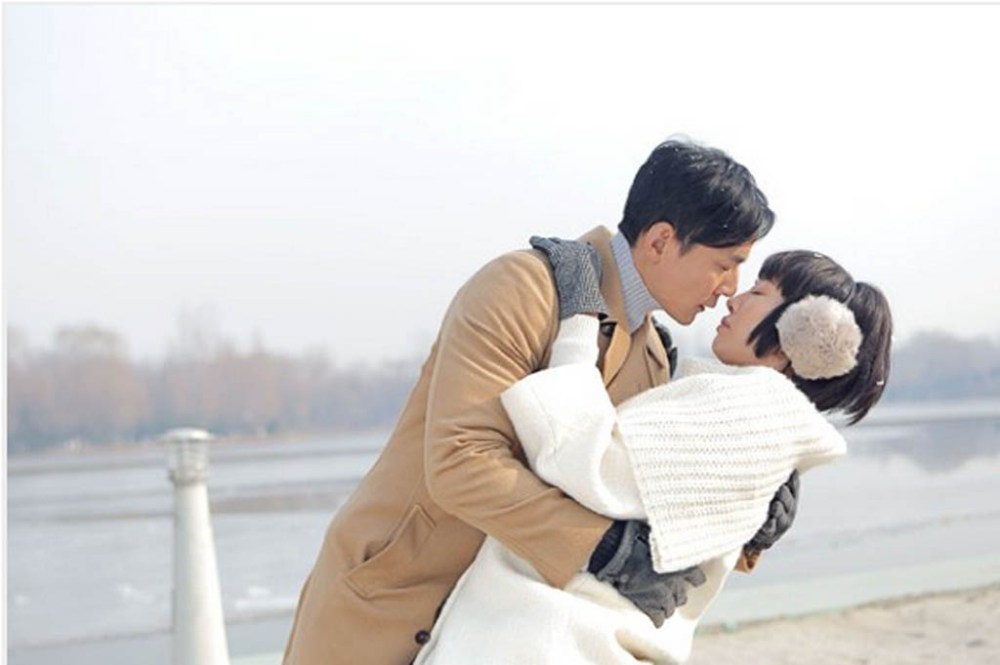
The goofy, cutsy, CGI-driven, Chinese fantasy cancer melodrama we didn’t know we needed. The clash of tones I imagine would be unbearable for most, especially audiences trained on Hollywood rules about tonal and generic consistency, but it was a smash hit in China (and is still on-going) and managed an extremely rare third week in diasporic theatrical release here in Seattle. When I left the auditorium, I saw a woman sobbing uncontrollably, the guy with her trying in vain to console her. I can’t blame her at all. It’s silly and dumb and heartfelt and devastating.
Category: Reviews
Digging for Fire (Joe Swanberg, 2015)
If there’s an equivalent to Hong Sangsoo in contemporary American cinema, I guess it may as well be Joe Swanberg. Both directors are wildly prolific, churning out tales of middle class ennui and relationship anxiety with frightening regularity. Both work with extremely low-budgets and high-quality actors, the result of the curious mix of critical acclaim and lack of box office their films achieve. Their films have a relaxed, naturalistic vibe in pace and performance, with lengthy scenes of actors seemingly just hanging out (and, more often than not, drinking). Of course, Hong is know for his structural experimentation, each film taking the form of a new exercise in narrative unreliability, where dreams and waking life, the past and the present, and multiple versions of reality all coexist in an unstable, purely cinematic universe. Swanberg, on the other hand, seems allergic to structure, shying away from anything that could be construed as plot, what can charitably be called an experiential vision of narrative. Hong always knows precisely where to place his camera, and once there, rarely moves but for an occasional ostentatious quick-zoom that serves to reframe the image and functions as a stand-in for the emotional impact of editing. Swanberg apparently is aware that a camera is essential for the making of a motion picture.
Memories of the Sword (Park Heung-shik, 2015)
Opening this week at the Century Cinemas in Federal Way is this Korean wuxia film, a revenge tale bearing more than a little resemblance to a certain sic-fi trilogy and filled with striking sunsets, lovely fields, elaborate sets and digitally-enhanced swordfighting. Directed by Park Heung-shik, the man behind such award-winning films as 2001’s I Wish I Had a Wife and 2004’s My Mother, the Mermaid, Memories of the Sword follows in the footsteps of Zhang Yimou’s martial arts films Hero, House of Flying Daggers and Curse of the Golden Flower in that it is a highly melodramatic tale told in sumptuous, gorgeously photographed settings. Beginning with a young woman walking through a field of sunflowers, she puts down her basket and takes a flying leap over a giant stalk, soaring weightlessly through the air. Her joy as she lands safely, accomplishing what must have been a task she’d set herself for weeks if not years, is palpable. Unfortunately it’s the last bit of happiness in what becomes an unremittingly grim tragedy. Like Zhang’s films, the tastefulness of the enterprise undermines any life the genre film within might have possessed.
Continue reading “Memories of the Sword (Park Heung-shik, 2015)”
The Iron Ministry (J.P. Sniadecki, 2014)
The Iron Ministry is the first film in many years to begin with an overture. Particularly popular with the opulent studio productions of the 1950s and ’60s, the practice of including an orchestral score as prelude to the narrative was intended to provide gravitas to the proceedings as well as act as a transition from the real world to the cinematic. The overture in The Iron Ministry definitely provides the latter, but unlike films such as Ben-Hur, the music is not grasping at majesty. In fact, it’s not really music. As the droning sound plays out we discover that it is not a string section but the straining sound of metal on metal of a train moving along its tracks.
Filmed between 2011 and 2013, The Iron Ministry takes place entirely on trains traversing through China on the world’s largest railway network. The film is another project released under the Sensory Ethnography Lab, whose ascendence among cinephiles has been astronomical in recent years, thanks to a string of well-received releases such as Leviathan and Sweetgrass. The Ethnography Lab’s immersive documentaries have provided some of the most unexpected thrills in cinema as of late and The Iron Ministry is no exception. The film does not possess the formal rigor of something like the glorious gondola ride of Manakamana but that is not what this subject calls for. In fact, it needs the opposite, an embracement of movement and messiness.
Two Screwball Comedies: Mistress America (Noah Baumbach, 2015) and She’s Funny That Way (Peter Bogdanovich, 2014)
The third of Noah Baumbach’s collaborations with actress/writer Greta Gerwig, following 2010’s Greenberg and 2012’s Frances Ha, Mistress America is their best film yet, and possibly the best work Baumbach has ever done, with or without her. For the first time in his career, he’s made a film that feels loose, free from the strained serious grasps at artistry that have plagued his career from the beginning, ranging from endearingly awkward in his debut, 1995’s Kicking and Screaming to really kind of irritating in what nonetheless remains his most critically successful film, The Squid and the Whale. A pure screwball companion to While We’re Young, the 2014 film that graced Seattle Screens just a few months ago, the two films form a hilarious portrait of our culture’s obsession with a certain kind of youth, a Manhattanite companion to Sylvia Chang’s brilliant exploration of Hong Kong womanhood, 20 30 40, in which the idiosyncrasies of three women of the eponymous ages are compared and contrasted. Where While We’re Young followed an older couple’s attempts to match coolness with a much younger pair while also somewhat clunkily exploring the interplay between authenticity in life and authenticity in art, this one focuses on a college freshman’s infatuation with her older future stepsister, a free spirit who makes New York seem as magical as it should be, while much more deftly exploring the oft-contentious relationship between an artist and the people who inspire their work. In both cases, the idyllic figure is a creative powerhouses in their early 30s, stable enough to enjoy a certain standard of living, but not so rooted as to avoid taking risks. It’s the age of sitcom heroes. Gerwig is a powerhouse as always (she’s already a three-time Endy Award winner, for her work in the Baumbach films and Whit Stillman’s Damsels in Distress) dogged in pursuit of her ideals and not nearly as ridiculous as she might first appear, her effervescence contains unfathomable depths and Lola Kirke is excellent as the younger woman, wide-eyed but with a steely determination that’s more than a little unnerving, the coldness of youth. There’s no fat in the film, it’s Baumbach’s tightest, most-focused work, for the first time he demonstrates the ease, the lack of apparent effort that marks a truly virtuosic film. The lengthy set piece at a Connecticut mansion is a classic of screwball escalation, as Baumbach ably piles a Sturgesian array of characters and relationships into a few crowded rooms.

More consciously seeking to recreate an old Hollywood vibe is the latest from Peter Bogdanovich, the refugee from the first golden age of cinephile directors who has found film work increasingly hard to find in recent years (this is his first theatrical fiction feature since 2001’s The Cat’s Meow). In fact, his new film is pretty hard to find as well, with an under-the-radar nationwide release (it opened on Seattle Screens with little fanfare last week at the Varsity, we’re it continues on a reduced schedule this week), a far cry from his generation-defining 70s masterpieces like The Last Picture Show, What’s Up Doc? or Paper Moon. Combing a theatrical farce reminiscent of his 1992 film Noises Off with the cosmic screwball romanticism of his 1981 masterpiece They All Laughed, She’s Funny That Way is a story told by a young woman (Imogen Poots) to a reporter (Illeana Douglas), the story of how she was discovered and her life changed from that of a hooker (with a heart of gold, naturally) to star of stage and screen. The story is wildly improbable, its reality questioned every step of the way by the reporter, but so seductive in its interconnections and coincidences as to be irresistible. The conflation of cinema as real life is charmingly seductive (print the legend), and the myth-making power of star cameos only adds to the glowing unreality. Familiar faces abound: contemporary icons like Jennifer Aniston and Owen Wilson, older relics Austen Pendleton, Richard Lewis and Cybil Shepard, and up-and-comers like Poots, Will Forte and the always marvelous and perpetually under-utilized Kathryn Hahn and Rhys Ifans. Douglas herself provides a link to the old world the film idealizes: her grandfather Melvyn, in a different Lubitsch film, told Greta Garbo an even better joke than the one from Cluny Brown that serves as a key line for Owen Wilson’s character. While the film isn’t as existentially radical as They All Laughed, in a weird kind of way it’s Bogdanovich’s Hong Sangsoo film. Like with the greatest modern director of romantic comedies, She’s Funny That Way questions the very nature of the cinema’s relation to reality, reveling in the idealized illusions while simultaneously undermining their spell by pointing out their unreality. But where Hong relentlessly deconstructs his narratives, laying bare their artifices and exposing the lonely needs that drive us to invent them, Bogdanovich the classicist is content to faithfully recreate the form of the old (his zooms are subtle and patient, not Hong’s wild, drunken lurches), with nothing but a sly wink to the audience to remind us of the precariousness of our ideals. We know it’s all a lie, but we happily dream away nonetheless.
Mistress America is now playing at the Guild 45th, SIFF Uptown and Cinemark Lincoln Square.
She’s Funny That Way is now playing at the Varsity Theatre.
Princess Chang Ping (John Woo, 1976)
Before he hit it big with 1986’s A Better Tomorrow, John Woo was a journeyman director for hire on the margins of the Hong Kong film industry. He worked mostly in slapstick comedies such as the Chaplin homage Laughing Times with Dean Shek, or the hit Ricky Hui film From Riches to Rags, along with a handful of action films in the established kung fu and wuxia genres, most notably his 1973 debut The Young Dragons and 1979’s Last Hurrah for Chivalry, which is in many respects The Killer with swords instead of guns. One of his oddest films during this period was a musical made for the Golden Harvest studio in 1976, Princess Chang Ping, which plays this week in Scarecrow Video’s Screening Lounge.

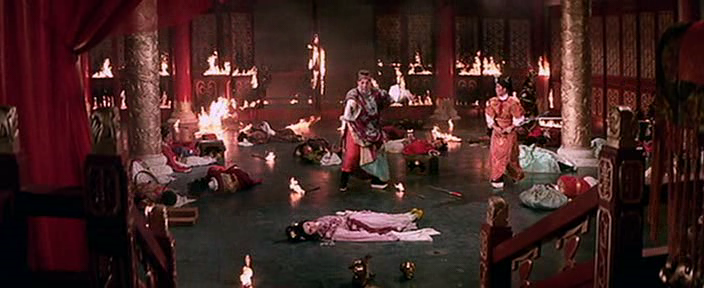
Based on a 1957 Cantonese opera that was itself based on historical events from the late Ming Dynasty (the mid-1600s) and starring actors from an actual opera troupe, in performance it is wildly theatrical, translating the gestural and recitative stage tradition to the big screen. The structure is theatrical as well, made up of long scenes set in a single location, with the actors coming and going developing the plot in song. The first twenty minutes takes place entirely in one throne room location, establishing the romance between the eponymous Princess, daughter of the Ming Emperor, and a young courtier named Chow Shih-hsien. In full view of the court, he woos her with wit and wordplay, a Shakespearean exchange that marks them both as outsiders in the restrictive court world and demonstrates their shared aesthetics and belief system. Things are going well, when Woo, in a shocking cut, throws us outside the palace as cannons roar and the rebels are closing in: the Manchus are about to bring the dynasty to an end. The break in location is more than just a jolt of explosion: it’s a blast of reality into the highly ritualized world of court culture, an intrusion of violence into the ultra-civilized.

This sets up the first of several Woovian dilemmas, conflicts between moral codes that drive so many of his later films. The Emperor, rather than let them be taken alive, orders his wives and children to kill themselves before he does the same. The older women do so, with much wailing, but Chang Ping herself doesn’t want to die (she’s just found a guy that really understands her!). In a rush, her father resolves to do it himself (for her own good) and draws his sword (here the play differs from history: according to tradition, the Emperor severed her arm. In one version of the tale, she becomes a martial artist and leader of the anti-Manchu resistance, known as the One-Armed Divine Nun). Merely scratched, the princess survives and goes into hiding. One day, the prince (he survived too, being haplessly knocked unconscious in a manner befitting a young scholar caught up in a battle), having assumed she had died, runs into her at a monastery. They rekindle their love affair, but soon more people discover her secret and she becomes a pawn in the remaining Ming elites’ attempts to ingratiate themselves with the new Qing Dynasty. Chang Ping and Shih-hsien confront the new Emperor (played by the same actor as the old Emperor), resolved to do the honorable thing regardless of what they must sacrifice to accomplish it.

This is the progression of most of Woo’s best heroes. First an instantaneous connection with someone who shares their understanding of the moral universe (think of Chow Yun-fat with Danny Lee in The Killer and with Tony Leung in Hard-Boiled). In the gangster films its a shared Code, based on ideas of honor that go back centuries throughout martial arts literature. Such sparks dominant Woo’s career from his debut to his latest film The Crossing, where the connection is explicitly romantic. Eventually, in most cases, the connected pair will find themselves in a stand-off against the forces of the world at large, opportunistic villains motivated by greed or ambition some other base motive. Usually the result is a sacrifice of some kind, as one hero (or both) trade their life for the survival of innocents or simply to prove a point. Thus it’s easy to see why Woo would have been drawn to this story, as opposed to other popular opera films, say something like Li Han-hsiang’s Beyond the Great Wall, in which a Princess is used as a dynastic pawn in a Mizoguchian tale of the historical oppression of women. In Woo’s films, of course, the heroes are almost always men. Princess Chang Ping is a notable exception, especially when you consider that the prince Shih-hsien is also, in following Chinese operatic convention, played by a woman.

The film isn’t as glossy or elaborate as the huangmei films the Shaw brothers specialized in before they shifted into martial arts movies (Li Han-hsiang films like The Love Eterne or The Enchanting Shadow) but as mid-70s Golden Harvest productions go, it’s pretty ornate (helped no doubt by the fact that it only has three or four sets). Woo’s camera moves fluidly, emphasizing the theatricality of the world and performances rather than reinforcing it to an alienating degree. He’s said it was one of his favorite of his early films, the one he had the most fun making and the joy is evident on the screen. Woo’s musicality is an underrated aspect of his film style, not just in the oft-stated relation between his balletic action choreography and the dance film, but simply in the way his best films use music to convey emotion, connecting events and people across space and time. This is the case here, as an opera film the music is inescapable, but also in the synth-pop soundtracks of his late 80s masterpieces and the lush Taro Iwashiro scores of his 21st Century epics. One of the weird things I’ve found in watching a rewatching a ton of Woo films in preparation for an upcoming episode of the They Shot Pictures podcast (should be out early next week) is that my enjoyment of his films is almost directly proportional to my enjoyment of their scores. There might be a chicken and egg relation there, but who knows.
Princess Chang Ping plays Thursday, August 27 Only in the Scarecrow Video Screening Lounge.
Phoenix (Christian Petzold, 2014)
Ash, ash–
You poke and stir.
Flesh, bone, there is nothing there–
A cake of soap,
A wedding ring,
A gold filling.
. . .
Out of the ash
I rise with my red hair
And I eat men like air.
~Sylvia Plath, “Lady Lazarus”
I confess, I found myself a bit disappointed when I learned Christian Petzold’s new film, Phoenix, would be “about the Holocaust.” There is a certain weariness that arises out of the fact that so many use or have used the events of the Holocaust as a reference point, whether artistically, for a film’s central story (see Sophie’s Choice, Schindler’s List, The Pianist, among others) or socially, for a cheap point in a debate gone awry (see my Facebook feed). I wondered whether I was up for seeing yet another movie centering around the much-documented tragedy.
But great artists work familiar things in such unfamiliar ways that even the cliché can take on unexpected, fresh resonance, and I see the familiar thing as I had not seen it before. It is both old and wholly new. Continue reading “Phoenix (Christian Petzold, 2014)”
Jenny’s Wedding (Mary Agnes Donoghue, 2015)
Jenny’s Wedding—a coming-out story set in Cleveland and starring Katherine Heigl—is a dated, lugubrious mess. The tone is drippy, the dialogue is ponderous, and the pacing operates in geological time. Watching this movie is like getting slapped in the face with raw, boneless chicken over and over.
Continue reading “Jenny’s Wedding (Mary Agnes Donoghue, 2015)”
Straight Outta Compton (F. Gary Gray, 2015)
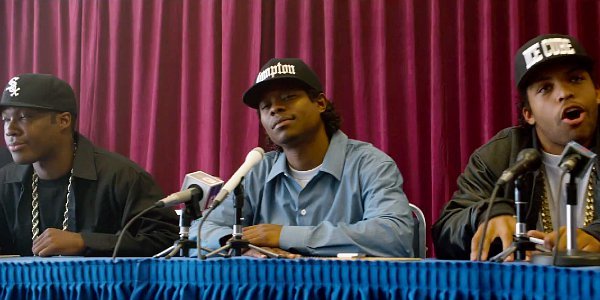
While they sold tons of records and the content of their songs grabbed a lot of headlines, there was never enough appreciation for the look of N.W.A. Their late-’80s ensemble of black sweatshirts and Los Angeles sportsgear doesn’t get as much traction as Beatle boots but it is just as iconic. Certainly the group worked because it was comprised of astonishingly talented individuals, but they also looked the part. F. Gary Gray’s new film, which tackles the meteoric rise and enduring impact of N.W.A., also looks the part. That goes a long way in selling this story. Not all the way, but pretty close.
Continue reading “Straight Outta Compton (F. Gary Gray, 2015)”
A Better Tomorrow II (John Woo, 1987)
The following is an adaptation of a review of A Better Tomorrow II I wrote for my website a couple of years ago.
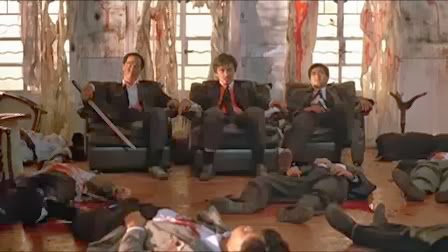
A Better Tomorrow was a massive hit for the Cinema City studio, director John Woo and the film’s producer and co-writer, Tsui Hark. As such, a sequel was inevitable. But almost immediately problems began. Chow Yun-fat’s character had died at the end of the first film, but a sequel without the man who’d become the biggest star in Hong Kong was unthinkable. So, of course, they decided his character Mark had a twin brother that nobody bothered to mention in the first film. The film is most horribly marred though by a new character, a former Triad gone straight named Lung and played by Dean Shek (a comedian and one of the founders of Cinema City). After Lung is betrayed by one of his underlings, Shek goes crazy and ends up in an insane asylum, where he is found by Mark’s twin brother Ken who nurses him back to health in tedious and endless scenes where Shek refuses to eat. Shek’s performance in these scenes is abysmally broad, so much so that it out-balances his later scenes, when he’s returned to his apparently bad motherfucker real self. The film’s most bizarre food-related scene, though, is a notorious one in which Ken, a restauranteur in New York, is shaken down by some mafia hoods and harangues them in badly-dubbed English, with Chow giving his loudest DeNiro impression while the dubber channels Pacino (note that since I wrote this in 2013, I’ve read that this scene is entirely performed by Chow and not an anonymous voice actor, but I don’t know that I believe it). (The best part of the scene is at the end, where a cop shows up, sees Ken trying to force the mafia guys to eat some rice at gunpoint and tells the hoods, “You’d better eat it!”)