Episode 5: A Brighter Summer Day, SPL 2 and Purple Rain

A-Brighter-Summer-Day1

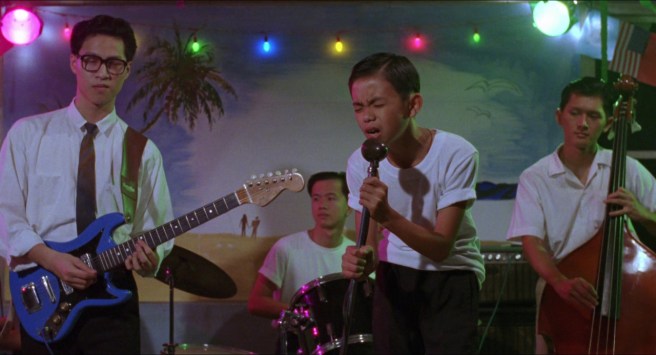
With Mike on vacation this week Sean is joined by Seattle Screen Scene writer Melissa Tamminga to discuss Edward Yang’s long sought after 1990 epic A Brighter Summer Day, which has just recently been released by the Criterion Collection, and Soi Cheang’s action film SPL 2: A Time for Consequences, starring Tony Jaa and Wu Jing, which will be released here in the US as Kill Zone 2 in a couple of weeks. They also pick their essential Violent Youth films, take a look ahead to what’s coming soon to Seattle (and Bellingham) Screens and talk about Prince’s classic 1984 film Purple Rain.

You can listen to the show by downloading it directly, or by subscribing on iTunes or the podcast player of your choice.

Links:

Adrian Martin on Purple Rain

Rise of the Legend (Roy Chow, 2014)

rise_of_the_legend_still

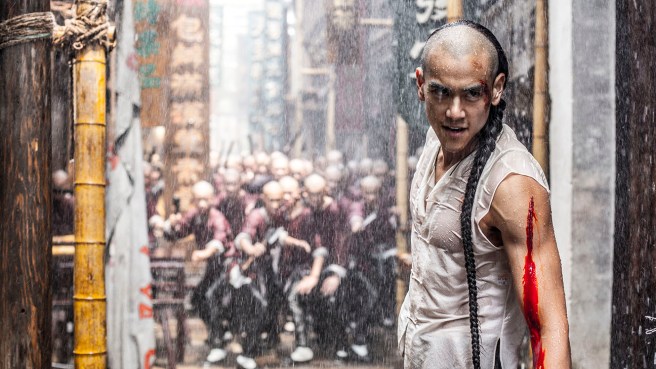
Every generation gets the Wong Fei-hung they deserve. A fin-de-siècle doctor and martial arts instructor, the real life Wong has been inspiring cinematic incarnations for most of the history of Hong Kong’s film industry. The first was in a series of productions running form the late 1940s to the mid 1960s, where Wong was played by Kwan Tak-hing as the embodiment of Confucian masculine values. Dignified, somewhat aged, even-handed and scrupulous, Kwan played Wong in an astounding 77 films (at least), between 1949’s The True Story of Wong Fei-hung: Whiplash Snuffs the Candle Flame and 1981’s Dreadnaught, which is some kind of a record. A generation of actors and stuntmen, choreographers and directors (most notably Lau Kar-leung and Yuen Woo-ping) got their starts training on the Wong Fei-hung films, which served roughly the same role for Hong Kong action cinema that Roger Corman’s exploitation films did for the New Hollywood. Lau Kar-leung put his twist on the character with Gordon Liu starring as a young student Wong in Challenge of the Masters in 1976 and as a somewhat older man striving after nonviolent resolutions to the deadly rivalries of the kung fu world in 1981’s Martial Club. Yuen Woo-ping and his father Yuen Siu-tien, who also worked on the Kwan Tak-hing series, upended the Wong Fei-hung mythos in 1978 with Drunken Master, in which a young Jackie Chan plays Wong as an impetuous, vulgar, undisciplined youth who is beaten into shape by the eponymous instructor (the elder Yuen), kicking of an era of irreverent kung fu comedy hybrids and launching Chan as a superstar. Tsui Hark revising the legend again in 1991 with his Once Upon a Time in China series, in which Jet Li played the hero with a mix of Kwan’s grace and nobility,  Chan’s youthfulness and Li’s own awkward romanticism. Now, Roy Chow gives us Rise of the Legend, with Eddie Peng playing Wong as a brooding, blood-spattered young warrior, desperately fighting against the nihilistic hell that is Guangzhou’s Pearl River Delta in the late 19th Century.

Continue reading Rise of the Legend (Roy Chow, 2014)”

It’s Already Tomorrow in Hong Kong (Emily Ting, 2015)

Emily Ting’s romantic comedy opens this week at the Varsity Theatre, but we saw it last fall at the Vancouver International Film Festival (The title has inexplicably misplaced its “It’s” since then, which we are choosing to ignore). Here’s what we wrote about it back then:

Sean’s Review:

Emily Ting’s It’s Already Tomorrow in Hong Kong is a different kind of fantasy, one of ex-patriates in Hong Kong and, more distressingly, of indie filmmakers weaned on Before Sunrise. Jamie Chung plays an American from Los Angeles (her grandparents emigrated from Hong Kong) lost in the city who runs into a fellow American named Josh. He’s the Joshiest Josh in film history, working in finance but really, an aspiring novelist. Actor Bryan Greenberg looks like the child of Michael Rappaport and John Krasczinski, but with even worse hair than that implies. He shows her around, lets slip way too late in the evening that he has a girlfriend and the couple splits. . . only to reunite a year later for another walk (once again hitting places best seen in Wong Kar-wai and Johnnie To films) and faux-naturalistic conversation (and a trip to a bar to see a Hong Kong knock-off of Arcade Fire, which is exactly as appalling as that sounds). After a century of Parisian dominance, it’s clear to me that Hong Kong is the most cinematic city in the world, and it certainly doesn’t let Ting down. The film is gorgeous, the bright lights of Hong Kong providing enough inherent pleasure that one is able to overlook the constructed obviousness of the script and the bland nothingness that is Greenberg’s performance. Chung fares better, her lines are just as generic but she sells them with big eyes and a world-saving smile. Pretty as the city is, it’s a problem when during the romantic climax of your film, the most interesting thing on screen is the multi-layered play of lights on a taxi cab window. Not even a cameo from the great Richard Ng can bring it to life.

Mike’s Review:

White guy living in Hong Kong meets an American woman of Chinese descent. The two hit it off but complications ensue when it is discovered they have other attachments. As a travelogue for the gorgeous city of Hong Kong, this works well enough, with depictions of the majestic skyline and bustling streets. As a romance or a comedy or a showcase for the art of acting, it is a failure.

From Vegas to Macau III (Wong Jing, 2016)

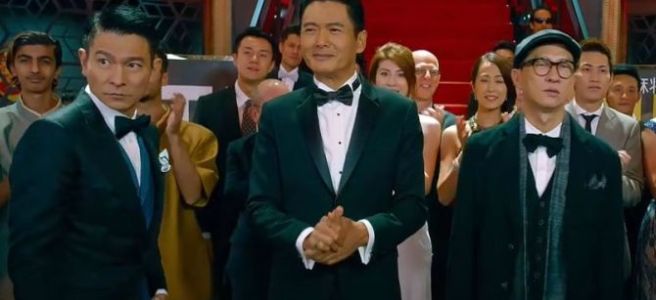
Relentless director Wong Jing’s latest farce has less of a plot than either of the first two films in the series, and is even less tethered to reality, in action, story, setting or character. It’s a bunch of shiny effects thrown at aged stars of the 90s, old movie and TV references (Chow Yun-fat spends awhile thinking he’s in Heaven Sword and Dragon Sabre, a ping-pong match with Jacky Cheung calling back to Johnnie To’s The Eighth Happiness, a little joke about Nick Cheung’s award-winning performance in Unbeatable, a whole sequence set in a prison with leftover costumes from Prison on Fire, even the central romance is Jacky Cheung’s unrequited love for Carina Lau, ala Days of Being Wild, etc etc*).

Of course the whole thing is a riff on the God of Gamblers series, with Chow playing a dual role as the original character and this newer farcical incarnation, kind of as if his amnesia-induced split personalities in that first film had developed into two separate realities. Andy Lau unites them (as he did the original series and Steven Chow’s parody of it), reprising his role as the Knight of Gamblers, but his performance bears no relation to that original character: he’s merely a vehicle for dumb slapstick jokes (a literal pie in the face, peeing baby robots) and inside jokes about Lau’s own career. It’s a movie that breaks into a song or an extended effects-driven bit of action, or a series of dumb mostly unfunny jokes at any opportunity. But there’s something liberating about Wong’s indifference to normalcy.

*Movie loses a half a star because the two dying robots didn’t crawl past each other like at the end of The Killer.

Ip Man 3 (Wilson Yip, 2015) and Monster Hunt (Raman Hui, 2015)

Ip-Man-photo-2

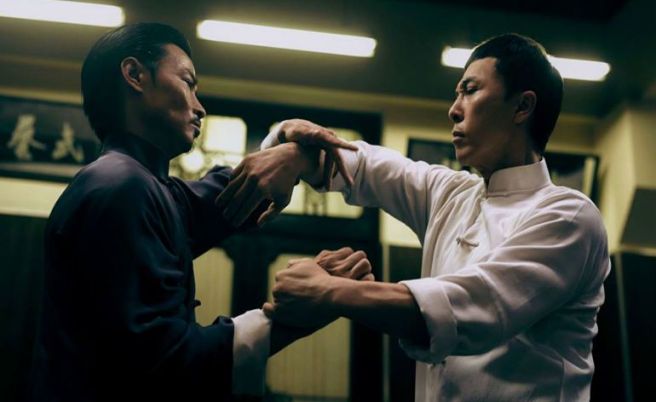
The disaporic film program at the AMC Pacific Place this week features two of the hottest Chinese-language films of the past year: the latest in Donnie Yen’s series about Wing Chun Master Ip Man and the CGI monster-wuxia that took the Chinese box office by storm last summer, breaking records on its way to becoming the highest-grossing local film in the Mainland’s history. The two films represent state of the art variations on the two oldest forms of the Chinese martial arts film, kung fu and wuxia tricked out with digital manipulations and effects, packed with enough celebrity cameos and show-stopping stunts to make even the most generic or implausible story a lot of fun.

Continue reading Ip Man 3 (Wilson Yip, 2015) and Monster Hunt (Raman Hui, 2015)”

Office (Johnnie To, 2015)

office 4

The world of Office, the latest from director Johnnie To, is a world without walls. Or, rather, a world where walls do nothing to differentiate space. It’s hard to tell where one place begins and another ends. Each scene takes place in a largely artificial environment where geometric figures and shapes suggest the outline of a room; this strategy essentially means that at any given moment there’s tons of action happening on multiple planes of the frame. Whether it’s a hospital room, a character’s apartment, there is no personal space. There’s only a series of transparent chambers where only emotional/financial transactions can take place.

Chow Yun Fat plays Chairman Ho. While his wife is in a coma, he’s been having an affair with CEO Chang for the last 20 years (played by Sylvia Chang, the film is an adaptation of her 2009 play, Design for Living), and his daughter, Kat, is now working at an entry-level position to gain knowledge of the business. One of his underlings tries to get an accountant to cook the books. Meanwhile Lee Xiang, played by Wang Ziyi (Lee for Ang Lee, Xiang for Dream – aspirational!), also starting at the company, just wants to make a good impression, achieve his dreams and ride that direct elevator to the 71st floor. The film uses all of them to explore certain attitudes and ways of living in capitalist society by testing their bonds after the 2008 crash.

Continue reading Office (Johnnie To, 2015)”

Princess Chang Ping (John Woo, 1976)

Clipboard04-17

Before he hit it big with 1986’s A Better Tomorrow, John Woo was a journeyman director for hire on the margins of the Hong Kong film industry. He worked mostly in slapstick comedies such as the Chaplin homage Laughing Times with Dean Shek, or the hit Ricky Hui film From Riches to Rags, along with a handful of action films in the established kung fu and wuxia genres, most notably his 1973 debut The Young Dragons and 1979’s Last Hurrah for Chivalry, which is in many respects The Killer with swords instead of guns. One of his oddest films during this period was a musical made for the Golden Harvest studio in 1976, Princess Chang Ping, which plays this week in Scarecrow Video’s Screening Lounge.

Clipboard02-17

Based on a 1957 Cantonese opera that was itself based on historical events from the late Ming Dynasty (the mid-1600s) and starring actors from an actual opera troupe, in performance it is wildly theatrical, translating the gestural and recitative stage tradition to the big screen. The structure is theatrical as well, made up of long scenes set in a single location, with the actors coming and going developing the plot in song. The first twenty minutes takes place entirely in one throne room location, establishing the romance between the eponymous Princess, daughter of the Ming Emperor, and a young courtier named Chow Shih-hsien. In full view of the court, he woos her with wit and wordplay, a Shakespearean exchange that marks them both as outsiders in the restrictive court world and demonstrates their shared aesthetics and belief system. Things are going well, when Woo, in a shocking cut, throws us outside the palace as cannons roar and the rebels are closing in: the Manchus are about to bring the dynasty to an end. The break in location is more than just a jolt of explosion: it’s a blast of reality into the highly ritualized world of court culture, an intrusion of violence into the ultra-civilized.

Clipboard03-17

This sets up the first of several Woovian dilemmas, conflicts between moral codes that drive so many of his later films. The Emperor, rather than let them be taken alive, orders his wives and children to kill themselves before he does the same. The older women do so, with much wailing, but Chang Ping herself doesn’t want to die (she’s just found a guy that really understands her!). In a rush, her father resolves to do it himself (for her own good) and draws his sword (here the play differs from history: according to tradition, the Emperor severed her arm. In one version of the tale, she becomes a martial artist and leader of the anti-Manchu resistance, known as the One-Armed Divine Nun). Merely scratched, the princess survives and goes into hiding. One day, the prince (he survived too, being haplessly knocked unconscious in a manner befitting a young scholar caught up in a battle), having assumed she had died, runs into her at a monastery. They rekindle their love affair, but soon more people discover her secret and she becomes a pawn in the remaining Ming elites’ attempts to ingratiate themselves with the new Qing Dynasty. Chang Ping and Shih-hsien confront the new Emperor (played by the same actor as the old Emperor), resolved to do the honorable thing regardless of what they must sacrifice to accomplish it.

Clipboard01-17

This is the progression of most of Woo’s best heroes. First an instantaneous connection with someone who shares their understanding of the moral universe (think of Chow Yun-fat with Danny Lee in The Killer and with Tony Leung in Hard-Boiled). In the gangster films its a shared Code, based on ideas of honor that go back centuries throughout martial arts literature. Such sparks dominant Woo’s career from his debut to his latest film The Crossing, where the connection is explicitly romantic. Eventually, in most cases, the connected pair will find themselves in a stand-off against the forces of the world at large, opportunistic villains motivated by greed or ambition some other base motive. Usually the result is a sacrifice of some kind, as one hero (or both) trade their life for the survival of innocents or simply to prove a point. Thus it’s easy to see why Woo would have been drawn to this story, as opposed to other popular opera films, say something like Li Han-hsiang’s Beyond the Great Wall, in which a Princess is used as a dynastic pawn in a Mizoguchian tale of the historical oppression of women. In Woo’s films, of course, the heroes are almost always men. Princess Chang Ping is a notable exception, especially when you consider that the prince Shih-hsien is also, in following Chinese operatic convention, played by a woman.

Clipboard05-16

The film isn’t as glossy or elaborate as the huangmei films the Shaw brothers specialized in before they shifted into martial arts movies (Li Han-hsiang films like The Love Eterne or The Enchanting Shadow) but as mid-70s Golden Harvest productions go, it’s pretty ornate (helped no doubt by the fact that it only has three or four sets). Woo’s camera moves fluidly, emphasizing the theatricality of the world and performances rather than reinforcing it to an alienating degree. He’s said it was one of his favorite of his early films, the one he had the most fun making and the joy is evident on the screen. Woo’s musicality is an underrated aspect of his film style, not just in the oft-stated relation between his balletic action choreography and the dance film, but simply in the way his best films use music to convey emotion, connecting events and people across space and time. This is the case here, as an opera film the music is inescapable, but also in the synth-pop soundtracks of his late 80s masterpieces and the lush Taro Iwashiro scores of his 21st Century epics. One of the weird things I’ve found in watching a rewatching a ton of Woo films in preparation for an upcoming episode of the They Shot Pictures podcast (should be out early next week) is that my enjoyment of his films is almost directly proportional to my enjoyment of their scores. There might be a chicken and egg relation there, but who knows.

Princess Chang Ping plays Thursday, August 27 Only in the Scarecrow Video Screening Lounge.

A Better Tomorrow II (John Woo, 1987)

500full

The following is an adaptation of a review of A Better Tomorrow II I wrote for my website a couple of years ago.

A Better Tomorrow was a massive hit for the Cinema City studio, director John Woo and the film’s producer and co-writer, Tsui Hark. As such, a sequel was inevitable. But almost immediately problems began. Chow Yun-fat’s character had died at the end of the first film, but a sequel without the man who’d become the biggest star in Hong Kong was unthinkable. So, of course, they decided his character Mark had a twin brother that nobody bothered to mention in the first film. The film is most horribly marred though by a new character, a former Triad gone straight named Lung and played by Dean Shek (a comedian and one of the founders of Cinema City). After Lung is betrayed by one of his underlings, Shek goes crazy and ends up in an insane asylum, where he is found by Mark’s twin brother Ken who nurses him back to health in tedious and endless scenes where Shek refuses to eat. Shek’s performance in these scenes is abysmally broad, so much so that it out-balances his later scenes, when he’s returned to his apparently bad motherfucker real self. The film’s most bizarre food-related scene, though, is a notorious one in which Ken, a restauranteur in New York, is shaken down by some mafia hoods and harangues them in badly-dubbed English, with Chow giving his loudest DeNiro impression while the dubber channels Pacino (note that since I wrote this in 2013, I’ve read that this scene is entirely performed by Chow and not an anonymous voice actor, but I don’t know that I believe it). (The best part of the scene is at the end, where a cop shows up, sees Ken trying to force the mafia guys to eat some rice at gunpoint and tells the hoods, “You’d better eat it!”)

Continue reading A Better Tomorrow II (John Woo, 1987)”

The Heroic Trio (Johnnie To, 1993)

The-Heroic-Trio

Before becoming an renowned auteur, a favorite of critics and film festivals the world over, Johnnie To was known primarily in the West for the two films he made in 1993 in collaboration with director and action choreographer Ching Siu-tung. The Heroic Trio and Executioners star Michelle Yeoh, Maggie Cheung and Anita Mui as superheroes in a pre- and then post-apocalyptic Hong Kong, a wuxia Charlie’s Angels. Though he’d had a run of local hits, including back-to-back highest-grossing films of the years 1988 and 1989 (the ensemble farce The Eighth Happiness and the melodrama All About Ah-Long, respectively), none of his films managed to find much interest outside of Hong Kong, and his reputation, locally as well as abroad, was one of a competent professional filmmaker, subservient to the authorial personalities of his stars (Chow Yun-fat, Stephen Chow and Andy Lau) and producers (the gang at the Cinema City studio, where he worked alongside more accomplished peers such as Tsui Hark and Ringo Lam). But the prospect of beautiful women in sexy costumes flying around, doing weird shit and beating the hell out of people was enough to get the Heroic Trio films a home video release in the US, where more than 20 years later they remain among the most available of all of To’s films, standard content for streaming services. It was the first Johnnie To film I ever saw, I rented the old English-dubbed VHS from Scarecrow Video a long time ago. It plays tomorrow night in a definitely-better (hopefully subtitled) version in Scarecrow’s Screening Lounge.

Continue reading The Heroic Trio (Johnnie To, 1993)”

Wild City (Ringo Lam, 2015)

wildcitymovie

After more than a decade of semi-retirement, legendary director Ringo Lam returns to the big screen with a thriller that hearkens back to the golden age of the Hong Kong crime film. Lam made his mark in the late 80s and early 90s with a series of action films, gritty, ultra-violent and grounded in a darkly pessimistic view of human nature and Hong Kong’s future, movies where everything seemed to be, as many of their titles indicate, ‘on fire’. Rejecting the aspiration toward transcendence of John Woo, or the narrative and thematic ambition of Tsui Hark, Lam’s films best captured the nihilistic urge for chaos at the heart of the Hong Kong New Wave. That particular moment, an apocalyptic age when the prospect of the Handover to the Mainland hung over every aspect of Hong Kong life, had dissipated by the late 90s, when Lam had joined Woo and Tsui in scraping together Hollywood products beneath their talent level (as fine as many of their American films are, and many of them are quite good, I don’t think this point is debatable). When he tired of that, he walked away to spend more time with his family. His only film since the 2003 direct-to-video Van Damme film In Hell was one third of the omnibus film Triangle made with Tsui and Johnnie To in 2007.

Continue reading Wild City (Ringo Lam, 2015)”