The Death of Stalin (Armando Iannucci, 2017)

OZY5SB2XP5DWBMLWOQPNI3YX7Y

Armando Iannucci is, if nothing else, the defining political comedian of our era. The anti-Aaron Sorkin, he understands that politics is about power, and nothing else. His lying, manipulative, vulgar, grasping, venal, and above all stupid bureaucrats, officials, advisors and other governing detritus barely even pay lip service to the ideals and ideology valorized in the word of the last era’s most celebrated propagandist, Aaron Sorkin, and Iannucci, with his television series The Thick of It and Veep and his film In the Loop, seems to have dedicated himself to undermining and unraveling all the myths and delusions of propriety, fair play and principled centrism that The West Wing perpetuated. I don’t know that the functionaries of Iannucci’s work are any more “accurate” than Sorkin’s heroes and heroines, but they seem like it. And in their degradation they certainly speak more to the present moment than the earnest ideologues of neo-liberal technocracy. That Iannucci can so deftly translate his style from the world of contemporary American politics to that of Soviet Russia should tell us a lot about what politics truly is: games of manipulation performed by the vile, the scheming and the moronic for the sake of self-preservation and, above all, power.

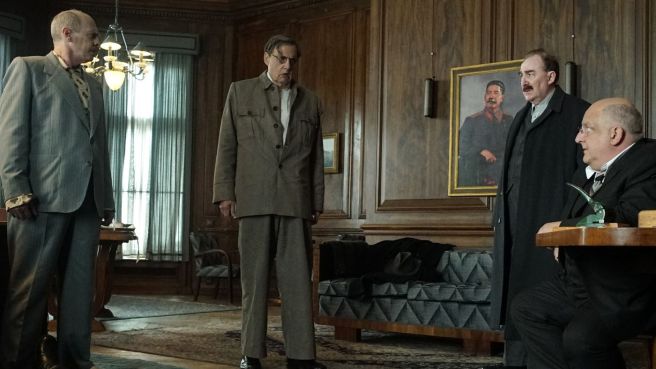
The Death of Stalin, based on a French graphic novel, begins on the last day of the Russian dictator’s life. He eats a big meal with his closest advisors: Khrushchev (Steve Buscemi), Beria (Simon Russell Beale), and Malenkov (Jeffrey Tambor), watches a Western (I couldn’t tell which one, but they toast Wayne and John Ford at the end of their boozy night) and, left alone in his room, suffers a cerebral hemorrhage. He’s not discovered until the next morning and, because he’d recently killed or exiled all the best doctors in Moscow, he’s unable to receive medical attention until it’s too late. The delay is exacerbated by the scheming of his advisors, most of whom are more than willing to let the man die: as soon as his condition is discovered Beria and Khrushchev begin their plotting, a race to secure the support of the various other members of the inner circle and the various state security forces. Beria, as head of the secret police (called the NKVD at this point), has the initial advantage, and is able to manipulate Malenkov (a fool in most things and especially devoted to Stalin: a pointed reminder that in a totalitarian state the only officials who survive long enough to attain any kind of importance are either evil or stupid or both), who as Stalin’s deputy becomes the titular ruler in his absence.

The scramble for control between Khrushchev and Beria is greatly accelerated in time: events that here transpire over only a few days in fact took about six months, but while the film certainly takes liberties with historical fact, in its essence it is accurate. A host of fascinating side characters fill out the world, the overwhelming sense of terror and irrationality and double-thinking inherent in the Stalinist state. Olga Kurylenko plays the pianist Maria Yudina, whose defiant note to Stalin (included in a concert recording, the apocryphal story of which opens the film) may have killed him. Michael Palin plays Molotov, a longtime Stalin ally who had been marked for death but is rescued by the dictator’s demise, who nonetheless sticks to the Stalinist party line (Palin gives maybe the best performance in the film, and Molotov is its most dizzying character, a cruel man driven mad by even greater cruelties). Jason Isaacs appears late in the film as General Zhukov, bedecked in a lunatic assembly of medals, who comes to Khrushchev’s aid. But the Beria/Khrushchev conflict is at the film’s core: Beria tries to consolidate power by appearing to overthrow the “excesses” of Stalinism, positioning himself as a reformer while merely switching out one list of enemies for another. Khrushchev, on the other hand, actually is a reformer (well, relatively speaking), and while he (apparently) lacks Beria’s most vile qualities (in addition to all the murders, Beria was a perpetrator of just about every sex crime you can imagine) he has no qualms about exercising any means necessary to achieve his goals.

The Death of Stalin is deeply, darkly funny at almost every moment, like all of Iannucci’s work. Whether in the petty infighting and reversals of the Soviet leaders, to minor side-plots like the comic opening sequence with the fear and panic of the Radio Moscow technicians when Stalin requests a recording of a concert that was broadcast live, forcing them (led by Paddy Considine) to regather the audience and musicians to play the whole thing again, or the desperate scrambling of Stalin’s children, suddenly pawns in a greater game they are wholly unequipped to play (the son’s coaching of the state hockey team is especially funny), or more terrifying background action, like the cold brutal efficiency in which everyone in Stalin’s household is rounded up and shot by the NKVD. It’s an absurdist world where there are literally no moral or ideological values, and only the people who actually understand that truth are able to achieve power.

Grass (Hong Sangsoo, 2018)

Grass-Kim-Min-Hee

Evan Morgan: Let’s start with the title. Hong arguably crafts the best titles of any filmmaker working today: something like On the Beach at Night Alone is tinged with mystery, poetical and allusive. Grass, on the other hand, sounds quite atypical: earthy, prosaic, direct. Critical writing on Hong often runs the risk of devolving into a game of spot-the-differences (full disclosure: it’s a game I like to play) but this title, which initially seems uncharacteristic, continues a certain tendency of Hong’s: to telegraph to his audience, quite literally, which objects will exercise a totemic effect on the film, objects that can shape and reshape the narrative. Claire’s Camera, Oki’s Movie, On the Occasion of Remembering Turning Gate. So why, then, Grass? The film does open with some kind of potted shrub, though it quickly moves to the interior space of nearby café. At one point, a few characters wander over to crouch down near the plant, though nothing much is made of it. It does make one final appearance after the credits roll, but it never takes center stage quite like those other objects. Whatever power it exerts over Hong’s narrative is merely suggestive, lacking the obvious metaphorical potential of, say, Huppert’s camera. The title speaks, rather modestly, of things that grow, of fecundity and naturalness and finally—dare I say—of a kind of utopia.

We’ll get to where Grass ultimately ends up, I’m sure, but let’s linger on the road for a while—and a verdant lane it is not. The film is haunted by at least two deaths (more on that later too), and is, for much of its short runtime, a rather cruel work.

Sean Gilman: I do think there’s something to the title. Initially I thought of Whitman, the source as well of the title for On the Beach at Night Alone, especially when you mentioned to me that the Korean version of the title more directly translates to “Grass Leaves”. Whitman apparently chose Leaves of Grass as the title of his life’s work, continuously revised, as a pun. Quoting wikipedia quoting someone else: “”Grass” was a term given by publishers to works of minor value, and “leaves” is another name for the pages on which they were printed.” Hong’s Grass too is made up of stories of seemingly minor value, exchanges and conversations that are variations on theme Hong has been working with for over twenty years now, losing some value perhaps in their repetition.

But I also think about the title in relation to Carl Sandberg and his poem of the same name. That poem is specifically about death, about the dead men of Austerlitz, Waterloo, Gettysburg and Verdun, shoveled under and covered by grass.  The final lines I think give a new perspective to our Hongian short stories, perhaps shedding some light on Kim Minhee’s role in the film:

Two years, ten years, and passengers ask the conductor:
What place is this?
Where are we now?

I am the grass.
Let me work.

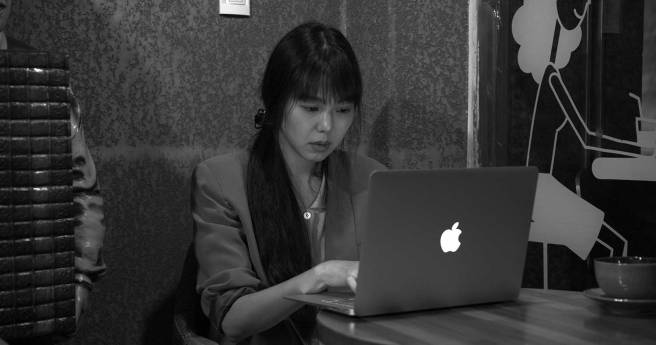
Kim sits in her café, like us overhearing various Hongian conversations, about love gone wrong and suicide and horny actors trying to convince women to let them stay with them for a few days. She takes in the stories and writes. . . something. We don’t know what. She could be writing the characters themselves (twenty years of Hong has taught us to expect that kind of thing) or she could just be writing what she thinks about them. Or she could be inspired by their stories to create new ones of her own. She covers them all, if they’d just let her work.

I suppose I’m getting ahead of where we should be in trying to review this film, but it’s such an unusual work that it’s hard to talk about it as a linearly progressing narrative. It has that, a story of a day in the life of a café and the people who hang around there, each with their own little story arc and unique interaction with Kim’s own. It’s basically a network narrative, along the lines of Robert Altman, but Altman’s cynical coldness (which Hong adopted frequently, especially in his early work) is leavened by the film’s raw emotionality and its omnipresent score, dominated by long stretches of the lush romanticism of Schubert and Wagner. In its circularity, an essential feature of Altman’s network stories (and as opposed to, say, Richard Linklater’s), the film invites increasingly mystical readings. The café could be a way station in the afterlife, it could be a fictional construct of a writer dealing with her own issues (perhaps she had a friend or lover recently commit suicide?), or it could just be an ordinary café. As is usual with Hong, I end up deciding that it is all those things (and more) at the same time.

EM: I like the idea of the café as afterlife, and in that way your citation of Sandberg might not be so far off. There’s a telling line of dialogue that really stuck out to me. The oldest actor, who appears to be recovering from a deep bout of depression, mentions an attempt to take his own life: “After my suicide I didn’t drink much.” It could be a consequence of translation, but to me the particular phrasing implies that the man who speaks the line might already be dead. But, as you suggest, Hong is too protean an artist, too resistant to metaphor, to allow for a reading that thuddingly literary. To allude to Whitman again, there are always multitudes.

In a great interview that CinemaScope ran a few years back, Hong drew a weird little sketch with the caption “infinite worlds possible,” and though he’s played with repetition and narrative branching before, I do wonder if Grass realizes that principle most fully: instead of his oft-used this-then-that structure, which is multivalent but still fundamentally linear, Grass seems to hover between worlds, never committing to one or the other. The overwhelming sense here is one of simultaneity. I’m thinking of something as simple as that first pan from the couple in the café to Kim, who is also in the café but near the window, just off-screen. The way Hong shoots the interior of the café prevents us from obtaining a complete understanding of the space: it’s always segmented into this table or that table, this couple or that couple. So when he initially cuts from Kim contemplating her writing to a man and a woman speaking, one naturally assumes that these are her fictional creations, that we’ve moved onto a different narrative plane. But after a few minutes of chatter, Hong casually tracks over to Kim, and two worlds, previously understood to be apart, are fused together. When taken in combination with the wall-to-wall music (which I’m glad you mentioned; it’s integral to the emotional texture of the film) moments like this create a sense of the film rising and converging, a crescendo effect prolonged until the final moments.

That effect is also an essential feature of the network film: the movements of a dozen roundelays suddenly clicking together. Though I wasn’t thinking of Altman. The Rivette of Haut bas fragile and Va savoir came to mind: actors swirling around a central location, lives bleeding into fiction, and the bar or café transformed into a theater (what is a writer doing in a café if not performing the act of writing?). And there’s nothing more Rivettian in Hong’s body of work than that sequence which comes about halfway through Grass, where one of the women appears to achieve some kind of breakthrough (or maybe it’s a breakfrom: from the network of couples, from the café, from the fiction) by traversing a staircase over and over again. She begins the scene frustrated but ends, after much physical exertion, elated and smiling. In its trajectory from anger to some kind of bliss, it functions as a perfect synecdoche for the film.

SG: You know I love that sequence, one of the most singular in all of Hong’s work. Like the piggyback ride in Hahaha it’s a wholly unexpected physical expression of an unnameable feeling, but even more abstract, because we know so little about that woman. We’d met her earlier: she’s a writer with whom the director from Claire’s Camera is hoping to work. They form the third of the three couples we meet in the café. She rebuffs his advances, and he moves on to make a similar offer to Kim herself (the first character to actually interact with her), while the writer goes away (she says she has to meet. . . her boyfriend? I forget). We don’t see her again until sometime later, after the events in the restaurant, right? In that strange interlude after the mood of the film has turned its sourest (the interrogation scene and Kim’s fight with her brother)? But then, with her repeated climbing and descending, as her mood changes so does that of the film. Kim undergoes something similar: walking back to the café she hears a song, some kind of folk pop song coming from somewhere. She walks past and it diminishes, then she walks back toward it and it grows louder. We don’t know what happens next, Hong elides it, but when we’re back in the café everything has changed. It’s like the movie is wholly uninterested in traditional narrative trajectory (the this-then-that you refer to), rather trying to capture the rising and falling (and vice versa) feeling of music itself. Never has a Hong film been so structured by mood.

At the same time, its building blocks are the typical Hongian games of repetition. All three men in the café are actors, though at different stages of life and career. Three women are asked by a man if he can live with them for awhile. There are three suicides, two successful (or maybe three, if this is the afterlife). There are three writers (counting Kim). All the conversations are standard Hong table shots, except one. That one, what I’ve been calling the “interrogation scene”, is one of the more intense conversations of Hong’s career, as raw as the opening fight in Yourself and Yours but much more cruel. It’s not a table shot, but rather a long over-the-shoulder one of a man questioning a woman he thinks contributed to their mutual friend’s suicide (by inducing him to drink too much). The camera holds on her face for a long time, we never see his. But the most unusual thing is when it pans away from them to the wall, where we see the man’s shadow speaking while any trace of the woman has been erased. It may be the most horrifying thing Hong has ever shot, and that’s including the bloody finale of The Day a Pig Fell Into the Well.

EM: Why is that “interrogation scene” so upsetting? The narrative material is well-trod ground, so it must be a consequence of that pan to the wall that you highlight, which is almost a mirror image of the earlier pan to Kim in the café: instead of fusing two worlds, it tears them apart. A form of erasure, as you suggest. Or maybe it’s that over-the-shoulder framing: at some point in the movie one of the actors jokes that “it feels like we’re being observed” and there’s a way in which Hong’s constricted compositions throughout amplify the general air of surveillance. The “standard table shot” you refer to typically balances the performers across the center of the frame. Hong isn’t aiming for Premingerian objectivity, I don’t think, though his customary approach deploys none of the film grammar that typically signals perspective either. But this film does. Given Kim’s role as outsider looking in, as a potential artificer weaving fiction from what she sees, the film’s attention to the act of watching—and being watched—seems essential to its final purpose.

Which brings me back to my claim that Grass arrives, ultimately, at a place of renewal. The network of couples end up back in the café—or just outside, in the case of Kim’s brother and his girlfriend—for another night of reminiscences. Kim initially hovers back, as she has done throughout, apart and alone, but after sharing a smoke outside with one of the men, she finally joins the group. The writer brought back into the fold of life. Grass features, arguably, more plot than any Hong since the ‘90s. But all the incident is there just to bring us to this one moment: inviting Kim to join in on a classic Hong table shot. Only Hong could conceive of a movie in which something as simple as sitting down at a café table seems to lighten the weight of all the world’s loneliness.

Friday March 9 – Thursday March 15

Featured Film:

Before We Vanish at the Grand Illusion

We didn’t get the great Japanese director Kiyoshi Kurosawa’s last feature, the moody French mystery Daguerrotype, which only came out on DVD. But the Grand Illusion has his latest, an alien invasion film about an advance team of extra-terrestrials taking human form and attempting to learn all they can about people by telepathically removing certain concepts from our brains. Genuinely weird and off-beat, it’s equal parts satire and sap, and a lot more besides.

Playing This Week:

Ark Lodge Cinemas:

Terrifier (Damien Leone) Thurs Only

Central Cinema:

The Great Muppet Caper (Jim Henson, 1981) Fri-Tues
Set It Off (F. Gary Gray, 1996) Fri-Tues

SIFF Egyptian:

A Fantastic Woman (Sebastian Lelio) Fri-Mon, Weds & Thurs

Century Federal Way:

Laung Laachi (Amberdeep Singh) Fri-Thurs

Grand Cinema:

Film Stars Don’t Die in Liverpool (Paul McGuigan) Fri-Thurs
The Party (Sally Potter) Fri-Thurs
Animation Show of Shows (Various) Tues Only
The Women’s Balcony (Emil Ben-Shimon) Thurs Only

Grand Illusion Cinema:

Before We Vanish (Kiyoshi Kurosawa) Fri-Thurs Our Review
November (Rainer Sarnet) Fri-Thurs
Blond Fury (Various) Sat Only VHS
Saturday Secret Matinee: Atomic Monsters Sat Only 16mm

Cinemark Lincoln Square:

Sonu Ke Titu Ki Sweety (Luv Ranjan) Fri-Thurs
Ye Mantram Vesave (Shridhar Marri) Fri-Thurs
Pari (Prosit Roy) Fri-Thurs
Aamhi Doghi (Pratima Joshi) Sun Only
Tagaru (Duniya Soori) Sat & Sun Only

Northwest Film Forum:

Western (Valeska Grisebach) Fri-Sun Our Review
Above & Beyond: Giving Up the Day Job (Paul Dugdale) Fri-Sun
Kagemusha (Akira Kurosawa, 1980) Sat Only 35mm, Members Only
Vintage: Families of Value (Thomas Allen Harris, 1995) Sat Only
12 Days (Raymond Depardon) Weds & Thurs Only
Did You Wonder Who Fired the Gun? (Travis Wilkerson) Starts Thurs

AMC Oak Tree:

Operation Red Sea (Dante Lam) Fri-Thurs Our Review

AMC Pacific Place:

Detective Chinatown 2 (Chen Sicheng) Fri-Thurs Our Review
Operation Red Sea (Dante Lam) Fri-Thurs  Our Review

AMC Seattle:

The Party (Sally Potter) Fri-Thurs

Seattle Art Museum:

Persona (Ingmar Bergman, 1966) Thurs Only

SIFF Film Center:

Big Time (Kaspar Astrup Schröder) Fri Only
Step Up to the Plate (Paul Lacoste, 2011) Weds Only

SIFF Uptown:

Animation Show of Shows (Various) Fri-Thurs
2018 Oscar Nominated Animated Shorts (Various) Fri-Thurs
2018 Oscar Nominated Live-Action Shorts (Various) Fri-Thurs
The Party (Sally Potter) Fri-Thurs

Varsity Theatre:

Submission (Richard Levine) Fri-Thurs

In Wide Release:

Annihilation (Alex Garland) Our Review
Black Panther (Ryan Coogler) Our Review
Fifty Shades Freed (James Foley) Our Review
Phantom Thread (Paul Thomas Anderson) Our Review
The Post (Steven Spielberg) Our Review
The Last Jedi (Rian Johnson) Our Review Our Podcast
The Shape of Water (Guillermo del Toro) Our Review
Lady Bird (Greta Gerwig) Our Review
Three Billboards Outside Ebbing, Missouri (Martin McDonagh) Our Review

Before We Vanish (Kiyoshi Kurosawa, 2017)

image-w856

The latest film from one of the most interesting directors in the world right now is playing at the Grand Illusion for week starting this Friday. Kiyoshi Kurosawa, director of such key Japanese horror films as Pulse and Cure, as well as award-winning dramas like Tokyo Sonatawas last seen here at SIFF in 2016 with Creepy, though his Daguerrotype was also released on VOD last fall. The new one is a science-fiction film about an alien invasion, and while its conclusion veers dangerously close to sappy, the path it takes to get there is anything but.

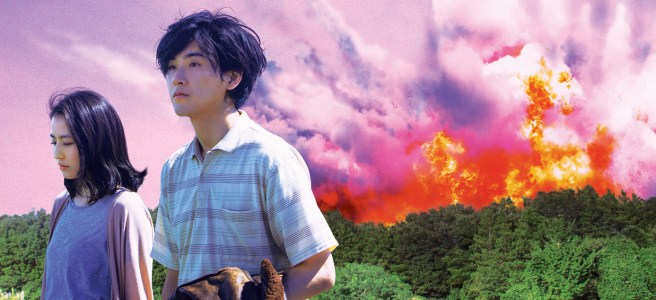
The aliens’ scout team consists of three “people” who take over the bodies of a trio of Japanese people: a teenage girl, a young man and an older married man. Before the invasion can begin, they have to learn everything they can about the people of Earth, but language gets in the way so the aliens have figured out a way to steal “conceptions”, the preverbal ideas which are the Platonic forms of things like “family”, “work”, “ownership”, etc, directly out of human’s heads. This has the unfortunate side-effect of completely removing the concept from the victim, leaving them forever without any conception of self or otherness or what have you.

In theory this amount to a kind of philosophical state of nature experiment, wherein you remove these basic ideas from our understanding of the world to see how we behave and what kind of society we’d build. The aliens have no understanding of these concepts until they take them, and we can see their behavior change when they learn what family is, for example, which ultimately contributes to their downfall. They enlist two “guides” along their way: the married man’s wife, who honestly likes him a lot better once he’s possessed by a malevolent creature from beyond the stars, and a tabloid journalist from a weekly news magazine, who agrees to help the aliens in hopes of staying alive long enough to thwart their plans, though his run-ins with the government forces pursuing the same goal and reexamination of his own life see him wavering in his loyalty to humanity.

Kurosawa’s direction is crisp and fluid, with snaking long takes, eerily upbeat music and unexpected cuts giving everything a comic, off-kilter vibe that meshes nicely with the film’s not quite satirical, not quiet earnest message. There’s even a healthy dose of violence and mayhem to keep things moving. A genuinely weird, light, and funny movie, a perfect tonic after all the dreary self-importance of recent Hollywood science-fiction.

I Was Born, But: Nobuhiko Obayashi and Japan’s Lost Children

Screen Shot 2018-03-01 at 11.37.58 PM

Nobuhiko Obayashi is most famous in this country for a film about a house that eats the young.

In Japan, Obayashi is known for his films that celebrate the laze and haze and promise of youth in its natural season, summer. These are his furusato—or hometown—movies, as he calls them: films conceived in close consultation with their locales, suffused with the particular light of a place or its singular air, where the action is as much determined by the ungainly curve of an ancient street as it is by the generic demands of the youth film. Familiar adolescent conflicts are there, and occasionally inflected with a touch of the supernatural—as in his great body swap comedy Exchange Students—but they are always enveloped and nurtured by the real communities in which these young people live. Summer is, then, Obayashi’s natural season too: when the heat ticks up childhood spills out into the streets, all the better for detailing the public spaces where communities educate their children through performance, ritual, and, most importantly for Obayashi, festivals. In His Motorbike, Her Island a young man falls in love on summer vacation, with an island first, a young woman second. When she takes him home, the joyous dancing at a local ceremony puzzles him. Isn’t this festival to honor the dead? Yes, she tells him. They dance for the people who were born, lived, and died on this island.

Continue reading “I Was Born, But: Nobuhiko Obayashi and Japan’s Lost Children”

Friday March 2 – Thursday March 8

Featured Film:

Legend of the Mountain at the Northwest Film Forum

One of King Hu’s very best films is playing this weekend only at the Northwest Film Forum. Less known than his major swordplay epics Come Drink With MeDragon Gate Inn or A Touch of ZenLegend of the Mountain was one of two films he shot in Korea and released in 1979 (the other being the Buddhist heist film Raining in the Mountain). It’s a ghost story about an itinerant scribe who is sent to an abandoned castle to work on copying a powerful sutra, one whose ability to control the spirits of the dead makes him the unwitting target of a gang of ghosts, led by the incomparable Hsu Feng, with only Sylvia Chang and a mysterious lama to protect him. This restored version presents the Director’s Cut, with almost 90 minutes more material than the original release. I reviewed it a few weeks ago, don’t miss it.

Playing This Week:

Ark Lodge Cinemas:

2018 Oscar Nominated Documentary Shorts (Various) Fri-Thurs
2018 Oscar Nominated Animated Shorts (Various) Fri-Thurs
2018 Oscar Nominated Live-Action Shorts (Various) Fri-Thurs
Life of Brian (Terry Jones, 1979) Fri-Weds
Monty Python and the Holy Grail (Terry Jones & Terry Gilliam, 1975) Fri-Weds  Sing-along

Central Cinema:

Enchanted (Kevin Lima, 2007) Fri-Mon
Frida (Julie Taymor, 2002) Fri-Mon

SIFF Egyptian:

A Fantastic Woman (Sebastian Lelio) Fri-Tues, Thurs

Century Federal Way:

Sonu Ke Titu Ki Sweety (Luv Ranjan) Fri-Thurs
Laavan Phere (Smeep Kang) Fri-Thurs
Nostalgia (Mark Pellington) Fri-Thurs

Grand Cinema:

The Young Karl Marx (Raoul Peck) Fri-Thurs
2018 Oscar Nominated Animated Shorts (Various) Fri-Sun
Mohawk (Ted Geoghegan) Sat Only
Human Flow (Ai Weiwei) Tues Only
The Living Fire (Ostap Kostyuk, 2015) Thurs Only

Grand Illusion Cinema:

Pow Wow (Robinson Devor) Fri-Thurs
The Insult (Ziad Doueiri) Fri-Thurs
Saturday Secret Matinee: Atomic Monsters Sat Only 16mm

Cinemark Lincoln Square:

Sonu Ke Titu Ki Sweety (Luv Ranjan) Fri-Thurs
Oscar Shorts (Various) Fri-Thurs
The Party (Sally Potter) Fri-Thurs
Padman (R. Balki) Fri-Thurs
Pari (Prosit Roy) Fri-Thurs
Raju Kannada Medium (Naresh Kumar) Sat & Sun Only

Regal Meridian:

Nostalgia (Mark Pellington) Fri-Thurs

Northwest Film Forum:

Legend of the Mountain (King Hu, 1979) Fri-Sun Our Review
In Between (Maysaloun Hamoud) Fri-Sun
Rebels on Pointe (Bobbi Jo Hart) Sat Only
Bill Nye: Science Guy (David Alvarado & Jason Sussberg) Fri & Sun Only
The Comedy Club (David C. Schendel) Weds Only Filmmaker in Attendance
Above & Beyond: Giving Up the Day Job (Paul Dugdale) Starts Thurs
Western (Valeska Grisebach) Starts Thurs Our Review

AMC Oak Tree:

Operation Red Sea (Dante Lam) Fri-Thurs Our Review

AMC Pacific Place:

Detective Chinatown 2 (Chen Sicheng) Fri-Thurs
Operation Red Sea (Dante Lam) Fri-Thurs  Our Review

Regal Parkway Plaza:

La boda de Valentina (Marco Polo Constandse) Fri-Thurs

AMC Seattle:

The Party (Sally Potter) Fri-Thurs
Nostalgia (Mark Pellington) Fri-Thurs

SIFF Film Center:

Big Time (Kaspar Astrup Schröder) Thurs Only Skype Q&A

Regal Thornton Place:

The Dark Crystal (Jim Henson & Frank Oz, 1982) Sat & Tues Only

SIFF Uptown:

Faces Places (Agnès Varda & JR) Fri-Thurs Our Review
2018 Oscar Nominated Animated Shorts (Various) Fri-Thurs
2018 Oscar Nominated Live-Action Shorts (Various) Fri-Thurs
The Party (Sally Potter) Fri-Thurs

Varsity Theatre:

Happy End (Michael Haneke) Fri-Thurs

In Wide Release:

Annihilation (Alex Garland) Our Review
Black Panther (Ryan Coogler) Our Review
The 15:17 to Paris (Clint Eastwood) Our Review
Fifty Shades Freed (James Foley) Our Review
Phantom Thread (Paul Thomas Anderson) Our Review
The Post (Steven Spielberg) Our Review
The Last Jedi (Rian Johnson) Our Review Our Podcast
The Shape of Water (Guillermo del Toro) Our Review
Lady Bird (Greta Gerwig) Our Review
Three Billboards Outside Ebbing, Missouri (Martin McDonagh) Our Review

Half Magic (Heather Graham, 2018)

Image from Half Magic

This movie has the best of intentions. As a message-delivery device, it could hardly be timelier, dealing as it does with misogyny and sexism in the film industry and beyond in the #MeToo era. Deep into America’s third wave of feminism (or at the dawn of its fourth, depending on who you ask), the film’s larger messages are praiseworthy and, sadly, still deeply relevant: In the public sphere, women’s personal freedoms and access to professional opportunities continue to be unfairly curtailed; in the private sphere, women’s dignity and senses of self-worth are still continually eroded; and in the sexual sphere, women’s pleasure in heterosexual relationships is still too often disregarded as too many men still prioritize their own satisfaction over that of their partners. Heather Graham, in her debut as writer and director of a feature film, is right to try to deliver these messages by whatever means she can.

Perhaps unfortunately for Graham, however, movies are (or should be) much more than message-delivery devices. Graham aims for comedy as her spoonful-of-sugar to help the medicine go down, but her movie’s uneven tone, dated gags, and strained performances cause the whole thing to feel so bogged down that the movie ultimately lands well short of success as either commentary or comedy.

Continue reading Half Magic (Heather Graham, 2018)”

Friday February 23 – Thursday March 1

Featured Film:

Cuban Cinema at the Grand Illusion

This week the Grand Illusion premieres the new restoration of Tomás Gutiérrez Alea’s 1968 Memories of Underdevelopment alongside a 35mm print of Mikhail Kalatozov’s I Am Cuba. I haven’t seen Memories yet, but it sounds phenomenal (“One of the greatest films ever made. As essential as cinema gets.” says Bilge Ebiri in the Village Voice.) But I have seen I Am Cuba, and I can for sure say it is one of the greatest films ever made. An episodic story about the lead-up to and the culmination of the revolution, it’s propaganda of the highest order, with Kalatozov and his genius cinematographer Sergey Urusevsky coming up with the craziest camera stunts you can think of, but all in service of a searing portrait of the people’s suffering and the glory of their ultimate victory. I don’t think it’s been seen here in Seattle since we played it at the Metro a decade ago. Don’t miss it this time.

Playing This Week:

AMC Alderwood:

Golden Slumber (Noh Dongseok) Fri-Thurs
Detective Chinatown 2 (Chen Sicheng) Fri-Thurs

Ark Lodge Cinemas:

Suspiria (Dario Argento, 1977) Fri-Thurs
The Lodgers (Brian O’Malley) Fri-Sun

Central Cinema:

Ghost in the Shell (Mamoru Oshii, 1995) Fri-Mon
Hackers (Iain Softley, 1995) Fri-Mon

SIFF Egyptian:

A Fantastic Woman (Sebastian Lelio) Fri-Weds
Kiki’s Delivery Service (Hayao Miyazaki, 1989) Sat Only Our Podcast

Century Federal Way:

Golden Slumber (Noh Dongseok) Fri-Thurs
Laavan Phere (Smeep Kang) Fri-Thurs
The Dark Crystal (Jim Henson & Frank Oz, 1982) Sun & Weds Only

Grand Cinema:

Concert for George (David Leland) Mon Only
2018 Oscar Nominated Documentary Shorts (Various) Tues Only
The Wedding Day (Lee Byungil, 1956) Thurs Only

Grand Illusion Cinema:

Memories of Underdevelopment (Tomás Gutiérrez Alea, 1968) Fri, Sun, Tues & Thurs
Scarecrow Video presents: Red Roses of Passion (Joe Sarno, 1966) Fri Only
I Am Cuba (Mikhail Kalatozov, 1964) Sat & Weds Only 35mm
The Insult (Ziad Doueiri) Sat, Sun, Mon & Thurs
Saturday Secret Matinee: Twisted Intrigues Sat Only 16mm
Have a Nice Day (Liu Jian) Sun-Tues Our Review

Cinemark Lincoln Square:

Sonu Ke Titu Ki Sweety (Luv Ranjan) Fri-Thurs
Awe (Prashanth Varma) Fri-Thurs
Welcome to New York (Chakri Toleti) Fri-Thurs
Padman (R. Balki) Fri-Thurs
Aiyaary (Neeraj Pandey) Fri-Thurs
Padmaavat (Sanjay Leela Bhansali) Fri-Thurs
The Dark Crystal (Jim Henson & Frank Oz, 1982) Sun & Weds Only

Regal Meridian:

Padman (R. Balki) Fri-Thurs

Northwest Film Forum:

Seattle Asian American Film Festival Fri-Sun Full Program
Rebels on Pointe (Bobbi Jo Hart) Weds & Next Sat Only
In Between (Maysaloun Hamoud) Starts Thurs
Legend of the Mountain (King Hu, 1979) Starts Thurs Our Review

AMC Oak Tree:

Operation Red Sea (Dante Lam) Fri-Thurs

AMC Pacific Place:

Detective Chinatown 2 (Chen Sicheng) Fri-Thurs
Operation Red Sea (Dante Lam) Fri-Thurs
Monster Hunt 2 (Raman Hui) Fri-Thurs

Regal Parkway Plaza:

Padmaavat (Sanjay Leela Bhansali) Fri-Thurs
La boda de Valentina (Marco Polo Constandse) Fri-Thurs
Concert for George (David Leland) Weds Only

AMC Seattle:

Film Stars Don’t Die in Liverpool (Paul McGuigan) Fri-Thurs
2018 Oscar Nominated Documentary Shorts (Various) Fri-Thurs
2018 Oscar Nominated Animated Shorts (Various) Fri-Thurs
2018 Oscar Nominated Live-Action Shorts (Various) Fri-Thurs

Seattle Art Museum:

Through a Glass Darkly (Ingmar Bergman, 1961) Thurs Only

SIFF Film Center:

Shut Up and Play the Hits and Wild Combination (Will Lovelace & Dylan Southern, 2012 and Matt Wolf, 2008) Thurs Only Double Feature

AMC Southcenter:

Detective Chinatown 2 (Chen Sicheng) Fri-Thurs

Regal Thornton Place:

Mary and the Witch’s Flower (Hiromasa Yonebayashi) Sat & Mon Only Our Review
The Dark Crystal (Jim Henson & Frank Oz, 1982) Sun & Weds Only

SIFF Uptown:

Faces Place (Agnès Varda & JR) Fri-Thurs Our Review
2018 Oscar Nominated Animated Shorts (Various) Fri-Thurs
2018 Oscar Nominated Live-Action Shorts (Various) Fri-Thurs
Boy and the World (Alê Abreu, 2013) Sat Only Our Review
Concert for George (David Leland) Sun Only

Varsity Theatre:

Half Magic (Heather Graham) Fri-Thurs
Curvature (Diego Hallivis) Fri-Thurs

In Wide Release:

Annihilation (Alex Garland) Our Review
Black Panther (Ryan Coogler) Our Review
The 15:17 to Paris (Clint Eastwood) Our Review
Fifty Shades Freed (James Foley) Our Review
Phantom Thread (Paul Thomas Anderson) Our Review
Hostiles (Scott Cooper) Our Review
The Post (Steven Spielberg) Our Review
The Last Jedi (Rian Johnson) Our Review Our Podcast
The Shape of Water (Guillermo del Toro) Our Review
Lady Bird (Greta Gerwig) Our Review
Three Billboards Outside Ebbing, Missouri (Martin McDonagh) Our Review

Annihilation (Alex Garland, 2018)

annihilation-3-copy

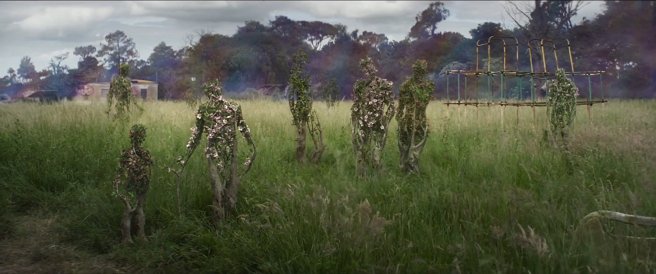
A sparkly meteor screams across the sky and crashes into a lighthouse. Three years later, Oscar Isaac shows up in Natalie Portman’s house. He’s her husband and has been missing for three years, is acting oddly and suddenly becomes very ill. On the way to the hospital, the two are captured and brought to a secret location, the edge of a shimmering wall of. . . something. Isaac escaped from the something and Portman heads into it, part of a team of women led by Jennifer Jason Leigh and including Tessa Thompson, Gina Rodriguez and Tuva Novotny. What they find in there is both easy to figure out (stuff is mutating), beautiful and scary and weird (stuff is mutating) and inexplicable (most of the why and a bunch of other side mysteries), explored in a mostly unsatisfactory blend of arthouse stillness and genre thriller scares, part of a burgeoning subgenre of sci-fi films that I suppose function as a counterweight to the more populist nonsense of superhero sc-fi. Director Alex Garland’s last film, Ex Machina, is a prime example, along with Jonathan Glazer’s Under the Skin, Denis Villeneuve’s Arrival (and his Blade Runner too, probably, I haven’t seen it) and so on. These films give an aura of respectability and complexity to an otherwise disreputable genre, and Annihilation is basically Predator for people who think Predator is dumb, but without any of the qualities that actually make Predator good (structure, pacing, action, coherence). Or Stalker for people who think Stalker is too arty and obscure.

While Annihilation is following its women on a weird mission plot, it’s mostly pretty good. The environment is new even if the situations are not: the group will of course be picked off one-by-one, either by unexpected creatures or their own tendency toward madness. Interspersed are flashbacks to Portman’s former life with Isaac, before he went on his mission into the unknown, which are mostly useless, designed to ground her character in the boring pyschology of Hollywood screenwriting convention, where women are only allowed to be motivated by something involving their role as wife and/or mother. These are actually flashbacks within a flashback, as the entire film is actually a dramatization of the story of her experience told by Portman to a team of radiation suit investigators led by Benedict Wong. How reliable a narrator Portman is, though, is not explored, potentially destabilizing the whole film, if not outright rendering the whole thing pointless. Is everything we’re seeing in her head, or is it what she’s telling Wong? Are the flashbacks real and the other stuff fake? Is she telling Wong about her relationship with her husband? Is it all phony, a story designed to satisfying her inquisitors but not actually the truth? I guess we’ll find out in the sequel? There are a lot of these little “mysteries” in Annihilation, things left unexplained that I suppose one could expend some brain energy trying to figure out, but I don’t know that it would be worth it, since the central mystery is both easily guessed and not that interesting, and it’s probably rendered moot by the film’s ending anyway. I’m curious about the tattoo that Portman and Rodriguez seem to share, for example, but I’d have to watch the movie again to try to solve it. But that’s probably not going to happen.

Black Panther (2018, Ryan Coogler)

t'challa

During the aftermath of a car chase in South Korea, Nakia (Lupita Nyong’o) cautions T’Challa (Chadwick Boseman), the newly-crowned warrior king of Wakanda and the eponymous superhero, warning him that “the whole world is watching.” It is a tempting and largely justifiable sentiment to apply to Black Panther, given both the lamentable societal state and the slightly more specific cultural moment. Though it is by no means the first film to have as its center a black superhero (as BAMcinématek’s excellent series demonstrated), it is the first of note since the rise of the juggernaut known as the Marvel Cinematic Universe in 2009. As a member of this alternately prestigious and dubious enterprise, its very existence brings along a whole host of expectations and baggage in terms of overall quality and, perhaps most crucially, representation.

That Black Panther is almost certainly the finest and most distinctive entry in the MCU is one bonus, but that it genuinely grapples with these issues and its particular place in modern society is another aspect entirely. The two are certainly linked, even down to the basic motivations of narrative, and the film’s ability to sublimate this and notions of culture within the loose template of a Marvel film is, at times, genuinely invigorating.

killmonger

Part of what distinguishes Black Panther is its deftness, its ability to locate character struggles within in a world that feels genuinely engaged with the present moment – in a way that does not simply kowtow to “The Way We Live” back-patting – even as it weaves its own fantasies. The main locus is Wakanda, a fictional African nation that conceals its status as the most technologically advanced country in the world, thanks to its virtually unlimited supply of a versatile metal known vibranium. As the film begins, T’Challa inherits the crown from his dead father, only to encounter the heretofore unknown Killmonger (Michael B. Jordan). A Wakandan hardened by his upbringing in Oakland, California, an extensive stint in the military, and his desire for vengeance, he seeks to usurp the new ruler and use the technological advancements of the country to trigger black uprisings against white-dominated governments around the world.

Such a description is certainly more grounded than the average MCU entry, but what is most curious about Black Panther is how it upholds and subverts its comic book origins. The decision to (pre-Marvel company credit!) open with a fantastical animated retelling of the origin of Wakanda and the Black Panther, only to move immediately into a crucial scene set in 1992 Oakland – complete with a plastic crate standing in for a basketball hoop – is an early indication, as is the bold fusion of old traditions and ceremonial wear with hypermodern landscapes.

Much of the credit for this uncharacteristic level of cultural engagement must go to director and co-writer Ryan Coogler, who appears from this effort to have a knack for negotiating his own sense of artistry within franchise efforts after both this and 2015’s Creed (although his direction here on the whole feels less balletic than in that film). But the efforts of the cast, which in itself represents a remarkable collection of black talent (from Daniel Kaluuya to Forest Whitaker to Angela Bassett to Danai Gurira to even Isaach de Bankolé), lend an immense vitality to the proceedings. Boseman and especially Letitia Wright (as his technical genius of a sister) are marvelous, but Jordan, who has appeared in all of Coogler’s films to date, is utterly magnetic, infusing his ostensible villain with genuine pain and swagger that makes his already sympathetic aims (if not sympathetic methods) become even more attractive.

Black Panther‘s spirit thrums with this continual back-and-forth, this negotiation of lore (both comic-book and tribal) and reality, personal motivations and pragmatism. I don’t have the knowledge or confidence to fully go into the occasionally questionable politics of the film, but suffice it to say that the radicalism of Killmonger is never simply undercut by the film, which continually questions Wakanda’s and its own position as the most exalted form of modern black representation. What seems to matter most at this particular moment is the film’s very existence, its ability to present customs totally outside of the mainstream with nothing less than total acceptance. (What the culture does with them is another matter entirely.)