Free Fire (Ben Wheatley, 2016)

free_fire_cast_3

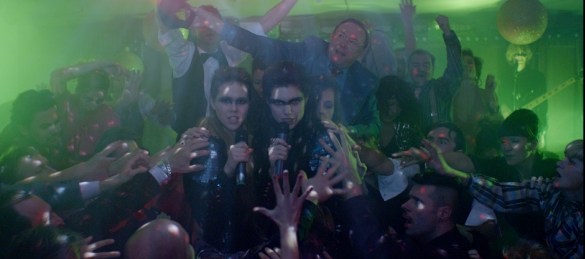
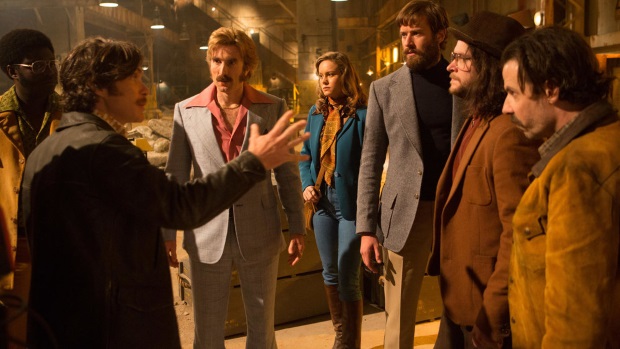
Ben Wheatley’s Free Fire is as pointless an exercise in nihilistic violence as Seattle Screens have seen in some time. For some reason it’s set in the late 1970s, as a representative of the IRA played by Cillian Murphy (The Wind that Shakes the Barley) attempts to buy machine guys at an abandoned factory in Boston. The deal has been put together by Brie Larson (Room) and Armie Hammer (The Lone Ranger), the latter unrecognizable in turtleneck and beard. The dealer is South African actor Sharlto Copley (Chappie), leading a gang of ruffians, one of whom got in a fight with one of Murphy’s gang of ruffians the night before. When the two men recognize each other, they begin fighting, someone pulls a gun and soon the two sides are, as they say, freely firing at each other. Later some other people will show up and start shooting at everyone, but no one, apparently, knows why. One person will survive, of course, but it doesn’t matter who, or why, or for how long, though the final shot manages the unique feat of cribbing from both Reservoirs Dogs and The 400 Blows.

Continue reading Free Fire (Ben Wheatley, 2016)”

Lost Highway ( David Lynch, 1997)

highway1

The following is adapted from a review I wrote back in 2007 for a David Lynch Blog-athon.

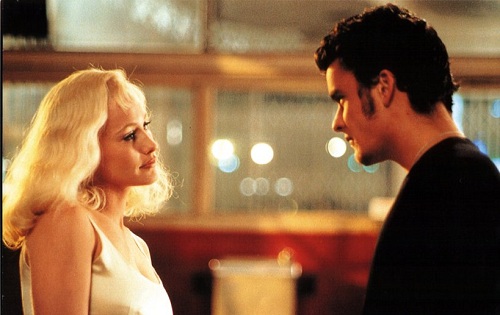
Bill Pullman plays a saxophonist who kills his wife (Patricia Arquette) because she was apparently cheating on him, and is so guilty over the murder that while in prison he goes insane and creates another reality for himself, one in which he’s a young mechanic (Balthazar Getty). Pullman’s fantasy world is something out of the 50s or early 60s of American Graffiti, with its car obsessions, pleasant suburban family, and the cute girl next door (Natasha Gregson Wagner). Unfortunately for Pullman, his subconscious won’t quite let him forget his crime, and soon Getty’s hanging around with a gangster (Robert Loggia) and his femme fatale girl (Arquette again). As in a typical film noir, Getty falls for the bad girl, conspires with her to commit some crimes (including a murder or two) and comes to a bad end.

Continue reading Lost Highway ( David Lynch, 1997)”

The Fate of the Furious (F. Gary Gray, 2017)

car crush

Especially in a time where franchises are getting only more complex, more bloated, it is interesting to consider the evolution of such a hugely successful movie series as The Fast and the Furious. Originally a comparatively “small” franchise focused exclusively on street racing, it has ballooned into an insane, globe-trotting mesh of spycraft and ensemble drama. I have only seen the previous incarnation of this series, Furious 7, but it is clear that the franchise has become much more (for better and worse) than its humble origins: from box office alone, Furious 7 grossed twice the amount of its predecessor, for more reasons than the untimely demise of franchise star Paul Walker.

So what step in the series’ evolution does The Fate of the Furious take? Quite simply, it doubles down on the core, car-fueled action. While the previous installment featured no small amount of hand-to-hand combat and gunplay (even bringing Tony Jaa for a fairly small role), Fate is, for better or worse, focused on races and chases. As a result, the movie more than delivers on the requisite amount of vehicular destruction across several countries and types of terrain.

Continue reading The Fate of the Furious (F. Gary Gray, 2017)”

Your Name. (Makoto Shinkai, 2016)

57d24a23a675e_1

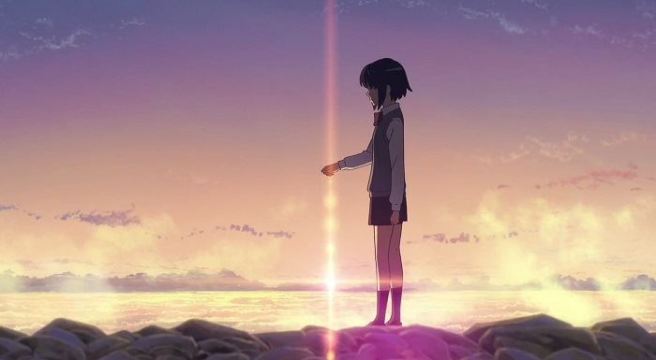
Makoto Shinkai’s latest anime smashed records across Asia last fall, becoming the highest grossing Japanese film in the history of China and Thailand, the second highest grossing Japanese film in Japanese history (behind Spirited Away), the worldwide top-grossing anime ever and the eighth highest grossing traditionally-animated film of all-time. Finally opening across North America this week, it has a chance to add to that record, and I think we’re all pulling for it to raise that extra $20 million it needs to overtake Pocahontas. Like his highly-acclaimed short features 5 Centimeters per Second (2007) and The Garden of Words (2013), it’s a story of two young people attempting to forge a connection. Romantically, yes, but also metaphysically. Apparently caused by the appearance of a comet close to the Earth, country girl Mitsuha and city boy Taki begin switching bodies: sometimes they wake up inhabiting the other, sometimes they don’t. They find this bewildering, of course, but eventually they figure out its rhythms and it turns out to be quite fun. And funny: Taki’s teenaged-boy obsession with his own (sort-of) breasts is perhaps the film’s truest note. Things reach a crisis point when the comet reaches its closest point and the body-switching ceases, sending each character in desperate search of the real-life other, complicated by the fact that they keep forgetting the other person’s existence.

Your Name. isn’t quite as other-worldly gorgeous as those two earlier films (they’re the only two other features I’ve seen from Shinkai), its combination of hand-drawn, computer and rotoscoped animation is a little more conventional, just as its plot and approach to narrative is a little more familiar. 5 Centimeters per Second was a trilogy of vignettes about a couple who loved each other once but where split apart by geography, and their attempts and failures to reconnect over a lifetime. The Garden of Words was about the Platonic love between a depressed teacher and a fifteen year old student. Your Name. unites these two in splitting its heroes in both time and space; human connection being so difficult that truly achieving it involves breaking the known laws of physics. The tragedy of the film comes from the loss of memory: human brains are unreliable and fungible, and the omnipresent devices we think make us more interconnected are even more fragile. Tradition and ritual though unite us with a past we cannot comprehend. Mitsuha is part of a long family line of makers of braided cords, who specially prepare a kind of saké as an offering for an unnamed god. They’ve forgotten the reasons for the rituals, but they perform them nonetheless. Where every other device of history and communication (cell phone, history book, museum photograph) fails, the braided cord, explicitly a metaphor for the dense and incomprehensible construction of space-time, persists.

Queen of the Desert (Werner Herzog, 2015)

queen_of_the_desert_523x2751

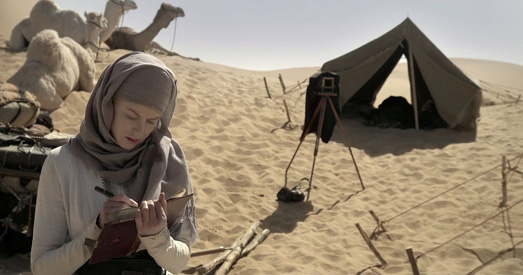
Werner Herzog’s biopic of British archeologist Gertrude Bell premiered more than two years ago at the Berlin Film Festival to poor reviews, and is only this week making its way onto American screens. Why this should be is not immediately clear, the ins and outs of which international art house films make it into domestic distribution is far too complex a matter for my mind to comprehend, but I believe it involves some combination of corporate nepotism, the star system and random chance. The stars in this case are what make the film worth watching, as Nicole Kidman can enliven even the deadest of features, and this might be her most heroic effort in that vein to date. There’s almost nothing of Werner Herzog in the film, though there might have been once: Bell superficially appears to be his kind of a hero, obsessed with a harsh landscape, driven outside the bounds of society to do something remarkable, but at nearly every level the film feels compromised. Herzog is the only credited writer, but this has all the hallmarks of a film written and edited by a committee.

Continue reading Queen of the Desert (Werner Herzog, 2015)”

Song to Song (Terrence Malick, 2017)

song-to-song_terrence-malick_rooney-mara_02

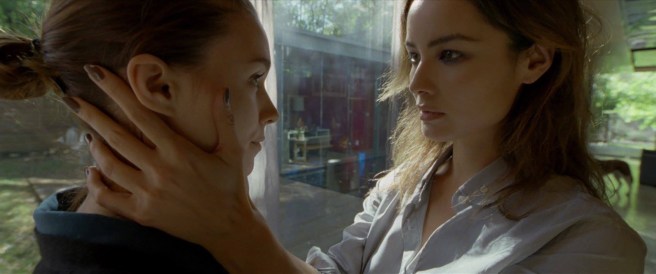
Making its way to Seattle last week for an unheralded run at the Pacific Place, then quickly dropped to a single show in town and shunted off to Tukwila’s Parkway Plaza was the latest film from the most singular artist working in mainstream American film today. As with every Terrence Malick film since his reemergence with 1998’s The Thin Red LineSong to Song has been met with baffled derision by much of what passes for the Hollywood intelligentsia, that dense Ouroboros of movie reviewers, Oscar bloggers and self-appointed box office gurus that pass as journalists in our debased world. The complaints are familiar, cheap and lazy, ultimately sourced in the fact that Malick doesn’t make movies like They expect movies to be made. Unable to conceive of possibilities beyond their narrow imaginations, his refusal to conform is viewed alternately as pretension or incompetence (see for example Christopher Plummer’s whining about Malick during The Tree of Life‘s Oscar campaign that Malick didn’t know how to edit films, a complaint (I believe, perhaps uncharitably) ultimately sourced in the fact that Malick cut out most of Plummer’s performance in The New World). Malick doesn’t make conventional movies, and it’s easier to snark about twirling and poetry (the nerve!) than it is to wrestle with what he does make.

Continue reading Song to Song (Terrence Malick, 2017)”

Personal Shopper (Olivier Assayas, 2016)

personal shopper

For a film as surprisingly dense and multi-faceted as Personal Shopper, it is first important to consider exactly what comprises the work. It is at once a subtle exploration of grief and a glimpse into the unknown, a thriller at times bordering on horror and a relentlessly lowkey experience that borders on parodying the cliches of a normal viewer’s notion of a French arthouse film, and a movie that both embraces and rejects what ultimately becomes the film’s driving principle: spiritualism. Yet it manages to reconcile these differences to some degree or another, and the credit must be given to two incredibly well-matched collaborators: director and writer Olivier Assayas and his new muse Kristen Stewart.

It should be noted that this is Assayas’s second film with Stewart, following his previous film Clouds of Sils Maria (2014). There, Stewart played the assistant and essential foil to Juliette Binoche’s veteran actress, but in this movie she stands alone, quite literally by herself for much of the narrative. Her character is Maureen, a personal shopper living in Paris for a diva model named Kyra who is often heard (through handwritten notes) but only seen in one short sequence. Maureen is also an amateur medium, introduced in the opening minutes wandering the home of her recently deceased twin brother in the hopes of receiving a sign from the other side.

Continue reading Personal Shopper (Olivier Assayas, 2016)”

Twin Peaks: Fire Walk With Me (David Lynch, 1992)

fire walk

Considering his cemented status in film culture as one of the great American directors, David Lynch has had a far more divisive, controversial reception from film to film, often for good reason. The cinephiles who mostly know him from his three most popular films Eraserhead, Blue Velvet, and Mulholland Drive (though even Eraserhead doesn’t fit neatly into the “most popular” designation) would likely be shocked to see the fragmentation of Lynch’s oeuvre, a nervy bundle of obsessions, hang-ups, and looming iconography that infects everything from the immensely straightforward (The Straight Story) to the near-abstract (Inland Empire). Speaking as an avowed Lynch fanatic, his movies always conjure an ineffable mix of pity, fear, and absolute awe within, but perhaps no film in his filmography illustrates that more hauntingly than Twin Peaks: Fire Walk With Me.

It is difficult to designate one film in such a contentious oeuvre in this manner, but it seems more and more apparent with each passing year that Twin Peaks: Fire Walk With Me is David Lynch’s ultimate film maudit. Infamously, it was booed viciously during its premiere at Cannes, and Quentin Tarantino declared that Lynch had “disappeared so far up his own ass”, a statement echoed by many during its initial release. It had sunk to the bottom of Lynch’s filmography, long regarded as the least of Lynch’s “uncompromised” works (which only leaves out his even more misunderstood adaptation of Dune) until recently, when it underwent a drastic reappraisal and is regarded by a small but vocal contingent as one of the legendary director’s finest works.

[SPOILERS FOR THE TWIN PEAKS SHOW FOLLOW]

Continue reading Twin Peaks: Fire Walk With Me (David Lynch, 1992)”

Yourself and Yours (Hong Sangsoo, 2016)

yourselfandyours_06

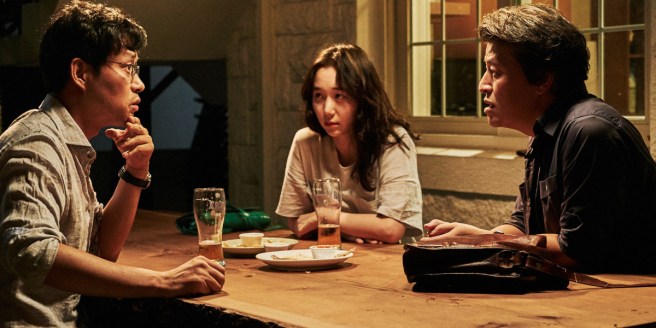
Yourself and Yours isn’t the latest film from South Korean director Hong Sangsoo, that would be On the Beach at Night Alone, which premiered a few weeks ago at the Berlin Film Festival (where it picked up a Best Actress award) and which Evan wrote about here last week (Evan has also written here about both Yourself and Yours and its trailer). Yourself and Yours may still come to Seattle Screens, Hong’s Right Now, Wrong Then played here last summer, almost a year after its festival premiere in 2015. It’s probable that if it does, it won’t be until after another new Hong movie plays the Cannes Film Festival, as his Claire’s Camera is rumored to be finished by that time. With a director this prolific (since taking a year off in 2007, Hong has directed thirteen feature films in ten years) it’s easy for a film here or there to get lost in the mix, especially given the lethargic pace at which films today move from the festival circuit to the theatrical art house. The system simply isn’t designed, at present, for a director who releases a new film every nine months. This isn’t unique to Hong (the similarly prolific Johnnie To has had equally haphazard distribution) nor is it unique to the present (take a look sometime at the distribution schedule of Jean-Luc Godard’s 1960s period). But don’t let these institutional vagaries obscure the fact that Hong is in the midst of one of the great cinematic winning streaks, a frenetic burst of creative energy that comes along only a few times in a generation. And Yourself and Yours, seemingly already forgotten though it premiered just six months ago, epitomizes the greatness of that streak as well as anything.

Continue reading Yourself and Yours (Hong Sangsoo, 2016)”

The Lure (Agnieszka Smoczynska, 2015)

the-lure-club

“What is that fishy smell?”

Agnieszka Smoczynska’s debut feature film functions as a pastiche of “The Little Mermaid,” but it comes to us by way of smoky cabaret clubs of a Warsaw in the 80’s, New Wave synthpop music videos, and the queasy glamour of capitalistic excess. It’s a gritty fairy tale of slyly telepathic sister-mermaids whose siren calls satisfy carnivorous tastes – until one sister falls in love with her prey, and their world and their sisterly bond begins to disintegrate.

It’s more grim Grimm than gentle Hans Christian Andersen: no swift and bloodless magic here, just buzzing grinding surgeon’s tools, human legs and mermaid tails on beds of ice. But the surgeon drunkenly dances and the mermaid sings until her voice wheezes dry, and I remember I always did prefer the intoxicating horror of Grimm to Andersen anyway.

Does it all add up to a fairy tale moral or even a thematically cohesive whole? I’m not sure it does, but it does fully commit to its individual scenes: carnal, sordid, crunchy, or sexy, and like the immersive quality of a vivid dream, its overall sensations linger, far into the waking hours.

 mermaid-on-ice

The Lure plays at Grand Cinema on February 24 and 25. 

(Note: This review is adapted from my notes on 5/25/16 on Letterboxd.)