VIFF 2016: After the Storm (Kore-eda Hirokazu, 2016)

6b2ee282-4e5c-11e6-ba91-9b331c0ddad9_1280x720

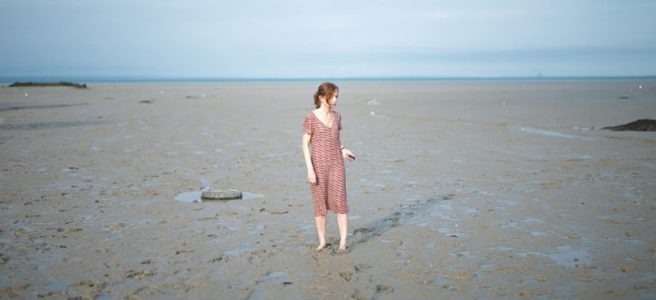
Beginning with a shot out of the canon, a small Japanese kitchen, mother and daughter at work, receding into the distance on the left side of the screen are a series of rectangular spaces, the right angles of doorways leading to doorways, director Kore-eda Hirozaku states his intention to work in the mines first exploited by Yasujiro Ozu in a series of domestic comedies and dramas from the 1930s through the 1960s. This seems to be Kore-eda’s increasingly preferred mode of work, it’s been a long time since the minimalist fantasy of Afterlife, or even the bizarre Doona Bae vehicle Air Doll (in which the one of the great actresses working today plays a sentient sex doll who learns what it means to be human, and to kill). Since that film, Kore-eda has been following the vein of his 2008 masterpiece Still Walking, with a handful of films about families told in a patient, superficially Ozuvian style (no director has ever made a film completely in Ozu’s style: his editing and framing system is simply too idiosyncratic, most, like Kore-eda, recall the shapes of his sets and seek to recreate the pace of his movies with longer shot lengths). If this period of his work is as strong as After the Storm, I for one am content to let Kore-eda keep churning out these movies indefinitely.

Hiroshi Abe plays an acclaimed writer who, blocked in the creation of his second novel and succumbing to his gambling addiction, is working as a shady private investigator. He’s recently divorced and trying to keep the affection of his young son and win his wife back as she moves on to another man. The old woman in the opening scene is his mother, played by Kirin Kiki, who was exceptional as the matriarch in Still Walking and just as good here, the woman was his sister, like him a mooch and a bit of a failure. Hanging over everything is their recently deceased father, a compulsive gambler, an unliterary man who nonetheless took great pride in his penmanship. The various threads weave together during the eponymous storm, the latest in an unusually large number of typhoons (I write in the midst of a typhoon here in Tacoma) to hit Japan that year. After the storm, things aren’t resolved, as they can’t ever be in movies like this, where the recognition of irresolvability is always the resolution, but the air is a little cleaner.

VIFF 2016: Things to Come (Mia Hansen-Løve, 2016)

201609145_2_img_fix_700x700

The first of two remarkable performances from Isabelle Huppert this year comes as a teacher of philosophy who in late middle-age finds herself with a remarkable amount of freedom and not much idea of what to do with it. Saddled at the beginning of the film with a husband, adult children, friendly former students, an overbearing mother, and a book contract, she loses each one in turn. The husband admits he’s having an affair (“why tell me?” is her gloriously French deadpan response), the kids are off to school, the maddening publicity representatives of her publisher pelt her with inane ideas and finally cut her loose, the mother even dies, leaving her a cat. She takes the cat (Pandora, naturally) to the mountains, a remote writer’s commune, at the invitation of one of her former students. She hangs out with the idealistic twenty-somethings and listens to their deeply-felt internecine lefty squabbles and feels no connection to any of it: these passions are her past. Where Hansen-Løve’s last film, Eden (which played here at SIFF last year) was the life story of a man whose life never really got going, trapped in a perpetual loop of the early 20s, always on the verge but never quite becoming anything, until one day he’s middle-aged and never made it, Things to Come tackles what accomplishment means in life from the other end of the age spectrum. By any conventional standard, Huppert had it all: friends, family, fulfilling employment, but strip all that away and she finds she’s not much different from Eden‘s hero. We are, in most ways, defined by what we do and who we interact with on a daily basis, our role in life is too often conflated with our life itself. Hansen-Løve is after something else though, searching for an irreducible core to our humanity. If anyone can find it, Isabelle Huppert can.

VIFF 2016: Index

Today is the closing day of the Vancouver International Film Festival, and while we’ve been home for awhile now, our coverage continues. Here is an index of what we’ve reviewed, listed alphabetically by title:

After the Storm (Kore-eda Hirokazu, 2016)
Aquarius 
(Kleber Mendonça Filho, 2016)
Beautiful 2016 (Jia Zhangke, Stanley Kwan, et al, 2016)
Crosscurrent (Yang Chao, 2016)
Hermia & Helena (Matías Piñeiro, 2016)

The Intestine (Lev Lewis, 2016)
Last Poems Trilogy (Sofia Bohdanowicz, 2016)
The Lockpicker (Randall Okita, 2016)
Maudite Poutine (Karl Lemieux, 2016)
Never Eat Alone (Sofia Bohdanowicz, 2016)

Paterson (Jim Jarmusch, 2016)
Pop Song (Matthew Taylor Blais, 2016)
A Quiet Passion (Terence Davies, 2016)
Ta’ang (Wang Bing, 2016)
Things to Come (Mia Hansen-Løve, 2016)

Toni Erdmann (Maren Ade, 2016)
The Unknown Girl (Jean-Pierre & Luc Dardenne, 2016)
Werewolf (Ashley McKenzie, 2016)
Yellowing (Chan Tze-woon, 2016)
Yourself and Yours (Hong Sang-soo, 2016)

Friday October 14 – Thursday October 20

Featured Film:

In the Mouth of Madness at the Grand Illusion

The Grand Illusion kicks off Halloween movie season in style with a 35mm print of John Carpenter’s 1994 classic, the director’s last indisputably great film. Sam Neill plays an investigator sent to find a missing horror author and recover his latest manuscript, which apparently causes insanity, suicide and the destruction of the universe as we think we know it. “Reality’s not what it used to be.”

Playing This Week:

AMC Loews Alderwood:

Asura: The City of Madness (Kim Sung-su) Fri-Thurs

Central Cinema:

Spellbound (Alfred Hitchcock, 1945) Fri-Mon
Hausu (Nobuhiko Obayashi, 1977) Fri-Tues

SIFF Egyptian:

TWIST 2016 Full Program

Century Federal Way:

Asura: The City of Madness (Kim Sung-su) Fri-Thurs
Lock (Smeep Kang) Fri-Thurs
Taxi Driver (Martin Scorsese, 1976) Sun & Weds Only
Young Frankenstein (Mel Brooks, 1974) Tues Only

Grand Cinema:

Cameraperson (Kirsten Johnson) Fri-Thurs Our Review Our Other Review
A Man Called Ove (Hannes Holm) Fri-Thurs
Ghostbusters (Ivan Reitman, 1984) Sat Only
Our Little Sister (Kore-eda Hirokazu) Tues Only Our Review
The Princess Bride (Rob Reiner, 1987) Weds Only

Grand Illusion Cinema:

The Greasy Strangler (Jim Hosking) Fri-Thurs
In the Mouth of Madness (John Carpenter, 1994) Sat & Tues Only 35mm
Blonde Death (James Robert Baker, 1984) Thurs Only

Landmark Guild 45th:

Shin Godzilla (Hideaki Anno) Sun & Mon Only

Cinemark Lincoln Square:

M.S. Dhoni (Neeraj Pandey) Fri-Thurs
Premam (Alphonse Puthren) Fri-Thurs
Neer Dose (Vijaya Prasad) Fri-Thurs
Harry Potter Movies Fri-Thurs
Taxi Driver (Martin Scorsese, 1976) Sun & Weds Only

Regal Meridian:

Operation Mekong (Dante Lam) Fri-Thurs Our Review
M.S. Dhoni (Neeraj Pandey) Fri-Thurs
L.O.R.D. – Legend of Ravaging Dynasties 3D (Guo Jingming) Fri-Thurs

Northwest Film Forum:

TWIST 2016 Full Program
Ghosts, Spirits and Miracles on a Summer Night: Short Animated films of Joanna Polak
 Tues Only

AMC Oak Tree:

Better Off Single (Benjamin Cox) Fri-Thurs

AMC Pacific Place:

I Belonged to You (Zhang Yibai) Fri-Thurs

Pacific Science Center:

Voyage of Time (IMAX) (Terrence Malick) Mon-Thurs
Harry Potter Movies Fri-Sun

Regal Parkway Plaza:

La Leyenda del Chupacabras (Alberto Rodriguez) Fri-Thurs
No Manches Frida (Nacho Garcia Velilla) Fri-Thurs

Seattle Art Museum:

The Unsuspected (Michael Curtiz, 1947) Thurs Only 35mm

Seven Gables:

A Man Called Ove (Hannes Holm) Fri-Thurs

SIFF Film Center:

Seattle South Asian Film Festival Full Program 

Sundance Cinemas:

American Honey (Andrea Arnold) Fri-Thurs Our Review
Don’t Think Twice (Mike Birbiglia) Fri-Thurs
London Town (Derrick Borte) Fri-Thurs
Under the Shadow (Babak Anvari) Fri-Thurs
Demon (Marcin Wrona) Fri-Thurs

Regal Thornton Place:

Harry Potter Movies Fri-Thurs
Taxi Driver (Martin Scorsese, 1976) Sun & Weds Only
Young Frankenstein (Mel Brooks, 1974) Tues Only

SIFF Cinema Uptown:

American Honey (Andrea Arnold) Fri-Thurs Our Review
A Man Called Ove (Hannes Holm) Fri-Weds
Seattle Polish Film Festival Full Program 
The Decalogue (Krzysztof Kieślowski, 1988) Mon-Thurs
Solitary (Kristi Jacobson and Julie Goldman) Thurs Only

Varsity Theatre:

Hunt for the Wilderpeople (Taika Waititi) Fri-Thurs
Ordinary World (Lee Kirk) Fri-Thurs

VIFF 2016: Yourself and Yours (Hong Sang-soo, 2016)


A comedy of remarriage as only Hong Sang-soo could imagine it, Yourself and Yours rearranges the familiar building blocks of social anxiety, sex, and—most of all—soju to tell the story of one couple’s breakup and reunion. Or, given that this is Hong’s protean world, perhaps it’s not a reunion at all but a new couple, newly formed. Key to this Hongian puzzlebox is Minjung, a young woman with a well-known love of drink recently sworn off the sauce at the behest of her boyfriend. Rumors of soju recitivism split the couple up and Minjung encounters two different men who profess to know her from the past. Minjung, for her part, claims no memory of them, offering up a suspicious twin sister look-a-like story or blank stares in response. The exact nature of these  misidentifications forms the film’s core mystery. It’s certainly possible that Minjung’s penchant for drink has obliterated these men from her mind, though it’s equally plausible that the self is an infinitely branching set of traits, often repeated and therefore identifiable, but always shifting emphasis, shape, and order, so also essentially unstable. Sounds like Hong’s movies.

Unlike his other recent features, Yourself and Yours offers no structural blueprint at the outset. Hill of Freedom‘s jumbled letters explain that film’s disorganized narration and Right Now, Wrong Then‘s initial title card (the inverted Wrong Then, Right Now) clues the attentive Hong viewer into the game being played. The dissipated dreaminess that governs Nobody’s Daughter Haewon comes closest, but with a crucial difference: Minjung does not appear to be dreaming. None of the strange happenings emanate from her consciousness. If anything, the unblinking earnestness of actress You-Young Lee’s performance ensures that Minjung remains a fixed point, no matter the cognitive dissonance she inflicts on the men around her. She is a mystery to others but never to herself.

That self-assurance allows Minjung to act the Hongian sage, the one character with sufficient wisdom to proffer extra-filmic advice: “Knowing is not as important as we think.” Perhaps that’s the only explanation for this hall of mirrors, though if this is a Stanley Cavellian comedy, as the final moments suggest, it’s one that takes his idea of transformation literally: “I am changed before your eyes, different so to speak from myself, hence not different. To see this you will have to correspondingly suffer metamorphosis.” Is Minjung’s mutable personhood just a screwball game to win back her lover, to make him transform? He can’t deny his partner’s true self (I drink therefore I am) and expect to keep her. So she wins. Is her victory a consequence of drunken forgetfulness, a spatiotemporal rupture, farcical roleplay? The beauty of Hong’s cinema lies in never having to choose.

Voyage of Time: The IMAX Experience (Terrence Malick, 2016)

voyage-of-time-sun

Avowed acolytes of Terrence Malick have been practically foaming at the mouth since word got out that the revered filmmaker planned to release a movie capturing the birth of the universe. The idea stems from the most infamous sequence in Malick’s masterpiece, The Tree of Life, which audaciously inserted the Big Bang into the story of young boy growing up in Texas. Oh, and he’s going to release it in IMAX. Detractors argued that Malick has been making nature documentaries for the last decade already, as his narrative features have become more abstract and often appear to be more interested in their elemental shots of earth and sky. But regardless of one’s perceptions and expectations, nothing can truly prepare a viewer for the experience of drifting through the newborn cosmos on a six-story high screen as Bach comes booming out in 12,000 watts of surround sound.

Continue reading Voyage of Time: The IMAX Experience (Terrence Malick, 2016)”

TFF 2016: Women Who Kill (Ingrid Jungermann, 2016)

women-who-kill

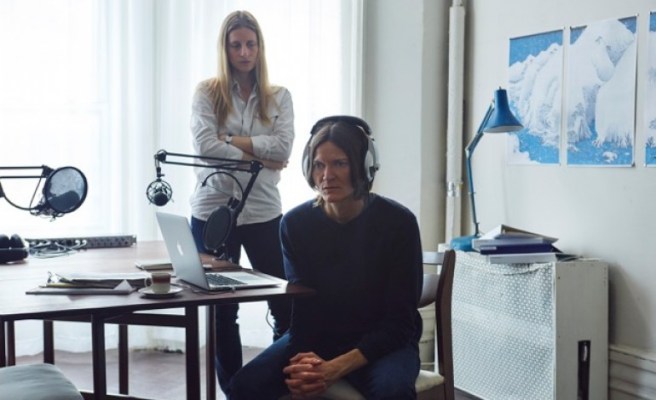
Fear not America, with Women Who Kill the 21st century finally has the indie So I Married an Axe Murderer it has long been clamoring for. Writer/director Ingrid Jungermann stars as Morgan, an employee at a natural foods cooperative and co-host of a popular podcast about female murderers. The show unearths the gruesome details of different homicides and even includes interviews from prison with the women incarcerated for their crimes. Morgan’s podcast partner is Jean, played by Ann Carr, who also happens to be Morgan’s ex. When Morgan falls for a mysterious new arrival at the co-op, Jean sees signs that Simone–or is her real name Alison?–might be a killer herself.

Continue reading “TFF 2016: Women Who Kill (Ingrid Jungermann, 2016)”

Friday October 7 – Thursday October 13

Featured Film:

The 2016 Vancouver International Film Festival

Our coverage of the VIFF 2016 continues this week, with more reviews coming of films we saw last week and films we’re going to see this week. So far we’ve covered: The Unknown Girl, The Lockpicker, Beautiful 2016, The Intestine, Toni Erdmann, Never Eat Alone and Last Poems, Maudite Poutine and Pop Song, Crosscurrent, Werewolf, A Quiet Passion, and Yellowing. There’s more to come, including the runaway hit of the festival: Rat Film!

Playing This Week:

AMC Loews Alderwood:

Mirzya (Rakeysh Omprakash Mehra) Fri-Thurs

Central Cinema:

Rear Window (Alfred Hitchcock, 1954) Fri-Weds
The ‘Burbs (Joe Dante, 1989) Fri-Weds

SIFF Egyptian:

The Beatles: 8 Days a Week (Ron Howard) Fri-Mon, Weds
The 18th Annual Animation Show of Shows Fri-Mon, Weds

Century Federal Way:

Nikka Zaildar (Simerjit Singh) Fri-Thurs
American Graffiti (George Lucas, 1973) Fri-Thurs

Grand Cinema:

Tacoma Film Festival Fri-Thurs Full Program
Top Gun (Tony Scott, 1986) Weds Only

Grand Illusion Cinema:

Phantasm: Remasterd (Don Coscarelli, 1979) Fri-Thurs
Phantasm: Ravager (David Hartman) Sat Only
Ben Popp: Juxtaposed Aesthetix Tues Only Video

Landmark Guild 45th:

A Man Called Ove (Hannes Holm) Fri-Thurs
Shin Godzilla (Hideaki Anno) Tues Only

Cinemark Lincoln Square:

M.S. Dhoni (Neeraj Pandey) Fri-Thurs
Mirzya (Rakeysh Omprakash Mehra) Fri-Thurs
Premam (Alphonse Puthren) Fri-Thurs
Remo (Bakkiyaraj Kannan) Fri-Thurs
American Graffiti (George Lucas, 1973) Fri-Thurs

Regal Meridian:

Soulmate (Derek Tsang) Fri-Thurs Our Review
Operation Mekong (Dante Lam) Fri-Thurs Our Review
M.S. Dhoni (Neeraj Pandey) Fri-Thurs
L.O.R.D. – Legend of Ravaging Dynasties 3D (Guo Jingming) Fri-Thurs

Northwest Film Forum:

KINOFEST Seattle 2016  Fri-Sun Full Program
Chatty Catties (Pablo Valencia) Sat Only
Mr. Blot’s Academy (Krzysztof Gradowski, 1983) Weds Only

AMC Oak Tree:

Better Off Single (Benjamin Cox) Fri-Thurs

AMC Pacific Place:

I Belonged to You (Zhang Yibai) Fri-Thurs

Regal Parkway Plaza:

Mirzya (Rakeysh Omprakash Mehra) Fri-Thurs
No Manches Frida (Nacho Garcia Velilla) Fri-Thurs
M.S. Dhoni (Neeraj Pandey) Fri-Thurs
Barcelona: A Love Untold (Olivia Lamasan) Fri-Thurs

Seattle Art Museum:

T-Men (Anthony Mann, 1947) Thurs Only 35mm

Seven Gables:

Captain Fantastic (Matt Ross) Fri-Thurs

SIFF Film Center:

Irish Reels Film Festival Fri-Sun Full Program

Sundance Cinemas:

American Honey (Andrea Arnold) Fri-Thurs Our Review
Don’t Think Twice (Mike Birbiglia) Fri-Thurs
London Road (Rufus Norris) Fri-Thurs
Under the Shadow (Babak Anvari) Fri-Thurs

SIFF Cinema Uptown:

American Honey (Andrea Arnold) Fri-Thurs Our Review
A Man Called Ove (Hannes Holm) Fri-Weds
Seattle 48 Hour Horror Film Project Tues Only

Varsity Theatre:

Hunt for the Wilderpeople (Taika Waititi) Fri-Thurs
Ebb and Flow  Sun Only

VIFF 2016: Yellowing (Chan Tze-woon, 2016)

f_yellowing_still_03

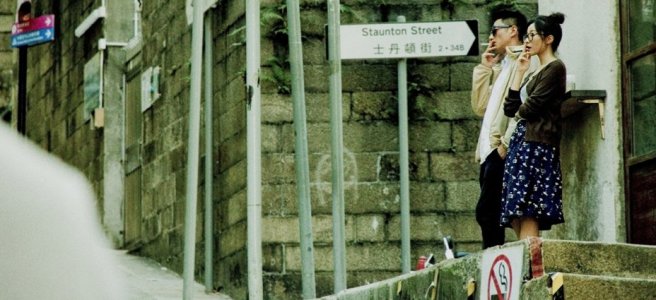
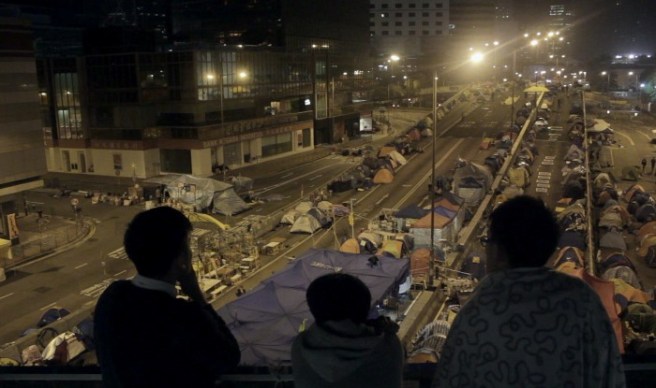
As a documentary about the 2014 Umbrella Movement, in which thousands of young Hong Kongers gathered to Occupy districts throughout the city in protest of the PRC’s decision to not allow the former colony to directly choose its candidates for high office, Yellowing is something remarkable in our time: an honest direct cinema film, with nary a hint of meta-commentary about film theory or storytelling. Not that there’s anything wrong with the doc/fiction hybrids that have become so ubiquitous lately, there’s just something refreshing about the open earnestness of the filmmaking here, mirroring a little bit the idealism of the young people at its center. Shortly after the Hong Kong police attacked protesters with tear gas on September 27, 2014, Chan began filming the students as they set-up in and occupied the Admiralty and Mongkok neighborhoods. He focuses on a few young people through the run of the 67 day occupation: a man nicknamed Lucky Egg who gives impromptu lectures in English and political philosophy; a young man who works in construction who wanders in and out of the protests–something big always seems to happen when he’s there; a law and literature student named Rachel who makes announcements in three languages and provides the film’s eloquent final statement, an open letter to a professor who had infuriatingly denounced the students’ idealism.

f_yellowing_still_01

In focusing on the details of the occupation, recording the quotidian requirements of activism (building rain-proof shelters, finding a mattress to sleep on, distributing water, masks and umbrellas to counter gas attacks), as well as the ideological arguments the protestors are making (they want to be able to vote for their leaders, this is anathema to a paranoid one-party state), Chan’s film resembles no less than Peter Watkins’s La Commune (Paris 1871), one of the great films of this century. The similarities between the protestors then and now is striking, but Watkins’s film, being nearly six hours long, takes a couple of meta-fictional turns in its historical reenactments (for instance: the film’s actors discuss the issues the Communards raised in character, and also as themselves, expressing how the process of playing 150 year old activists affected the way they see politics in their own time). Chan has no need of such artifice: his movie isn’t a reenactment, and we see the impact the process has on his subjects unfolding as it actually happened. Beyond that, we get a feel for both the city itself and the young people not leading, but forming the heart of the movement. Whether discussing the nuts and bolts of activism and its limits (most of them know very well they cannot succeed, but they’re there anyway; Rachel distributes yellow wristbands sporting the slogan “They Can’t Kill Us All”), or just hanging around trying (and failing) to meet girls (“you need guts and brains to get a girl”). In its ground-floor, first-person perspective, it finds more honesty and wisdom and life than a hundred Hollywood issue-advocacy films.

VIFF 2016: A Quiet Passion (Terence Davies, 2016)

aquietpassion

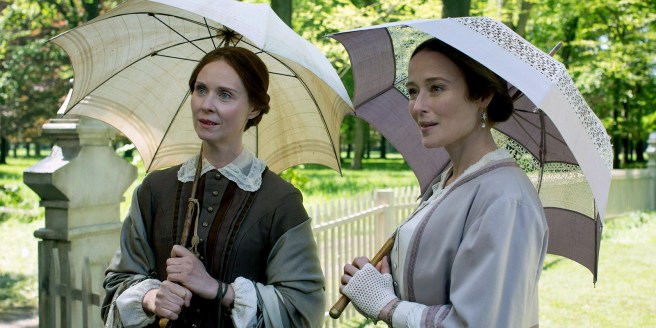
If Sunset Song, Terence Davies’s other recent feature, is a film of the enduring earth, than A Quiet Passion is a film of the withering body, the mortal coil that wheezes and shakes and is finally shuffled off. Human fragility, of both the corporeal and spiritual variety, haunts Emily Dickinson from the opening moments, in which a puritanical interrogator questions the young poet about her relationship with God and the promise of hell. Religion’s frightening specter shadows even the warmest moments in Davies’s cinema—the terror is a scar, an old spur in his bones—though here it takes on a specifically American character. Quoth New England theologian Jonathan Edwards: “The God that holds you over the pit of hell, much as one holds a spider, or some loathsome insect over the fire, abhors you, and is dreadfully provoked.” A gossamer-thin suspension is all that holds Emily Dickinson above the eternal flames.

The signal achievement of A Quiet Passion is to render the world of Dickinson’s New England with burnished clarity, to conjure the specifics of time, place, and ideology from which her art emerges. The intellectual foment of 19th century New England arguably represents the earliest maturity of American thought, a spiritual founding to echo the political founding a half century earlier. Dickinson’s poetry claims a clear piece of this lineage. Less clear are the narrative possibilities offered by her life’s story. Dickinson rarely left the house and Davies’s eye does not violate this cloister. A swirling camera and symphonic music are the director’s instruments, which can elevate even the hard-scrabble existence of a young Liverpudlian to heights of poetry, and here they transfigure the space of the Dickinson estate into a expanse of wallpaper and candlelight, and most importantly, they give remarkable sonorousness to an otherwise hushed life. The spirit of the age lives alone in a room upstairs.

On paper this sounds theoretical—more The American Scholar than “Tell all the truth and tell it slant”—but Davies is constitutionally incapable of making something so dry, and in addition to his trademark romanticism, A Quiet Passion also possess more wit than any other movie this year, save perhaps for Love and Friendship. Early passages provide Ms. Dickinson, and actress Cynthia Nixon, with a roundelay of able sparring partners. The barbs that fly in these scenes occasionally best Whit Stillman at his own game. But if we’re sticking with cinematic references, George Cukor might be more apropos. The classical auteur’s ability to reveal depth of character beneath each perfectly-timed quip gets taken up by Davies here, who understands that Emily Dickinson’s inner life is profoundly rich, though just out of reach for those around her. Humor opens up a window into the poet’s soul, and the fear and trembling that finally beset her are all the more tragic for the spirit they trample out.

A Quiet Passion’s parade of exits (“they all go” is the poet’s summation of solitude) rounds out with Dickinson’s own. The biopic ends where it must, at the grave’s hard, eternal earth, though it should be clear as we arrive at this final resting place that A Quiet Passion is as personal as anything in Davies’s career. Even a cursory knowledge of his life reveals the connection to Dickinson’s: his struggles with his sexuality, his trembling before the void, and the necessary—though always inadequate—consolation provided by his art. “You have your posterity,” Emily’s sister says to comfort her. “And you have your life,” she responds. Dickinson seems willing to trade all the glories of her poetry for a few hours of certain joy and one wonders if Davies, in his old age, might do the same. The world is richer for their abiding beauties, but in the face of mortality the afterlife of art is cold comfort for all their departed, unhappy days.